AI Music Generation: A Composer’s New Best Friend?

AI Music Generation is revolutionizing how composers create, but here’s the beautiful truth: it’s not here to replace you. Think of it as that brilliant collaborator who never sleeps, always has fresh ideas, and never argues about creative direction. I’ve watched countless musicians transform their workflow by embracing these tools, and today, I’m excited to show you exactly how to make AI your creative partner rather than your competitor.
Whether you’re a bedroom producer sketching out ideas at midnight or a seasoned composer facing a tight deadline, artificial intelligence can spark inspiration when you’re stuck, generate variations you’d never think of, and handle the tedious parts so you can focus on what makes your music uniquely yours. The key is learning how to collaborate with it effectively.
Understanding AI Music Generation as Creative Collaboration
Allow me to share something I’ve learned from experimenting with AI music tools: they’re not magic boxes that create finished masterpieces. They’re more like highly skilled assistants who can quickly sketch ideas based on your direction. When I explain the process to beginners, I often compare it to having a conversation. You provide the vision, the tool offers possibilities, and then you refine, reshape, and inject your personal style.
The technology works by analyzing thousands of musical compositions to understand patterns, progressions, and structures. But here’s what makes it exciting rather than threatening: it doesn’t have taste, emotion, or personal experience. That’s all you. Machine learning can suggest a chord progression that technically works, but only you can decide if it captures the feeling you’re chasing.
Think about how photographers use digital cameras and editing software. The tools are sophisticated, but they don’t make someone a photographer. Similarly, AI music generation provides powerful capabilities, but your creative instincts, cultural knowledge, and emotional intelligence make the music meaningful. You’re still the composer; you’ve just gained an incredibly versatile brainstorming partner.
Step-by-Step: Getting Started with AI Music Collaboration
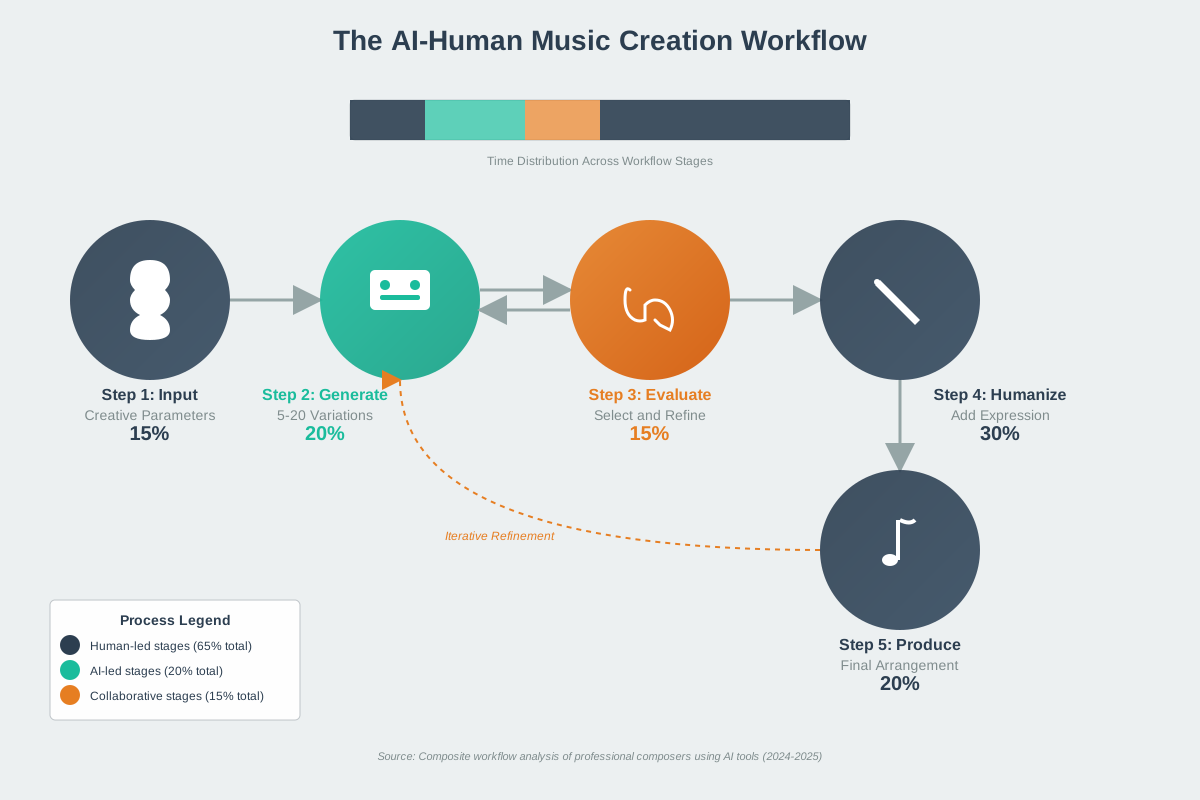
Step 1: Choose Your AI Music Tool Wisely
Not all AI music generators serve the same purpose, and choosing the right one makes all the difference. Start by identifying what you need most. Are you looking for melodic inspiration? Rhythm generation? Entire arrangement suggestions? Some tools excel at creating atmospheric soundscapes, while others focus on structured compositions.
Popular options include platforms like AIVA for orchestral compositions, Amper Music for quick commercial tracks, and MuseNet for experimenting with different styles. Many offer free tiers perfect for learning. I recommend starting with one tool rather than jumping between several. Give yourself time to understand its strengths and quirks. Each has a unique “personality” in how it interprets your inputs.
Step 2: Learn to Communicate in Musical Parameters
Many beginners make the mistake of expecting the AI to read their minds. Generative music tools need clear direction. Like ordering food, the more specific you are, the closer you’ll get to what you want. Instead of saying “make me something good,” try “create a melancholic piano piece in C minor, slow tempo, with arpeggiated patterns.”
Most tools let you specify genre, mood, tempo, key, and instrumentation. Experiment with these parameters systematically. Change one element at a time to understand how it affects the output. I keep a notebook where I jot down parameter combinations that yielded intriguing results. Over time, you’ll develop an intuition for how to guide the AI toward your vision.
Step 3: Generate Multiple Variations
Here, AI-powered composition demonstrates its true potential. Generate five, ten, or even twenty variations of an idea. It costs you nothing but a few clicks and moments of time. Traditional composition might take hours to explore that many directions. With AI, you can audition possibilities rapidly, identify promising threads, and discard what doesn’t resonate.
I’ve found that the first generation is rarely the keeper. It’s usually the third or fourth variation—or occasionally a hybrid combining elements from different outputs—that sparks something special. Don’t settle for the first result. Think of it as sketching: you wouldn’t expect your first pencil stroke to be the final drawing.
Step 4: The Art of Refinement and Humanization
Here’s where your expertise becomes irreplaceable. Please refine the AI-generated material. Add unexpected chord substitutions. Introduce rhythmic variations. Layer in live instruments or vocals. Adjust dynamics to create emotional peaks and valleys. The raw output from algorithmic composition often feels mechanically perfect—which paradoxically makes it feel less human.
I deliberately introduce imperfections: slightly off-time notes that add groove, velocity variations that create expression, and unexpected harmonic choices that reflect personality. This humanization process transforms AI suggestions from sterile demonstrations into music with soul. Your job isn’t to perfectly execute what the AI provides; it’s to use it as raw material for your artistic vision.
Step 5: Hybrid Workflow Integration
The most successful composers I know treat AI music software as one tool among many in their creative arsenal. They might use AI to generate a chord progression, play it on their guitar to find new voicings, run it through their DAW (Digital Audio Workstation) with their favorite plugins, and then add vocals or lead lines they compose traditionally.
Create a workflow that feels natural to you. Maybe AI handles the initial structure while you focus on melody. Perhaps you compose the main themes and let AI explore arrangement variations. Some composers use it specifically for breaking creative blocks—when stuck, they generate something random to jolt their thinking in new directions. There’s no single “correct” way to integrate these tools.
Creative Tips for Maximizing AI Collaboration
Embrace Happy Accidents
Some of my favorite musical moments came from AI “mistakes”—outputs that didn’t match my intention but sparked something better. When the tool generates something unexpected, pause before dismissing it. Ask yourself, “What if I leaned into this?” That weird chord progression might become your signature sound. That unusual rhythm could define an entire piece.
Neural networks sometimes make connections our trained brains wouldn’t. They’re not bound by conventional music theory or genre expectations. Such thinking can produce nonsense, yes, but occasionally it produces innovation. Stay curious and open-minded during generation.
Use AI for Arrangement Exploration
You’ve composed a melody you love, but you’re uncertain about the arrangement. Feed it to an AI composition tool and ask for different instrumentation ideas. Generate a version with strings, another with synthesizers, and another with acoustic instruments. You’re not looking for the AI to make the final decision—you’re rapidly auditioning possibilities that would take days to mock up manually.
This technique works brilliantly for film scoring or production music where you need multiple versions of the same cue. Create your main composition, then use AI to explore variations in tempo, mood, and instrumentation. You’ll deliver options to clients faster while maintaining creative control over the core musical ideas.
Beat Creative Block with Constraint-Based Prompts
When creativity feels stuck, AI-generated music can unstick you—but only if you use it strategically. Instead of asking for generic output, create intriguing constraints. Try “write a melody using only these five notes” or “create a rhythm in 7/8 time signature” or “compose something in the style of two entirely different genres combined.”
The resulting output might not be usable as-is, but it jolts your thinking out of familiar patterns. I’ve broken through countless blocks by feeding the AI deliberately weird prompts, then using the strange results as springboards for original ideas. It’s like brainstorming with someone who has no fear of suggesting wild ideas.
Common Mistakes to Avoid
Many beginners either view automated music creation as a panacea or completely disregard the human refinement stage. Neither extreme works well. If you simply accept AI output without editing, you’ll produce generic-sounding music lacking personality. If you overcorrect every note the AI suggests, you’re not really collaborating—you’re just composing slowly.
Find balance. Learn which suggestions align with your style and which need adjustment. Some composers fall into the trap of endlessly generating variations without committing to developing one. Please establish some boundaries: create ten variations, select the best two, and then focus on refining them. Otherwise, you’ll drown in options without finishing anything.
Another pitfall: forgetting about copyright and licensing. Most AI music platforms have specific terms about commercial use of generated content. Read them carefully before using AI-assisted compositions in commercial projects. Some require attribution, others restrict certain usage types, and licensing terms vary widely between platforms.
Real-World Success Stories
Professional composers are already integrating these tools successfully. Film composers use AI to rapidly generate temp scores during pre-production, then refine them into final soundtracks. Game developers employ procedural music generation to create dynamic soundtracks that respond to gameplay. Advertising agencies leverage AI tools for quick turnaround on commercial music beds.
What these success stories share is understanding: AI handles the groundwork, and humans provide the artistry. One composer I know uses AI to generate bass lines and drum patterns for pop tracks, freeing her to focus on melody and lyrics—where her unique voice shines. Another uses it specifically for orchestration suggestions, learning new techniques by seeing how the AI approaches instrumentation.
The technology excels at exploration and variation—tasks that traditionally consume enormous time. By offloading these to AI, composers reclaim time for the irreplaceable human elements: emotional nuance, cultural context, storytelling, and that indefinable quality that makes music resonate with listeners.
Integrating AI in Your Daily Creative Practice
Start small and build gradually. Begin by using AI music generation for fifteen minutes during warm-up. Generate a few chord progressions or melodic ideas as creative prompts before diving into your main work. This low-pressure experimentation helps you learn the tools without the stress of a real project.
As comfort grows, integrate it into actual projects. Apply it to areas where you find yourself stuck or require rapid modifications. Many composers keep AI tools running in the background, occasionally generating ideas while working on other aspects of a project. It becomes part of the creative environment rather than a separate, intimidating process.
Consider keeping an “AI inspiration library”—a collection of intriguing outputs you’ve generated but haven’t used yet. When starting new projects, browse this library for starting points. Occasionally a melody you generated six months ago perfectly fits a current need. This practice also helps you recognize your emerging preferences and refine your prompting skills.
Frequently Asked Questions
Your Next Creative Steps
Ready to explore this collaboration? Start by choosing one free AI music tool and spending a week experimenting without pressure. Generate ideas daily, even if just for five minutes. Pay attention to what excites you and what feels useful. Don’t worry about creating finished pieces yet—focus on understanding how the tool thinks and responds to your input.
Then, take one AI-generated idea and develop it into a complete piece using your traditional workflow. This hybrid approach—AI for initial ideas, human skill for development—is where magic happens. Notice how much faster you move from a blank page to an interesting starting point. Notice where the AI suggestions surprised you or pushed you in unexpected directions.
Remember, AI Music Generation doesn’t diminish your artistry—it expands your possibilities. You’re not automating creativity; you’re augmenting it. The tools handle exploration so you can focus on expression. They provide technical possibilities so you can concentrate on emotional impact. Think of every great artist who embraced new tools throughout history: electric guitars, synthesizers, digital recording, and sampling. Those who learned to wield new technologies didn’t become less artistic—they became more able to realize their artistic visions.
The future of music isn’t human versus machine. It’s human plus machine, creating possibilities neither could achieve alone. Your creativity, experience, taste, and emotional intelligence guide the process. AI provides speed, variation, and tireless exploration. Together, you’ll compose music that’s more ambitious, more experimental, and more authentically yours than ever before.
So pick up that AI tool. Start experimenting. Make mistakes. Discover unexpected sounds. And most importantly, keep your unique creative voice at the center of every decision. The technology serves you, not the other way around. Let it be your assistant, your brainstorming partner, your creative catalyst—but never your replacement. You’re the composer. You always were, and you always will be.
About the Authors
Main Author: Alex Rivera is a creative technologist passionate about helping non-technical users unlock the potential of AI tools. With a background in digital media and interactive design, Alex specializes in making complex technology accessible and fun. Through hands-on workshops and practical tutorials, Alex encourages experimentation and creative exploration, showing that AI is a collaborative tool anyone can use to enhance their creative projects.
Co-Author: Abir Benali is a friendly technology writer dedicated to explaining AI tools in clear, jargon-free language for everyday users. With years of experience translating technical concepts into practical advice, Abir focuses on real-world applications and beginner-friendly guidance. Through step-by-step instructions and relatable examples, Abir helps readers confidently embrace new technologies and integrate them into their personal and professional lives.
This article represents a collaboration between Alex’s creative perspective on AI as an artistic tool and Abir’s practical approach to technology education, offering readers both inspiration and actionable guidance.