How AI is Transforming Data Analysis Workflows

How AI is Transforming Data Analysis Workflows isn’t just changing how companies work with numbers—it’s putting powerful analysis tools into everyone’s hands. I remember spending hours manually sorting through spreadsheets, searching for patterns that an AI tool now finds in seconds. Whether you’re a small business owner tracking sales or a student analyzing research data, AI is making data analysis faster, simpler, and surprisingly accessible.
This guide walks you through exactly how AI transforms traditional data analysis processes, with practical steps you can follow today. You don’t need a technical degree, just a willingness to try something new.
Understanding the Traditional Data Analysis Challenge
Before we explore the transformation, let’s be honest about what data analysis used to look like. Traditional workflows involved multiple time-consuming steps: collecting data from various sources, cleaning it manually, creating formulas in spreadsheets, building charts one by one, and trying to spot trends with the naked eye.
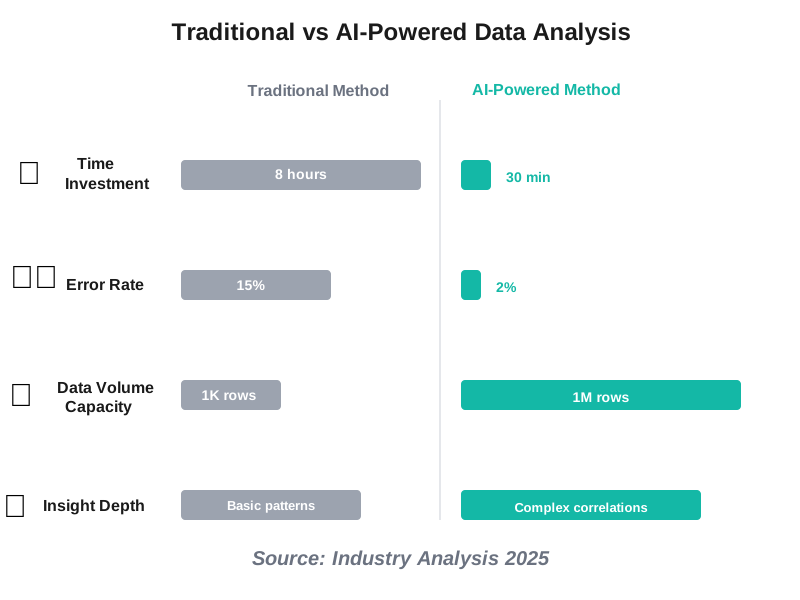
I’ve watched colleagues spend entire afternoons on tasks that modern AI-powered data analysis tools complete in minutes. The problem wasn’t just time—it was the potential for human error, the difficulty of handling large datasets, and the complexity of statistical analysis that intimidated many users.
How AI Changes Everything: The Core Benefits
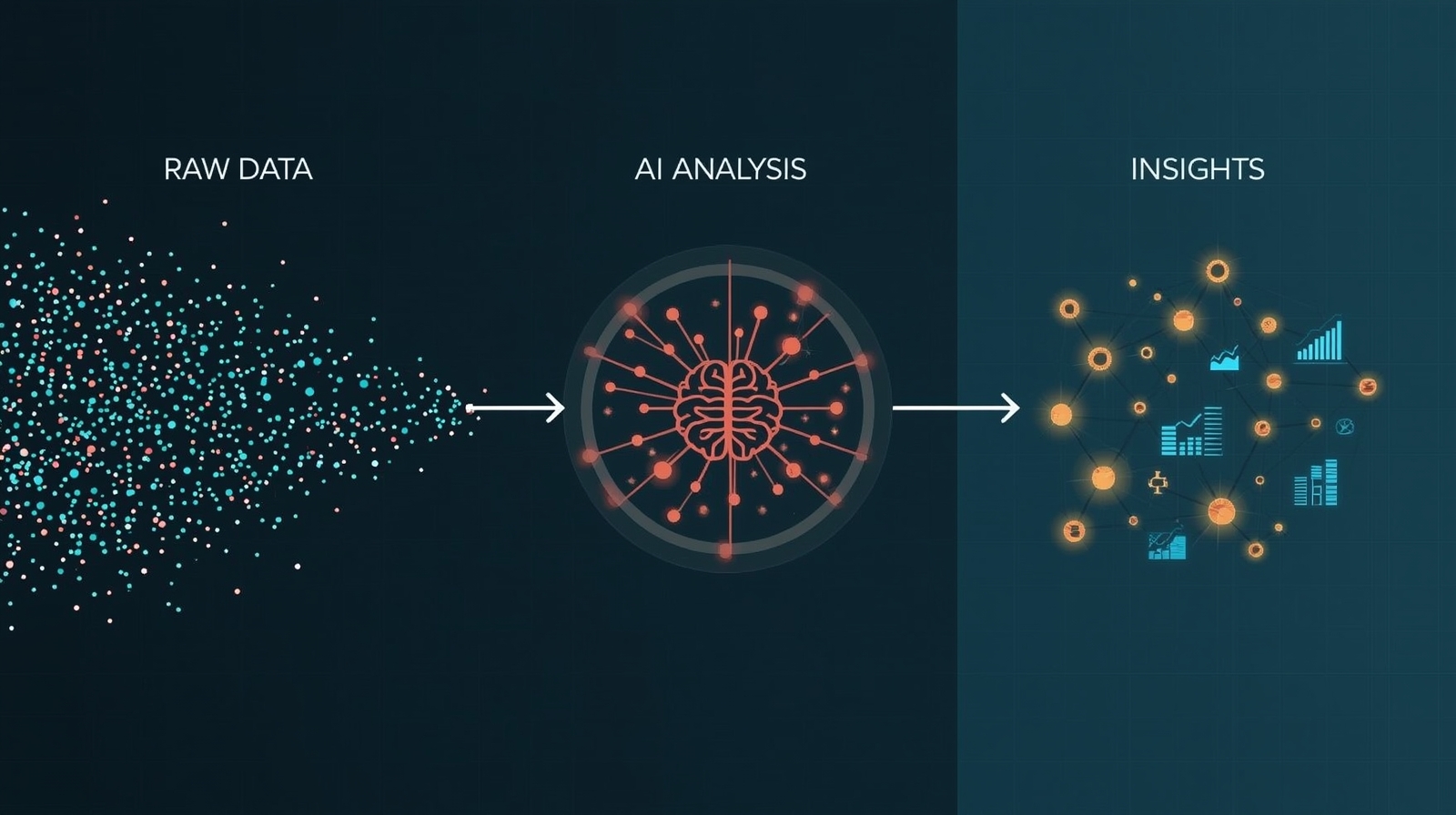
AI is transforming data analysis workflows by automating repetitive tasks, identifying patterns humans might miss, and presenting insights in plain language. Here’s what this actually means for your daily work:
Automated data cleaning eliminates the tedious process of fixing errors, removing duplicates, and standardizing formats. AI algorithms scan your data and flag inconsistencies automatically.
Pattern recognition happens at a scale impossible for human analysts. While you might notice a trend in dozens of rows, AI examines thousands or millions of data points simultaneously.
Natural language processing lets you ask questions in plain English instead of writing complex formulas. Type “What were my best-selling products last quarter?” and get immediate answers.
Predictive analytics transforms historical data into future insights, helping you anticipate trends before they happen.
Step-by-Step: Implementing AI in Your Data Workflow
Step 1: Choose Your AI Data Analysis Tool
Start by selecting a tool that matches your skill level and needs. Popular AI-powered platforms include Google’s Looker, Microsoft Power BI with AI features, Tableau with Einstein Analytics, and beginner-friendly options like MonkeyLearn and DataRobot.
For complete beginners, I recommend starting with tools that have visual interfaces and don’t require coding. Many offer free trials, so you can experiment before committing.
Step 2: Connect Your Data Sources
Most AI analysis tools let you import data from multiple sources—spreadsheets, databases, cloud storage, or even real-time APIs. The beauty of modern platforms is their flexibility.
Simply upload your CSV file, connect your Google Sheets, or link your business software. The AI immediately begins understanding your data structure. I’ve discovered that AI organizes even messy data more quickly than manual methods.
Step 3: Let AI Clean Your Data
This is where the transformation begins. Traditional data cleaning consumed 60-80% of analysis time. Now, AI tools automatically detect and fix common issues.
The system identifies missing values, suggests appropriate fill methods, removes duplicates, standardizes date formats, and flags outliers for your review. You simply approve the suggestions or adjust parameters. What once took hours happens in minutes.
Step 4: Ask Questions in Plain Language
Instead of writing complex formulas, type questions naturally: “Which products had declining sales last month?” or “Show me customer behavior patterns by region.”
The natural language processing capability translates your question into the appropriate analysis and generates visualizations automatically. It’s like having a data analyst who speaks your language.
Step 5: Explore AI-Generated Insights
Most platforms now offer automated insight discovery. The AI proactively surfaces intriguing patterns you might not think to look for—seasonal trends, unusual correlations, and emerging anomalies.
This approach has led me to uncover undiscovered business opportunities. The AI doesn’t replace your judgment; it expands what you can see.
Step 6: Create Automated Reports
Set up scheduled reports that refresh automatically. Your AI tool pulls new data, updates analyses, and sends formatted reports to stakeholders without manual intervention.
This transforms data analysis workflows from periodic manual projects into continuous intelligence systems. You stay informed without constant effort.
Step 7: Build Predictive Models
Once comfortable with basic analysis, explore predictive features. AI algorithms learn from historical patterns to forecast future trends.
Select your target variable (like “monthly sales”), choose relevant factors (season, marketing spend, economic indicators), and let the AI build a model. Modern tools make this surprisingly simple, with visual interfaces guiding each step.
Step 8: Monitor and Refine
AI-powered analysis improves over time. Review the insights regularly, provide feedback when predictions are off, and adjust parameters as your needs evolve.
The system learns from corrections, becoming more accurate and aligned with your specific context. This continuous improvement is a key benefit of AI-driven workflows.
Real-World Applications Across Industries
Small Business Inventory Management
A local retailer I know implemented AI analysis and reduced overstock by 35%. The system predicted seasonal demand patterns and recommended optimal ordering schedules. Previously, she relied on intuition and manual spreadsheets.
Marketing Campaign Optimization
Digital marketers use AI to analyze campaign performance across dozens of variables simultaneously. The tools identify which combinations of messaging, timing, and audience targeting produce the best results—then automatically apply those lessons to future campaigns.
Healthcare Data Analysis
Medical researchers process patient data faster while maintaining privacy. AI tools identify treatment patterns, predict patient outcomes, and flag potential complications earlier than traditional methods allowed.
Financial Forecasting
In real time, finance teams analyze market trends, customer payment patterns, and risk factors. The predictive capabilities help organizations make faster, more confident decisions about investments and resource allocation.
Common Mistakes to Avoid
Trusting AI blindly: Always review automated insights for context. AI identifies patterns but doesn’t understand business nuance. Your expertise validates the findings.
Ignoring data quality: AI amplifies what you feed it. Garbage in, garbage out remains true. Invest time in understanding your data sources and ensuring basic accuracy.
Over-complicating initial projects: Start simple. Analyze one clear question before building complex dashboards. Success builds confidence and skills.
Skipping the learning curve: Spend time with tutorials and documentation. Most platforms offer excellent free training. The investment pays off quickly.
Forgetting about privacy: When working with sensitive data, understand your tool’s security features and compliance capabilities. This matters especially for customer information or regulated industries.
Choosing the Right AI Analysis Tool for Your Needs
Consider these factors when selecting your platform:
Budget: Options range from free tools with basic features to enterprise platforms costing thousands monthly. Many mid-tier solutions offer excellent value for small teams.
Technical skill level: Assess honestly. Some tools require coding knowledge; others work entirely through visual interfaces. Match the tool to your current abilities, not aspirational skills.
Data volume: How much data will you analyze? Some tools handle millions of rows effortlessly; others slow down with large datasets.
Integration needs: Does it connect with your existing software? Seamless integration with your CRM, accounting system, or other tools multiplies the value.
Support and community: Strong documentation, active user communities, and responsive customer support matter when you’re learning.
The Future: Where AI Data Analysis is Heading
The transformation continues accelerating. Emerging trends include even more sophisticated natural language interfaces, automated insight narratives that explain findings in a plain storytelling format, and augmented analytics that proactively recommend questions to ask.
AI democratization means analysis capabilities once requiring data science degrees become available to everyone. This fundamentally changes how organizations operate—insights inform decisions at every level, not just in specialized departments.
I’m particularly excited about AI tools that explain their reasoning process, building trust and helping users learn analytical thinking alongside technical skills.
Frequently Asked Questions
Your Next Steps
How AI is transforming data analysis workflows isn’t just a technical evolution—it’s an opportunity for anyone willing to learn. Start with one small project. Choose a simple question about your data, pick a user-friendly tool, and work through the analysis step by step.
The transformation happens gradually. Each small success builds confidence and reveals new possibilities. What once seemed impossibly complex becomes routine. Your data stops being a burden and starts being an asset that guides better decisions.
You don’t need to become a data scientist. You just need curiosity, a willingness to experiment, and the right tools. The AI handles the heavy lifting while you focus on understanding what the insights mean for your work.
Try it today. Pick one dataset you’re curious about and explore it with an AI tool. You’ll be amazed at what you discover—and how quickly the process becomes second nature.
References:
1. McKinsey & Company – “The State of AI in 2025”
- Source: McKinsey Global Survey on AI (2025)
- URL: https://www.mckinsey.com/capabilities/quantumblack/our-insights/the-state-of-ai
- Date: Survey conducted from June 25 to July 29, 2025.
- Sample: 1,993 participants across 105 nations
- Key Finding: 88% of organizations now regularly use AI in at least one business function (up from 78% in 2024)
- Why it’s authoritative: McKinsey is a leading global management consulting firm with rigorous research methodology
2. Salesforce Blog – “How AI Will Transform Data Analysis in 2025”
- Source: Salesforce official blog
- URL: https://www.salesforce.com/blog/ai-transform-data-analysis/
- Date: February 13, 2025
- Why it’s authoritative: Salesforce is a major enterprise software company and industry thought leader
3. Gartner Research (Referenced in Multiple Sources)
- Key Prediction: By 2028, 33% of enterprise software applications will include agentic AI, up from less than 1% in 2024
- Also: By 2028, at least 15% of day-to-day work decisions will be made autonomously through agentic AI
- Why it’s authoritative: Gartner is a leading research and advisory company in technology
4. Academic Source – Data Science and Engineering Journal
- Title: “Relational Data Cleaning Meets Artificial Intelligence: A Survey”
- URL: https://link.springer.com/article/10.1007/s41019-024-00266-7
- Date: December 20, 2024
- Why it’s authoritative: Peer-reviewed academic journal published by Springer
5. Industry Statistics on Data Cleaning
- Finding: Data scientists spend 60-80% of their time cleaning data (widely cited across multiple sources, including Tamr and Express Analytics)
- Finding: Companies using AI tools for data cleaning report 30% increase in productivity and 40% reduction in data-related errors (cited in Sparkco.ai analysis)
6. LakeFS – “The State of Data and AI Engineering 2025”
- URL: https://lakefs.io/blog/the-state-of-data-ai-engineering-2025/
- Date: September 25, 2025
- Why it’s authoritative: Industry-specific technical platform with detailed engineering insights
About the Author
Abir Benali is a friendly technology writer who specializes in making AI tools accessible to non-technical users. With a background in practical tech education, Abir focuses on clear, step-by-step guidance that helps everyday people leverage powerful technology without the jargon. When not writing, Abir enjoys testing new AI tools and finding creative ways to simplify complex processes for beginners. Through hands-on exploration and real-world examples, Abir demonstrates that anyone can master modern data analysis tools with the right guidance and encouragement.