
AI Security: Understanding the Unique Threat Landscape

AI Security isn’t just traditional cybersecurity with a new label—it’s an entirely different battlefield. As someone who’s spent years studying digital safety and AI ethics, I’ve watched organizations struggle because they tried applying old security playbooks to AI systems, only to discover their defenses were full of holes they didn’t even know existed. The threats targeting artificial intelligence are fundamentally different: attackers aren’t just breaking into systems anymore; they’re manipulating how AI thinks, poisoning what it learns, and stealing the intelligence itself. If you’re building with AI or relying on AI-powered tools, understanding these unique vulnerabilities isn’t optional—it’s essential for keeping your systems, data, and users safe.
What Makes AI Security Different from Traditional Cybersecurity
Traditional cybersecurity focuses on protecting systems, networks, and data from unauthorized access, breaches, and malicious software. We’ve built firewalls, encryption protocols, and authentication systems that work remarkably well for conventional software. But AI security requires protecting something far more complex: the learning process itself, the training data that shapes behavior, and the decision-making mechanisms that can be subtly manipulated without leaving obvious traces.
The critical difference lies in how AI systems operate. Traditional software follows explicit instructions—if you secure the code and the infrastructure, you’ve done most of the work. AI systems, however, learn from data and make probabilistic decisions. This means attackers have entirely new attack surfaces: they can corrupt the learning process, trick the model with carefully crafted inputs, or extract valuable information from how the model responds to queries.
Think of it this way: securing traditional software is like protecting a building with locks and alarms. Securing AI is like protecting a student who’s constantly learning—you need to ensure they’re learning from trustworthy sources, that no one is feeding them false information, and that they can’t be tricked into revealing what they know to the wrong people.
The Three Pillars of AI-Specific Threats
Adversarial Attacks: Tricking AI into Seeing What Isn’t There
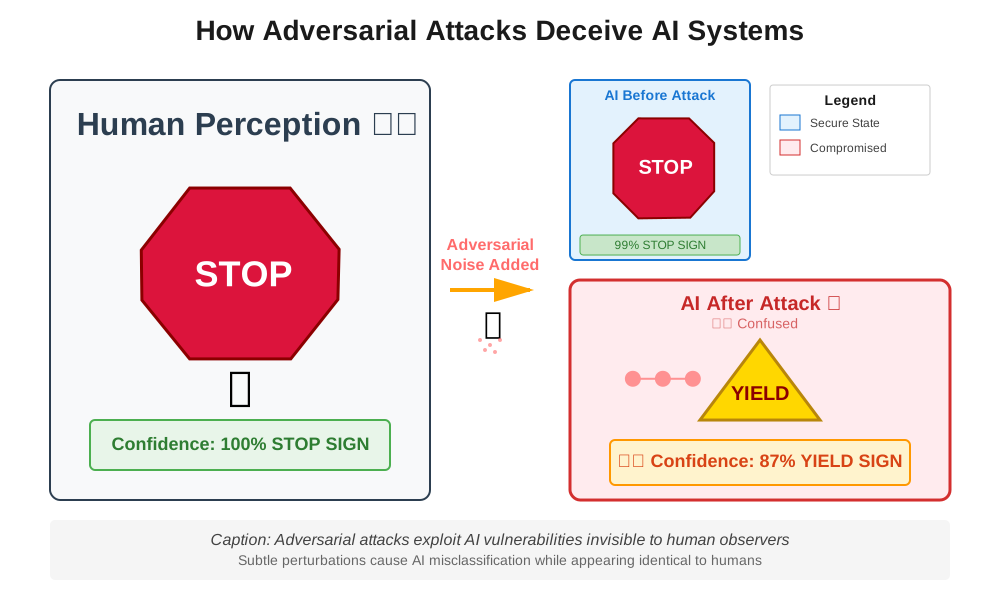
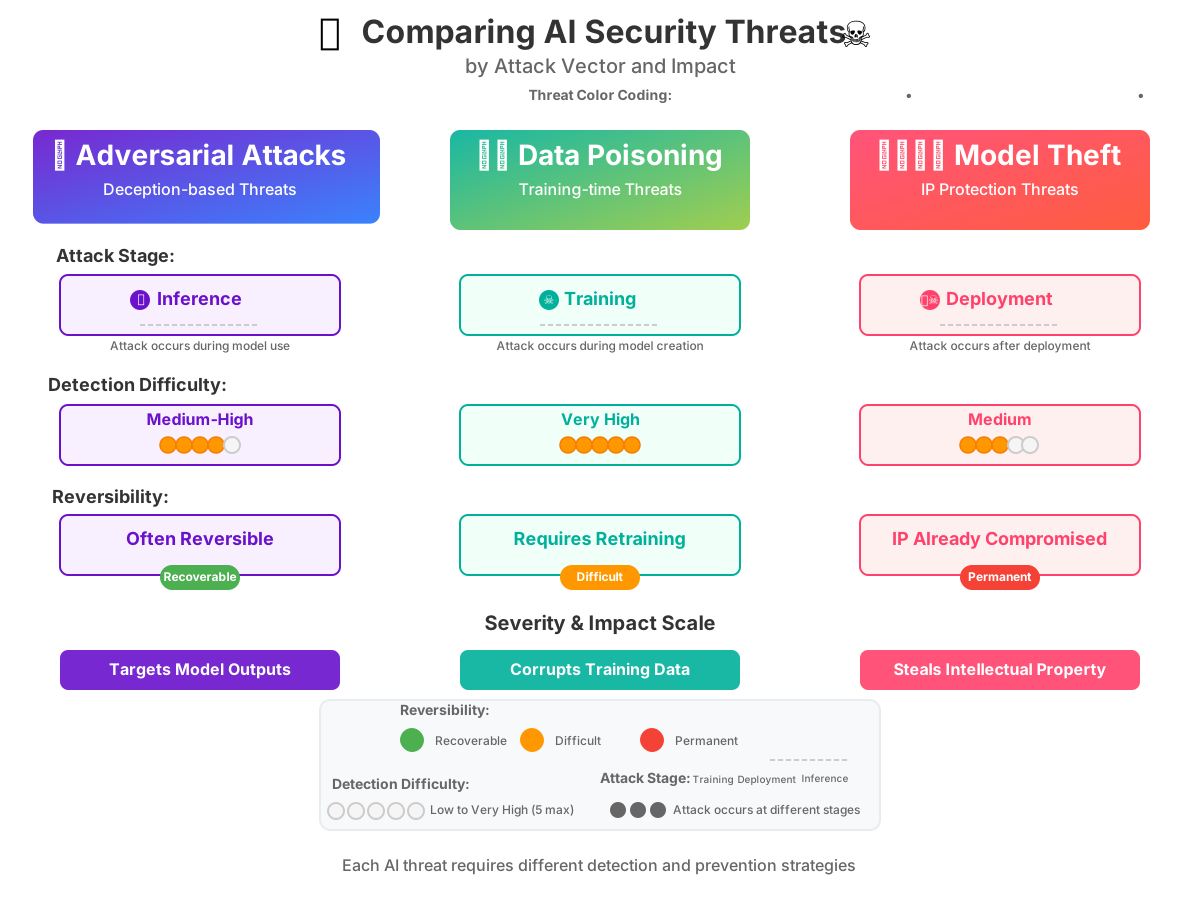
Adversarial attacks represent one of the most unsettling threats in the AI landscape. These attacks involve subtly modifying inputs—often imperceptibly to humans—to cause AI models to make incorrect predictions or classifications. Imagine adding invisible noise to an image that makes an AI system classify a stop sign as a speed limit sign or tweaking a few pixels so facial recognition misidentifies someone.
What makes these attacks particularly dangerous is their stealth. A human looking at an adversarially modified image sees nothing unusual, but the AI system’s decision-making completely breaks down. Attackers can use these techniques to bypass security systems, manipulate autonomous vehicles, or evade content moderation systems.
Real-world example: Security researchers have demonstrated that placing carefully designed stickers on stop signs can cause autonomous vehicle vision systems to misclassify them as yield signs or speed limit signs. In another case, researchers showed that slight modifications to medical imaging data could cause diagnostic AI to miss cancerous tumors or flag healthy tissue as diseased.
The sophistication of these attacks continues to evolve. Modern adversarial techniques can work across different models (transferability), function in physical environments (not just digital images), and even target the text inputs of large language models to produce harmful or biased outputs.
Data Poisoning: Corrupting AI at Its Source
Data poisoning attacks target the most fundamental aspect of AI systems: the training data. By injecting malicious or manipulated data into the training set, attackers can influence how an AI model behaves from the ground up. This is like teaching a student with textbooks that contain subtle lies—the student will learn incorrect information and apply it confidently without knowing it’s wrong.
These attacks are particularly insidious because they’re hard to detect and can have long-lasting effects. Once a model is trained on poisoned data, it carries those corrupted patterns into production. The damage isn’t always obvious—it might manifest as biased decisions, backdoors that activate under specific conditions, or degraded performance in particular scenarios.
We’re seeing several types of data poisoning emerge:
Label flipping involves changing the labels of training examples. For instance, marking spam emails as legitimate or labeling benign network traffic as malicious. This directly teaches the AI to make incorrect classifications.
Backdoor poisoning is more sophisticated. Attackers inject data with hidden triggers—specific patterns that cause the model to behave maliciously only when those patterns appear. The model performs normally in most cases, passing all standard tests, but activates its malicious behavior when it encounters the trigger.
Availability attacks aim to degrade model performance by adding noisy or contradictory data that makes it harder for the AI to learn meaningful patterns. This doesn’t create a specific malicious behavior but makes the system unreliable overall.
Real-world concern: Imagine a company training a hiring AI using publicly available resume data. If competitors or malicious actors poison that dataset by injecting resumes with specific characteristics paired with false success indicators, they could bias the AI to favor or reject certain candidate profiles. Or consider AI systems trained on user-generated content from social media—bad actors could systematically post content designed to shift the model’s understanding of normal versus harmful behavior.
The rise of foundation models and transfer learning makes data poisoning even more concerning. When organizations fine-tune pre-trained models, they’re building on top of someone else’s training process. If that foundation is poisoned, every downstream application inherits the vulnerability.
Model Theft: Stealing AI Intelligence
Model theft (also called model extraction) involves attackers recreating a proprietary AI model by querying it and analyzing its outputs. Think of it as reverse-engineering, but for artificial intelligence. Companies invest millions of dollars and countless hours developing sophisticated AI models—attackers want to steal that intellectual property without paying for the development costs.
The process works through strategic querying. Attackers send carefully chosen inputs to the target model and observe the outputs. By analyzing patterns in these input-output pairs, they can train their own model that mimics the original’s behavior. With enough queries, they can create a functional copy that performs similarly to the original.
This threat is particularly acute for AI-as-a-service platforms. When companies expose their models through APIs, they make them accessible for legitimate use—but also vulnerable to systematic extraction attempts. The economics are compelling for attackers: why spend years developing a state-of-the-art model when you can steal one in weeks?
Model inversion attacks take theft a step further by attempting to extract information about the training data itself. Attackers might be able to reconstruct faces from a facial recognition system’s training set or extract sensitive text from a language model’s training corpus. This doesn’t just steal the model—it potentially exposes private information the model learned from.
Real-world implications: A competitor could steal your customer service chatbot by systematically querying it with thousands of variations of customer questions, then using those responses to train their own cheaper version. Or attackers could target medical diagnosis AI systems, extracting enough information to build knockoffs that bypass expensive licensing while potentially compromising patient privacy through model inversion.
Organizations are responding with query monitoring, rate limiting, and adding noise to outputs, but these defenses create trade-offs between security and usability. Too much protection degrades the user experience; too little leaves the model vulnerable.
How AI Security Fits Into Your Overall Security Strategy
AI security shouldn’t exist in isolation—it needs to integrate with your existing cybersecurity framework while addressing AI-specific vulnerabilities. This means adopting a layered approach that protects AI systems throughout their entire lifecycle.
Secure the Data Pipeline
Your AI is only as trustworthy as the data it learns from. Implement rigorous data validation and provenance tracking for all training data. Know where your data comes from, verify its integrity, and monitor for anomalies that might indicate poisoning attempts. Use cryptographic hashing to detect unauthorized modifications and maintain detailed audit logs of who accessed or modified training datasets.
For organizations using external data sources or crowd-sourced labeling, the risks multiply. Institute review processes where multiple annotators label the same data and flag inconsistencies for human review. Consider using differential privacy techniques during training to limit what individual data points can influence in the final model.
Implement Robust Model Validation
Before deploying any AI model, subject it to comprehensive testing that goes beyond accuracy metrics. Test for adversarial robustness by attempting to fool the model with modified inputs. Check for unexpected behaviors under edge cases and unusual input combinations. Validate that the model performs consistently across different demographic groups and use cases to catch potential bias or poisoning effects.
Create red teams specifically focused on AI security—experts who actively try to break your models using adversarial techniques, data poisoning, or extraction attacks. Their findings should inform hardening measures before production deployment.
Monitor in Production
AI security doesn’t end at deployment. Implement continuous monitoring to detect anomalous queries that might indicate extraction attempts, unusual input patterns suggesting adversarial attacks, or performance degradation that could signal poisoning effects manifesting over time.
Set up query rate limiting and fingerprinting to identify suspicious access patterns. Use ensemble models or randomization techniques that make extraction harder by introducing controlled variance in outputs. Monitor for distribution shift—when the real-world data your model encounters differs significantly from training data, which could indicate either legitimate environmental changes or malicious manipulation.
Build Defense in Depth
No single security measure is sufficient. Layer multiple defenses: adversarial training that exposes models to attack examples during development, input sanitization that filters suspicious inputs before they reach the model, output monitoring that checks predictions for anomalies, and model watermarking that helps detect unauthorized copies.
Consider federated learning approaches for sensitive applications where training data stays distributed and never centralizes in one vulnerable location. Use secure enclaves or confidential computing for particularly sensitive model inference, encrypting data even while it’s being processed.
Practical Steps for Protecting Your AI Systems
Whether you’re building AI from scratch or integrating third-party models, these actionable steps will strengthen your security posture:
Step 1: Conduct an AI Security Risk Assessment
Start by inventorying all AI systems in your organization—including shadow AI that individual teams might be using without IT oversight. For each system, document what data it trains on, where it gets inputs from, who has access to it, and what decisions or actions it influences.
Evaluate each system’s risk exposure. A customer-facing recommendation engine has different threat profiles than an internal analytics tool. Prioritize security investments based on both the potential impact of compromise and the likelihood of attack.
Step 2: Establish Data Governance for AI
Create clear policies for training data acquisition, validation, and storage. Require data provenance documentation—knowing the chain of custody for every dataset. Implement anomaly detection in your data pipelines to catch suspicious additions or modifications early.
For high-stakes applications, consider using trusted data sources exclusively, even if it means smaller training sets or higher costs. The security trade-off is often worth it compared to the risk of poisoned models making critical decisions.
Step 3: Adopt Adversarial Testing Practices
Make adversarial robustness testing a standard part of your AI development lifecycle. Use tools like IBM’s Adversarial Robustness Toolbox or Microsoft’s Counterfit to systematically test your models against various attack techniques. Document your findings and iterate on defenses before deployment.
Don’t just test once—as attackers develop new techniques, regularly reassess your models’ robustness. Consider subscribing to AI security research feeds and participating in communities sharing information about emerging threats.
Step 4: Implement Access Controls and Monitoring
Treat your AI models as valuable intellectual property requiring the same protection as source code or customer databases. Implement role-based access control limiting who can query models, view training data, or modify deployed systems. Log all interactions for audit purposes.
For externally accessible AI services, implement rate limiting, authentication requirements, and query pattern analysis to detect extraction attempts. Consider adding slight randomization to outputs that maintains utility for legitimate users while frustrating systematic extraction efforts.
Step 5: Plan for Incident Response
Develop AI-specific incident response procedures. What happens if you detect adversarial attacks in production? How quickly can you roll back to a previous model version? What’s your process for investigating suspected data poisoning?
Create model version control systems that let you quickly revert to known-good states. Maintain backup models trained on verified clean data. Document communication plans for notifying affected users if AI security incidents occur.
Step 6: Stay Informed and Keep Learning
The AI security landscape evolves rapidly. What’s secure today might be vulnerable tomorrow as researchers discover new attack vectors. Follow academic conferences like NeurIPS, ICML, and specific security venues covering AI/ML security. Participate in industry working groups addressing AI safety and security standards.
Consider formal training for your team. Organizations like MITRE maintain AI security frameworks and best practices. Professional certifications in AI security are emerging as the field matures.
Common AI Security Misconceptions
Traditional security is enough
This is perhaps the most dangerous misconception. While traditional security measures remain important—you still need firewalls, encryption, and access controls—they don’t address AI-specific threats. You can have perfect network security and still be completely vulnerable to data poisoning or adversarial attacks. AI security requires specialized knowledge and tools that complement, not replace, conventional cybersecurity.
Only large organizations need to worry
Small and medium businesses increasingly rely on AI through third-party services and open-source models. You might not be training models from scratch, but if you’re using AI-powered tools for customer service, fraud detection, or business analytics, you’re exposed to AI security risks. In fact, smaller organizations often face greater risk because they have fewer security resources and may not realize AI-specific threats exist.
Open-source models are inherently less secure
This cuts both ways. Open-source models face scrutiny from the security research community, which can identify and fix vulnerabilities faster than closed systems. However, transparency also gives attackers complete knowledge of the model architecture for planning attacks. The security depends more on how you implement and protect the model than on whether it’s open or closed source. Use open-source models with proper security controls and monitoring.
Adversarial attacks only work in labs
Early adversarial attack research focused on digital-only scenarios that seemed impractical for real-world deployment. Modern adversarial techniques have proven effective in physical environments—specially designed patches that fool object detection, audio perturbations that change speech recognition outputs, and even manipulated inputs that survive printing and photographing. These attacks work in practice, not just in theory.
Frequently Asked Questions About AI Security
The Future of AI Security: Emerging Challenges and Solutions
As AI systems become more sophisticated and widespread, the security challenges evolve alongside them. Multimodal AI models that process text, images, audio, and video simultaneously introduce new attack surfaces where adversaries can exploit the interactions between different modalities. An attacker might use a benign image with malicious audio or text that triggers unexpected behavior when combined with visual inputs.
Autonomous AI agents capable of taking actions without human oversight raise the stakes dramatically. When AI can execute trades, modify databases, or control physical systems, security failures have immediate real-world consequences. We need new frameworks for ensuring these agents operate within safe boundaries even under attack.
The democratization of AI through easy-to-use platforms means more people can build AI systems without deep technical expertise—which also means more systems built without adequate security consideration. The security community is responding with security-by-default approaches in development frameworks, automated security testing tools, and clearer guidelines for non-experts.
Research into provably robust AI systems aims to provide mathematical guarantees about model behavior under certain attack scenarios. While we’re far from comprehensive solutions, progress in certified defenses offers hope for critical applications where we need absolute certainty about AI security properties.
Your Next Steps: Building a Secure AI Practice
Start where you are. If you’re just beginning to explore AI, build security awareness into your learning from day one. Understand that every AI implementation decision—from data sourcing to model architecture to deployment approach—has security implications. Ask security questions early and often.
For organizations already using AI, conduct that security assessment we discussed earlier. Identify gaps between current practices and best practices for AI security. Prioritize improvements based on risk exposure and start implementing layered defenses. You don’t need to solve everything at once, but you do need to start.
Invest in education for your team. AI security requires specialized knowledge that most security professionals and AI developers don’t currently have. Workshops, training programs, and hands-on experimentation with security testing tools build the competence you need internally.
Collaborate with the broader community. AI security is too important and too complex for any organization to solve alone. Participate in information sharing, contribute to open-source security tools, and learn from others’ experiences. The field is young enough that your insights and challenges can help shape best practices that benefit everyone.
Remember that perfect security doesn’t exist—in AI or anywhere else. The goal is risk management, not risk elimination. Make informed decisions about what level of security your applications require, implement appropriate controls, and maintain vigilance as threats evolve. AI security isn’t a destination you reach but an ongoing practice you maintain.
The unique threats targeting AI systems are real and growing, but they’re not insurmountable. With understanding, proper tools, and consistent effort, you can build and deploy AI systems that are both powerful and secure. Start taking those steps today—your future self will thank you for building security in from the beginning rather than retrofitting it after a breach.
References:
Government & Standards Organizations (Highest Authority)
- NIST AI 100-2e2025 – Adversarial Machine Learning: A Taxonomy and Terminology of Attacks and Mitigations
- Published: 2025
- URL: https://nvlpubs.nist.gov/nistpubs/ai/NIST.AI.100-2e2025.pdf
- Comprehensive government framework covering adversarial attacks, defenses, and taxonomy
- NIST AI Risk Management Framework (AI RMF)
- Released: January 26, 2023; Updated regularly through 2025
- URL: https://www.nist.gov/itl/ai-risk-management-framework
- Official U.S. government framework for AI risk management
- NIST SP 800-53 Control Overlays for Securing AI Systems (Concept Paper)
- Released: August 14, 2025
- URL: https://www.nist.gov/blogs/cybersecurity-insights/cybersecurity-and-ai-integrating-and-building-existing-nist-guidelines
- Latest NIST guidance on cybersecurity controls for AI systems
Academic Research Papers (Peer-Reviewed, 2025)
- “A Comprehensive Review of Adversarial Attacks and Defense Strategies in Deep Neural Networks”
- Published: May 15, 2025, MDPI Journal
- URL: https://www.mdpi.com/2227-7080/13/5/202
- Comprehensive academic review of DNN security
- “Adversarial machine learning: a review of methods, tools, and critical industry sectors”
- Published: May 3, 2025, Artificial Intelligence Review (Springer)
- URL: https://link.springer.com/article/10.1007/s10462-025-11147-4
- Latest comprehensive review covering multiple industries
- “A meta-survey of adversarial attacks against artificial intelligence algorithms”
- Published: August 13, 2025, ScienceDirect
- URL: https://www.sciencedirect.com/science/article/pii/S0925231225019034
- Meta-analysis of adversarial attack research
- “Adversarial Threats to AI-Driven Systems: Exploring the Attack Surface”
- Published: February 13, 2025, Journal of Engineering Research and Reports
- DOI: https://doi.org/10.9734/jerr/2025/v27i21413
- Recent study showing adversarial training provides 23.29% robustness gain
- Anthropic Research: “Small Samples Can Poison Large Language Models”
- Published: October 9, 2025
- URL: https://www.anthropic.com/research/small-samples-poison
- Groundbreaking research showing only 250 documents can poison LLMs
Industry Security Organizations
- OWASP Gen AI Security Project – LLM04:2025 Data and Model Poisoning
- Updated: May 5, 2025
- URL: https://genai.owasp.org/llmrisk/llm04-model-denial-of-service/
- Industry standard for LLM security vulnerabilities
- OWASP Gen AI Security Project – LLM10: Model Theft
- Updated: April 25, 2025
- URL: https://genai.owasp.org/llmrisk2023-24/llm10-model-theft/
- Authoritative guidance on model extraction attacks
- Cloud Security Alliance (CSA) AI Controls Matrix
- Released: July 2025
- URL: https://cloudsecurityalliance.org/blog/2025/09/03/a-look-at-the-new-ai-control-frameworks-from-nist-and-csa
- Comprehensive toolkit for securing AI systems
ArXiv Research Papers (Latest Findings)
- “Preventing Adversarial AI Attacks Against Autonomous Situational Awareness”
- ArXiv: 2505.21609, Published: May 27, 2025
- URL: https://arxiv.org/abs/2505.21609
- Shows 35% reduction in adversarial attack success
- “A Survey on Model Extraction Attacks and Defenses for Large Language Models”
- Published: June 26, 2025
- URL: https://arxiv.org/html/2506.22521v1
- Comprehensive survey of model theft techniques and defenses
Reputable Industry Sources
- IBM: “What Is Data Poisoning?”
- Updated: November 2025
- URL: https://www.ibm.com/think/topics/data-poisoning
- Clear explanation with enterprise perspective
- Wiz: “Data Poisoning: Trends and Recommended Defense Strategies”
- Published: June 24, 2025
- URL: https://www.wiz.io/academy/data-poisoning
- Notes: 70% of cloud environments use AI services
- CrowdStrike: “What Is Data Poisoning?”
- Updated: July 16, 2025
- URL: https://www.crowdstrike.com/en-us/cybersecurity-101/cyberattacks/data-poisoning/
- Practical security perspective with defense strategies
Case Studies & Real-World Examples
- ISACA: “Combating the Threat of Adversarial Machine Learning”
- Published: 2025
- URL: https://www.isaca.org/resources/news-and-trends/industry-news/2025/combating-the-threat-of-adversarial-machine-learning-to-ai-driven-cybersecurity
- Includes real-world incidents like DeepSeek-OpenAI case
- Dark Reading: “It Takes Only 250 Documents to Poison Any AI Model”
- Published: October 22, 2025
- URL: https://www.darkreading.com/application-security/only-250-documents-poison-any-ai-model
- Covers Anthropic research with practical implications
About the Author
This article was written by Nadia Chen, an expert in AI ethics and digital safety who helps non-technical users understand and navigate the security implications of artificial intelligence. With a background in cybersecurity and years of experience studying AI safety, Nadia translates complex security concepts into practical guidance for everyday users and organizations implementing AI systems. She believes everyone deserves to use AI safely and works to make security knowledge accessible to those building with or relying on artificial intelligence.