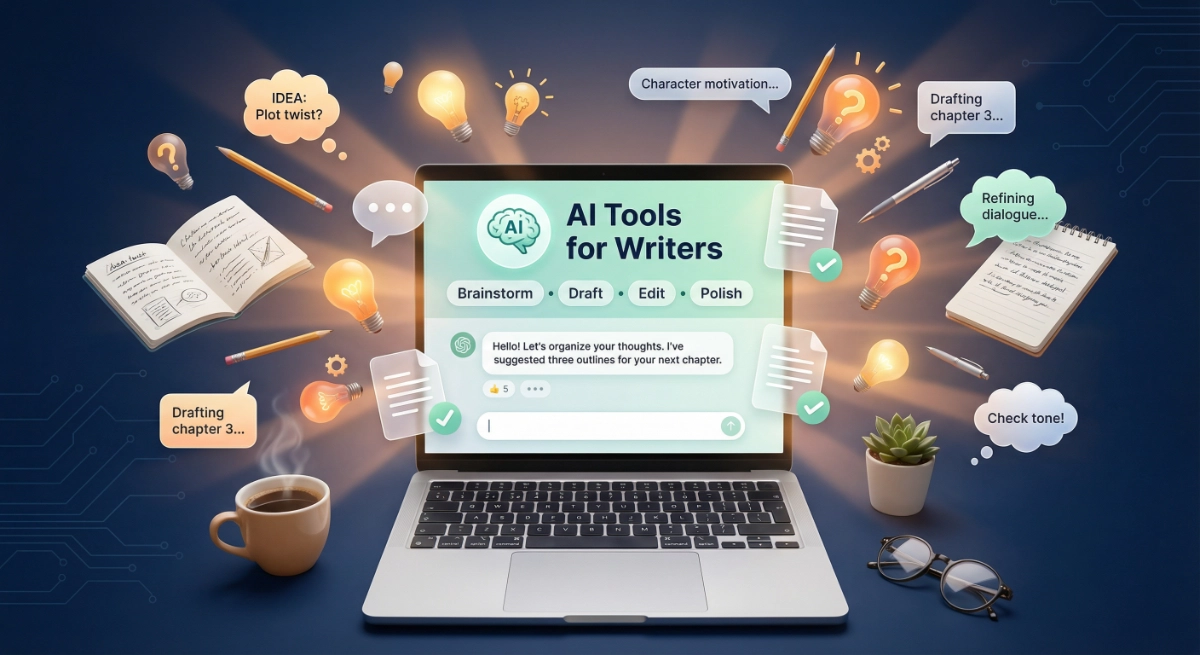
AI Tools for Writers: Boost Your Creative Process

AI Tools for Writers are transforming how creative professionals work in 2025. According to Siege Media’s comprehensive study in their “AI Writing Statistics 2025” report, 90% of content marketers now use AI to support their writing efforts—a dramatic jump from just 64.7% in 2023 [ℹ️Source]. This isn’t just a trend; it’s a productivity revolution that’s saving writers countless hours while improving content quality.
As a productivity coach, I’ve witnessed firsthand how AI writing tools eliminate the friction points that slow creative professionals down. Whether you’re battling writer’s block at 2 AM or racing against a tight deadline, these tools act as your tireless collaborator—ready to brainstorm, draft, edit, and polish at a moment’s notice.
The numbers tell a compelling story. According to the Digital Marketing Institute in their 2025 analysis, marketers using AI writing assistants see a 31% boost in campaign ROI compared to traditional content teams, while businesses report a 61% increase in productivity[ℹ️Source]. But here’s what matters most: these tools don’t replace your creativity—they amplify it.
Why Writers Need AI Tools Now
The creative writing landscape has fundamentally shifted. The AI writing assistant software market reached $88.99 billion in 2025 and is projected to hit $1,478.73 billion by 2034, according to Market Research Future’s latest industry report—a staggering 36.65% compound annual growth rate [ℹ️Source]. This explosive growth reflects one reality: writers who leverage AI-powered writing tools gain a decisive competitive advantage.
Think about your typical writing workflow. How much time do you lose to blank-page syndrome? How many drafts do you labor through before reaching something publishable? Artificial intelligence for writers tackles these exact pain points, letting you channel energy into what truly matters—your unique voice and perspective.
Top AI Tools for Writers in 2025
Let me walk you through the most powerful AI writing platforms that can revolutionize your creative process. I’ve tested each extensively and organized them by specific use cases to help you choose the right fit.
1. ChatGPT – The Versatile All-Rounder
ChatGPT dominates the AI writing space for good reason. As of November 2025, it draws 37.2 million monthly searches in the US, ranking in the top 10 Google searches nationwide [ℹ️Source]. With 700 million weekly active users worldwide and over 10 million ChatGPT Plus subscribers, it’s become the go-to tool for writers across every genre.
What makes it essential: ChatGPT excels at brainstorming, outlining, drafting, and polishing content through natural conversation. The GPT-4 model understands context deeply, making it ideal for developing ideas, conducting research, and generating first drafts quickly.
Practical use case: When facing a blank page, start a conversation with ChatGPT about your topic. Ask it to generate 10 angle ideas, then have it expand your favorite into a detailed outline. Within minutes, you’ll have a complete roadmap that would have taken hours to develop alone.
Tips for beginners:
- Use specific prompts rather than vague requests—instead of “write about AI,” try “explain how AI chatbots work in simple terms for small business owners”
- Leverage the chat history to build on previous responses
- Request multiple variations to compare different approaches
- Always fact-check generated content, especially statistics and dates
Pricing: A Free version is available with GPT-3.5; ChatGPT Plus costs $20/month for GPT-4 access, faster responses, and priority access during peak times.
2. Grammarly – Your Real-Time Writing Coach
Grammarly has evolved far beyond simple grammar checking. In 2025, it’s a comprehensive AI writing assistant that improves your writing everywhere you type. According to their user data, Grammarly helps professionals and students create mistake-free, compelling content across emails, documents, and social media.
What makes it essential: Grammarly works seamlessly across your entire workflow—Gmail, Google Docs, Microsoft Word, Slack, and virtually any web-based platform. Its AI analyzes your writing for grammar, clarity, tone, and engagement in real-time, offering instant improvements without disrupting your flow.
Practical use case: Draft your content in your preferred editor while Grammarly highlights issues as you type. The tone detector ensures your message lands correctly—whether you’re writing a professional proposal or a friendly blog post. The AI-powered rewriting suggestions assist you in discovering more effective phrasing without the need to start from the beginning.
Tips for beginners:
- Install the browser extension to get writing assistance everywhere online
- Set goals for each document (audience, formality, intent) for more targeted suggestions
- Use the “Rewrite” feature when a sentence feels awkward but you’re not sure how to fix it
- Review the explanations for each suggestion to improve your writing skills over time
Pricing: A Free version is available with basic grammar and spelling checks; Grammarly Pro starts at $12/month with advanced features including tone suggestions, plagiarism detection, and full-sentence rewrites.
3. Jasper – The Marketing Content Powerhouse
Jasper specializes in AI content generation for marketing teams and businesses. According to recent industry analysis, Jasper helps marketers create content five times faster while maintaining brand consistency across channels. With over 50+ templates optimized for different content types, it’s built specifically for professionals who need volume without sacrificing quality.
What makes it essential: Jasper’s brand voice feature learns your company’s tone and style, ensuring every piece of content sounds authentically you. The platform integrates with Surfer SEO for optimization and includes collaboration tools for team workflows.
Practical use case: Create a complete blog post by selecting the “Blog Post Outline” template, inputting your topic and keywords, then using the long-form editor to expand each section. Jasper generates drafts that require editing rather than starting from zero, cutting content creation time dramatically.
Tips for beginners:
- Start by training Jasper on your brand voice with examples of your best content
- Use templates as starting points, then customize the output to match your specific needs
- Combine multiple template outputs to create comprehensive pieces
- Leverage the Chrome extension to generate content directly in Google Docs or your CMS
Pricing: A seven-day free trial is available; the Creator plan starts at $49/month for individual users; the Pro plan at $69/month includes collaboration features; and the Business tier is available with custom pricing for larger teams.
4. Claude – The Long-Form Specialist
Claude, developed by Anthropic, has quickly become essential for writers tackling complex, long-form content. Its standout feature is an expansive context window that can process and reference massive amounts of information simultaneously—perfect for maintaining consistency across lengthy documents.
What makes it essential: Claude excels at nuanced, thoughtful writing that requires depth and coherence over thousands of words. Unlike tools that lose track of earlier content, Claude maintains context throughout entire manuscripts, making it ideal for books, comprehensive reports, and detailed analyses.
Practical use case: When writing a research-heavy article or book chapter, upload your source materials and ask Claude to synthesize findings while maintaining your unique perspective. It processes complex information and generates outputs that feel more natural and less “AI-generated” than many alternatives.
Tips for beginners:
- Provide clear context about your project’s scope and objectives upfront
- Use Claude for content that requires careful reasoning and analysis
- Upload reference documents to ensure consistency with existing work
- Request specific sections rather than asking for complete long-form pieces in one go
Pricing: A Free tier is available; Claude Pro costs $20/month for priority access and increased usage limits.
5. Sudowrite – The Fiction Writer’s Dream
Sudowrite stands alone as the premier AI tool for creative writing and fiction. With its proprietary Muse language model specifically fine-tuned for creative prose, it understands narrative elements that general-purpose AI tools miss—character development, scene blocking, dialogue flow, and storytelling rhythm.
What makes it essential: The Story Bible feature tracks characters, plot lines, settings, and lore across your entire manuscript, ensuring consistency throughout long projects. Tools like “Describe” add rich sensory details to scenes, while “Show, Don’t Tell” mode helps transform exposition into vivid narrative.
Practical use case: When you’ve written a scene that feels flat, highlight the paragraph and use Sudowrite’s “Expand” tool to add descriptive details, emotional depth, and sensory elements. The “Rewrite” function offers multiple variations, helping you find the perfect phrasing for crucial moments.
Tips for beginners:
- Build your Story Bible early with detailed character profiles and world-building notes
- Use the brainstorming tools when planning your novel rather than waiting until you’re stuck
- Experiment with different AI models (Claude, GPT-4) for different writing tasks
- Maintain your authorial voice by editing AI suggestions rather than accepting them wholesale
- Join the active Discord community for tips from other fiction writers using the platform
Pricing: Hobby & Student plan at $19/month ($10/month billed annually) with 225,000 credits; Professional plan at $29/month ($22/month annually) with 1,000,000 credits; Max plan at $59/month ($44/month annually) with 2,000,000 credits.
6. Copy.ai – The Short-Form Content Master
Copy.ai dominates the AI copywriting space for marketers and businesses needing high-quality short-form content at scale. With over 90+ templates covering everything from email subject lines to social media captions, it’s optimized for the quick-turnaround content that drives modern marketing.
What makes it essential: Copy.ai excels at generating multiple variations quickly, allowing you to test different angles and find what resonates. The workflow automation features let you string together multiple steps—from brief to outline to final copy—creating repeatable processes for common content needs.
Practical use case: Generate 20 headline variations for your blog post in seconds, then refine the top performers. Create complete social media campaigns with posts tailored for different platforms, all maintaining consistent messaging but adapted to each channel’s requirements.
Tips for beginners:
- Generate multiple options for everything and cherry-pick the best
- Use the workflow builder to automate repetitive content creation tasks
- Combine outputs from different templates to create more comprehensive pieces
- Always personalize the AI output to inject your unique brand voice
Pricing: A Free plan is available with limited features; the starter plan varies based on needs. The advanced plan includes workflow automation and team collaboration tools.
7. QuillBot – The Rewording Specialist
QuillBot focuses on one task and does it exceptionally well: paraphrasing and rewriting. This makes it invaluable for writers who need to rephrase content, summarize research, or avoid repetitive phrasing across multiple pieces.
What makes it essential: The paraphraser offers multiple modes—Standard, Fluency, Creative, and Formal—allowing you to adjust tone and style instantly. The summarizer condenses long articles or research papers into digestible overviews, while the grammar checker and plagiarism detector ensure quality.
Practical use case: When researching a topic, use QuillBot’s summarizer to quickly extract key points from multiple sources. Then employ the paraphraser to incorporate research findings into your writing without directly copying source material.
Tips for beginners:
- Experiment with different paraphrasing modes to find the best fit for each task
- Use the synonym slider to control how much the text changes
- Run content through the plagiarism checker before publishing
- Combine with other writing tools—use QuillBot for rewrites after drafting in ChatGPT
Pricing: A Free version is available with limited features; premium starts around $9.95/month with unlimited paraphrasing and advanced features.
Choosing the Right AI Writing Tool for Your Needs
The explosion of AI writing software options might feel overwhelming, but selecting the right tool becomes simple when you match capabilities to your specific workflow. Here’s my framework for making the decision.
For general content creation and brainstorming: Start with ChatGPT. Its versatility and conversational interface make it perfect for exploring ideas, generating outlines, and creating first drafts across any topic. The free version handles most basic needs, while the Plus subscription ($20/month) unlocks more powerful features.
For professional communications and editing: Grammarly is non-negotiable. Install it once and benefit from instant writing improvements everywhere you type—emails, documents, social posts, and web forms. The real-time feedback helps you improve not just your current piece but your writing skills overall.
For marketing teams and businesses: Jasper delivers the highest ROI for organizations producing content at scale. The brand voice training, SEO integration, and collaboration features justify the higher price point when you’re managing multiple writers and campaigns.
For fiction and creative writing: Sudowrite isn’t optional—it’s essential. No other tool understands narrative structure, character development, and storytelling craft at this level. The Muse model produces prose that actually sounds human and maintains consistency across long manuscripts.
For short-form marketing copy: Copy.ai generates headlines, social posts, and ad copy faster than any alternative. The template library and workflow automation make it ideal for social media managers and digital marketers who need volume.
For research and academic writing: Combine ChatGPT for initial research and synthesis with Grammarly for polishing. Add QuillBot for paraphrasing research findings into your words while maintaining academic integrity.
Maximizing Your AI Writing Investment
Simply having these tools won’t transform your writing—you need to integrate them strategically into your workflow. Here’s how to extract maximum value from your AI writing assistants.
Build a layered workflow: Use different tools for different stages. I start with ChatGPT for brainstorming and rough drafts, refine the structure and content myself, then run everything through Grammarly for final polish. This combination leverages each tool’s strengths while maintaining my authentic voice.
Train the AI on your voice: Tools like Jasper and Copy.ai improve dramatically when you feed them examples of your best work. Spend an hour uploading samples and defining your brand voice—it pays dividends across every future piece.
Set up templates and shortcuts: Most AI content creation tools let you save common prompts and workflows. Create templates for your regular content types—weekly blog posts, newsletter sections, and social media campaigns. This transforms recurring tasks from 60-minute jobs to 10-minute executions.
Develop a quality control process: AI-generated content requires human oversight. My rule: every AI output gets two editing passes. The first addresses factual accuracy and coherence. The second injects personality and ensures the piece sounds like me, not a machine.
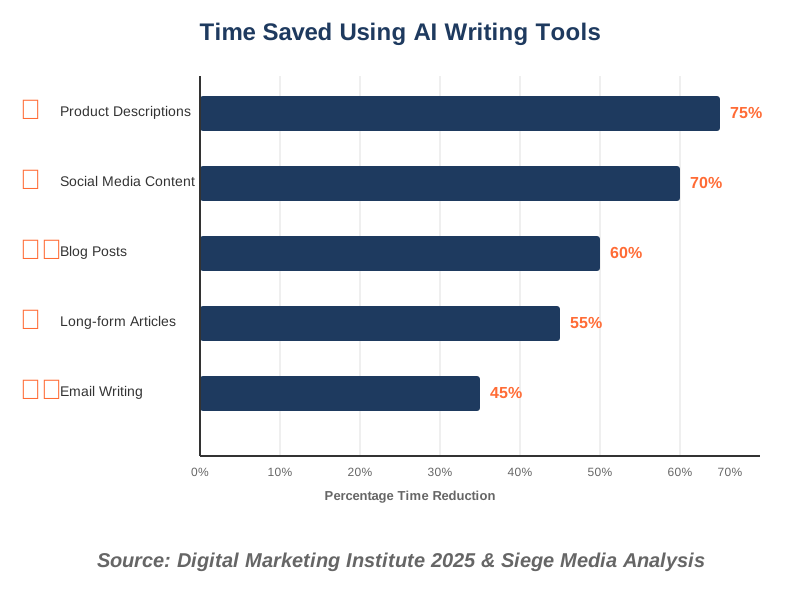
Track your time savings: Document how long tasks took before and after implementing AI writing tools. When you see that you’re completing projects 50–60% faster, it reinforces the habit and justifies the investment. According to the Digital Marketing Institute’s 2025 research, businesses using AI writing tools report average productivity increases of 61%.
Common Mistakes to Avoid
After coaching dozens of writers through their AI adoption journey, I’ve identified pitfalls that derail success.
Over-reliance without editing: The biggest mistake? Publishing AI-generated content without substantial editing. These tools create drafts, not finished products. Your expertise, voice, and perspective transform AI output from generic to compelling.
Choosing the wrong tool for the task: Don’t force ChatGPT to do what Grammarly does better, or vice versa. Each tool has optimal use cases. Match the task to the tool’s strength rather than trying to make your favorite do everything.
Neglecting prompt engineering: Vague prompts yield vague results. Specific, detailed prompts generate useful output. Instead of “write about AI writing tools,” try “explain how marketing teams can use AI writing assistants to create social media content 50% faster, including specific examples and common mistakes to avoid.”
Ignoring the learning curve: Every tool requires investment to master. Allocate time to learn keyboard shortcuts, explore templates, and experiment with features. The productivity gains compound as you become more proficient.
Forgetting data security: Be cautious with sensitive or proprietary information. Review each platform’s data handling policies before inputting confidential content. Many tools offer enterprise versions with stronger security and data controls.
Frequently Asked Questions About AI Writing Tools
The Future of AI-Assisted Writing
The AI writing tools landscape continues evolving rapidly. According to Market Research Future’s industry analysis, the AI writing assistant software market will reach $1,478.73 billion by 2034—a 36.65% compound annual growth rate that reflects accelerating adoption across industries. This growth signals not just market expansion but fundamental transformation in how we approach content creation.
We’re moving beyond simple text generation toward genuinely intelligent collaboration. Upcoming developments include real-time performance optimization, where content automatically adjusts based on reader engagement data, and an increasingly sophisticated understanding of context, tone, and audience needs.
For writers, this means your competitive advantage lies not in resisting these tools but in mastering them early. The writers succeeding in 2025 and beyond are those who view AI as a productivity multiplier—a way to produce more, better, faster without sacrificing the human elements that make content compelling.
Taking Action: Your Next Steps
You’ve now got a comprehensive understanding of the leading AI writing platforms and how to leverage them effectively. Here’s how to move forward immediately.
This week: Choose one free tool and experiment for three days. I recommend starting with ChatGPT—create a free account and use it to brainstorm your next three content pieces. Notice how it feels to have instant access to ideas and rough drafts.
This month: Add a second tool that complements your workflow. If you started with ChatGPT for drafting, add Grammarly for editing. Or if you’re a fiction writer, try Sudowrite’s free trial. Track your time on three similar projects—one without AI and two with different tools. Quantify the difference.
This quarter: Build your complete AI writing workflow. Identify tools for each stage—research, outlining, drafting, editing, and optimization. Create templates for your recurring content types. Train any customizable tools on your voice and style.
The writers who thrive over the next decade won’t be those with the fanciest tools—they’ll be those who most thoughtfully integrate AI writing assistants into sustainable, productive workflows that amplify their unique creative voice.
Remember: these tools exist to make writing easier and more efficient, not to replace the irreplaceable—your expertise, perspective, and authentic voice. Use them to reclaim time, overcome obstacles, and produce more of the work that only you can create.
Start small, experiment freely, and let the time savings speak for themselves. Your next breakthrough piece is waiting—and now you have the tools to create it faster than ever before.
References
- Siege Media + Wynter. (2025). “AI Writing Statistics 2025.” Retrieved from https://www.siegemedia.com/strategy/ai-writing-statistics
- All About AI. (2025). “AI Writing Statistics 2025: Data on Adoption, Impact, and Future Trends.” Retrieved from https://www.allaboutai.com/resources/ai-statistics/ai-writing/
- Market Research Future. (2025). “AI Writing Assistant Software Market.” Retrieved from https://www.marketresearchfuture.com/reports/ai-writing-assistant-software-market-31158
- Planable. (2025). “77 AI Statistics: Market Size, Adoption & Trends.” Retrieved from https://planable.io/blog/ai–statistics/
About the Author
This article was written by James Carter, a productivity coach specializing in helping creative professionals leverage AI tools to save time and boost efficiency. With over a decade of experience in content strategy and workflow optimization, James helps writers, marketers, and entrepreneurs integrate AI seamlessly into their daily routines without sacrificing quality or authenticity. His mission is to show that AI simplifies work without requiring technical knowledge, making advanced tools accessible to everyone ready to work smarter, not harder.