
How to Define Marketing Objectives Using AI

How to Define Marketing Objectives Using AI starts with understanding what you actually want to achieve before creating any content. Most marketers rush into producing blog posts, social media updates, and campaigns without a solid strategic foundation. The result? Scattered messaging, wasted effort, and campaigns that don’t convert.
We’ve both experienced this firsthand—spending hours on content that looked excellent but didn’t move the needle because we hadn’t clarified our core objectives first.
In this guide, we’ll walk you through a practical, step-by-step process to define clear marketing objectives, craft compelling position statements, articulate your value proposition, and identify your content pillars—all with AI as your strategic partner.
Why Strategic Clarity Comes Before Content Creation
Here’s what happens when you skip the foundation: you create content that sounds good but doesn’t support clear business goals. Your team argues about messaging because there’s no shared reference point. You struggle to measure success because you never defined what success looks like.
We’ve seen countless solopreneurs and small marketing teams burn through months of effort this way. They produce dozens of social posts, write blog articles, and launch campaigns—only to realize six months later that nothing connects to an actual business outcome.
Marketing objectives give you direction. A position statement defines where you fit in the market. Your value proposition explains why someone should choose you. And content pillars organize your messaging so every piece of content reinforces your strategy.
AI doesn’t replace this strategic thinking—but it dramatically accelerates the process and helps you explore angles you wouldn’t consider alone.
Step 1: Define Your Core Marketing Objectives
Start here: what specific business outcome do you need marketing to drive? Not vague aspirations like “increase brand awareness,” but concrete, measurable targets tied to your business model.
Use AI to Brainstorm Objective Clarity
Open your AI tool (we use Claude, but ChatGPT and others work similarly) and start with this prompt structure:
Prompt Template:
I'm a [your role] at [company description]. We [what you sell/do] for [target audience]. Our business model is [how you make money].

Help me define 3-5 specific marketing objectives for the next [timeframe]. Each objective should:
- Be measurable with clear metrics
- Connect directly to revenue or customer acquisition
- Be achievable with our [team size/resources]
- Support our overall business goal of [main goal]

Ask me clarifying questions before suggesting objectives.
What Makes a Strong Marketing Objective
AI will likely ask about your current metrics, target audience, and business stage. Answer honestly—the AI can’t help if you’re vague. Strong objectives follow this pattern:
- Specific: “Acquire 50 qualified leads per month”, not “get more leads”
- Measurable: Includes numbers, percentages, or clear thresholds
- Time-bound: Has a deadline or timeframe
- Revenue-connected: You can draw a line from the objective to business impact
Common Mistake: Confusing Tactics with Objectives
We constantly see people write objectives like “post on LinkedIn 3x per week” or “start a newsletter.” These are tactics, not objectives. An objective might be, “build an email list of 1,000 qualified prospects in Q1.” The newsletter is just one tactic to achieve that.
Ask AI to challenge your objectives: “Review these objectives and tell me if any are actually tactics disguised as objectives. Suggest how to reframe them as outcome-focused goals.”
Step 2: Craft Your Position Statement
Your position statement is an internal compass—it’s not customer-facing copy but rather a strategic declaration of where you fit in the market and who you serve. It answers: What category are we in? Who specifically are we for? What makes us different?
The Position Statement Formula
Use this structure with AI’s help:
For [target customer segment]
Who [specific need or frustration]
Our [product/service/offering] is a [category]
That [key benefit or outcome]
Unlike [main competitors or alternative solutions]
We [unique approach or differentiator]
AI-Assisted Position Development
Here’s a prompt we use that works remarkably well:
Prompt Template:
Help me develop a position statement using this format: [paste format above]

Context:
- Our offering: [what you sell/do]
- Target audience: [who you serve - be specific]
- Main competitors or alternatives: [what else people consider]
- What makes us different: [your unique approach, not features]

Ask me questions to refine each element. Challenge me if my answers are too generic or could apply to competitors.
The AI will push you to get specific. If you say “small businesses,” it’ll ask, “which industry, what size, what specific problem?” This interrogation is valuable—vague positioning leads to vague marketing.
Example: Refining Position with AI
Let’s say you’re a freelance content writer. Your first draft might be:
“For small businesses that need content, I’m a writer who creates blog posts. Unlike other freelancers, I’m reliable and deliver quality work.”
AI will immediately flag this description as too generic. After conversation, you might refine it to:
“For B2B SaaS companies with technical products who struggle to explain complex features simply, I’m a content strategist and writer that transforms technical documentation into customer-focused content that drives trial signups. Unlike generalist writers, I have 8 years of software development experience and speak developer language fluently.”
See the difference? The second version tells you exactly who to market to and why they’d choose you.
Ready to apply this strategic thinking faster? We’ve created a comprehensive Marketing Strategy Foundation Checklist that walks you through defining objectives, position statements, value propositions, and content pillars in a structured format. It takes about 2-3 hours to complete and gives you a solid strategic foundation before you create any content. Think of it as your strategic thinking worksheet—and it’s completely free.
Step 3: Write Your Value Proposition
Your value proposition is customer-facing. It’s the clearest, most compelling statement of why someone should choose you. While your position statement is for internal alignment, your value proposition lives on your website, in your pitch, and in your marketing materials.
The Value Proposition Framework
A strong value proposition has three components:
- The outcome: What result does the customer obtain?
- The differentiator: What makes your approach better/different?
- The proof point: Why should they believe you?
AI Prompts for Value Proposition Development
Prompt Template:
Help me write a compelling value proposition for [your offering].

Information:
- Target customer: [specific segment from your position statement]
- Main problem we solve: [the core frustration or need]
- How we solve it: [your unique approach]
- Key outcome/benefit: [the transformation or result]
- Proof points: [credentials, results, testimonials, or data]

Generate 5 different value proposition options, each under 25 words. Make them concrete and specific, not generic marketing language.
AI excels at generating multiple variations quickly. You might love one version completely, or you might combine elements from several options. We usually run this prompt 2-3 times, refining the inputs based on what we see.
Testing Your Value Proposition
Once you have a draft, use this validation prompt:
Evaluate this value proposition: [paste your draft]

Criteria:
- Is it immediately clear what we do and for whom?
- Does it state a specific outcome, not vague benefits?
- Would a competitor struggle to claim the same thing?
- Does it address a real customer pain point?
- Is it believable (not hyperbolic)?

Be brutally honest. Score each criterion 1-10 and explain your scores.
This forces you to look at your value prop objectively. If AI scores you low on “competitor differentiation,” you need to get more specific about what makes you different.
Common Value Proposition Mistakes
Too feature-focused: “We offer 24/7 support and mobile apps” doesn’t tell me the outcome.
Too vague: “We help businesses grow” could mean anything.
Too broad: “For everyone who needs marketing” means you’re for no one specifically.
AI will catch these patterns if you ask it to review critically. The key is being willing to hear the feedback and iterate.
Step 4: Identify Your Content Pillars
Content pillars are the 3-5 core themes that all your content should reinforce. They stem directly from your objectives, position, and value proposition. Think of them as the main topics you’ll become known for—the areas where you build authority and trust.
Why Content Pillars Matter
Without defined pillars, you’ll jump from topic to topic chasing trends or following competitors. Your audience won’t know what you stand for. Your content won’t compound—each piece exists in isolation instead of building on previous work.
With clear pillars, every piece of content strengthens your position. You become the go-to resource for specific topics. Your messaging stays consistent even as individual content pieces vary.
AI-Driven Pillar Identification
Prompt Template:
Based on this marketing strategy:

Marketing Objective: [paste your objective]
Position Statement: [paste your position]
Value Proposition: [paste your value prop]
Target Audience: [describe in detail]

Suggest 4-5 content pillars that would:
- Directly support achieving my marketing objective
- Reinforce my market position
- Address topics my target audience actively searches for
- Allow me to demonstrate unique expertise
- Differentiate from what competitors typically cover

For each pillar, explain why it's strategically important and give 3 example content topics.
The AI will analyze your strategy and suggest themes that connect to your business goals. It’s remarkably good at spotting opportunities you might overlook.
Validating Your Content Pillars
Your pillars should pass these tests:
The Expertise Test: Can you credibly speak about this topic better than most competitors?
The Interest Test: Does your target audience actively search for or care about this topic?
The Objective Test: Does content in this pillar move you toward your marketing objective?
The Longevity Test: Will this topic still be relevant in 6-12 months?
Use AI to stress-test your pillars:
Review these content pillars: [list them]

For each pillar:
1. Identify potential weaknesses or gaps
2. Suggest how to make it more specific or differentiated
3. Recommend the best content formats for this pillar
4. Rate how well it supports my overall marketing objective (1-10)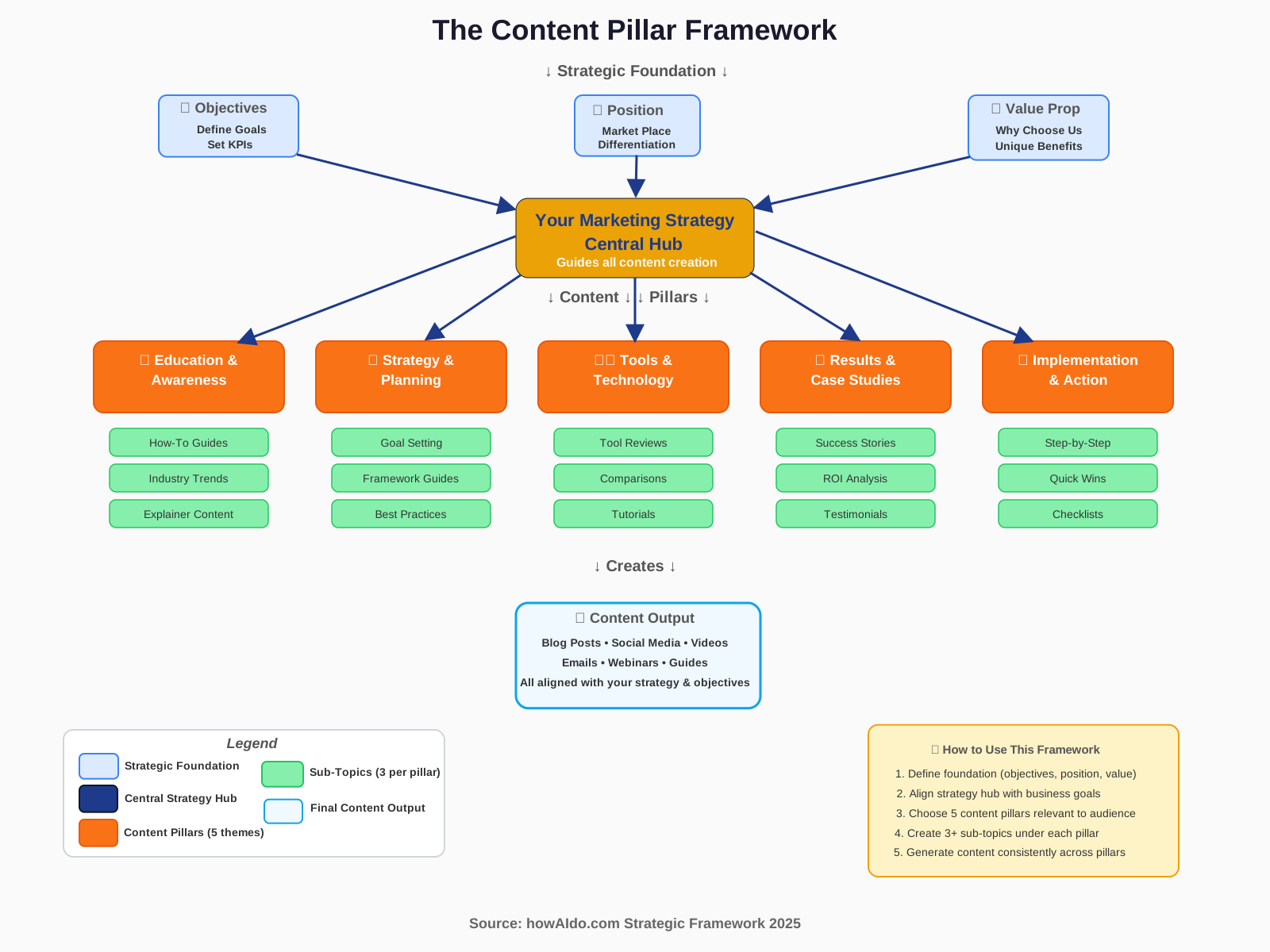
Bringing It All Together: Your Strategic Foundation Document
Now you have the four core components. The next step is documenting them in one place where your team (even if your team is just you) can reference them.
Create Your Strategy Brief with AI
We recommend creating a simple one-page strategy brief that captures everything:
Prompt Template:
Create a one-page marketing strategy brief document based on these inputs:

Marketing Objectives: [paste yours]
Position Statement: [paste yours]
Value Proposition: [paste yours]
Content Pillars: [list them]

Format the brief as a clear, scannable document that includes:
- A brief executive summary (2-3 sentences)
- Each element in its own section
- Practical implications for content creation under each element
- Success metrics tied to the objectives

Make it something I can share with freelancers, contractors, or team members.
This document serves as your guide. Before creating any content, you check: Does this support one of my objectives? Does it reinforce my position? Does it fit within my content pillars?
Monthly Strategy Review Ritual
Marketing strategy is not a static process. We conduct a monthly review of our marketing strategy using this AI prompt:
Review this marketing strategy: [paste your full brief]

Based on [describe what happened in the past month - metrics, feedback, challenges]:

1. Which elements of the strategy are working well? What evidence supports this?
2. Where am I seeing misalignment between strategy and execution?
3. Should any elements be adjusted? Why or why not?
4. What should I focus on this coming month to better align with objectives?
AI helps you spot patterns and disconnects you might rationalize away on your own.
Want to accelerate your content creation once your strategy is set? Check out our 100+ AI Marketing Prompts collection. These are the exact prompts solo entrepreneurs, creators, and agencies use to turn strategic foundations like yours into high-quality content quickly. Every prompt is ready to copy and use immediately—no guesswork, no starting from scratch. Think of it as your complete AI content toolkit, designed specifically for people who’ve done the strategic work and are ready to execute.
Real-World Example: Putting This Into Practice
Let me show you how this works with a real scenario.
Say you’re a virtual assistant specializing in podcast production support.
Before AI Strategy Work:
- Vague objective: “Get more clients”
- Vague positioning: “I help podcasters”
- Vague value prop: “Professional podcast support”
- No defined content pillars—posting random tips about podcasting
After AI-Guided Strategy Work:
Marketing Objective: Acquire 5 new podcast production clients per quarter at $1,500/month retainer by demonstrating deep expertise in podcast workflow optimization.
Position Statement: For B2B podcasters producing weekly interview shows who struggle with inconsistent production workflows and missed publishing deadlines, I’m a podcast production specialist that creates custom systems and handles end-to-end production. Unlike general VAs, I have 4 years of audio engineering experience and have produced over 200 podcast episodes across multiple genres.
Value Proposition: Get your podcast published consistently every week without sacrificing quality or spending your time on editing. I handle everything from guest coordination to final distribution—guaranteed on-time delivery or your money back.
Content Pillars:
- Podcast workflow optimization and systems
- Audio quality improvement for non-technical podcasters
- Guest management and interview preparation
- Podcast growth strategies specific to B2B shows
Now every piece of content has purpose. A LinkedIn post about guest preparation systems? Supports pillar #3 and demonstrates expertise that differentiates from general VAs. A blog post about workflow automation? Directly addresses the position statement’s core problem. Everything connects.
FAQ: Common Questions About AI-Assisted Marketing Strategy
Your Next Steps: From Strategy to Execution
You now have a complete framework for defining your marketing foundation before creating any content. Here’s your immediate action plan:
This week: Allocate 3 hours to thoroughly work through each of the four components using the AI prompts we’ve provided. Don’t rush—it’s better to spend time getting this right than to create another vague strategy you’ll ignore.
Next week: Create your one-page strategy brief and share it with anyone who creates content for your business. If you work with freelancers, contractors, or team members, this document ensures everyone’s aligned on what you’re trying to achieve and how you’re positioning yourself.
Month 1: Create content exclusively within your defined pillars and evaluate what resonates. Track how your content connects to your objectives. Be willing to adjust based on real feedback, but give your strategy time to work before abandoning it.
The difference between marketers who succeed with AI and those who don’t isn’t access to better tools—it’s having a clear strategy that AI can execute against. Tools are commodities; strategic clarity is your competitive advantage.
We created this guide because we’ve lived both sides: the scattered, reactive approach where you create content without direction, and the focused approach where every piece of content has purpose. The second approach is dramatically more effective and less exhausting.
Start with strategy. Let AI help you define it. Then use AI to execute faster than you could alone. That’s the formula.
About the Authors
Alex Rivera and Abir Benali collaborated to write this article, combining Alex’s creative technology expertise with Abir’s clear, beginner-focused teaching approach.
Alex Rivera (Main Author) is a creative technologist who helps non-technical users harness AI for content creation and strategy. With years of experience making complex tools accessible, Alex specializes in turning AI from intimidating to intuitive. Alex believes the best technology disappears into your workflow—you focus on the creative work while AI handles the heavy lifting.
Abir Benali (Co-Author) is a technology writer dedicated to making AI tools understandable for everyday users. Abir’s superpower is taking technical concepts and explaining them so clearly that anyone can implement them immediately. Abir has helped hundreds of non-technical professionals adopt AI tools without feeling overwhelmed.
Together, we focus on practical, immediately actionable advice that bridges the gap between AI capabilities and real-world marketing challenges. We write for people who want results, not people who want to become AI experts.