How to Build Research‑Based Audience Personas Using AI

How to Build Research‑Based Audience Personas Using AI starts with understanding one fundamental truth: generic marketing messages fail because they speak to everyone and connect with no one.
We’ve watched countless campaigns fall flat because they were built on assumptions rather than actual audience insights.
The solution? Creating detailed, research-backed personas that capture the real motivations, fears, and desires of your ideal customers.
Here’s the exciting part—AI has transformed what used to take weeks of research, interviews, and data analysis into a streamlined process you can complete in an afternoon. We’re not talking about shallow demographic sketches. We mean comprehensive profiles that reveal why your audience makes decisions, what keeps them up at night, and exactly how to speak their language.
The difference between guessing at your audience and truly understanding them is measurable in every metric that matters: engagement rates, conversion percentages, and customer lifetime value.
Whether you’re launching a new product, refining your marketing strategy, or trying to understand why your current messaging isn’t landing, building research-based audience personas gives you the clarity to make confident decisions.
In this guide, we’re sharing the exact process we use to build personas that actually drive results. These aren’t theoretical exercises—they’re practical frameworks you can implement immediately, even if you’ve never created a persona before.
Ready to stop guessing and start knowing your audience? Let’s dive in.
Understanding the Foundation: What Makes a Persona “Research-Based”
Before we jump into the how-to, let’s establish what separates a valuable persona from a creative writing exercise.
A research-based audience persona draws from multiple data sources, like:
- Actual customer behavior,
- Survey responses,
- Social media conversations,
- Purchase patterns,
- Direct feedback.
It’s the difference between imagining what your customer might want versus documenting what they actually do.
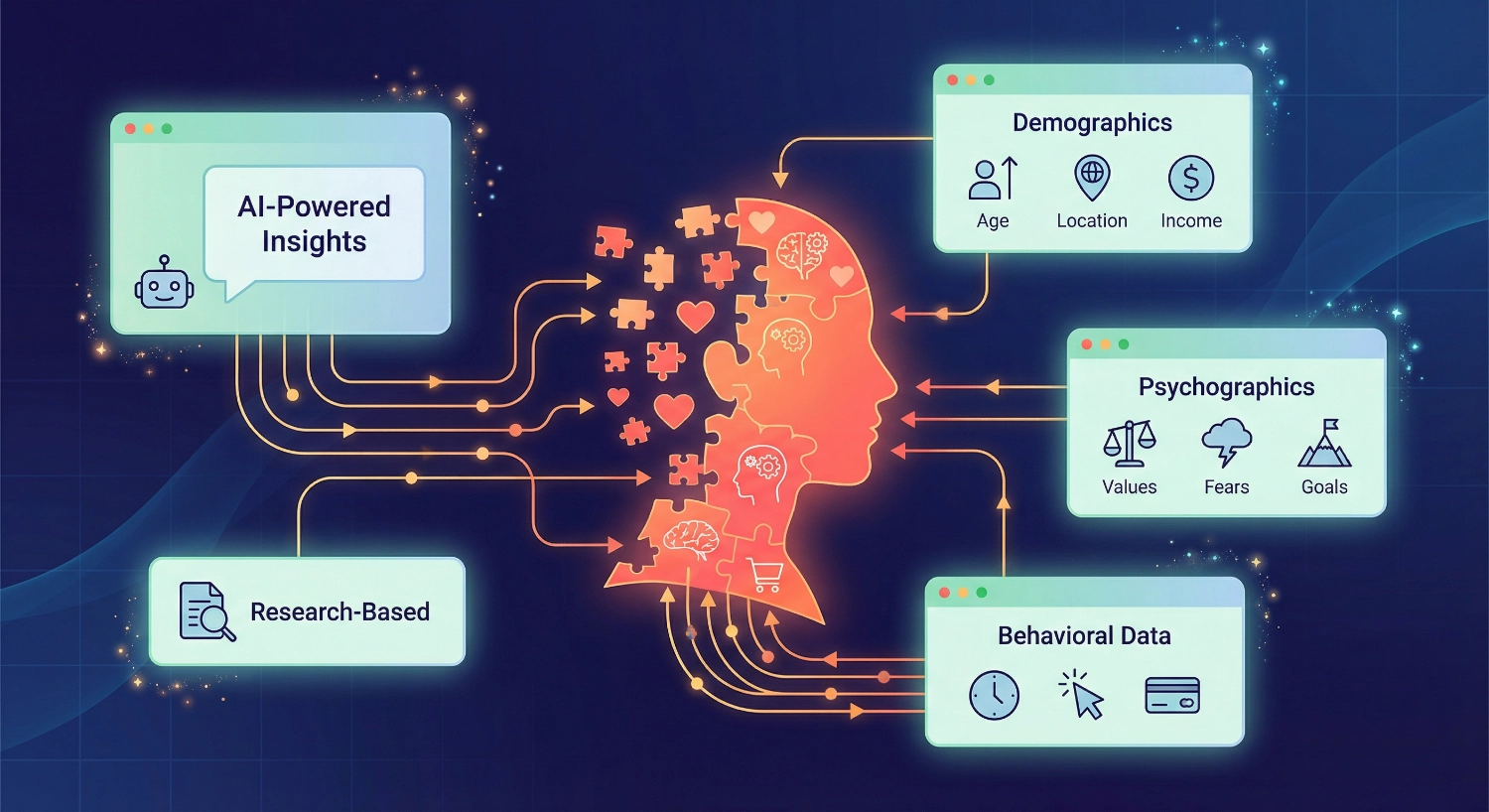
We’re combining AI-powered analysis with real-world data to create profiles that reflect genuine human complexity. This means your personas will include demographics (the basics like age and location), psychographics (values, beliefs, and attitudes), behavioral patterns (how they research and make decisions), and emotional drivers (what they fear and what they aspire to achieve).
The goal isn’t perfection—it’s actionable accuracy. You want personas detailed enough to guide specific marketing decisions but flexible enough to evolve as you learn more about your audience.
10 Proven Tips to Build Powerful AI-Driven Personas
1. Start With Your Existing Customer Data Before Asking AI Anything
The biggest mistake we see? Asking AI to “create a persona” from thin air. AI is incredibly powerful at analyzing and synthesizing information, but it needs raw material to work with. We always begin by gathering everything we already know about our customers.
Pull together your email list demographics, website analytics showing which pages resonate, customer support tickets revealing common pain points, and any purchase history showing patterns in buying behavior. If you have past survey results or customer interviews, include those too.
Upload this data to a document or spreadsheet. Even messy notes are valuable—AI excels at finding patterns in unstructured information. The more specific data you provide, the more accurate your personas will be. Think of AI as your research assistant who needs the files before they can write the report.
Common mistake to avoid: Don’t fabricate data to “help” the AI. If you don’t have certain information, explicitly state that in your prompt so AI can work around the gaps rather than make assumptions.
2. Use Multi-Step Prompting for Deeper Persona Layers
Here’s a technique that transforms superficial personas into strategic goldmines: break your persona creation into multiple focused conversations with AI instead of one mega-prompt. We call this “layered prompting,” and it mirrors how human research actually works.
Start with a prompt like:
Based on [your data], identify the 3-5 most distinct customer segments in this information.
For each segment, describe their primary goal when interacting with [your product/service].
Once AI provides those segments, choose the most valuable one and dive deeper: “For the [segment name] group, analyze their decision-making process. What questions do they need answered before purchasing? What concerns might prevent them from taking action?”
Then go even deeper: “What emotions drive this segment’s behavior? What are their deepest fears related to [your industry]? What do they aspire to achieve?”
This step-by-step approach produces nuanced personas because you’re guiding AI to examine different dimensions systematically rather than trying to capture everything at once.
Implementation tip: Keep a running document where you paste each AI response. By the end, you’ll have comprehensive persona profiles you can format and refine.
3. Leverage AI for Psychographic Analysis Using Social Media Language
Demographics tell you who your customers are; psychographics tell you why they behave the way they do. This is where AI becomes incredibly valuable because it can analyze language patterns at scale to uncover values, beliefs, and emotional triggers.
Gather real comments, reviews, social media posts, or forum discussions from your target audience. The key is authenticity—you want actual words from actual people.
Feed this language into AI with a prompt, like:
Analyze these customer comments and identify:
1) The core values are expressed,
2) The underlying beliefs about [your industry/product category],
3) The emotional tone and urgency level,
4) The specific language and terminology they use to describe their needs.
AI will surface patterns you’d miss reading manually. You might discover that your audience consistently uses words like “overwhelmed” and “simplify,” signaling that clarity and ease are core values. Or they might frequently mention “staying ahead” and “competitive edge,” revealing achievement-oriented motivations.
Document these psychographic insights in your persona profile. When you write marketing copy later, you’ll use their actual language, making your message instantly relatable.
Creative twist: Ask AI to create a “day in the life” narrative for your persona using these psychographic insights. It helps your team empathize with the actual human experience behind the data.
Now that you’ve started building your persona foundation, you might be thinking about how to organize all these insights effectively. We’ve created a Primary Persona Deep Dive Checklist that walks you through every element of a research-based persona, from demographics to behavioral triggers. It’s designed to work alongside AI tools, ensuring you don’t miss critical details that could transform your marketing effectiveness.
4. Create Problem-Solution Maps for Each Persona
Here’s where personas become genuinely actionable: mapping the specific problems your persona faces to the solutions they’re seeking. This technique bridges the gap between understanding your audience and knowing exactly how to serve them.
Use AI to create a structured analysis:
For [persona name], list their top five problems related to [your industry].
For each problem, describe:
1) How are they currently trying to solve it?
2) Why their current solution is inadequate,
3) What an ideal solution would look like to them,
4) The emotional impact of not solving this problem.
The output becomes your strategic roadmap. Each problem represents a content topic, a potential product feature, or a marketing message. Each inadequate current solution reveals your competitive positioning. Each ideal solution description tells you how to frame your offering.
We take this one step further by asking AI, “Based on these problems, what search queries would this persona use on Google? What questions would they ask a friend? What objections would prevent them from trying a new solution?”
These insights directly inform your SEO strategy, content calendar, and sales script. Your persona transforms from a static profile into a dynamic guide for every customer interaction.
Practical application: Create a simple matrix with Problems as rows and Touchpoints (awareness, consideration, decision) as columns. Fill in how the problem manifests at each stage. This becomes your content strategy blueprint.
5. Build Secondary Personas to Capture Audience Diversity
Most businesses have more than one type of customer, and oversimplifying with a single persona can blind you to important opportunities. We recommend creating one primary persona (your most valuable or common customer segment) and two to three secondary personas representing other significant groups.
The trick is doing these tasks efficiently without drowning in complexity. Once you’ve built your primary persona using the techniques above, use AI to identify variations: “Based on [primary persona profile], what other customer segments might be interested in [your offering] but have different motivations, constraints, or goals?”
For each secondary persona, focus on what makes them distinctly different rather than recreating the entire analysis.
Ask:
How does [secondary persona] differ from [primary persona] in terms of:
1) Their core motivation for seeking this solution,
2) Their decision-making criteria,
3) Their barriers to purchase,
4) Their preferred information sources?
Document these differences clearly. When creating marketing campaigns, you’ll design your primary approach for your main persona but include variations or separate touchpoints for secondary personas.
Real-world example: An online course creator might have a primary persona of career-switchers seeking new skills and secondary personas of current professionals wanting advancement and hobbyists exploring interests. Same product, completely different messaging angles.
6. Rank Personas by Strategic Value, Not Just Size
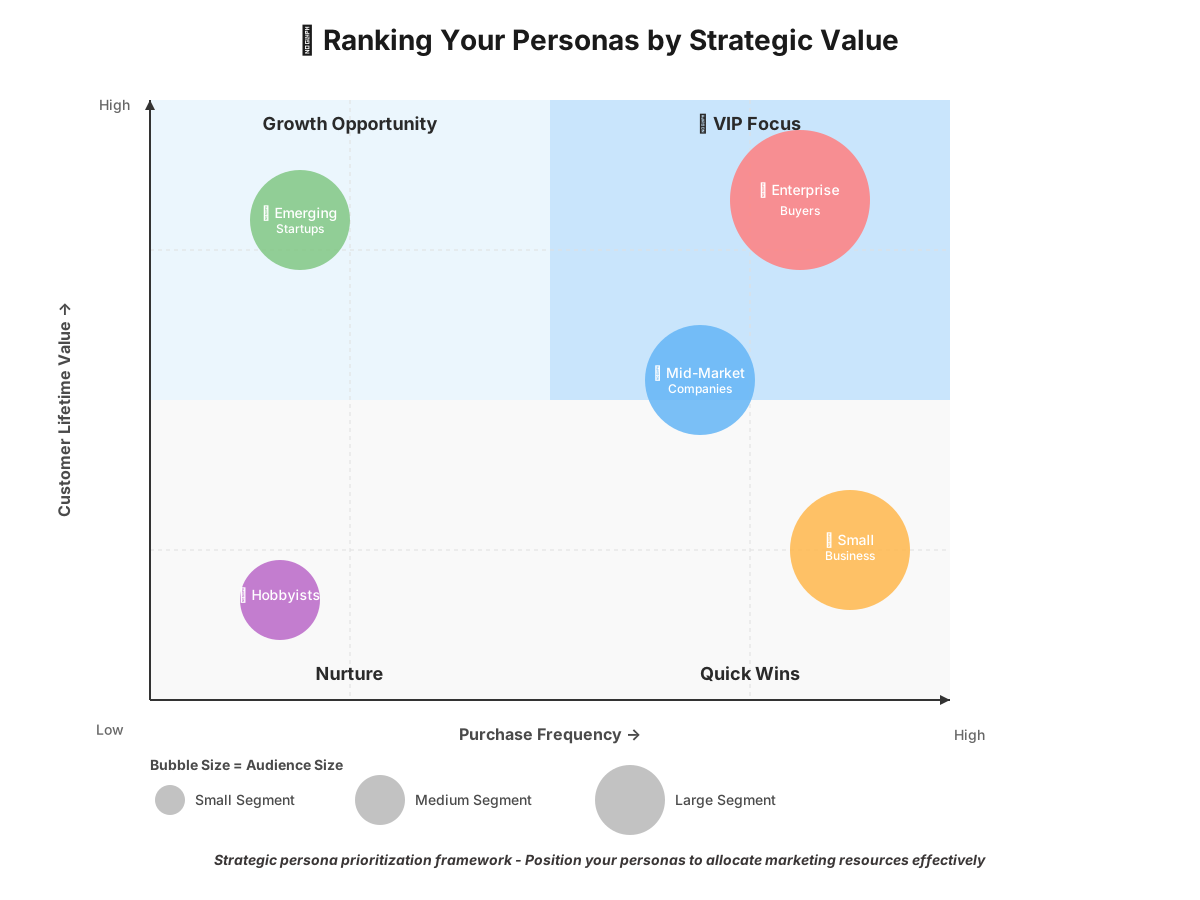
Not all personas are created equal, and treating them the same wastes resources. We use AI to help prioritize personas based on multiple value factors, not just how many people fit the profile.
Prompt AI with:
For each persona [list them], estimate their strategic value based on:
1) Average customer lifetime value,
2) Ease of reaching them through marketing channels,
3) Likelihood of becoming brand advocates,
4) Alignment with our business goals,
5) Current market competition for this segment.
Rank them from highest to lowest strategic value and explain the reasoning.
This analysis reveals where to focus your efforts. Your largest persona segment might not be your most valuable if they have low purchase intent or are expensive to acquire. Conversely, a smaller segment might deserve outsized attention if they’re high-value, easy to reach, and underserved by competitors.
Create a simple prioritization system: Primary Focus (allocate 50-60% of resources), Secondary Focus (30-40% of resources), and Monitoring (10% of resources, watching for growth opportunities). This prevents the common trap of trying to serve everyone equally and accomplishing nothing effectively.
Advanced technique: Use AI to identify “gateway personas”—segments that might start as low-value but frequently evolve into high-value personas. For example, free trial users who become enterprise clients. Understanding this progression informs your nurture strategy.
7. Document Persona Fears and Objections With Precision
Here’s where many persona exercises fall short: they focus on what customers want without adequately exploring what holds them back. We’ve found that understanding audience fears and objections often matters more than understanding their goals, because anxiety is a stronger motivator than desire.
Use AI to conduct “objection mining”:
Based on [customer feedback, reviews, support tickets], identify:
1) What are this persona's biggest fears about [your product category]?
2) What past negative experiences might they have had?
3) What specific objections might prevent them from purchasing?
4) What worst-case scenarios do they imagine?
5) What myths or misconceptions might they believe?
The responses become your objection-handling playbook. For each fear, document the underlying concern, how you’ll address it proactively in marketing, what proof points overcome it, and where in the customer journey to address it.
For example, if AI identifies that your persona fears “wasting money on something complicated they won’t use,” you know to emphasize simplicity, include a money-back guarantee, showcase quick-start guides, and feature testimonials about ease of use.
Implementation shortcut: Create an “objection response matrix” with common objections in one column and your responses (proof, guarantees, social proof, etc.) in the next. Train your sales team and include these responses in your FAQ section.
8. Use AI to Generate Persona Interview Questions
Even with all this AI-powered analysis, nothing replaces direct conversations with real humans. But AI can supercharge your interview process by generating targeted questions based on your existing persona insights.
Prompt:
Based on [persona profile], create 15 interview questions that would:
1) Validate or challenge our assumptions about their motivations,
2) Uncover unstated needs or desires,
3) Reveal their decision-making process,
4) Identify emotional triggers,
5) Explore their relationship with competing solutions.
Mix open-ended questions with specific scenario-based questions.
AI will generate questions like, “Walk me through the last time you tried to solve [problem]. What worked? What didn’t?” or “If you could wave a magic wand and create the perfect [solution], what would it look like?”
Conduct 5-10 interviews using these questions, then feed the transcripts back to AI:
Analyze these interview transcripts and identify:
1) Patterns that confirm our persona profile,
2) Surprises that contradict our assumptions,
3) Gaps in our current understanding,
4) Direct quotes that capture this persona's voice.
This iterative process ensures your personas stay grounded in reality while benefiting from AI’s pattern-recognition capabilities.
As you’re conducting these interviews and refining your personas, you might be wondering what prompts will help you extract the most valuable insights from AI. That’s exactly why we created 100+ AI Marketing Prompts Ready to Copy and Use—a comprehensive collection including persona-building prompts, customer research queries, and analysis frameworks used by successful solo entrepreneurs and marketing agencies. These templates eliminate the guesswork and help you ask the right questions at each stage of persona development.
9. Create “Jobs to Be Done” Profiles for Behavioral Accuracy
Here’s a perspective shift that makes personas dramatically more useful: instead of focusing solely on who your customer is, document what “job” they’re hiring your product to do. This Jobs to Be Done (JTBD) framework, combined with AI analysis, reveals the true context behind purchase decisions.
Ask AI:
For [persona name], identify the specific 'jobs' they're trying to accomplish when considering [your product/service].
For each job, describe:
1) The functional task they're trying to complete,
2) The emotional need they're trying to satisfy,
3) The social impression they're trying to create,
4) The situation or trigger that makes them realize they need this job done.
For example, someone buying a fitness program might have the functional job of “lose 20 pounds,” the emotional job of “feel confident in my body,” and the social job of “be seen as someone who takes care of themselves,” triggered by “upcoming beach vacation.”
Understanding these layers means you can send messages to multiple motivations simultaneously. Your marketing might lead with the functional benefit but include emotional and social proof elements that resonate with the deeper jobs being done.
Practical tip: Add a “JTBD” section to each persona profile listing the top 3 jobs and their context. Reference this when creating campaign messaging or designing product features.
10. Set Up Persona Validation and Evolution Systems
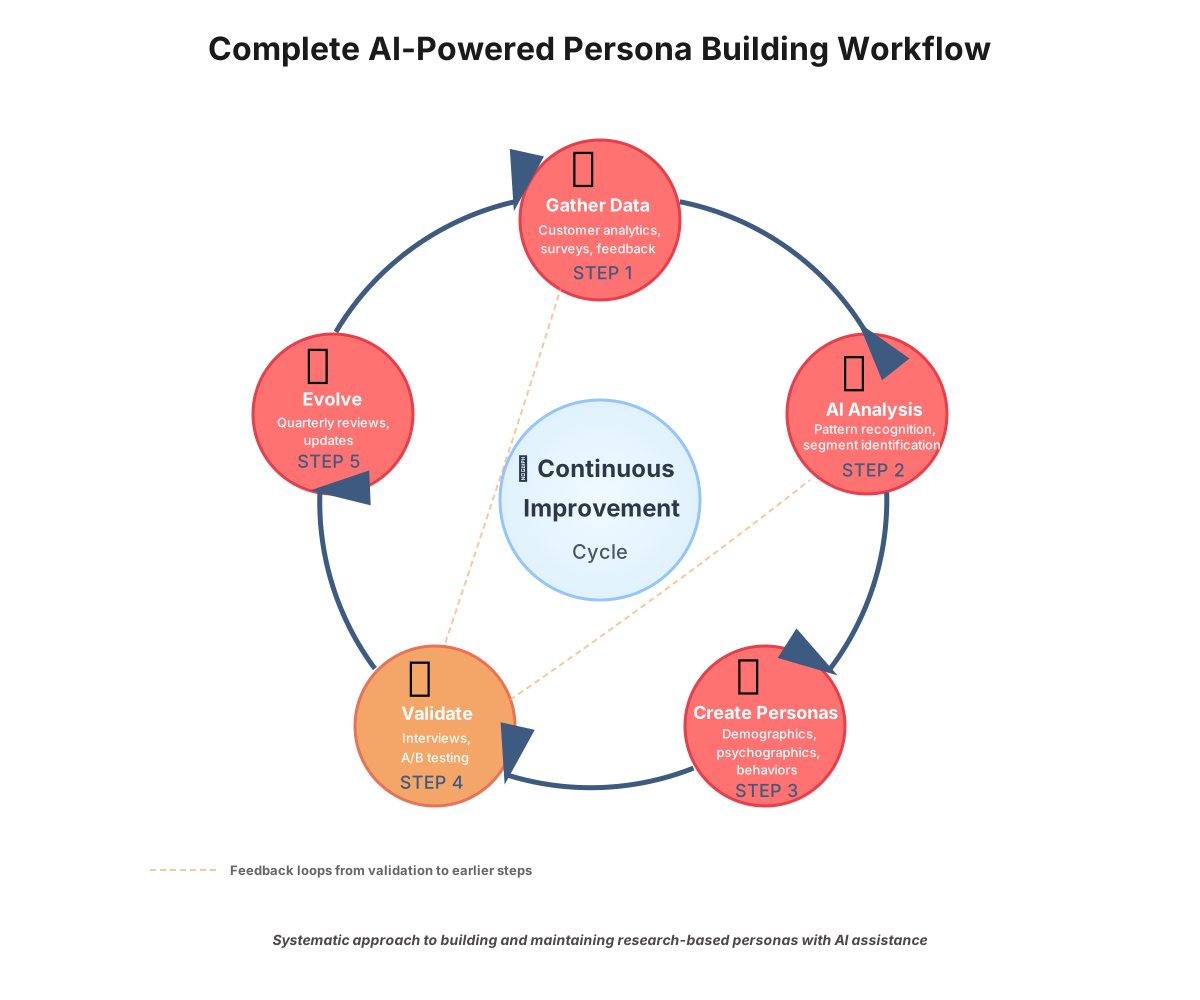
Personas aren’t static—they evolve as markets change, your business grows, and new data emerges. The final tip is building a system to continuously validate and update your personas rather than treating them as a one-time project.
Use AI to create a quarterly review process:
Create a checklist for reviewing [persona name] based on:
1) Recent customer data trends,
2) Changes in customer feedback themes,
3) New competitive dynamics,
4) Shifts in marketing channel performance,
5) Product usage patterns.
Flag any significant changes that suggest this persona needs updating.
Schedule persona reviews every 3-6 months. During reviews, feed AI your latest data with a prompt like:
Compare this new data [paste recent insights] against our existing persona profile [paste current persona].
Identify:
1) What's validated,
2) What's contradicted,
3) What's new,
4) What trends are emerging.
Make one team member the “persona owner” responsible for keeping profiles current. Store personas in a shared, easily accessible location (not buried in a deck from two years ago) so everyone references the same information.
Evolution indicator: If more than 30% of your persona profile no longer matches current customer data, it’s time for a refresh, not just an update.
Common Mistakes When Building AI-Powered Personas
Before we move to frequently asked questions, let’s address the pitfalls that derail persona projects. We’ve seen (and made) these mistakes ourselves:
Over-relying on AI without real data: AI is brilliant at analyzing information but terrible at creating information from nothing. Feed it actual customer data, not assumptions.
Creating too many personas: More isn’t better. Start with 1-3 personas that represent 80% of your audience. You can always add more later.
Making personas too generic: “Sarah, 35, marketing manager” isn’t useful, but “Sarah, who feels overwhelmed managing a marketing team of one while her CEO expects Fortune 500 results” is actionable.
Ignoring negative personas: Document who you’re NOT targeting. This prevents wasted resources pursuing poor-fit customers.
Treating personas as creative writing: Your persona isn’t a character in a novel. Ground every detail in data and research, even if that means some sections remain vague until you gather more information.
Setting and forgetting: Personas that live in a PDF no one references are useless. Make them visible, accessible, and integral to your planning process.
Frequently Asked Questions
Your Next Steps: From Personas to Performance
You now have a complete framework for building research-based audience personas that actually drive marketing results. The difference between reading this guide and transforming your marketing comes down to implementation. Here’s how to start:
This week: Gather your existing customer data—analytics, feedback, survey responses, and purchase patterns. Even incomplete data is better than starting from scratch.
Week two: Use the multi-step prompting technique (Tip #2) to build your primary persona. Focus on one comprehensive profile before attempting secondary personas. Quality beats quantity.
Week three: Validate your persona through 5-7 customer interviews using AI-generated questions (Tip #8). Look for patterns that confirm or contradict your AI-powered analysis.
Ongoing: Reference your persona before every marketing decision. If your team isn’t actively using the personas you’ve created, they’re decorative documents, not strategic tools.
Remember, persona building isn’t a one-time project—it’s an evolving practice. Markets shift, customers change, and your understanding deepens. The businesses that win are those that stay curious about their audience and are willing to update their assumptions based on new evidence.
About the Authors
This article was written through the collaboration of Alex Rivera and Abir Benali for howAIdo.com.
Alex Rivera (Main Author) is a creative technologist who specializes in making AI accessible to non-technical creators and entrepreneurs. Alex’s approach emphasizes experimentation and creativity, showing that AI tools can be fun, empowering, and surprisingly simple once you understand the basics. With a background in design thinking and human-centered technology, Alex helps people transform complex AI capabilities into practical solutions.
Abir Benali (Co-Author) is a technology writer focused on demystifying AI tools for everyday users. Abir’s strength lies in breaking down technical concepts into clear, actionable steps that anyone can follow, regardless of their technical background. With a commitment to accessible education, Abir ensures that guides are not just informative but genuinely helpful for people taking their first steps with AI.
Together, we believe that understanding your audience deeply is the foundation of effective marketing—and AI has made this once time-consuming process accessible to everyone willing to invest the effort to do it right.