
OpenAI in 2026: Hardware Push Amid Financial Pressure
Key Points
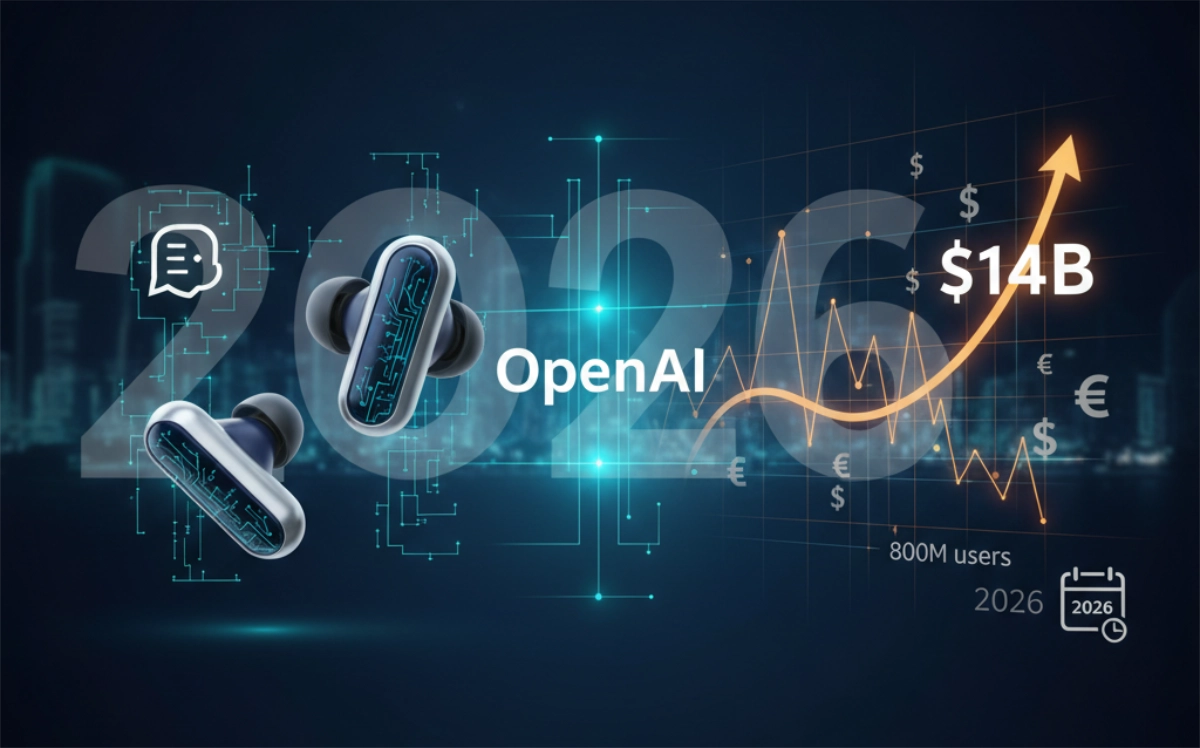
- OpenAI confirms first hardware device launch in second half of 2026, likely ChatGPT-powered earbuds codenamed “Sweetpea”
- Company faces projected $14 billion loss in 2026 despite reaching $20 billion in annual revenue
- Financial experts warn OpenAI could run out of cash by mid-2027 without additional funding rounds
- Plans for potential IPO in H2 2026 at up to $1 trillion valuation to fund $1.4 trillion infrastructure commitments
- Strategic shift includes introducing advertising to ChatGPT and expanding into consumer hardware market
Background
OpenAI in 2026 stands at a crossroads. The San Francisco-based artificial intelligence company has transformed from a research laboratory into a commercial powerhouse since launching ChatGPT in late 2022. Under CEO Sam Altman’s leadership, OpenAI has raised more than $60 billion in funding, created one of the world’s most popular AI products with nearly 800 million weekly users, and helped revive San Francisco’s tech sector following the post-pandemic slump.
In May 2025, OpenAI acquired former Apple design chief Jony Ive’s startup io for $6.5 billion, signaling ambitious hardware plans. The partnership between Altman and Ive promised to create “a family of devices that would let people use AI to create all sorts of wonderful things.” This acquisition positioned OpenAI to compete not just in software but also in the lucrative consumer electronics market dominated by Apple, Google, and Meta.
However, beneath the surface of rapid growth and technological achievement lies a stark financial reality. According to reporting from The Information, OpenAI projected in September 2025 that it would burn through $115 billion in cash between then and 2029—$80 billion more than it had forecast earlier in the year. (ℹ️ Source)
What Happened
On January 19, 2026, at an Axios-hosted panel during the World Economic Forum in Davos, Switzerland, OpenAI Chief Global Affairs Officer Chris Lehane confirmed the company is on track to announce its first hardware device in the second half of 2026. (ℹ️ Source)
While Lehane remained tight-lipped about details, recent leaks from Asian supply chain sources suggest the device will be AI-powered earbuds.
According to reports from Taiwanese and Chinese publications, the device is codenamed “Sweet Pea” and will feature a unique design compared to existing earbuds, potentially working on a custom 2-nanometer processor to handle AI tasks locally rather than relying entirely on cloud processing. (ℹ️ Source)
Manufacturing discussions reportedly involve both China-based Luxshare and Taiwan’s Foxconn, with ambitious first-year sales targets of 40 to 50 million units.
The earbuds would represent OpenAI’s first foray into consumer hardware, designed to provide users with seamless, always-on access to ChatGPT assistance through voice interaction. Previous reporting suggested the company wanted to build a screen-free and pocketable device, with Altman describing the potential product as more “peaceful and calm” than iPhones, according to TechCrunch.
This hardware announcement comes amid significant financial pressures. Multiple financial reports indicate OpenAI could face a $14 billion loss in 2026, driven primarily by infrastructure expansion, model training, research hiring, and compute costs. (ℹ️ Source)
The company’s cumulative losses before achieving profitability could reach $143 billion by 2029.
Why It Matters
OpenAI in 2026 represents a pivotal moment not just for the company, but for the entire artificial intelligence industry. The hardware push into earbuds signals a strategic shift toward controlling the full user experience—from the physical device to the AI models powering it. This vertical integration could allow OpenAI to bypass app stores and platform gatekeepers while delivering experiences tightly integrated with its language models.
According to Rob Siegel, a lecturer in management at Stanford Graduate School of Business, “At the end of the year, OpenAI is likely to still be the most important company in the generative-AI space. But there’s a lot of uncertainty about how things will play out in the near future, and there’s a risk the company could go bankrupt if investor confidence in AI wanes.” (ℹ️ Source)
The financial stakes are enormous. OpenAI has committed to spending approximately $1.4 trillion in coming years on projects including its $500 billion Stargate data center build-out. (ℹ️ Source)
These commitments dwarf the company’s current revenue, creating what financial expert Sebastian Mallaby of the Council on Foreign Relations describes as a situation where OpenAI could run out of money “over the next 18 months” unless it secures massive additional funding. (ℹ️ Source)
The company’s predicament highlights a broader challenge facing the AI industry. Unlike established tech giants like Google, Microsoft, and Meta—which can fund AI development from profitable legacy businesses—OpenAI lacks this financial cushion. As Mallaby notes, “Google and Meta already have successful businesses doing other things, but OpenAI doesn’t.” (ℹ️ Source)
For the broader technology ecosystem, OpenAI’s hardware entry could validate the AI wearables category while intensifying competition. Numerous startups are building AI-native wearables and smart audio devices. A successful OpenAI product could spark mainstream adoption, but it could also crowd out smaller competitors unable to match OpenAI’s resources and brand recognition.
The monetization challenges extend beyond hardware. With ChatGPT serving more than 800 million weekly active users as of December 2025, only approximately 5% of this massive user base subscribes to paid plans. (ℹ️ Source)
This revenue gap has forced OpenAI to explore advertising integration, which is a major departure from its original nonprofit research mission.
What’s Next
OpenAI faces several critical milestones in 2026 that will determine its trajectory. The company is reportedly laying groundwork for a U.S. IPO that could value it at up to $1 trillion, with internal targets for filing in H2 2026 and listing in 2027. This public offering would provide crucial capital to fund ongoing operations and infrastructure commitments.
On the product front, the “Sweetpea” earbuds are expected to debut in the latter part of 2026, representing OpenAI’s first major test in consumer electronics manufacturing and distribution. Success would give the company unprecedented control over how users experience AI in daily life. Failure would underscore the difficulty of hardware development—even for companies with world-class software capabilities.
The advertising integration into ChatGPT, temporarily shelved under “Code Red” internal discussions, is expected to launch in 2026. Industry analysts project this could generate billions in revenue, though it risks alienating users who value ChatGPT’s ad-free experience.
Beyond earbuds, leaks suggest OpenAI envisions a connected suite of devices that could include home assistants or AI pens, creating a cohesive ecosystem amplifying ChatGPT’s utility across different scenarios. Such expansion would solidify OpenAI’s position in the AI hardware arena while challenging incumbents to innovate faster.
The company also continues expanding its San Francisco footprint. OpenAI is in talks to sublease up to 250,000 square feet at 1800 Owens Street in Mission Bay, which would push its local presence to roughly 1 million square feet (San Francisco Chronicle).
Deep Details
The Hardware Gambit
The decision to enter hardware represents a calculated risk for OpenAI in 2026. AI-powered earbuds offer several strategic advantages: they’re already widely adopted, relatively affordable compared to smartphones, and naturally suited to voice-based interaction—where OpenAI’s models excel. By embedding AI directly into wearables, OpenAI could enable real-time translation, contextual assistance, proactive reminders, and hands-free interaction throughout the day.
However, previous attempts at AI wearable devices have struggled. The Humane AI Pin was sold to HP after failing to gain traction, while Rabbit continues with modest success following initial 2024 hype. Meta’s Ray-Ban smart glasses represent one of the few success stories, with the company unable to keep up with demand as of January 2026.
OpenAI’s advantage lies in its established user base and superior language models. ChatGPT’s brand recognition could drive adoption where lesser-known startups failed. The partnership with Jony Ive—who designed iconic products from the iMac to the iPhone—brings world-class industrial design expertise that could differentiate OpenAI’s hardware in a crowded market.
The Financial Tightrope
The numbers present a stark reality. According to leaked Microsoft data, in the first half of 2025, OpenAI’s inference costs actually exceeded its revenue—meaning the more users use ChatGPT, the faster the company loses money. (ℹ️ Source)
This inverse economics creates a paradoxical situation where success accelerates financial challenges.
The company’s compute power demands have skyrocketed from 200 megawatts in 2023 to 1.9 gigawatts in 2025, with plans to reach 30 gigawatts in coming years. These infrastructure investments, while necessary for maintaining competitive AI capabilities, carry astronomical costs that far outpace revenue growth.
Ram Bala, an associate professor of AI and analytics at Santa Clara University’s Leavey School of Business, suggests that financial constraints might actually benefit OpenAI: “Startups often are more innovative when they are operating under financial constraints. OpenAI was arguably more innovative when it had far less money at its disposal.” (ℹ️ Source)
The Competition Intensifies
OpenAI faces mounting competitive pressure from multiple directions. Google’s Gemini AI has reportedly outpaced ChatGPT in certain industry benchmarks, prompting Altman to declare “Code Red” internally. Google generates over $200 billion annually from advertising and possesses decades of infrastructure for monetizing AI products.
Meta continues offering massive compensation packages—some reportedly topping $100 million—to lure top AI talent from OpenAI. Meanwhile, smaller competitors are catching up technologically while operating with leaner cost structures.
The strategic response involves diversification. Beyond earbuds, OpenAI is developing custom chips with Broadcom, exploring e-commerce partnerships with Etsy and Walmart, expanding enterprise consulting services, and investigating various monetization models from advertising to affiliate commissions.
Sources
- TechCrunch—Published January 21, 2026
- Original article: https://techcrunch.com/2026/01/21/openai-aims-to-ship-its-first-device-in-2026-and-it-could-be-earbuds/
- San Francisco Examiner – Published January 2026
- Original article: https://www.sfexaminer.com/news/technology/why-openai-faces-massively-critical-year-ahead-in-2026/article_6112d59f-28b5-4770-bde1-b333deb5f01a.html
- Yahoo Finance—Published January 20, 2026
- Original article: https://finance.yahoo.com/news/financial-experts-warn-openai-may-113057515.html
- Futurism—Published January 14, 2026
- Original article: https://futurism.com/artificial-intelligence/financial-expert-openai-running-out-of-money
- 36 Kr – Published January 2026
- Original article: https://eu.36kr.com/en/p/3624813808157699
- San Francisco Chronicle—Published January 8, 2026
- Original article: https://www.sfchronicle.com/tech/article/openai-mission-bay-office-21284023.php
About the Authors
This article was researched and written by the howAIdo.com News Team, specialists in delivering timely, fact-based coverage of the artificial intelligence industry. Our mission is to make AI developments accessible and understandable for everyone, from tech enthusiasts to business professionals navigating the rapidly evolving AI landscape.