
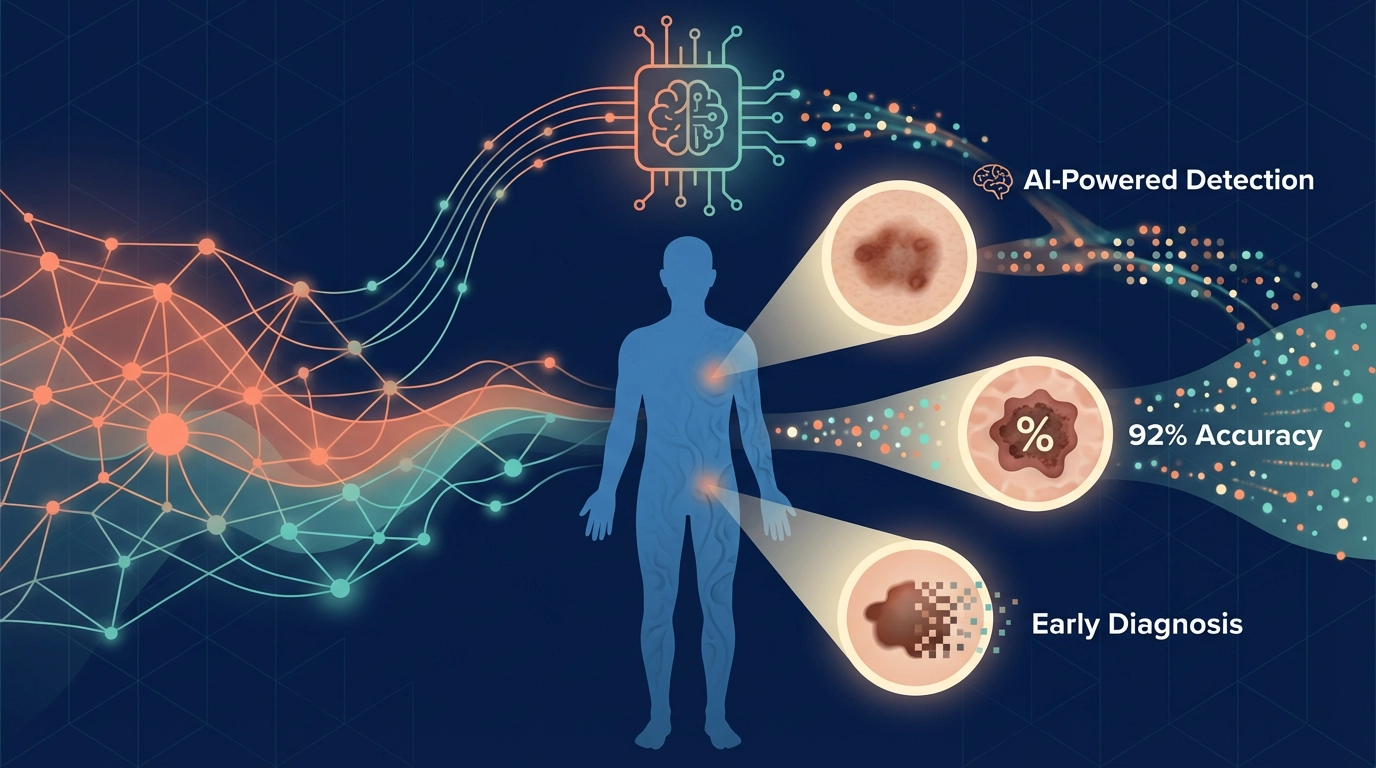
AI Detects Skin Cancer Early: 92% Accuracy Achieved
Spotting skin cancer sooner with the help of artificial intelligence just became more than a possibility—it’s now a proven reality. Imagine catching melanoma before it spreads, using technology that sees what the human eye might miss. That’s exactly what researchers at the University of Missouri have achieved, and the results are genuinely exciting.
Background
Melanoma remains the deadliest form of skin cancer, and early detection is literally a matter of life and death. The challenge? Access to dermatologists is limited in many areas, and visual diagnosis requires years of specialized training. Traditional screening methods rely heavily on expert interpretation, which creates bottlenecks in healthcare delivery.
This is where artificial intelligence steps in as a creative solution. AI doesn’t get tired, doesn’t need appointments, and can analyze thousands of images with consistent precision. The University of Missouri team, led by Kamlendra Singh from the College of Veterinary Medicine, saw an opportunity to democratize skin cancer screening through smart technology (ℹ️ EurekAlert!).
What Happened
The research team trained multiple AI models using an impressive dataset of 400,000 images captured through 3D total body photography. This advanced imaging technique creates high-resolution, three-dimensional digital maps of patients’ skin, allowing the system to analyze subtle details across the entire body.
Here’s where it gets interesting: individually, each AI model achieved up to 88% accuracy in distinguishing melanoma from benign skin conditions. But Singh had a creative insight—what if we combined these models? When the team merged three different AI approaches, the accuracy jumped dramatically to over 92% (ℹ️ EurekAlert!).
The AI evaluates multiple visual patterns, including size, shape, color, density, and sharpness of suspicious spots. It’s like giving the technology multiple “eyes” to cross-check its findings, significantly reducing the chance of missing something important.
Why It Matters
This breakthrough addresses a critical healthcare gap. Early detection of melanoma dramatically improves treatment outcomes, but not everyone can quickly access specialized dermatologists. Singh explains, “The goal is not for AI to replace doctors and other experts, but AI can help patients with limited access to dermatologists.”
Think about rural communities, underserved areas, or anyone facing long wait times for specialist appointments. This decision-support tool could flag suspicious lesions that need urgent attention, essentially creating a first line of defense. It’s not about replacing medical expertise—it’s about extending its reach.
The research, published in the journal Biosensors and Bioelectronics: X, represents a significant step toward integrating AI into practical healthcare settings. As datasets expand to include diverse skin tones, lighting conditions, and camera angles, the system’s accuracy will continue improving.
What’s Next
Singh emphasizes transparency as the key to wider adoption: “As researchers, if we can get better at explaining why and how AI comes to the conclusions it makes, more healthcare professionals will trust that it can be a helpful tool.”
The technology isn’t ready for immediate clinical deployment, but the proof of concept is solid. Future developments will focus on:
- Training models on more diverse datasets representing all skin types
- Improving the AI’s ability to explain its diagnostic reasoning
- Integrating the system into existing dermatology workflows
- Expanding accessibility for remote and underserved communities
The Creative Opportunity
What excites me most about this development is its potential to transform preventive care. Imagine a future where your smartphone camera, paired with AI, could perform preliminary skin checks during your morning routine. Not as a replacement for professional care, but as an early warning system that prompts you to seek expert evaluation when needed.
This research proves that spotting skin cancer sooner through AI isn’t science fiction—it’s an emerging medical reality. The 92% accuracy rate demonstrates that technology can match human expertise in specific diagnostic tasks, especially when designed as a collaborative tool rather than a replacement.
For anyone interested in the intersection of technology and healthcare, this study shows how creative thinking—like combining multiple AI models—can yield breakthrough results. It’s a reminder that innovation often comes from asking “what if we tried it differently?”
References
- University of Missouri. (2026). “Performance of transformer-convolutional neural network ensemble for melanoma diagnosis on segmented 3D total body photography data.” Biosensors and Bioelectronics: X. DOI: 10.1016/j.biosx.2025.100714
About the Authors
Alex Rivera is a creative technologist and AI content strategist at howAIdo.com, where he makes artificial intelligence accessible and inspiring for everyday users. With a passion for demystifying complex technology, Alex specializes in helping non-technical audiences discover creative ways to use AI tools in their daily lives. When not exploring the latest AI innovations, he enjoys experimenting with generative art and teaching workshops on AI creativity.