
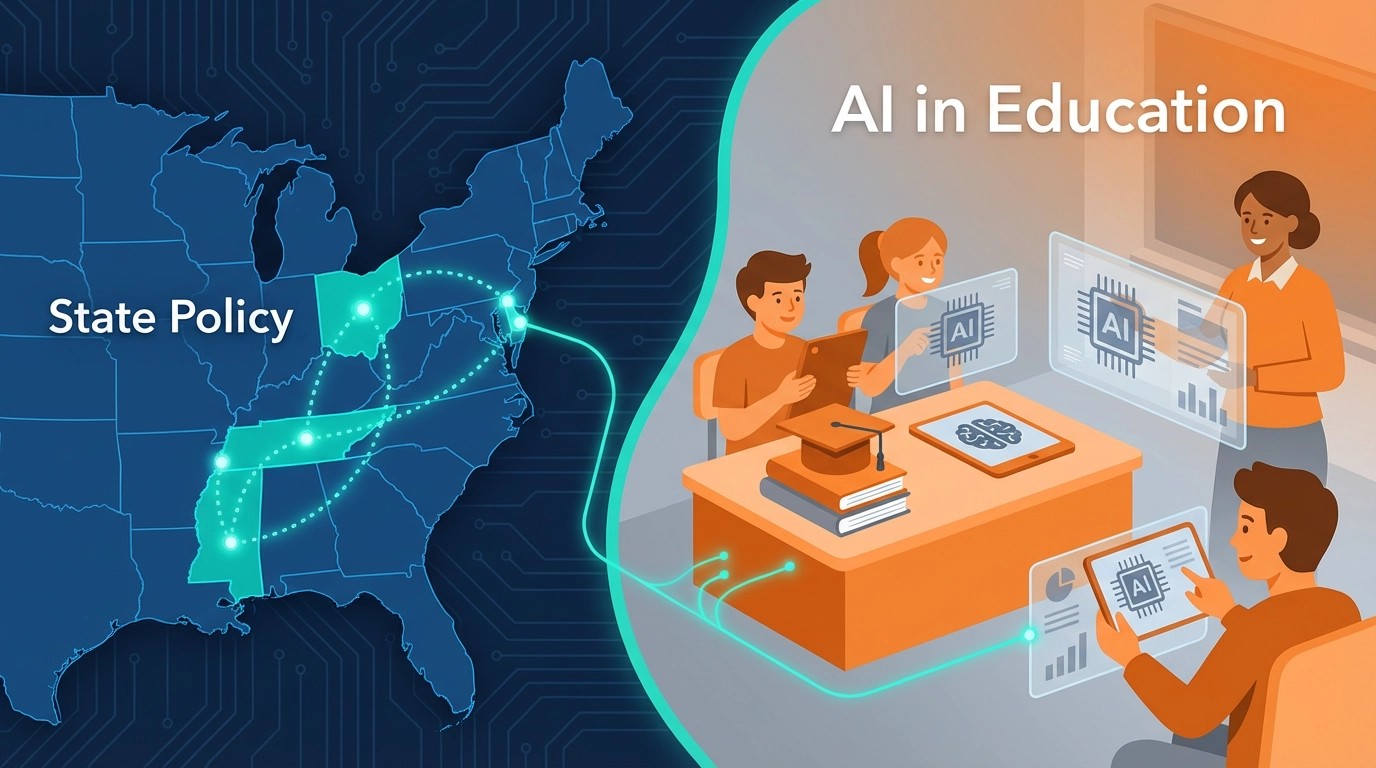
States Shape AI Education Policy Through Guidance
Key Points
- Artificial intelligence in education policy is evolving, with most states issuing guidance documents rather than passing binding legislation
- Ohio and Tennessee enacted laws requiring school districts to develop their own AI policies by 2026
- More than half of state Departments of Education have published AI guidance addressing privacy, bias, and academic integrity
- Future policy focus areas include teacher training and using AI as a literacy tool
- The rapid pace of AI development continues to challenge lawmakers creating education regulations
Background
Since ChatGPT’s public release in late 2022, the conversation around artificial intelligence in classrooms has moved from “Should we use this?” to “How do we use this responsibly?” As a student who’s watched AI tools transform how my peers and I approach learning, I’ve seen firsthand how quickly this technology is reshaping education. States are now racing to catch up with policy frameworks that balance innovation with student safety.
According to MultiState policy analysts, they have identified AI in education as one of the dominant issues in 2025 state legislatures. The challenge? Creating regulations for technology that evolves faster than legislative sessions can keep pace.
What Happened
Rather than rushing to pass restrictive laws, most states have taken a guidance-first approach. More than half of the country’s state Departments of Education issued AI guidance documents in 2025, providing frameworks without legal mandates (ℹ️ MultiState).
Delaware and Mississippi both published comprehensive guidance documents that define AI, outline benefits and concerns, and provide integration guidelines for classrooms. These documents typically address key concerns like privacy, algorithmic bias, and academic integrity while acknowledging AI’s potential for personalized learning and administrative efficiency.
Only two states went further with actual legislation. Ohio passed HB 96 and Tennessee enacted SB 1711, both requiring school districts to develop their own AI policies rather than imposing statewide mandates. Ohio’s law requires all traditional public school districts, community schools, and STEM schools to adopt formal AI policies by July 1, 2026 (ℹ️ Ohio Department of Education).
Why It Matters
This matters to me as a student because it affects how I’ll be allowed to use AI tools that genuinely help me study smarter. The district-level approach gives schools flexibility to adapt policies based on their unique needs and resources, rather than one-size-fits-all state mandates.
The guidance-over-legislation trend reflects practical wisdom. As the Education Commission of the States reported, when ChatGPT debuted in 2022, zero states had generative AI policies. By April 2025, at least 28 states had published guidance. This rapid evolution shows why flexible frameworks work better than rigid laws that become outdated quickly.
For teachers, this means support through guidance documents that address real classroom concerns: How do we prevent plagiarism while encouraging legitimate AI-assisted learning? How do we protect student data? These aren’t hypothetical questions—they’re daily challenges educators face.
What’s Next
Looking ahead to 2026, more states are expected to introduce AI education legislation focusing on teacher training and professional development. Understanding how to effectively integrate AI into lesson plans requires intentional preparation, not just technology access.
Another emerging focus is using AI as a literacy tool. Just as we learned to evaluate website credibility in the internet age, students now need to understand how AI works, its limitations, and how to use it responsibly. Some states are already developing AI literacy frameworks aligned with existing computer science standards.
The rapid pace of AI advancement will continue challenging lawmakers. What seems cutting-edge today might be standard tomorrow, making flexible guidance documents potentially more effective than rigid legislation.
For students like me, this means our educational experience with AI will likely vary significantly by state and district. Those differences will shape how prepared we are for workplaces where AI literacy is increasingly essential.
Deep Details
The two-pronged approach of guidance plus district-level legislation represents a practical middle ground. States like Colorado have released comprehensive roadmaps for AI integration while allowing local control. Washington created an AI advisory board including educators, tech workers, and students—recognizing that effective policy requires input from all stakeholders (ℹ️ GovTech).
The conversation around AI in education extends beyond technical implementation. It touches on fundamental questions about academic integrity, the future of assessment, and how we prepare students for an AI-integrated workforce. States issuing guidance documents address these philosophical questions alongside practical implementation details.
Source: MultiState—Published on January 21, 2026
Original article: https://www.multistate.us/insider/2026/1/21/how-states-are-tackling-artificial-intelligence-in-education-policy
About the Author
Rihab Ahmed is an educator and student who uses AI to study smarter. She writes step-by-step guides designed for students and lifelong learners with little technical experience, making AI tools accessible and understandable for everyone pursuing educational goals.