
Why Enterprise AI Scale Stalls and How to Fix It
Key Points
- 96% of organizations deploying generative AI report higher-than-expected costs, with 71% having little control over spending sources
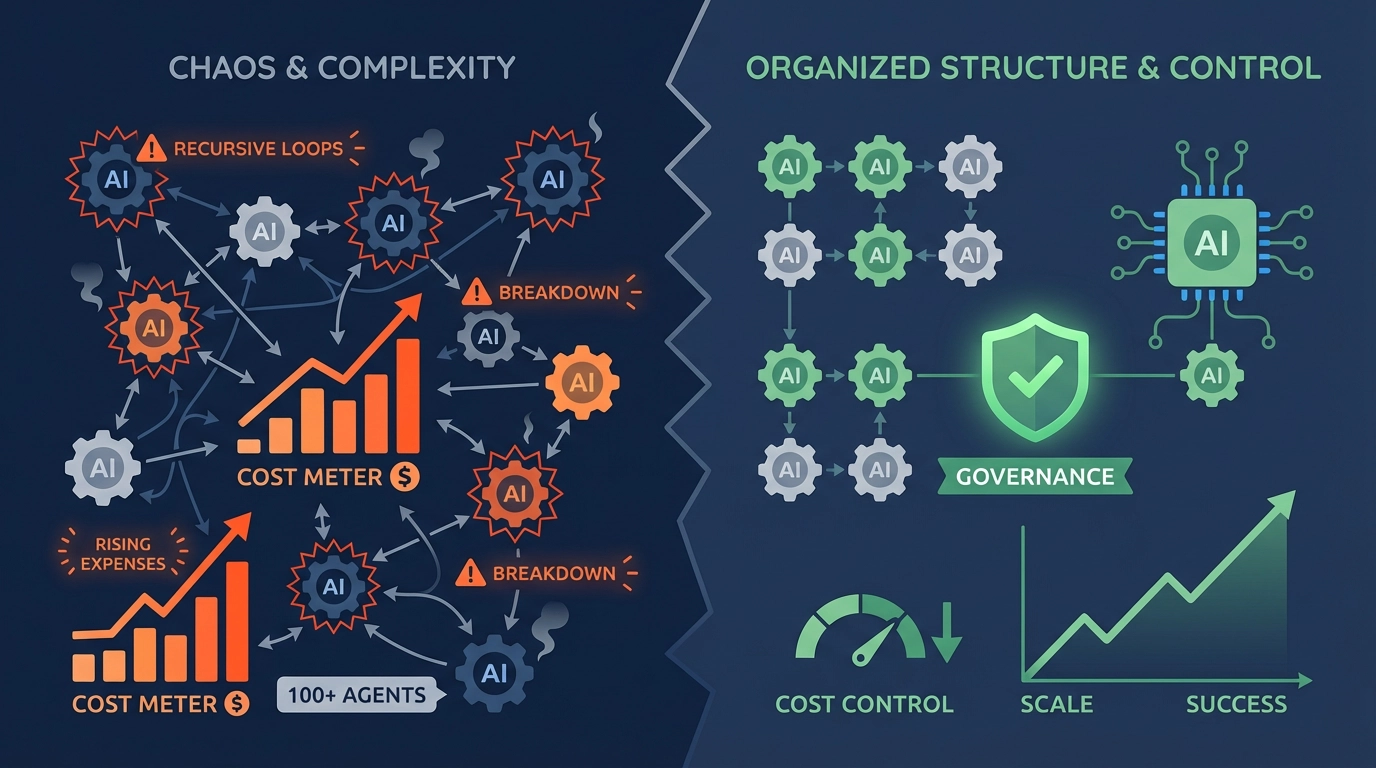
- The challenge isn’t building a single AI agent—it’s managing quality and value across 100+ agents at enterprise scale
- Three operational gaps drive costs: recursive loops consuming thousands in tokens overnight, integration complexity, and hallucination remediation
- Production failures compound exponentially, creating a “production wall” that stalls AI initiatives before they deliver business value
- Solutions require AI-first governance, flexible deployment, and unified platforms designed for managing an agentic workforce from day one
Background
Enterprises have embraced agentic AI as a transformative technology, but early enthusiasm has collided with harsh operational realities. Building a single AI agent is straightforward—many companies have successfully deployed pilots. However, the real challenge emerges when organizations attempt to scale from 10 agents to 100 or more.
This scaling challenge represents a fundamental shift in how companies must approach AI. What worked for experimental pilots falls apart when managing a fleet of agents that must operate reliably, cost-effectively, and safely across the enterprise.
What Happened
DataRobot published research highlighting critical gaps in how enterprises scale agentic AI. The findings, based on IDC research, reveal that why enterprise AI scale stalls and how to fix it have become the defining questions for organizations attempting to move beyond pilot projects.
The research identifies three specific operational gaps driving unexpected costs. First, recursive loops occur when agents enter infinite reasoning cycles without proper monitoring, consuming thousands of dollars in tokens overnight. Second, the integration tax forces 48% of IT and development teams into maintenance work rather than innovation as they manage complex vendor ecosystems. Third, hallucination remediation becomes a major unplanned expense when companies add guardrails to live systems.
Beyond cost overruns, companies face a “production wall” where technical debt and operational friction halt progress. Production reliability becomes critical in high-stakes industries—a manufacturing firm’s agent failure can stop production lines, while deployment constraints prevent companies from meeting sovereign AI compliance requirements. Infrastructure complexity overwhelms teams with constant validation needs, and inefficient operations drive up compute costs while failing to meet latency requirements.
Governance represents the single biggest obstacle to expansion. For 68% of organizations, clarifying risk and compliance implications is the top requirement for agent use (ℹ️ DataRobot).
Why It Matters
The competitive gap is widening between organizations that treat AI as isolated experiments and those building mission-critical digital agent workforces. Companies hitting the 100-agent benchmark reveal a permanent divide in the market.
Early movers are pulling ahead by focusing on production from day one rather than retrofitting governance after deployment. This approach requires AI-first governance that enforces policy, cost, and risk controls at the agent runtime level. Without this foundation, the financial drain compounds exponentially—what seems manageable at 10 agents becomes an enterprise-wide crisis at 100.
The stakes extend beyond immediate costs. Organizations locked into specific cloud environments face deployment constraints that prevent compliance with emerging sovereign AI requirements. Teams spending half their time on “infrastructure plumbing” cannot focus on developing core business requirements that drive value.
What’s Next
Organizations addressing these challenges are adopting unified platform approaches rather than fragmented point tools. DataRobot’s Agent Workforce Platform exemplifies this approach with four foundational capabilities: flexible deployment across public cloud, private GPU cloud, on-premises, or air-gapped environments; vendor-neutral architecture that allows component swapping as technology evolves; full lifecycle management using specialized tools like syftr for accuracy and Covalent for runtime orchestration; and built-in AI-first governance focused on agent-specific risks.
The research emphasizes that success requires treating the digital agent workforce as a system rather than a collection of experiments. Companies investing in governance, unified tooling, and cost visibility from day one are already demonstrating measurable business impact at scale.
DataRobot encourages organizations to download the full IDC InfoBrief to understand why most AI pilots fail and how early movers are driving real ROI (ℹ️ DataRobot).
Source: DataRobot—Published on December 24, 2025
Original article: https://www.datarobot.com/blog/enterprise-ai-scaling-challenges/
About the Author
Abir Benali, a friendly technology writer who explains AI tools to non-technical users, wrote this article. Abir specializes in making complex AI concepts clear and actionable for everyday readers.