
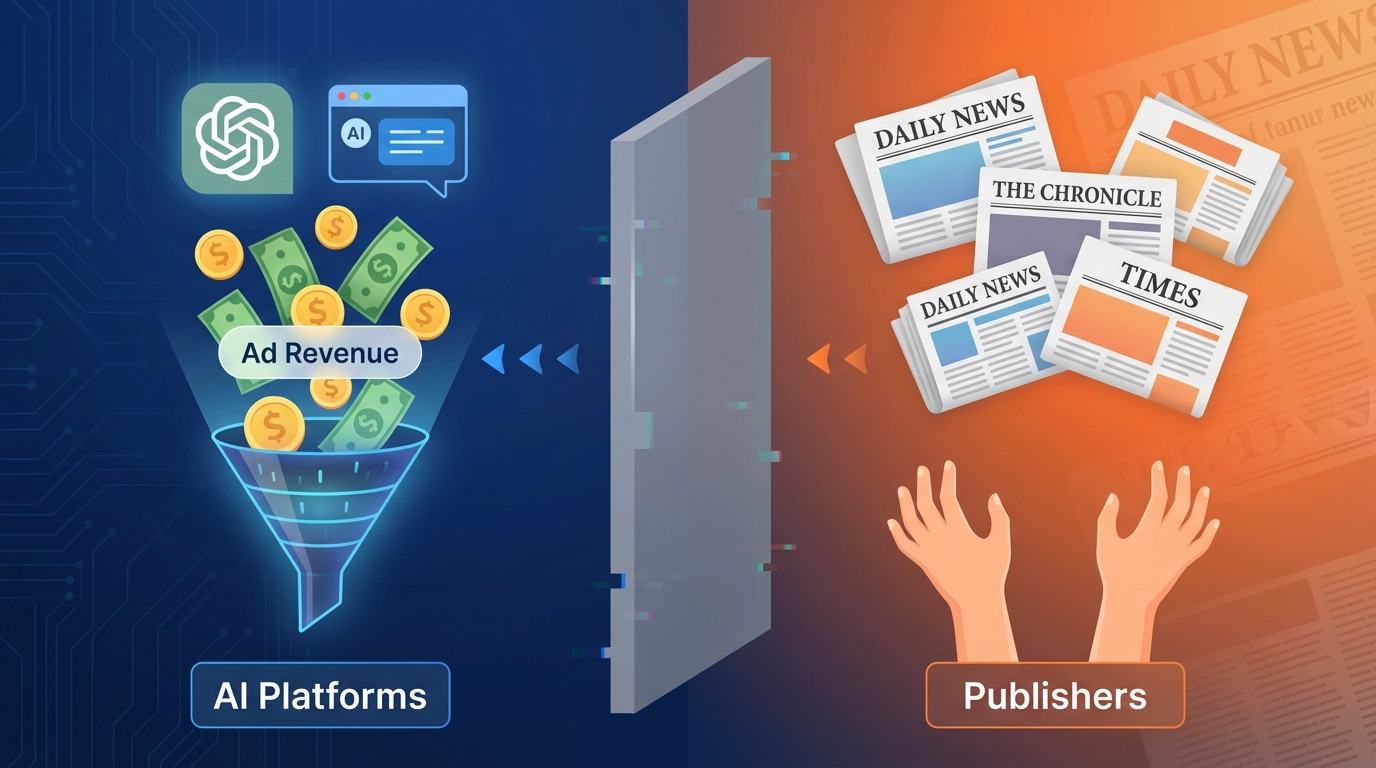
ChatGPT Ads Launch: Publishers Get No Revenue Share
Key Points
- Ads are coming to ChatGPT for free and $8/month “Go” tier users starting in late January 2026
- OpenAI has licensing deals with major publishers like The Atlantic, Vox, and Financial Times
- Publishers won’t receive any share of ChatGPT’s advertising revenue despite content usage
- OpenAI projects generating $1 billion from ads in 2026, scaling to $25 billion by 2029
- The move highlights growing tension between AI companies and news organizations over fair compensation
Background
OpenAI has been rapidly signing licensing agreements with news publishers over the past year. Major outlets including The Atlantic, Vox Media, Financial Times, News Corp, and Axios have struck deals reportedly worth millions of dollars. These agreements allow OpenAI to use publisher content for training AI models and displaying excerpts in ChatGPT responses with attribution.
Meanwhile, OpenAI’s costs have skyrocketed. The company posted over $13.5 billion in losses in the first half of 2025 alone, according to European Business Magazine. With 800 million weekly users but only a 3% paid subscription rate, advertising became an economic necessity.
What Happened
On January 16, 2026, (ℹ️ OpenAI announced) it will begin testing advertisements in ChatGPT. Ads will appear at the bottom of responses for adult users on free and Go ($8/month) tiers in the United States. Premium subscribers on Plus ($20/month), Pro ($200/month), and Enterprise plans won’t see ads.
The company stated ads will be “clearly labeled” as sponsored content and won’t influence ChatGPT’s answers. OpenAI promised never to sell user conversation data to advertisers and will exclude ads from sensitive topics like health, mental health, and politics.
Crucially, the announcement made no mention of sharing this new revenue stream with news publishers whose content appears in ChatGPT responses.
Why It Matters
This creates a concerning dynamic for journalism. Publishers signed licensing deals expecting one-time or recurring payments for content usage. Now OpenAI will generate substantial advertising revenue partly built on the back of that same content—without compensating publishers further.
According to Search Engine Journal, when AI systems answer questions directly, users rarely click through to original sources. Zero-click searches increased from 56% to 69% between 2024 and 2025, meaning publishers lose both traffic and traditional ad revenue.
Now they also miss out on AI-generated ad revenue. As Nieman Lab noted in a recent prediction, “publishers will see no meaningful licensing revenue in 2026.”
What’s Next
OpenAI’s ad testing begins in “the coming weeks,” per their announcement. Initial reports from Sherwood News suggest the company is seeking less than $1 million from early advertisers during beta testing, with a full launch expected by February 2026.
Publishers face difficult choices. Some may renegotiate licensing terms to include ad revenue sharing. Others might block OpenAI’s crawlers entirely, risking visibility loss. A few publishers, like Perplexity’s partners, have already experimented with revenue-sharing models where they receive a percentage when their content appears in AI results.
The broader question remains: As AI companies build billion-dollar advertising businesses on journalism’s foundation, will publishers ever see fair compensation?
Source: Multiple sources including Nieman Lab, CNBC, European Business Magazine — Published between January 16-21, 2026
Original articles: Nieman Lab, CNBC
About the Author
Abir Benali is a friendly technology writer who explains AI tools to non-technical users. Abir specializes in making complex AI developments accessible through clear, concise explanations that help readers understand how technology impacts their daily lives.
Read more articles by Abir Benali