
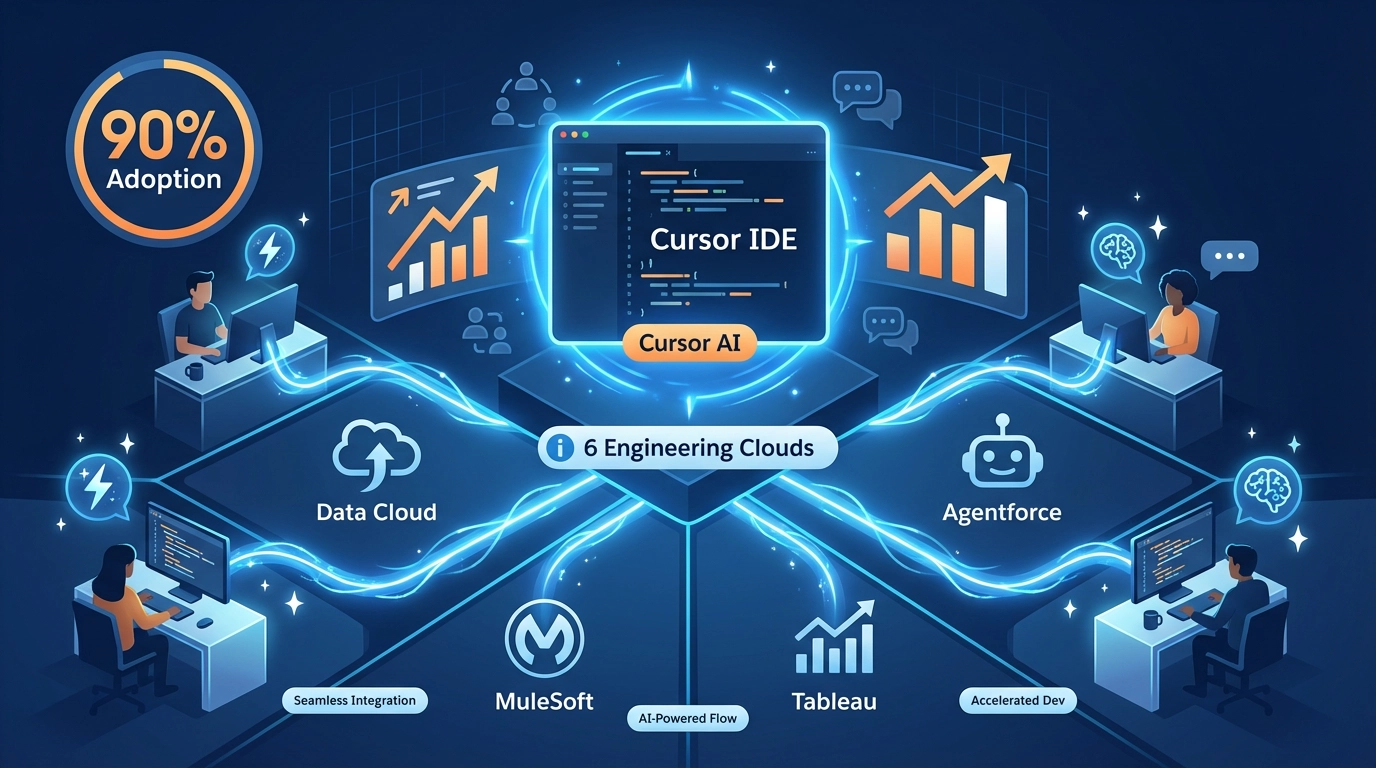
90% of Salesforce Engineers Use Cursor Daily
Key Points
- Salesforce achieved over 90% AI tool adoption across six major engineering clouds in just three weeks
- Cursor usage grew 300% within weeks after implementing company-wide AI productivity baseline
- Over 18,000 queries handled by Agentforce Slack agents, reducing repetitive tasks
- Engineers report significant gains in development velocity, testing throughput, and code quality
- More than 475 engineers upgraded to higher AI token tiers due to intensive usage
Background
Artificial intelligence coding assistants have rapidly transformed software development, with major tech companies racing to integrate these tools into their workflows. Cursor, an AI-first code editor built on Visual Studio Code, has emerged as a leading solution for enterprise engineering teams seeking to boost productivity and streamline development processes.
At Salesforce, a company with thousands of engineers across multiple product clouds, the challenge wasn’t just adopting AI tools—it was operationalizing them at scale to deliver measurable productivity gains without compromising code quality or security.
What Happened
In a groundbreaking company-wide initiative, Salesforce Engineering achieved over 90% adoption of AI coding tools across all six major engineering clouds—Data Cloud, Platform, Agentforce, MuleSoft, Tableau, and Heroku—in just three weeks, according to the Salesforce Engineering Blog.
The transformation began when Salesforce Engineering introduced a formal AI productivity baseline, designating Cursor and their internal CodeGenie tool as default coding agents. Rather than treating AI as optional, teams were directed to integrate these tools into daily workflows as essential productivity multipliers.
The results exceeded expectations. Cursor usage surged 300% within weeks, with consistent daily engagement tracked through prompt volumes and code acceptance rates. More than 475 engineers exceeded their default token limits and were upgraded to higher usage tiers—a clear signal that these tools had become indispensable to their work.
Why It Matters
This isn’t just another corporate tech adoption story. Salesforce’s achievement demonstrates that AI coding assistants can be successfully deployed at enterprise scale when approached systematically. For engineering leaders wondering whether AI tools deliver real productivity gains or just hype, Salesforce’s data-driven approach provides a compelling answer.
The productivity gains are substantial and measurable. Engineers are using Cursor to generate boilerplate code, auto-generate test templates for Q4 readiness, rewrite legacy dashboards during migrations, and create Selenium scripts from specification files. Meanwhile, Agentforce-based Slack bots handled over 18,000 queries, breaking down knowledge silos and reducing the time engineers spend answering repetitive questions.
What makes the case particularly significant is that adoption wasn’t mandated from above—it was driven by peer behavior and engineering curiosity. Junior developers who experimented early became internal enablers, sharing prompt strategies and debugging workflows. The tools gained traction because they genuinely improved efficiency, not because management demanded it.
For developers concerned about AI replacing jobs, Salesforce’s approach shows a different reality: AI tools are freeing engineers to focus on higher-order architecture and complex problem-solving while automating routine tasks. Cursor handles the boilerplate; humans handle the strategy.
What’s Next
Salesforce Engineering is now entering the next phase: formalizing reusable AI development playbooks. These include prompt templates for performance testing and CI/CD scripts, migration blueprints for internal tooling shifts, and policy guides for secure AI integration.
The company is also expanding its internal AI Productivity Thoughtluck demo series, where engineers showcase specific use cases and share prompt patterns across teams. The first session attracted over 400 engineers and generated numerous follow-up discussions that led to teams reusing shared solutions.
As other enterprises watch Salesforce’s success, the question shifts from “Should we adopt AI tools?” to “How do we operationalize them effectively?” With Cursor reported to be considering investment at a $30 billion valuation (ℹ️ Fortune), and major companies like Coinbase and NVIDIA reporting similar adoption patterns, the AI-assisted development revolution is clearly accelerating.
The key takeaway for engineering teams: AI coding assistants aren’t experimental anymore—they’re becoming infrastructure. Organizations that treat them as optional risk falling behind competitors who are already shipping codes faster, testing more thoroughly, and solving problems more efficiently.
Deep Details
Salesforce’s success came from treating AI adoption as an engineering problem requiring instrumentation and measurement. They expanded their Engineering 360 dashboard to track token usage volume per user, tool-specific activity like Cursor prompts and code acceptances, and adoption heatmaps showing which teams were actively using AI tools versus struggling.
This data-driven approach revealed patterns that informed training efforts. When certain clouds showed lower adoption, leadership could provide targeted support rather than generic mandates.
The company also integrated multiple AI tools strategically: Cursor for code editing and test generation, Gemini for infrastructure scaffolding and documentation, GitHub Copilot for additional coding assistance, and Agentforce agents for knowledge management on Slack. Each tool served specific workflow needs rather than competing for the same use cases.
Source: Salesforce Engineering Blog—Published on June 23, 2025
Original article: https://engineering.salesforce.com/how-salesforce-engineering-operationalized-ai-productivity-at-scale/
About the Author
This article was written by James Carter, a productivity coach who helps people use AI to save time and boost efficiency. James specializes in translating complex AI developments into actionable insights for professionals looking to work smarter, not harder.