
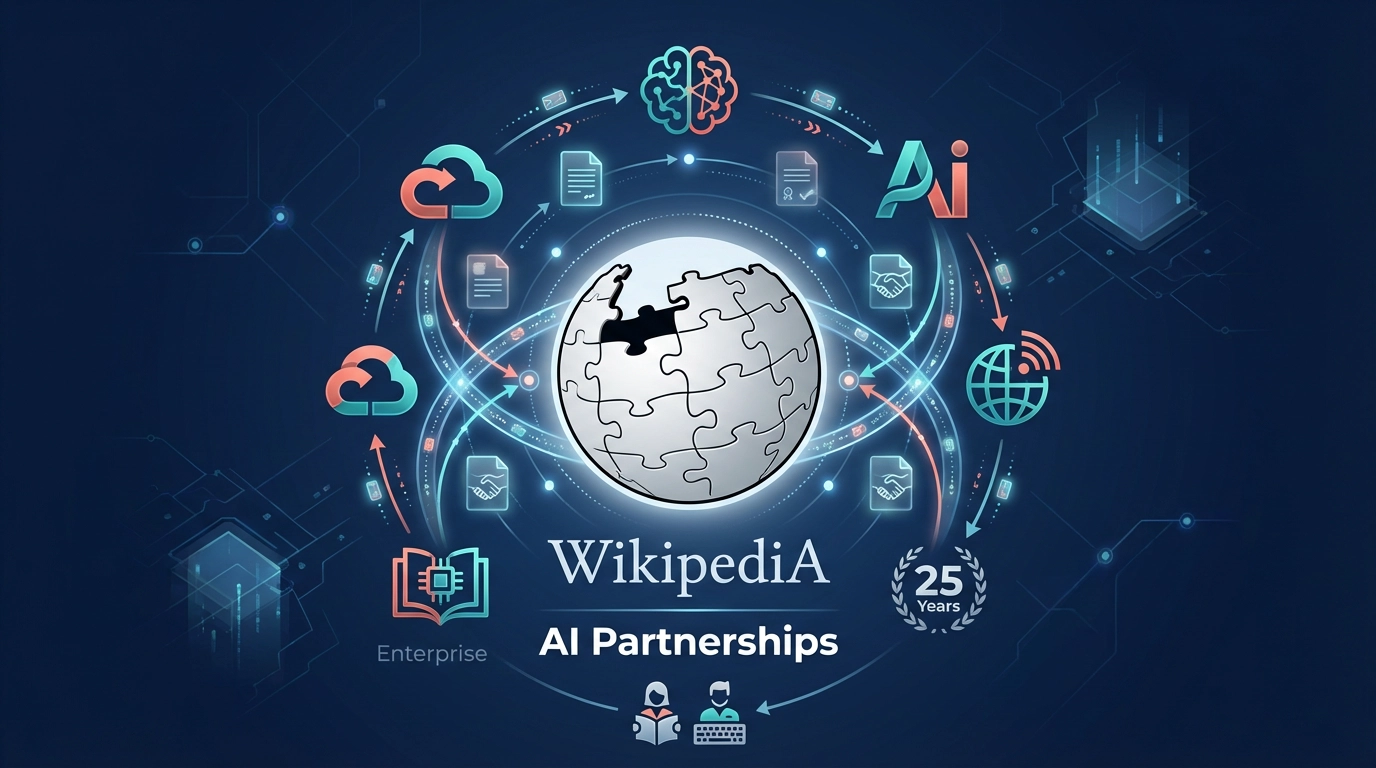
Wikipedia Formalizes Paid AI Partnerships with Tech Giants
Key Points:
- The Wikimedia Foundation announced formal partnerships with Amazon, Meta, Microsoft, Mistral AI, and Perplexity on Wikipedia’s 25th anniversary
- Companies gain structured access to Wikipedia’s 65 million articles through Wikimedia Enterprise, a commercial API product
- The agreements address concerns about AI companies scraping Wikipedia content without contributing to infrastructure costs
- Wikipedia traffic declined 8% year-over-year as AI-generated summaries reduce direct site visits
- Partnership revenues complement Wikipedia’s primary funding source of individual donations, exceeding $150 million annually
Background
For 25 years, Wikipedia has operated as a nonprofit encyclopedia maintained by approximately 250,000 volunteer editors who create and fact-check content across more than 300 languages. The platform receives nearly 15 billion page views monthly, making it one of the world’s ten most-visited websites and the only nonprofit in that category.
As artificial intelligence systems increasingly rely on high-quality training data, tech companies have scraped Wikipedia content at volumes that strain the nonprofit’s server infrastructure. This created an unsustainable situation where commercial entities extracted value from volunteer-created knowledge without supporting the platform’s operational costs (ℹ️ Reuters).
What Happened
On January 15, 2026, the Wikimedia Foundation publicly announced enterprise partnerships with Amazon, Meta, Microsoft, Mistral AI, and Perplexity. These companies join previously disclosed partners including Google (announced in 2022), Ecosia, Nomic, Pleias, ProRata, and Reef Media.
The agreements operate through Wikimedia Enterprise, a commercial product developed by the Wikimedia Foundation that provides API access to Wikipedia and other Wikimedia project data. According to the official announcement, Enterprise offers three access methods: an On-demand API for specific article requests, a Snapshot API providing hourly updated downloadable files for each language, and a real-time API that streams content updates as they occur (ℹ️ Wikimedia Enterprise).
Lane Becker, president of Wikimedia Enterprise, explained the motivation behind formalizing these relationships: “Wikipedia is a critical component of these tech companies’ work that they need to figure out how to support financially. It took us a little while to understand the right set of features and functionality to offer if we’re going to move these companies from our free platform to a commercial platform.” (ℹ️ Reuters)
Why It Matters
These partnerships represent a fundamental shift in how AI companies access training data, moving from unregulated scraping to formalized commercial agreements. This matters for three critical reasons related to digital sustainability and ethical AI development.
First, the agreements establish financial support for the infrastructure that AI companies depend on. Wikipedia founder Jimmy Wales emphasized this point: “They’re not donating to subsidize these huge AI companies. They’re saying, ‘You know what? You can’t just smash our website. You have to sort of come in the right way'” (ℹ️ WinBuzzer)
Second, the partnerships come as Wikipedia faces declining visibility due to AI-generated search summaries. Traffic data from October 2025 showed an 8% year-over-year decline in human page views, with nearly 60% of Google searches resulting in AI summaries that reduce the need to visit Wikipedia directly (ℹ️ WinBuzzer).
Third, Selena Deckelmann, CPO/CTO of the Wikimedia Foundation, framed the partnerships within broader concerns about AI and human knowledge: “Wikipedia shows that knowledge is human, and knowledge needs humans. Especially now, in the age of AI, we need the human-powered knowledge of Wikipedia more than ever.” (ℹ️ TechCrunch)
Microsoft Corporate Vice President Tim Frank added, “Access to high-quality, trustworthy information is at the heart of how we think about the future of AI at Microsoft. Together, we’re helping create a sustainable content ecosystem for the AI internet, where contributors are valued.” (ℹ️ Reuters).
What’s Next
The Wikimedia Foundation has not disclosed specific financial terms of the partnerships but indicated that annual revenues from AI agreements could reach tens of millions of dollars. This revenue stream will complement, not replace, the foundation’s primary funding from approximately 8 million individual donors who contributed over $150 million in the previous year.
The foundation also appointed Bernadette Meehan, former U.S. Ambassador to Chile, as its new chief executive, effective January 20, 2026, signaling strategic leadership for navigating the AI era. (ℹ️ Reuters)
As regulatory scrutiny on AI training data intensifies globally, these formalized agreements may establish industry standards for ethical data licensing. The partnerships demonstrate how nonprofit knowledge platforms can balance open access principles with financial sustainability in an AI-driven ecosystem.
Source: Multiple verified sources—Published on January 15-16, 2026
Original announcements: Wikimedia Enterprise Official Blog, TechCrunch, Reuters
About the Author
Nadia Chen is an expert in AI ethics and digital safety who helps non-technical users navigate artificial intelligence responsibly. With a focus on privacy protection, transparency, and ethical AI practices, Nadia creates accessible content that empowers readers to use AI tools safely while understanding their broader implications for society and digital rights. Learn more at Nadia Chen’s author page.