
Critical Ways AI-Driven Cyber Threats Will Escalate in 2026
The escalating sophistication of AI cyber threats in 2026 demands immediate attention from every organization. As someone who has dedicated years to AI ethics and digital safety, I need to share an uncomfortable truth: the threat landscape we’re entering is fundamentally different from anything we’ve faced before. Artificial intelligence has transformed from a defensive tool into an unprecedented weapon in the hands of cybercriminals, and the damage potential has grown exponentially.
Recent analysis from cybersecurity experts reveals that AI-powered attacks are not just more frequent—they’re more devastating, more personalized, and nearly impossible to detect using traditional security measures. This isn’t fearmongering; it’s a necessary wake-up call based on verified threat intelligence and real-world incidents already unfolding.
Background: The Perfect Storm of AI and Cybercrime
The convergence of accessible AI tools and sophisticated criminal networks has created what security researchers call a “threat multiplier effect.” While AI has democratized many positive capabilities, it has simultaneously armed malicious actors with tools that can automate, personalize, and scale attacks at unprecedented speeds.
In 2026, every organization will have to prove how well it can protect itself. Traditional cybersecurity defenses were built for human-paced threats. AI-driven cyberattacks operate at machine speed, adapting in real-time to bypass protections that would have stopped conventional attacks. According to analysis from ZDNet’s cybersecurity experts (ℹ️ ZDNet), published January 25, 2026, the threat vectors have expanded dramatically, with AI enabling attacks that were theoretically possible but practically impossible just months ago.
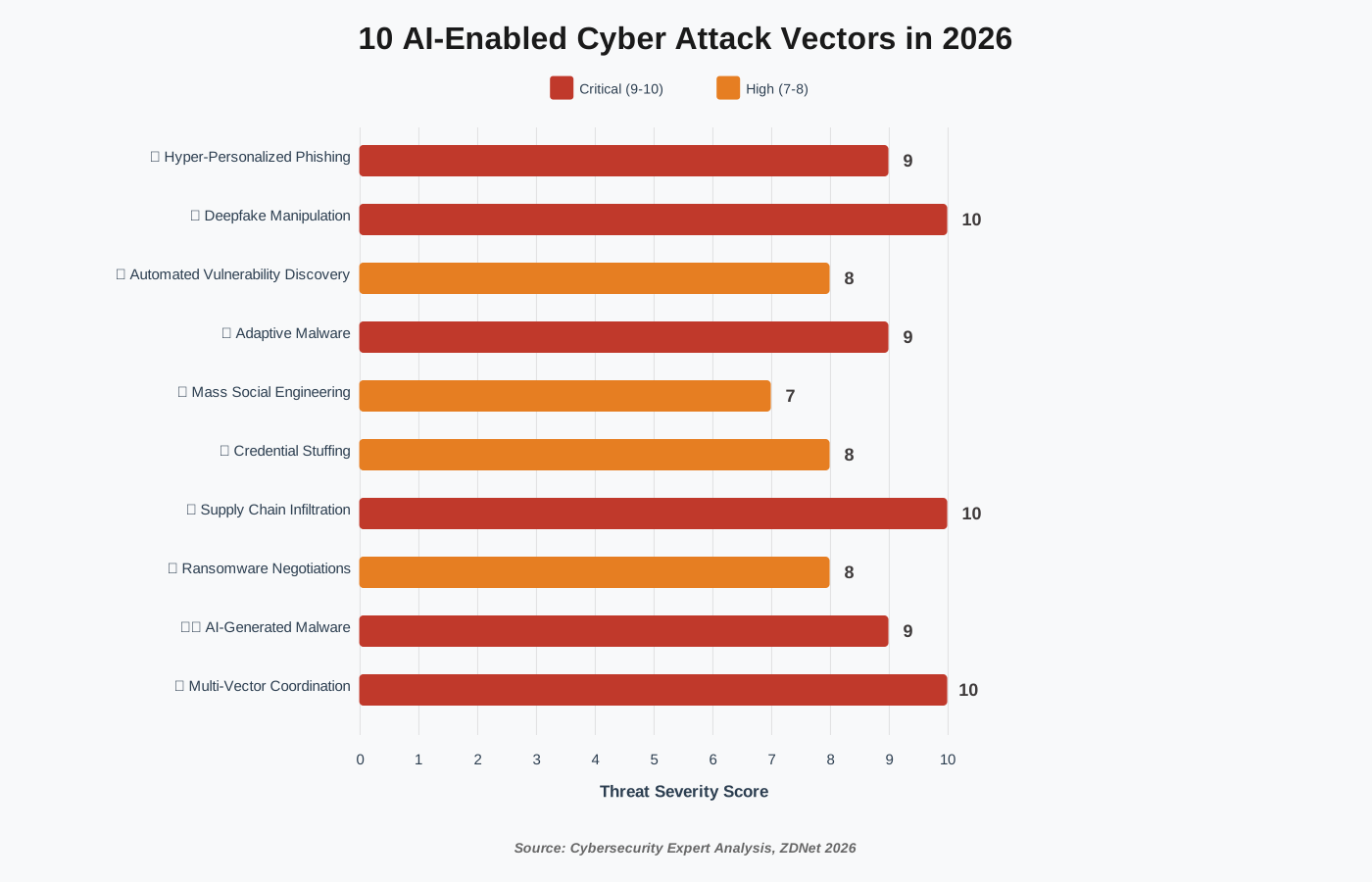
What’s Happening: 10 Devastating AI Attack Vectors
1. Hyper-Personalized Phishing Campaigns
AI systems now analyze years of social media activity, public records, and data breaches to craft phishing messages so convincing that even security-trained employees fall victim. These aren’t generic emails anymore—they reference real conversations, mimic writing styles perfectly, and exploit psychological vulnerabilities with surgical precision.
2. Deepfake Voice and Video Manipulation
Criminals are using AI to clone executive voices and create realistic video calls for fraud. Several organizations have already lost millions to fake CEO calls authorizing wire transfers. The technology has reached a point where visual and audio verification alone cannot be trusted.
3. Automated Vulnerability Discovery
AI-powered scanning tools can identify security weaknesses in software and networks millions of times faster than human researchers. While this helps defenders, it predominantly benefits attackers who can discover and exploit zero-day vulnerabilities before patches exist.
4. Adaptive Malware That Learns
Traditional malware follows programmed instructions. AI-enhanced malware adapts its behavior based on the environment it encounters, evading detection by changing its code structure and attack patterns in real time. It learns from failed attempts and adjusts accordingly.
5. Mass-Scale Social Engineering
AI chatbots can simultaneously engage thousands of targets in personalized conversations designed to extract sensitive information. These systems never get tired, never make mistakes, and continuously improve their manipulation tactics based on successful interactions.
6. Credential Stuffing at Unprecedented Scale
AI algorithms can test billions of username-password combinations while intelligently avoiding detection mechanisms. They analyze patterns in how people create passwords and predict variations with alarming accuracy, rendering simple password security obsolete.
7. Supply Chain Infiltration
AI-driven attacks are targeting software supply chains by identifying the most vulnerable links—often smaller vendors with weaker security. Once compromised, AI helps attackers move laterally through connected systems, hiding their presence while mapping entire networks.
8. Autonomous Ransomware Negotiations
Ransomware groups now deploy AI systems that automatically negotiate ransom amounts based on analyzing a victim’s financial capacity, insurance coverage, and business criticality. These systems maximize profit while minimizing the time human operators need to invest.
9. AI-Generated Malicious Code
Large language models can write sophisticated malware on demand, lowering the technical barrier for cybercrime. Attackers without coding expertise can now describe what they want, and AI generates functional malicious code within minutes.
10. Coordinated Multi-Vector Attacks
AI orchestrates simultaneous attacks across multiple systems, timing them for maximum impact. While security teams scramble to address one incident, AI-coordinated attacks exploit the distraction to breach other defenses.
Why It Matters: The Stakes Have Never Been Higher
The financial, operational, and reputational damage from these AI-powered cyber threats extends far beyond traditional breach costs. Organizations face existential risks when AI-enabled attackers can compromise critical infrastructure, manipulate financial systems, or destroy trust in digital communications.
Small and medium businesses are particularly vulnerable because they often lack the resources to implement AI-powered defensive measures. Meanwhile, large enterprises discover that their massive digital footprints provide more attack surfaces for AI systems to exploit.
The psychological impact cannot be understated. When employees cannot trust their own eyes and ears—when a video call with their CEO might be fake—the foundation of organizational trust begins to erode. This uncertainty benefits attackers who thrive in environments where verification becomes difficult.
What’s Next: Building Resilient Defenses
Security experts emphasize that traditional perimeter-based defenses are insufficient against AI-driven threats. Organizations must adopt a zero-trust architecture where every request is verified, regardless of source.
Employee training needs fundamental revision. Workers must understand that sophisticated AI cyberattacks will bypass their instincts. Verification protocols must become mandatory, even when communications appear legitimate. This means implementing multi-factor authentication everywhere, establishing out-of-band verification procedures for financial transactions, and creating security cultures where questioning authenticity is encouraged, not considered paranoia.
Investment in AI-powered defensive tools has become non-negotiable. Machine learning systems that detect anomalous behavior patterns, AI-driven threat hunting platforms, and automated response systems are essential components of modern cybersecurity stacks.
Practical Protection Steps You Must Take Now
Implement immediate verification protocols for any unusual requests, especially those involving money transfers, credential sharing, or system access changes. Even if the request appears to come from a trusted source, establish secondary confirmation channels that cannot be compromised by the same attack vector.
Segment your networks aggressively. AI-powered attacks excel at lateral movement once they breach initial defenses. Network segmentation limits the damage by creating barriers that slow automated spreading and force attackers to expose themselves when crossing boundaries.
Review and update your incident response plans to account for AI-speed attacks. Traditional response timelines assume human-paced threats. Your security team needs procedures for detecting and containing attacks that evolve faster than manual analysis allows.
Educate every team member about the specific characteristics of AI-driven phishing and social engineering. Generic security awareness training is no longer sufficient. People need to recognize the telltale signs of AI-generated content and understand that perfection—flawless grammar, perfectly matching writing styles—can actually be a red flag.
Deploy behavioral analytics that establish baselines for normal user and system activity. AI-driven threats often succeed because they initially appear legitimate. Behavioral monitoring catches subtle deviations that signature-based detection misses.
Establish strict verification procedures for high-risk actions. Before authorizing wire transfers, changing system permissions, or sharing sensitive data, require multi-person approval through different communication channels. This redundancy frustrates automated attacks that rely on single points of failure.
Regularly audit your supply chain security. Your organization is only as secure as your least-protected vendor. Require security assessments from all partners with system access and establish protocols for immediately isolating compromised vendors.
Deep Details: Understanding the Technical Landscape
The acceleration of AI-enabled cybercrime stems from several converging factors. First, the widespread availability of powerful AI models through APIs and open-source releases has eliminated technical barriers. Second, the commodification of cybercrime services means attackers can rent AI-powered attack infrastructure without building it themselves.
Defensive AI lags behind offensive AI because detection requires observing attack patterns, while attack generation only needs to bypass known defenses. This asymmetry gives attackers a structural advantage that accumulates over time. Each successful attack provides data that trains better attack algorithms, while defenders must wait for assaults to occur before they can develop countermeasures.
The economic incentives heavily favor attackers. A successful ransomware attack can generate millions in profit with relatively low risk, especially when AI automation reduces the time and expertise required. Meanwhile, organizations must continuously invest in defenses that might never face a direct test but become obsolete the moment they fail once.
Privacy regulations, while necessary, inadvertently help attackers by restricting the data defenders can collect and analyze. AI security systems work best with comprehensive data sets, but legal constraints limit what organizations can monitor. Attackers face no such restrictions when building profiles of potential victims.
Why Traditional Security Mindsets Fail Against AI Threats
The fundamental problem is that human intuition evolved to detect human deception. We recognize nervous behavior, inconsistent stories, and suspicious timing because these are human failure modes. AI-generated attacks exhibit none of these tells. They maintain perfect consistency, never show nervousness, and execute with inhuman patience.
Security professionals trained on decades of human attacker patterns find their expertise partially obsolete. An AI system doesn’t get greedy, doesn’t get sloppy when exhausted, and doesn’t make emotional mistakes. It executes its programming flawlessly, learning from failures without ego or frustration.
This feature requires a complete mindset shift. Security is no longer about catching criminals making mistakes; it’s about detecting perfection, about noticing when interactions are too smooth, too precisely tailored, or too persistently consistent. Paradoxically, flawlessness becomes the warning sign.
The Path Forward: Responsible AI Defense
As someone committed to ethical AI development and deployment, I believe the solution isn’t to abandon AI but to ensure defensive AI advances at least as quickly as offensive AI. This requires unprecedented cooperation between security researchers, AI developers, and policymakers.
Transparency in AI capabilities helps more than secrecy. When security researchers understand how AI attack tools work, they can develop effective countermeasures. The current trend toward restricting AI security research in the name of preventing misuse actually benefits attackers who face no such restrictions.
Organizations must view AI security as an ongoing investment, not a one-time expense. The threat landscape evolves continuously, and defensive postures must evolve equally fast. This means budget allocations that anticipate change rather than react to it.
Most importantly, we need to cultivate healthy skepticism without descending into paranoia. “Trust but verify” becomes the operational principle—maintaining productive working relationships while implementing verification procedures that assume nothing about the authenticity of digital communications.
In 2026, every organization will have to prove how well it can protect itself. Those who take these threats seriously, implement comprehensive defensive measures, and foster security-aware cultures will survive and thrive. Those who dismiss these warnings as exaggeration will become cautionary tales in future cybersecurity reports.
Source: ZDNet—Published on January 25, 2026, 11:00 UTC
Original article: https://www.zdnet.com/article/10-ways-ai-will-do-unprecedented-damage-in-2026-experts-warn/
About the Author
Nadia Chen is a digital safety expert and AI ethics specialist dedicated to helping non-technical users understand and protect themselves against emerging technological threats. With a focus on practical, actionable security advice, Nadia translates complex cybersecurity concepts into strategies that anyone can implement. She believes that safety and privacy are fundamental rights in the digital age and that clear, honest education is the best defense against evolving threats.