
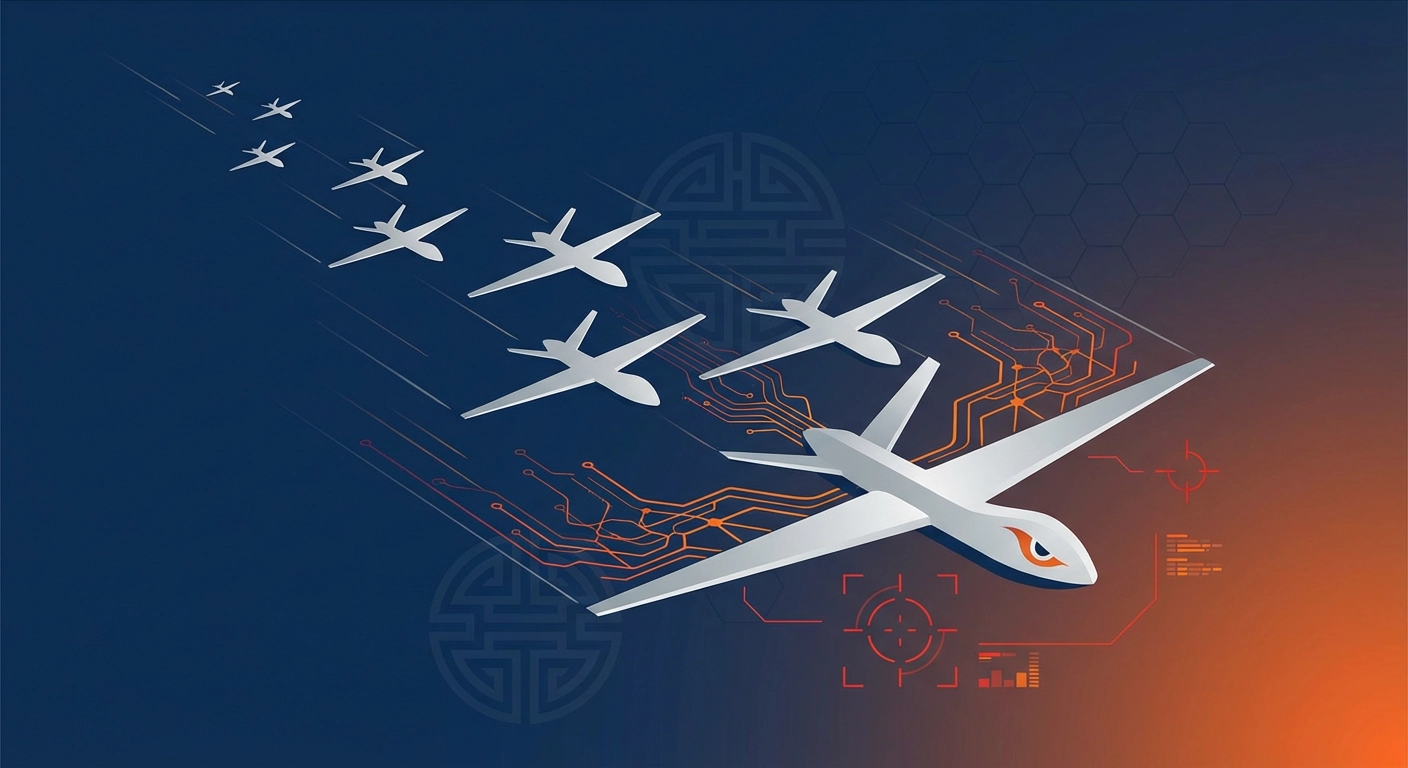
China’s AI Drones: Hunt Like Predators
Key Points
- Chinese researchers trained AI drones using hawk hunting behavior, destroying all targets in 5.3 seconds during tests
- On January 23, 2026, China demonstrated one soldier controlling over 200 autonomous drones in combat scenarios
- China has filed 930+ swarm intelligence patents since 2022, compared to just 60 in the United States
- Military experts warn these predator-inspired AI systems lack transparency and raise serious ethical concerns about autonomous warfare
Background
China’s military has systematically studied nature’s most efficient hunters to create autonomous weapon systems. At Beihang University, researchers observed how hawks select vulnerable prey, then programmed defensive drones to hunt using identical strategies.
This biomimicry extends beyond hawks. Chinese scientists have modeled algorithms on ants, wolves, coyotes, and whales to improve swarm coordination. The goal: create autonomous systems that can overwhelm enemies with minimal human oversight.
What Happened
On January 23, 2026, Chinese state television broadcast footage showing a single People’s Liberation Army soldier supervising more than 200 autonomous drones. The demonstration came from the PLA’s National University of Defence Technology. (ℹ️ AI CERTs News)
The most striking development involves predator-trained AI. In tests at Beihang University, researchers programmed defensive drones using hawk hunting patterns while attack drones mimicked pigeon evasion tactics. In a five-on-five combat simulation, The Wall Street Journal reported the hawk-trained drones destroyed all opponents in just 5.3 seconds. This work earned a patent in April 2024.
According to WebProNews, Chinese military theorists declared in October 2024 that AI will bring “a new style of warfighting driven by algorithms, with unmanned systems as the main fighting force and swarm operations as the primary mode of combat.”
The numbers reveal China’s aggressive pursuit. Since 2022, Chinese defense contractors and military universities have published at least 930 patent applications related to swarm intelligence. During the same period, only about 60 such patents appeared in the United States—with at least 10 filed by Chinese organizations.
Professor Duan Haibin, who led the hawk-pigeon modeling research, revealed at a Beijing conference in July that Chinese researchers are also mimicking eagle and fruit fly vision systems to solve drone perception challenges.
Why It Matters
These developments raise profound safety concerns. As an AI ethics specialist, I must emphasize: autonomous weapons that “learn to hunt” from nature’s predators operate in ways humans cannot fully understand or control.
The “algorithm black box” problem is real. Once these systems deploy, their decision-making processes remain opaque. National Defense University researcher Zhu Qichao warned that the “algorithm black box” could become a rationalized excuse when AI weapons malfunction.
China’s integration of DeepSeek AI into military systems amplifies these risks. The technology now powers autonomous vehicles traveling at 50 km/h and drone swarms targeting threats, with minimal meaningful human oversight.
Massed swarms threaten to overwhelm traditional air defenses by saturating sensors and interceptors. For users concerned about privacy and safety: these same technologies could later appear in civilian contexts without adequate safeguards.
What’s Next
The United States aims to field thousands of autonomous drones by the end of 2025 to counter China’s advantage, Reuters reports. However, American efforts face integration challenges and ethical constraints around human oversight.
China continues expanding its “robot wolves”—weaponized robotic dogs—which state-owned China South Industries Group plans to combine with aerial swarms for joint combat operations.
Global calls for limits on autonomous weapons persist, but testing races ahead of regulation. Retired PLA colonel Zhou Bo stated, “AI’s military applications are burgeoning, so its consequences have yet to be fully discovered.”
Deep Details
The January 2026 demonstration showcased “effect-based control” that researchers claim resists jamming. However, verification data on anti-jamming performance remains scarce. Critical questions persist: How do these systems distinguish friend from foe when hundreds share airspace? What happens when autonomous predator drones encounter unexpected scenarios?
China’s supply chain dominance—producing 80% of global drones—positions it to redefine warfare through massed intelligent machines. But without transparency, accountability, and robust ethical frameworks, we risk unleashing predatory AI systems we cannot control.
Best practices for staying informed:
- Follow authoritative defense technology sources
- Understand that autonomous weapon development lacks adequate safety oversight
- Advocate for international regulations on lethal autonomous systems
- Question claims that machines can safely make life-or-death decisions
Source: Multiple sources including The Wall Street Journal, AI CERTs News, WebProNews, and Reuters—Published on January 23-25, 2026
Original articles:
About the Author
Nadia Chen is an AI ethics and digital safety expert who helps non-technical readers understand emerging technology risks. Her work focuses on responsible AI development and protecting user safety in an increasingly automated world.