
AI Scribes Save Doctors Hour Daily on Paperwork
Key Points
- Canadian doctors spend roughly 9 hours weekly on administrative tasks, with half considered unnecessary paperwork
- AI tools are reducing physician workload by approximately one hour per day for the 28% currently using them
- Nearly half of surveyed physicians (45%) identified AI as a high-priority solution for cutting administrative burden
- Privacy and legal concerns affect 49% of respondents, following incidents where unauthorized tools exposed patient data
- Doctors request more vendor vetting support and training on AI scribe tools to safely adopt the technology
Background
Doctors across Canada face mounting administrative pressures that pull them away from patient care. The Canadian Medical Association (CMA) and Canadian Federation of Independent Business (CFIB) surveyed 1,924 physicians last summer to understand this growing burden (ℹ️ The Globe and Mail).
The administrative strain has reached critical levels, with physicians dedicating substantial time to tasks like insurance paperwork, referrals, and electronic documentation—work that often extends beyond regular hours and contributes directly to professional burnout.
What Happened
The survey revealed that physicians spend approximately nine hours each week on administrative work, with roughly half of that time deemed unnecessary. More than nine in ten doctors reported this paperwork burden disrupts their work-life balance, harms professional fulfillment, and contributes to burnout.
Among the most time-consuming tasks, three-quarters of respondents identified insurance paperwork, referrals, test requisitions, and electronic documentation as the primary culprits stealing time from patient care.
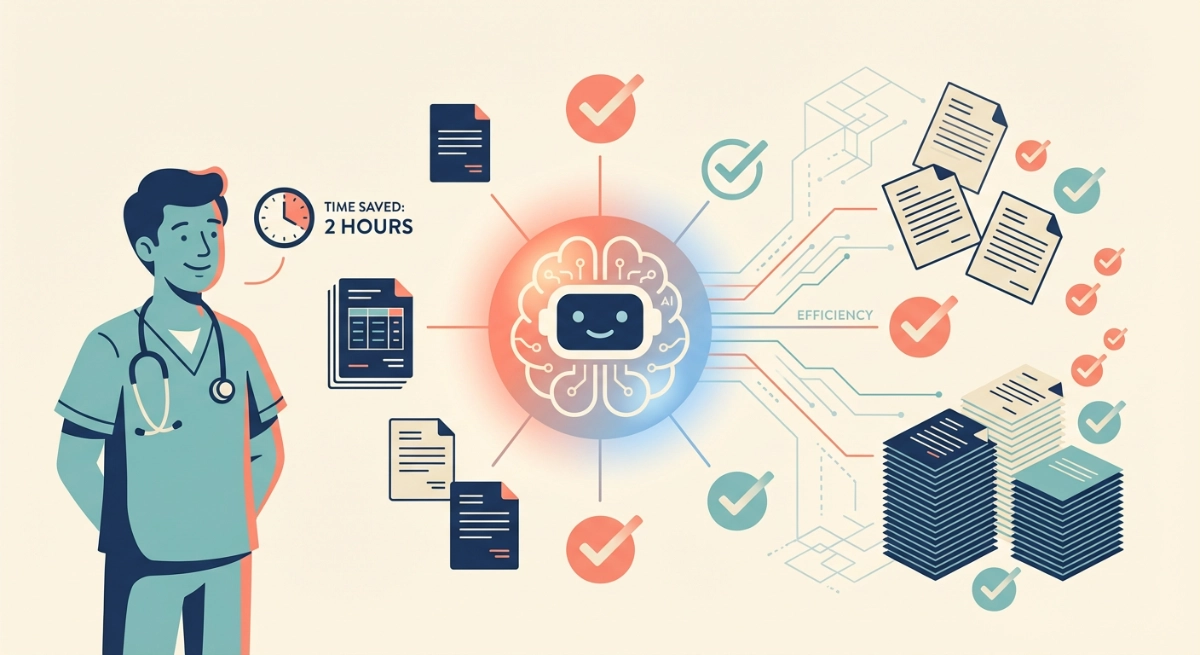
However, the survey uncovered promising news: AI scribe tools are making tangible differences. These applications listen to doctor-patient conversations, transcribe them into clinical notes, and automatically populate forms for physician review and approval. The 28% of doctors currently using these tools report saving approximately one hour daily—a significant reclamation of time that can be redirected to patient care.
“The more time that physicians spend on unnecessary paperwork, the less time they have to see patients,” said Dr. Margot Burnell, CMA president and oncologist, speaking with The Globe and Mail (ℹ️ The Globe and Mail).
Why It Matters
This development signals a shift in how Canadian healthcare might address physician burnout while improving patient access to care. Nearly half of surveyed physicians (45%) ranked AI tools as a high-priority solution for reducing administrative burden.
The timing is critical. With physician burnout rates climbing and many Canadians lacking access to regular primary care, any technology that returns doctors’ time to patient-facing work could help ease healthcare system pressures.
Yet adoption faces hurdles. About 49% of respondents expressed concerns about privacy and legal risks if tools aren’t used correctly. These worries aren’t theoretical—Ontario’s privacy watchdog recently issued a cautionary letter to a hospital where a doctor used an unauthorized transcription tool that emailed confidential patient information to current and former staff (ℹ️ The Globe and Mail).
“Who is it shared with, and who owns the data? It is all very critical,” Dr. Burnell noted, highlighting the legitimate security concerns accompanying this technological shift.
What’s Next
Approximately one-third of surveyed physicians said they need help identifying and vetting vendors, negotiating preferred pricing, and receiving more training on how to use AI scribe tools effectively. The challenge isn’t just adopting the technology—it’s choosing wisely from an exponentially growing market of options.
“Physicians do not have the capability to test each one of those because the number on the market is just increasing exponentially,” Dr. Burnell explained (ℹ️ The Globe and Mail).
One promising development: many electronic medical record (EMR) system providers are now integrating AI tools directly into their platforms. Dr. Jean-Joseph Condé, a family physician and CMA board member, noted this integration will help more doctors start using AI scribes since the technology will be embedded in systems they already use (ℹ️ The Globe and Mail).
Source: The Globe and Mail — Published on January 26, 2026
Original article: https://www.theglobeandmail.com/business/economy/article-ai-artificial-intelligence-doctors-physicians-hospitals/
About the Author
Abir Benali is a technology writer specializing in making AI and digital tools accessible to everyday users. With a focus on healthcare technology and practical applications, Abir breaks down complex innovations into clear, actionable insights for non-technical audiences.