
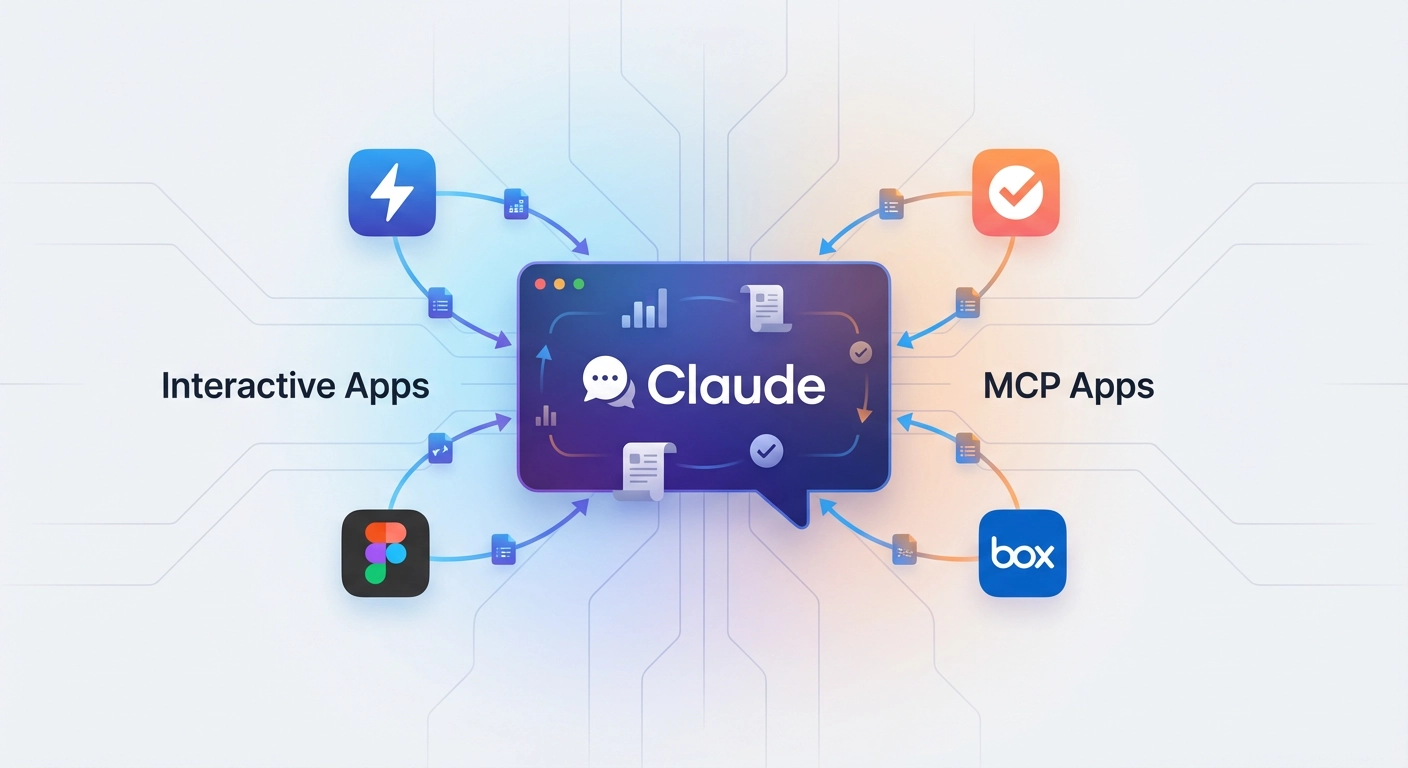
Claude Gets Interactive Apps Inside Chat Window
Anthropic launches interactive Claude apps directly within its AI assistant, eliminating the need to switch between windows for everyday workplace tasks. On January 26, 2026, the company rolled out MCP Apps, enabling users to access Slack, Figma, Asana, and seven other productivity tools without leaving their Claude conversation.
Key Points
- Claude now supports interactive apps from 10 enterprise partners, including Slack, Figma, Asana, Box, Canva, Clay, Amplitude, Hex, and monday.com
- The feature leverages the open Model Context Protocol (MCP) Apps extension developed with OpenAI and the MCP community
- Available immediately to Pro, Max, Team, and Enterprise subscribers on web and desktop platforms
- Users can draft Slack messages, create Figma designs, build Asana timelines, and manage Box files directly in Claude’s chat interface
- Integration with Claude Cowork expected soon, enabling more powerful automated workflows
Background
The Model Context Protocol emerged as Anthropic’s open standard in late 2024, designed to enable AI assistants to connect seamlessly with external tools and data sources. While Claude previously accessed third-party applications through MCP connections, those interactions returned only text-based responses (ℹ️ The Register).
The MCP community proposed extending this capability to include interactive user interfaces in November 2025, building on pioneering work from MCP-UI and the OpenAI Apps SDK. This collaboration between Anthropic, OpenAI, and independent developers resulted in the first official MCP extension (ℹ️ Model Context Protocol Blog).
What Happened
Starting today, Claude users can activate interactive app integrations that render complete user interfaces within the chat window. When you ask Claude to help with a task, relevant apps now display their full functionality—charts update in real-time, forms accept direct input, and dashboards refresh with live data.
“Claude already connects to your tools and takes actions on your behalf,” Anthropic explained. “Now those tools show up right in the conversation, so you can see what’s happening and collaborate in real time” (ℹ️ TechCrunch).
The technology works through secure sandboxed iframes that render app interfaces while maintaining strict security boundaries. Apps run with pre-declared templates and auditable message passing and they require user consent for tool calls—critical safeguards when third-party code operates within your workspace.
Ten launch partners provide interactive capabilities across different work functions:
- Analytics: Amplitude delivers real-time chart manipulation
- Project Management: Asana converts conversations into actionable timelines
- File Storage: Box enables inline document search and preview
- Design: Canva and Figma support creation and editing of visual content
- Data Operations: Clay pulls company data and drafts outreach
- Communication: Slack facilitates message composition with formatting
- Development: Hex provides data science notebook integration
- Workflow: monday.com offers project board management
Salesforce integration will arrive shortly, bringing enterprise CRM capabilities into the Claude interface.
Why It Matters
This launch represents a fundamental shift in how professionals interact with AI assistants. Rather than asking Claude for information and then manually implementing changes across multiple applications, users can now complete entire workflows without context-switching.
“Analyzing data, designing content, and managing projects all work better with a dedicated visual interface,” Anthropic noted. “Combined with Claude’s intelligence, you can work and iterate faster than either could offer alone” (ℹ️ TechCrunch).
The technology challenges traditional operating system paradigms by creating what The Register describes as “a cross-application interface layer”—Claude becomes the workspace, not just another application running within one (ℹ️ The Register).
Clare Liguori, Senior Principal Engineer at AWS, emphasized the practical impact: “MCP Apps address a real gap between what agentic tools can provide and how users naturally want to interact with them. The ability to render dynamic interfaces directly in conversation makes it easier to leverage MCP server capabilities in practical ways.”
The timing aligns with Anthropic’s broader enterprise push, coming just four days after the company unveiled a new constitutional framework for embedding safety guidelines directly into Claude’s reasoning—addressing enterprise compliance requirements.
What’s Next
Anthropic confirmed that MCP Apps will integrate with Claude Cowork, the general-purpose agent tool launched earlier this month. This combination will enable users to assign complex, multi-stage tasks that draw on files from Box, update graphics in Figma, or incorporate data from other connected applications—all through natural language instructions.
The company provides clear safety guidance for these powerful capabilities: “Be cautious about granting access to sensitive information like financial documents, credentials, or personal records. Consider creating a dedicated working folder for Claude rather than granting broad access” (ℹ️ TechCrunch).
Beyond Claude, the open standard approach means other AI platforms will adopt MCP Apps. ChatGPT support begins this week, with Goose and Visual Studio Code already offering the capability. Developers can access the SDK and working examples through the ext-apps repository on GitHub.
Users can activate available apps by visiting claude.ai/directory and selecting tools marked “interactive.” Free-tier users currently cannot access this feature.
Source: Model Context Protocol Blog—Published on January 26, 2026
Original articles:
About the Author
James Carter, a productivity coach who helps professionals leverage AI to save time and boost efficiency, wrote this article. James specializes in translating complex AI developments into actionable strategies that anyone can implement in their daily workflow.