
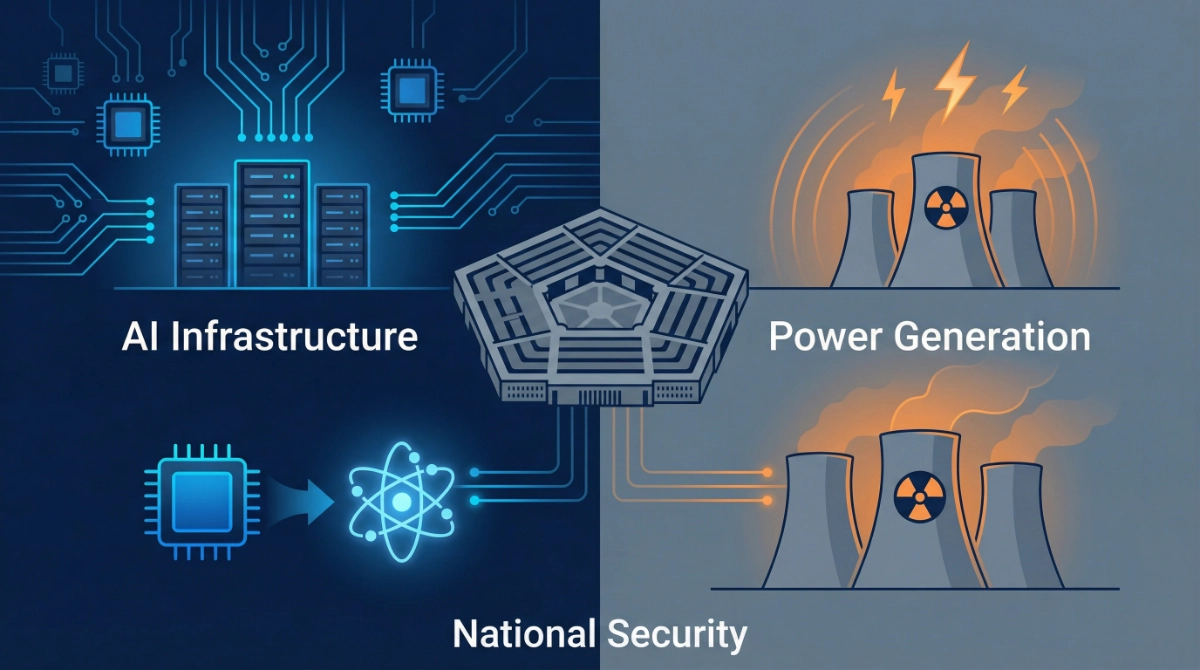
Pentagon Shifts AI Focus: Power Beats Chips
Key Points
- Pentagon officials identify power generation as the primary constraint for AI deployment, surpassing semiconductor availability
- Project Pele, a mobile nuclear reactor enters assembly phase in 2026, targeting 1-5 megawatts for remote military operations
- Jeff Waksman from Strategic Capabilities Office calls energy “the most underrated challenge” of AI infrastructure expansion
- Defense Department exploring both nuclear solutions and neuromorphic processors for energy efficiency
- Stargate initiative’s $500 billion investment faces grid capacity concerns across the United States
Background
The artificial intelligence revolution has consistently focused on one thing: computing power. For years, the conversation centered on access to advanced chips, particularly from manufacturers like NVIDIA. But the Pentagon’s Next AI Race has taken an unexpected turn.
While the private sector races to secure the latest processors, the Department of Defense faces a more fundamental problem. Military installations and forward operating bases need reliable, consistent power—something that’s becoming increasingly scarce as AI demands grow exponentially.
The challenge extends beyond military applications. OpenAI’s recent Stargate announcement, pledging $500 billion over five years for AI infrastructure, has highlighted a national infrastructure crisis that affects everyone from tech giants to defense operations.
What Happened
During a panel at the Potomac Officers Club’s Research and Development Summit in January 2025, Pentagon officials revealed a critical shift in AI strategy priorities. Jeff Waksman, leading the mobile nuclear reactor effort at the Strategic Capabilities Office, stated that power generation challenges could overshadow even massive investment initiatives. “This is not a problem that industry or the DOD can figure out by itself. It’s about the nation’s grid as a whole,” Waksman explained (ℹ️ Defense News). “It’s probably the most underrated challenge of this huge $500 billion announcement.”
Roy Campbell, deputy director of advanced computing in the Office of the Undersecretary of Defense for Research and Engineering, illustrated the practical impact. Forward operating bases frequently lack sufficient computing power to retrain AI tools, forcing operations to route back to continental U.S. supercomputing centers—a workflow that creates operational delays.
Project Pele, the Pentagon’s mobile nuclear reactor initiative, began assembling its prototype in January 2026 at Idaho National Laboratory. Built by BWXT Advanced Technologies, the reactor aims to deliver one to five megawatts of electrical power with a minimum three-year operating life.
Why It Matters
The Pentagon’s AI power challenge represents more than a military logistics problem—it signals a fundamental infrastructure crisis affecting national security and economic competitiveness. While tech companies scramble to secure advanced semiconductors, the Department of Defense faces a more basic question: where will the electricity come from?
The Pentagon uses approximately 30 terawatt-hours of electricity annually and more than 10 million gallons of fuel daily, according to Defense Department statements (ℹ️ Breaking Defense). Projections indicate a dramatic increase in these numbers as AI capabilities mature and operational requirements expand.
Forward bases in contested environments need reliable, consistent power that doesn’t depend on vulnerable supply chains. Renewable energy sources like solar and wind cannot provide the 24/7 baseload power that AI data centers and military operations demand, particularly in remote or austere locations.
What’s Next
Project Pele represents just the beginning of the Pentagon’s nuclear power strategy. In October 2025, Army Secretary Dan Driscoll announced the Janus Program, which will deploy commercially owned microreactors at nine military installations by 2030 (ℹ️ U.S. Army).
The selected locations include Fort Benning, Fort Bragg, Fort Campbell, Fort Drum, Fort Hood, Fort Wainwright, Joint Base Lewis-McChord, Redstone Arsenal, and the Holston Army Ammunition Plant. These installations will serve as testing grounds for next-generation nuclear technology.
Meanwhile, researchers at the Naval Research Center are exploring neuromorphic processors that promise 100-times greater efficiency than standard processors. Steven Meier, associate director of space technology at the center, believes these advanced chips could significantly reduce AI’s power appetite while maintaining computational capabilities.
The convergence of AI ambitions and energy reality has created an unexpected race. While headlines focus on who has the latest chips, defense planners know the real winner will be whoever solves the power equation first.
Source Attribution
Source: Defense News, Breaking Defense, U.S. Army
Published: January 24-27, 2026
Original articles: