
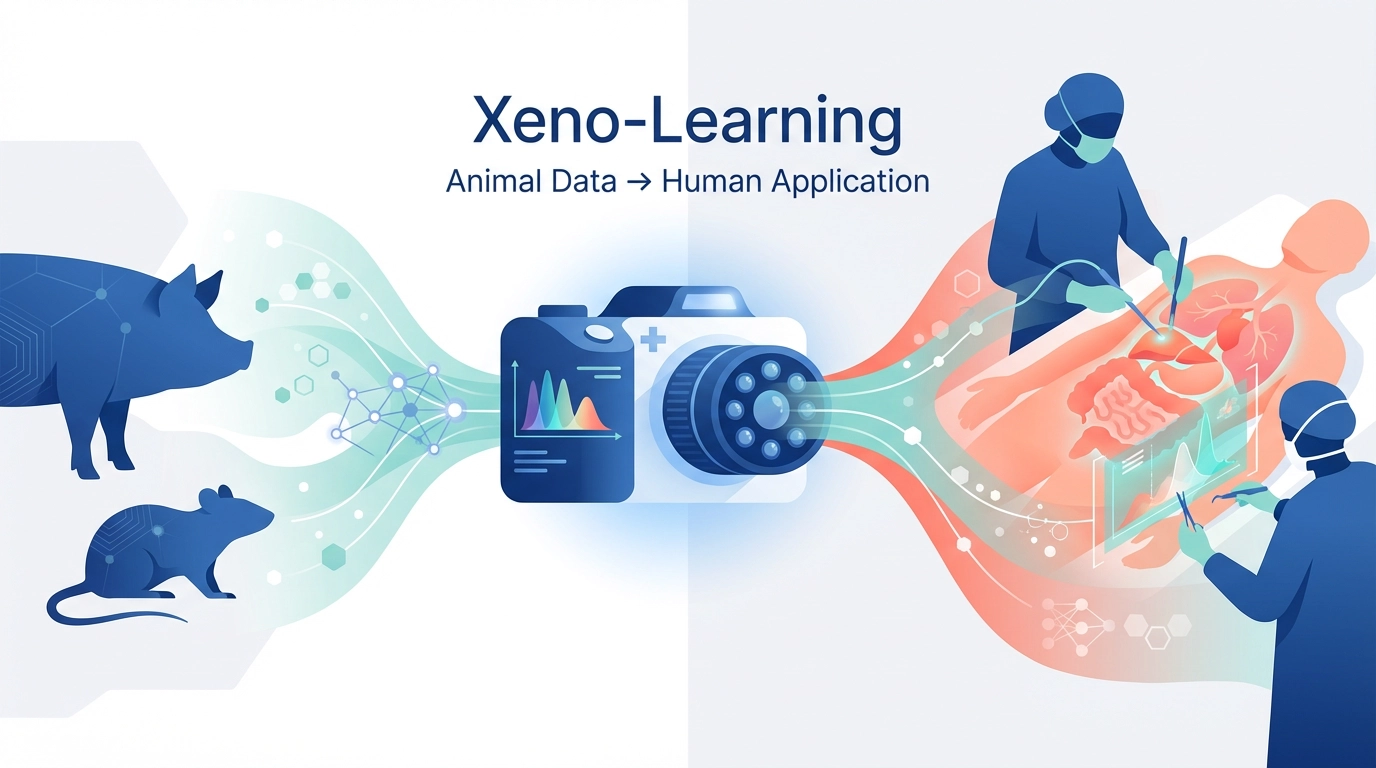
AI Learns from Animals to Improve Human Surgery
Key Points
- AI uses animal imaging data from pigs and rats to train systems that improve surgical precision in humans
- German researchers developed “xeno-learning,” a method that transfers medical knowledge across species without needing extensive human data
- The system analyzed over 13,000 hyperspectral images to learn patterns of tissue changes like blood flow disruption
- This breakthrough could make surgeries safer by helping AI distinguish between healthy and diseased tissue more accurately
Background
Surgeons have to constantly tell the difference between healthy and diseased tissue during surgery. While the human eye can see only basic colors, modern hyperspectral cameras capture far more information about tissue, including blood flow and oxygen levels. However, teaching AI systems to interpret this data requires massive amounts of annotated human medical images—something that’s difficult to obtain due to ethical, legal, and practical constraints.
Animal research, on the other hand, provides abundant standardized imaging data from controlled experiments. The problem? Tissue signatures differ significantly between species, causing AI trained on animal data to fail when applied to humans.
What Happened
Scientists at the German Cancer Research Center (DKFZ), Heidelberg University Hospital, and Mannheim University Medical Center published groundbreaking research (ℹ️ Nature Biomedical Engineering) on January 26, 2026, introducing “xeno-learning”—a method inspired by organ transplantation across species.
The research team, led by Lena Maier-Hein, Alexander Studier-Fischer, and Jan Sellner, analyzed 14,013 hyperspectral images from humans, pigs, and rats. Rather than teaching AI to recognize absolute tissue patterns (which differ between species), they trained it to identify relative changes—how tissue spectra shift when blood flow is disrupted or contrast agents are injected.
The key insight: while organs look different across species in absolute terms, the patterns of change from healthy to diseased states follow similar trajectories. AI trained to recognize these change patterns in animal models successfully transferred this knowledge to human tissue analysis.
Why It Matters
This advancement addresses a critical bottleneck in medical AI development. Creating annotated human medical datasets is expensive, time-consuming, and often impossible for ethical reasons. You can’t deliberately induce disease states in human patients just to train AI systems.
“Xeno-learning enables the use of spectral imaging even where human data is lacking,” (ℹ️ Medical Xpress) explains Jan Sellner, one of the study’s lead authors. “This is an important step toward making surgical procedures safer and more precise in the future.”
For kidney surgery specifically—where the team demonstrated their method—the AI system could accurately identify tissue even under different blood flow conditions. This matters because surgeons need to distinguish between healthy kidney tissue worth preserving and diseased areas requiring removal, especially during tumor operations or transplants.
The implications extend beyond kidneys. The method also works well for other organs and various imaging situations, such as finding tissues after using fluorescent dye during surgery.
What’s Next
The DKFZ researchers have made their program code and pre-trained AI models publicly available to accelerate adoption. This means other research institutions and medical device companies can build upon this work immediately.
The team plans to expand xeno-learning to additional surgical scenarios and organ systems. Future applications could include cancer detection (where tissue perfusion differs between tumors and healthy tissue), emergency surgery guidance, and real-time surgical decision support.
While this technology won’t replace surgeons’ expertise, it adds an extra layer of precision, enabling surgeons to see beyond what the human eye can detect.
Source: Medical Xpress, Nature Biomedical Engineering—Published on January 26, 2026
Original articles: Medical Xpress | Nature Biomedical Engineering
About the Author
Abir Benali, a technology writer specializing in making AI accessible to non-technical audiences, authored this article. Abir focuses on explaining complex medical AI innovations in clear, practical terms that help readers understand how emerging technologies will impact healthcare.