
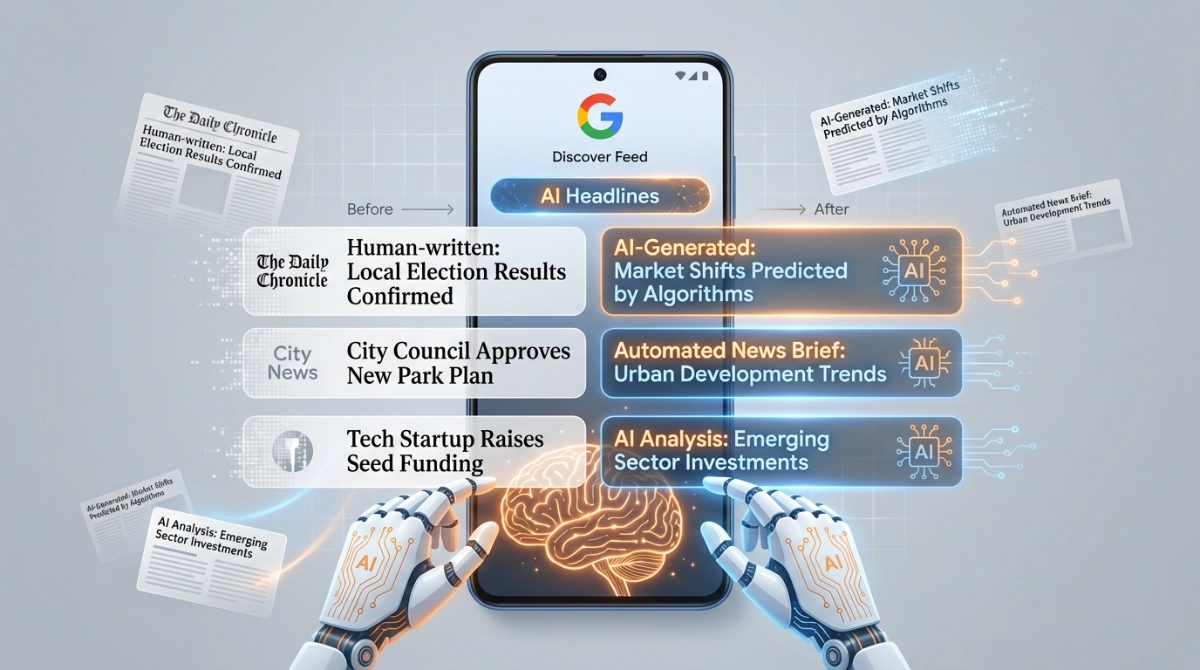
Google AI Rewrites News Headlines in Discover Feed
Google’s Discover feed has officially adopted AI-generated headlines as a permanent feature, replacing titles written by journalists and publishers with machine-created alternatives. What started as an experiment in late 2025 has now become standard practice, raising concerns about accuracy and publisher visibility.
What’s Happening with Google Discover
Google Discover AI headlines are now appearing across Android home screens and the Google app for millions of users. Instead of displaying original headlines from publishers like The Verge, Android Authority, or other news outlets, Google’s artificial intelligence creates new titles by scanning multiple sources covering the same story.
According to Android Authority, these AI-generated headlines appear on “trending topics”—stories covered by multiple publishers. Rather than picking one outlet’s carefully crafted title, Google’s AI attempts to synthesize information from all sources into a single headline.
The problem? Many of these AI-created headlines are confusing, misleading, or completely wrong.
Background: From Test to Permanent Feature
Google began testing AI headlines on Discover in mid-2025, initially describing it as a small experiment. By December 2025, tech journalists noticed increasingly bizarre headlines appearing in their feeds. The Verge reported examples like “BG3 players exploit children” for a story about video game mechanics and “Steam Machine price revealed” when no price had been announced.
In January 2026, Google officially confirmed the change. Spokesperson Jennifer Kutz told The Verge that the company “launched a new feature last year in Discover to help people explore topics that are covered by multiple creators and websites.” Google claims the feature “performs well” for user satisfaction.
Why Publishers Are Worried
The shift goes beyond just headlines. According to research from analytics platform Marfeel reported by Press Gazette, 51% of the Google Discover feed in the US, Brazil, and Mexico now consists of AI summaries designed to promote YouTube videos.
Even more concerning for news organizations: In the United States, 77% of clicks from these AI summaries go to YouTube videos rather than to the publishers whose reporting the content is based on. Only 23% of clicks reach actual news websites.
Xavi Beumala from Marfeel warned that “Google Discover is no longer a publisher-first surface. It’s becoming an AI platform with YouTube and X absorbing real estate that once went to newsrooms.”
How to Spot AI-Generated Headlines
You can identify AI-created headlines in Discover by looking for these signs:
- Multiple publisher icons at the top of the card (like “Android Authority +11”) instead of a single outlet logo
- No “Follow” button in the top-right corner
- Generic or confusing wording that doesn’t match the publication’s style
When you tap an AI headline, you’ll see a disclaimer noting the content is “Generated with AI, which can make mistakes”—but this warning only appears after you’ve already clicked.
What It Means for News Readers
For everyday users who rely on Discover for their daily news, this change means you need to be more careful about what you’re reading. AI-generated headlines can misrepresent stories, attribute incorrect information to reputable publishers, and send you to YouTube videos instead of in-depth reporting.
The redesign also means you’re more likely to see content from X (formerly Twitter) and YouTube rather than traditional news sources. According to Press Gazette, X became the most-trafficked domain on Google Discover in the UK during December 2025.
What’s Next
Google has indicated this is just the beginning. The company announced in September 2025 that it’s adding content from X, Instagram, and YouTube Shorts to Discover, with “more platforms to come.” The US, Brazil, and Mexico appear to be test markets for a broader global rollout.
For now, Discover users should approach AI-generated headlines with healthy skepticism, verify information through the original sources, and consider following specific publishers directly rather than relying solely on Google’s algorithm.
The shift represents Google’s broader strategy to keep users within its ecosystem—prioritizing its platforms like YouTube over sending traffic to independent publishers. Whether this improves the user experience or simply concentrates power remains an open question.
Source Attribution
Primary Sources:
- Android Authority—Published January 23, 2026
- Press Gazette—Published January 15, 2026
- The Verge—January 2026
About the Author
Abir Benali is a friendly technology writer who explains AI tools and digital trends to non-technical readers. Abir specializes in making complex tech topics accessible and actionable for everyday users.