
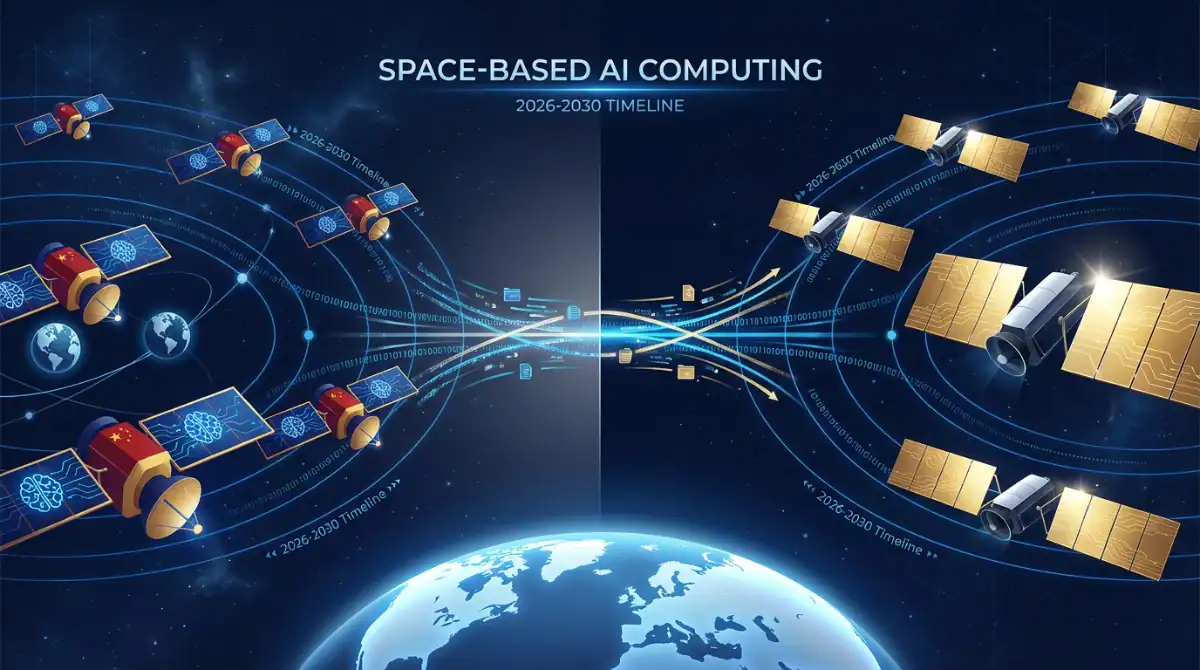
China Unveils Space AI Data Centers to Rival SpaceX
Key Points
- China plans space-based AI data centres through its main space contractor CASC over the next five years
- SpaceX aims to launch solar-powered AI satellites within 2-3 years using $25 billion IPO funds
- Orbital data centers leverage 5x more efficient solar power compared to ground-based panels
- China has already deployed 12 computing satellites as foundation for 2,800-satellite constellation
- Competition centers on solving AI’s growing power consumption crisis
Background
The race to deploy artificial intelligence computing infrastructure in space has intensified dramatically in early 2026. As global data centers consume increasing amounts of electricity—expected to exceed Japan’s total power consumption by 2030 according to the International Energy Agency—both nations see orbital solutions as essential for sustaining AI growth. (ℹ️ Reuters)
China plans space-based AI data centers as part of a strategic initiative led by China Aerospace Science and Technology Corporation (CASC). The country already achieved a significant milestone in May 2025 when it launched 12 computing satellites equipped with 8-billion-parameter AI models, forming the foundation of a planned 2,800-satellite constellation. (ℹ️ China Daily)
What Happened
On January 29, 2026, China’s state broadcaster CCTV reported CASC’s commitment to “construct gigawatt-class space digital-intelligence infrastructure” over the next five years. The new space data centers will integrate cloud, edge, and terminal capabilities while achieving deep integration of computing power, storage capacity, and transmission bandwidth, enabling Earth data to be processed in orbit. (ℹ️ Reuters)
China aims to create an industrial-scale “Space Cloud” by 2030, according to a December CASC policy document. This initiative forms a core pillar of China’s upcoming 15th Five-Year Plan, the nation’s economic development roadmap.
Meanwhile, at the World Economic Forum in Davos last week, Elon Musk announced SpaceX’s parallel ambitions. “It’s a no-brainer building solar-power data centers in space,” Musk stated. “The lowest-cost place to put AI will be space, and that will be true within two years, three at the latest.” (ℹ️ Business Today)
SpaceX plans to launch solar-powered AI data center satellites within the next two to three years, funded by its planned $25 billion IPO scheduled for 2026. Musk emphasized that solar generation in orbit can produce five times more power than ground-based panels.
Why It Matters
This development represents a fundamental shift in how humanity approaches computing infrastructure. Traditional data centers face three critical constraints: land scarcity in prime locations, electrical grid limitations, and massive cooling requirements. Space-based solutions eliminate all three challenges.
Orbital data centers operate continuously with access to uninterrupted solar energy, require no terrestrial real estate, and benefit from the natural cooling of space’s vacuum environment. For AI computing, which demands exponential increases in processing power, these advantages could prove decisive.
The competition also carries significant geopolitical implications. Control of orbital computing infrastructure may determine which nations lead AI development over the coming decades—similar to how GPS dominance provided strategic advantages in navigation technology.
China currently faces a key bottleneck: the absence of fully reusable rocket technology. SpaceX’s proven Falcon 9 reusable rocket system provides a substantial cost advantage, enabling cheaper and more frequent satellite deployments. However, China achieved a record 93 space launches in 2025, demonstrating its capacity for rapid space infrastructure development. (ℹ️ Reuters)
What’s Next
China’s Beijing Astro-future Institute has completed development of its first-generation experimental satellite, scheduled for launch by the end of 2025 or early 2026. The institute plans a three-phase development timeline: testing key technologies through 2027, integrating Earth-based data processing with space-based computing by 2030, and establishing large-scale space data centers by 2035. (ℹ️ Xinhua)
SpaceX’s timeline remains aggressive, with Musk projecting initial deployments within 2-3 years. The company’s planned IPO will provide capital specifically earmarked for developing orbital AI data centers.
Other players are entering the field as well. Google launched Project Suncatcher in November 2025 to explore satellite-based computing, while startup Starcloud successfully deployed an Nvidia H100 chip aboard its test satellite. (ℹ️ Popular Mechanics)
Deep Details
The technical challenges of space-based computing extend beyond rocket launches. Computer chips must withstand intense launch vibrations, operate reliably in microgravity, survive extreme temperature fluctuations, and resist damage from high-energy charged particles in the solar wind. Both Chinese and American teams are developing radiation-hardened processors and advanced cooling systems to address these challenges.
China’s approach emphasizes state coordination between commercial and government space programs. The country’s 2014 decision to open its traditionally state-dominated space sector to private capital has spawned hundreds of companies, many receiving substantial subsidies. This ecosystem enabled rapid progress from concept to orbital deployment.
SpaceX’s strategy leverages its existing Starlink satellite constellation and reusable launch capabilities. The company’s Starship rocket, designed for full reusability, could reduce space access costs by a factor of 100, according to Musk—making space-based data centers economically viable at scale.
The competition highlights how AI infrastructure requirements are reshaping humanity’s relationship with space. What began as scientific exploration and communication satellites is evolving into industrial-scale orbital computing networks that may eventually process more data than all terrestrial data centers combined.
Source: Reuters—Published on January 29, 2026, 5:37 AM UTC
Original article: https://www.yahoo.com/news/articles/china-vows-develop-space-tourism-053746628.html
About the Author
This article was written by Abir Benali, a friendly technology writer who explains AI tools to non-technical users. Abir specializes in making complex technological developments accessible and understandable for everyday readers, focusing on clear explanations without technical jargon.