
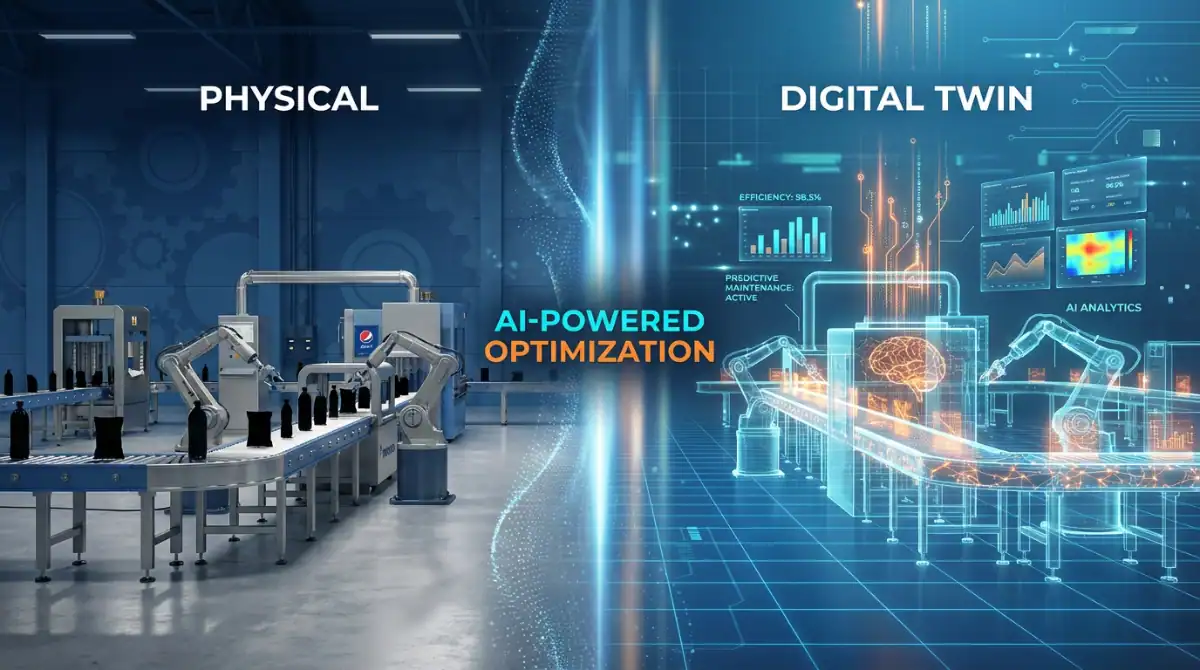
PepsiCo Transforms Factory Design with AI Digital Twins
AI to rethink how factories are designed and updated is no longer a distant possibility—it’s happening right now at PepsiCo. In a groundbreaking move announced at CES 2026, the global food and beverage giant is partnering with Siemens and NVIDIA to revolutionize manufacturing through digital twin technology and artificial intelligence.
Key Points
- PepsiCo launched a multi-year collaboration with Siemens and NVIDIA to transform plant operations using AI-powered digital twins
- Early pilots achieved 20% throughput increase, 90% issue detection before physical changes, and 10-15% capital expenditure reduction
- The initiative uses Siemens Digital Twin Composer built on NVIDIA Omniverse to create physics-accurate virtual factory replicas
- US facilities are being converted first, with global expansion planned for 2026-2027
- This marks the first time a major consumer packaged goods company has deployed digital twins at this scale
Background
Traditional factory expansion is expensive, time-consuming, and risky. Manufacturing companies typically invest millions in physical infrastructure changes, only to discover design flaws after construction begins. PepsiCo faced this challenge as consumer demand continued rising while traditional expansion methods limited the company’s flexibility and speed.
The solution? Test everything virtually before moving a single piece of equipment.
What Happened
On January 6, 2026, PepsiCo announced (ℹ️ PepsiCo) an industry-first partnership bringing together three powerhouses: PepsiCo’s manufacturing expertise, Siemens’ industrial AI technology, and NVIDIA’s visualization capabilities.
The collaboration deploys Siemens Digital Twin Composer—software that creates photorealistic 3D replicas of entire factories. Built on NVIDIA Omniverse libraries, these digital twins don’t just look like real facilities; they behave like them, simulating every machine, conveyor belt, pallet route, and operator movement with physics-level accuracy.
According to Retail TouchPoints, PepsiCo has converted select US manufacturing and warehouse facilities into high-fidelity virtual environments where AI agents serve as co-designers, testing configuration changes before any physical modifications occur.
Ramon Laguarta, Chairman and CEO of PepsiCo, emphasized the scale of this transformation: “The scale and complexity of PepsiCo’s business, from farm to shelf, is massive—and we are embedding AI throughout our operations to better meet the increasing demands of our consumers and customers.”
Why It Matters
The results speak for themselves. Early deployments have delivered:
- 20% increase in throughput on production lines
- 90% of potential design issues identified before physical changes
- Nearly 100% design validation accuracy
- 10-15% reduction in capital expenditure by uncovering hidden capacity
These aren’t minor improvements—they represent massive time and cost savings that ripple through PepsiCo’s global operations.
“We are deploying the first digital blueprint that reimagines how the supply chain is designed, built, and scaled,” explained Athina Kanioura, CEO of Latin America and Global Chief Strategy & Transformation Officer at PepsiCo. “In this future, our facilities don’t just respond to demand; they anticipate and then adapt to it.”
For the broader manufacturing industry, this collaboration sets a new standard. Jensen Huang, Founder and CEO of NVIDIA, noted, “Physical industries are entering the age of AI. For companies with real-world assets, digital twins are the foundation of their AI journey.”
What’s Next
PepsiCo is expanding this approach beyond initial US pilot sites. According to Manufacturing Digital, the company plans to scale the technology globally, beginning with its largest markets in 2026 and 2027.
Roland Busch, CEO of Siemens AG, confirmed the partnership’s industry-wide implications: “This collaboration sets a new standard for all industries. Customers can turn ideas into real-world impact with greater speed, quality, and efficiency.”
The Digital Twin Composer technology is currently in early access with select customers, suggesting more manufacturers may soon follow PepsiCo’s lead.
Deep Details
The technical foundation combines multiple cutting-edge technologies. Siemens Digital Twin Composer integrates 2D and 3D digital twin data with real-time physical information from manufacturing execution systems, quality management platforms, and IoT sensors across PepsiCo’s operations.
NVIDIA Omniverse provides the visualization engine, creating photorealistic virtual environments where teams can interact with factory designs as if walking through the actual facility. Computer vision technology tracks every element with precision, enabling AI agents to run thousands of simulations testing different configurations.
Within weeks of implementation, PepsiCo teams optimized and validated new configurations to boost capacity and throughput. This rapid iteration cycle—impossible with traditional physical planning—gives the company unprecedented flexibility to adapt to changing market demands.
The approach also addresses sustainability goals by maximizing existing facility utilization rather than requiring greenfield construction, reducing both environmental impact and capital investment.
Source: PepsiCo Official Press Release—Published on January 6, 2026
Original article: https://www.pepsico.com/newsroom/press-releases/2025/pepsico-announces-industry-first-ai-and-digital-twin-collaboration-with-siemens-and-nvidia
Frequently Asked Questions
What is a digital twin in manufacturing?
A digital twin is a virtual replica of a physical factory that simulates real-world operations with physics-accurate precision, allowing companies to test changes virtually before implementing them physically.
How does PepsiCo’s AI factory design work?
PepsiCo uses Siemens Digital Twin Composer and NVIDIA Omniverse to create 3D virtual replicas of factories where AI agents test different configurations, identifying issues and optimizing layouts before any physical changes occur.
What benefits has PepsiCo achieved with digital twins?
Early implementations delivered a 20% throughput increase, identified 90% of potential issues before physical changes, achieved nearly 100% design validation, and reduced capital expenditures by 10-15%.
When will PepsiCo expand this technology globally?
PepsiCo plans to scale the digital twin technology globally beginning with its largest markets in 2026 and 2027, following successful US pilot programs.
About the Author
James Carter is a productivity coach specializing in AI-powered workplace efficiency. He helps professionals and organizations leverage artificial intelligence to save time and boost productivity without requiring technical expertise. James believes that AI should simplify work, not complicate it, and focuses on practical, actionable strategies anyone can implement.