
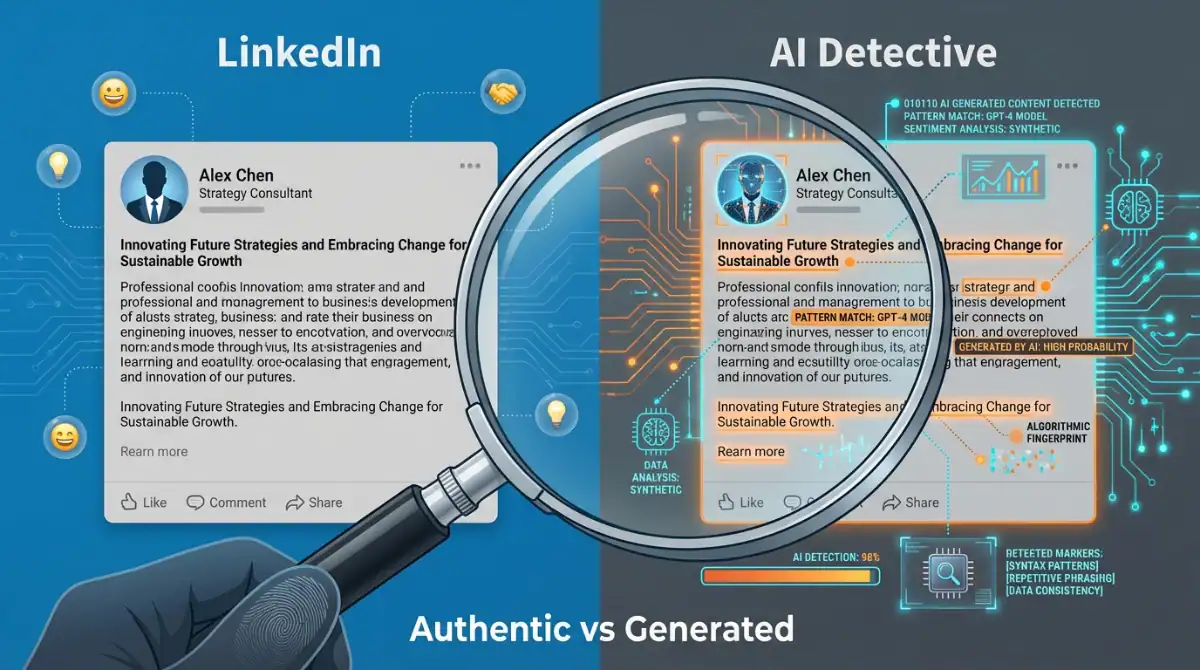
LinkedIn Users Turn AI Detectives: How to Spot Fake Posts
AI Detective On LinkedIn became the unexpected job description for thousands of professionals in early 2026. When Kiara Stent started her digital investigation last summer, she uncovered something that would resonate across the professional networking platform: the majority of posts she analyzed appeared to be written by artificial intelligence.
Key Points
- Over 53% of LinkedIn long-form posts are now AI-generated, according to recent research from Originality.ai
- Users are developing detection skills by spotting patterns: em dashes, excessive emojis, and repetitive phrasing
- A 25-year-old marketer’s viral post about AI Detective On LinkedIn techniques generated tens of thousands of impressions
- The shift represents a fundamental change in how professionals approach content authenticity on networking platforms
Background
The transformation began quietly in early 2023, coinciding with ChatGPT’s mainstream adoption. Stent, a marketer based in Cape Town, noticed her LinkedIn feed starting to sound eerily similar across different accounts. Posts featured the same dramatic metaphors, identical hooks, and a distinct lack of personal voice (ℹ️ Bloomberg).
Her informal research project analyzed approximately 200 posts across 50 different profiles, including marketing leaders and senior professionals. The results shocked her: roughly 75% appeared to be AI-generated.
What Happened
Stent’s August 2025 post detailing telltale AI Detective On LinkedIn signs quickly became her most successful content, sparking widespread discussion about authenticity. The reaction split into two camps: those who recognized the patterns and agreed, and those who became defensive about their content creation methods.
Research from Originality.ai validated these observations with hard data. Their January 2026 study analyzing 3,368 long-form posts found that 53.7% qualified as “Likely AI” based on detection algorithms (ℹ️ PPC Land). The spike in AI-generated content showed a 189% increase between January and February 2023 alone.
Why It Matters
This development impacts professional networking in several critical ways. First, trust becomes harder to establish when readers question content authenticity. Second, the algorithm itself is evolving—LinkedIn’s systems now penalize obvious AI-generated content with 30% less reach and 55% less engagement compared to human-written posts (ℹ️ Autoposting.ai).
For productivity-focused professionals, this creates a paradox: AI tools promise time savings, yet using them may actually reduce your content’s effectiveness. Human-written content consistently outperforms AI in trust-driven sectors, particularly in industries like healthcare, finance, and professional services.
What’s Next
LinkedIn continues implementing detection systems while users develop sharper AI Detective On LinkedIn skills. The platform announced in September 2025 that it would use member data to train generative AI models, creating a complex relationship between encouraging AI use for some features while penalizing obvious AI-generated posts.
Professionals who want authentic engagement are adapting their strategies. They’re using AI for research and outlining while maintaining their personal voice in the final draft. The most successful approach combines AI efficiency with human authenticity—using tools to save time on initial drafts, then heavily editing to inject personal experience and unique insights.
Frequently Asked Questions
Q: How can I spot AI-generated LinkedIn posts? A: Look for excessive emojis, em dashes (—), repetitive sentence structures, overly dramatic hooks, and generic advice without personal examples or specific data.
Q: Does using AI for LinkedIn posts always hurt engagement? A: Not necessarily. Human-edited AI drafts can perform well, but purely AI-generated content typically sees significantly reduced reach. The key is maintaining your authentic voice.
Q: What’s the best way to use AI for LinkedIn content? A: Use AI tools for research, outlining, and initial drafts, then extensively edit to add personal stories, specific examples, and your unique perspective before posting.
Source: Bloomberg—Published on January 30, 2026, 09:00 UTC
Original article: https://www.bloomberg.com/news/articles/2026-01-30/chatgpt-written-linkedin-posts-have-users-analyzing-emojis-other-ai-signs
About the Author
This article was written by James Carter, a productivity coach who helps professionals use AI efficiently while maintaining authenticity. James specializes in practical strategies that save time without sacrificing quality or personal connection.