
OpenAI Frontier: Intuit, Uber Lead AI Agent Trials
Key Points
- OpenAI launched Frontier platform on February 5, 2026, enabling enterprises to build and manage AI agents across business workflows
- Major companies including Intuit, Uber, and State Farm are first-wave adopters testing autonomous AI agents for complex operational tasks
- Early results show dramatic productivity gains: one tech company saved 1,500 hours monthly, while an investment firm freed up 90% more time for client-facing work
- The platform addresses the “opportunity gap” between AI capabilities and enterprise implementation, offering integrated security, governance, and deployment support
- Enterprise customers now represent 40% of OpenAI’s revenue, with projections to reach 50% by year-end 2026
Background
AI agents inside enterprise workflows have evolved from experimental pilot programs to production-ready systems. Until now, businesses struggled with fragmented AI tools, isolated data systems, and complex deployment challenges that prevented scaled adoption.
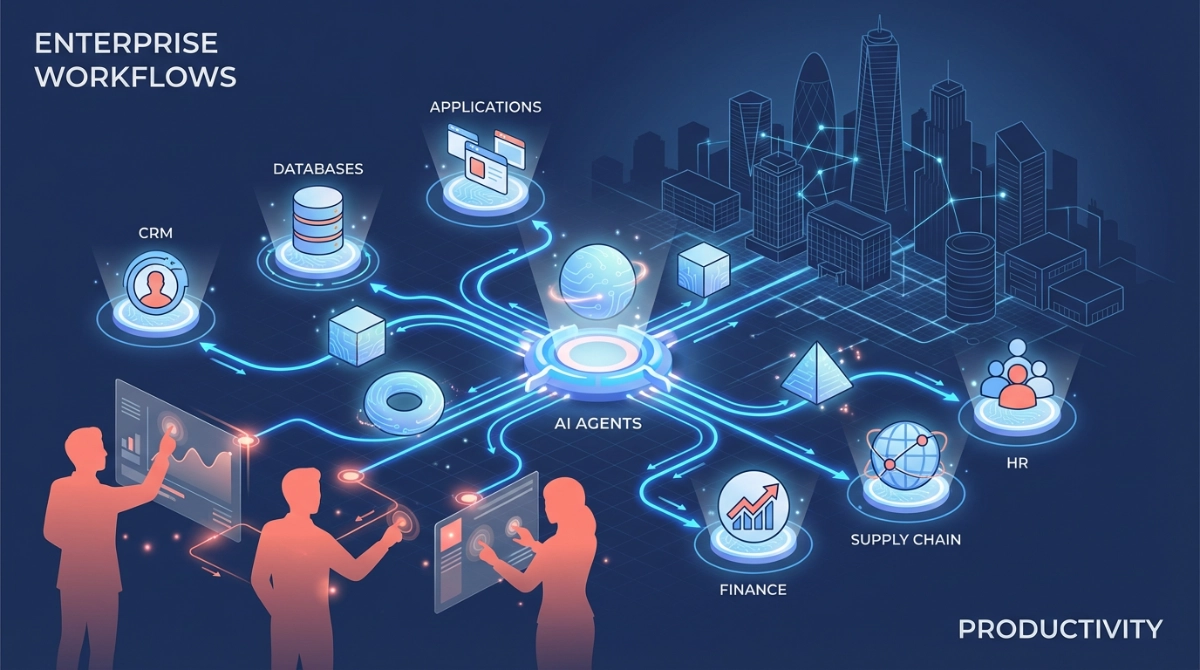
OpenAI’s Frontier platform directly tackles these barriers. The system functions as an intelligence layer connecting disparate enterprise systems—CRM platforms, data warehouses, ticketing tools, and internal applications—into a unified operational environment where AI agents can access shared business context and execute complex tasks (ℹ️ TechTarget).
What Happened
On February 5, 2026, OpenAI unveiled Frontier with immediate backing from six “first mover” enterprise customers. HP, Intuit, Oracle, State Farm, Thermo Fisher Scientific, and Uber are deploying AI agents through the platform, while BBVA, Cisco, and T-Mobile have piloted the approach for high-stakes operational workflows (ℹ️ Fortune).
The platform treats AI agents like digital employees, providing onboarding processes, performance evaluation systems, and permission-based access controls. These “AI coworkers” can work with files, execute code, use business applications, and build institutional memory through iterative learning from feedback.
“Partnering with OpenAI helps us give thousands of State Farm agents and employees better tools to serve our customers,” a State Farm representative stated in OpenAI’s announcement. “By pairing OpenAI’s Frontier platform and deployment expertise with our people, we’re accelerating our AI capabilities.”
Early performance metrics demonstrate substantial impact. According to OpenAI’s official release, a global financial services firm recovered 90% more time for client-facing teams, while a technology company saved 1,500 hours monthly in product development. A large energy producer reported AI agents contributed over $1 billion in additional revenue through optimized operations.
Why It Matters
This represents a fundamental shift in enterprise software architecture. Traditional SaaS platforms operate in silos, requiring manual integration and human coordination. AI agents’ enterprise adoption through Frontier enables autonomous cross-system operations—agents that can read from Salesforce, update SAP records, schedule via Google Calendar, and generate reports without human intervention for routine tasks (ℹ️ Axios).
For productivity-focused professionals, this means reclaiming thousands of hours from repetitive workflows. Sales teams can focus on relationship-building while agents handle CRM updates. Financial analysts can concentrate on strategy while agents compile data reports. Customer service representatives can tackle complex issues while agents manage standard inquiries.
The competitive landscape is intensifying rapidly. Anthropic launched Claude Cowork in January 2026, while Salesforce’s AgentForce targets similar enterprise automation. OpenAI holds 27% of the enterprise AI market, according to Menlo Ventures, making this platform launch critical for maintaining market leadership (ℹ️ WinBuzzer).
What’s Next
OpenAI CFO Sarah Friar expects enterprise customers to reach 50% of company revenue by the end of 2026, up from the current 40%. The company is expanding its Forward Deployed Engineers program, embedding technical experts within customer organizations to customize agent deployments for specific industry workflows.
Frontier remains in limited availability, with a broader rollout planned over the coming months. OpenAI has not disclosed pricing details, though the platform is positioned as complementary to existing ChatGPT Enterprise subscriptions rather than a replacement.
The platform supports open standards, including the Model Context Protocol, allowing enterprises to integrate AI agents from multiple vendors—including Google, Microsoft, and Anthropic—within the same management framework.
For businesses evaluating AI agents inside enterprise workflows, this marks an inflection point. The question is no longer whether to adopt autonomous AI agents but how quickly organizations can implement governance frameworks, train teams, and redesign workflows to leverage these productivity multipliers.
Source: Multiple sources including TechTarget, Fortune, Axios, and WinBuzzer
Published: February 5-6, 2026
Original coverage:
About the Author
This article was written by James Carter, a productivity coach specializing in AI-powered workflow optimization for enterprises. James helps organizations implement practical AI solutions that save time and boost operational efficiency without requiring extensive technical expertise. His focus is on translating complex AI capabilities into actionable strategies that deliver measurable productivity gains for business teams.