
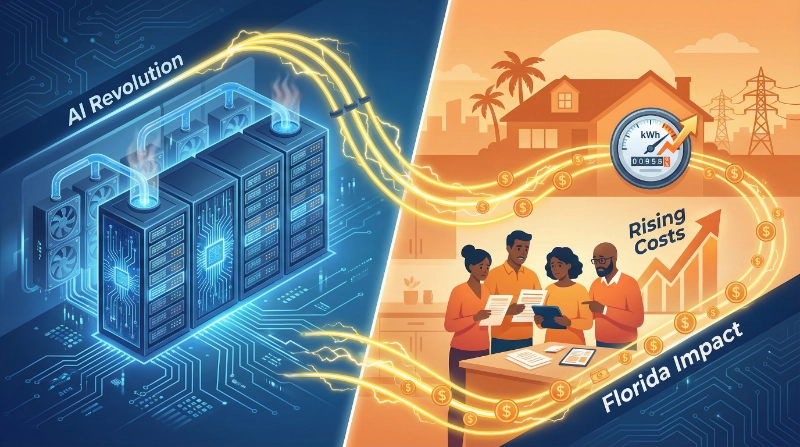
AI Revolution Hits Florida Wallets: The Hidden Cost of Progress
The Price of Progress Nobody Talked About
Blake Dowling and the tech community have long celebrated artificial intelligence as humanity’s next giant leap forward. But here’s what they didn’t put in the brochures: AI data centers are sending Florida electricity bills soaring, and residents are just now waking up to the reality of who’s paying for this digital revolution.
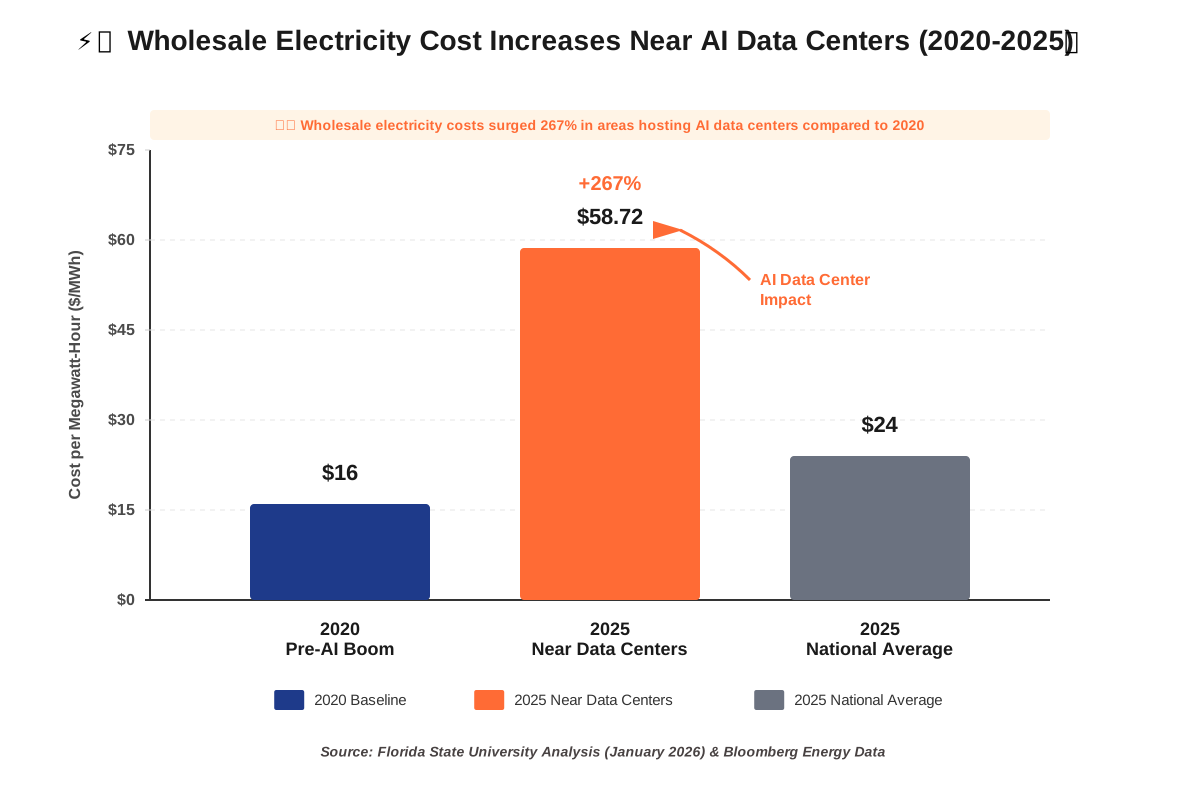
As Florida lawmakers wrestle with legislation to protect ratepayers, the numbers tell a startling story. According to Florida State University’s Mark McNees in their January 2026 analysis, wholesale electricity costs have surged as much as 267% in areas near data centers compared to five years ago (ℹ️ Florida State University).
Key Points
- Wholesale electricity costs near AI data centers have increased up to 267% in five years
- Florida Senate advances SB 484 requiring data centers to cover their infrastructure costs
- A single ChatGPT query consumes approximately 10 times more energy than a traditional Google search
- Florida Power & Light proposed rate hikes totaling $1.545 billion in 2026 to support AI infrastructure demands
Background: When Innovation Meets Infrastructure Reality
The artificial intelligence boom transformed from science fiction to economic powerhouse faster than anyone predicted. ChatGPT reached 100 million users in just two months—a feat that took Instagram two years and TikTok nine months to accomplish. But every query, every AI-generated image, and every machine learning model running in the cloud requires massive computational power housed in sprawling data center facilities.
These hyperscale AI data centers operate 24/7, consuming as much electricity as small cities while requiring millions of gallons of water for cooling systems. Florida, with its growing tech economy, tax incentives, and strategic location, became an attractive destination for these facilities. What nobody advertised was the hidden cost being transferred to everyday Floridians through their monthly utility bills.
What Happened: Florida Takes Action
On January 20, 2026, the Florida Senate Regulated Industries Committee unanimously approved Senate Bill 484, sponsored by Senator Bryan Avila (R-Miami Springs). The legislation establishes a regulatory framework requiring large data centers to bear their own full cost of service rather than shifting expenses to residential customers and small businesses (ℹ️ Center for Public Integrity).
The bill mandates that Florida’s Public Service Commission develop tariffs ensuring each large load customer—including AI data centers—covers costs related to grid connection, increased transmission, and power generation. Senator Jason Brodeur (R-Sanford) called data center regulation “one of the most important issues” lawmakers would address in 2026.
This legislative push comes after Florida Power & Light’s 2025 rate case, which already included specialized tariffs for large energy users, particularly in Southeast Florida’s Treasure Coast region, where significant transmission infrastructure exists.
Why It Matters: Beyond the Monthly Bill
The implications extend far beyond individual utility bills. AI infrastructure demands are fundamentally reshaping America’s power grid at a pace that infrastructure simply cannot match. According to analysis from FSU’s Mark McNees, the current utility system “was designed for an era when electricity demand grew only modestly year over year. That world ended when ChatGPT launched.” (ℹ️ Florida State University)
The numbers are staggering. AEP Ohio alone received requests for 30 gigawatts of new connections from data centers—enough to power 24 million homes. But here’s the catch: data center developers shop around multiple locations before committing to projects. When those projects don’t materialize, ratepayers are left funding “stranded infrastructure” that serves no one.
Nationally, residential electricity prices are forecast to rise another 4% in 2026 after increasing approximately 5% in 2025, according to the federal Energy Information Administration (ℹ️ CNBC). With cost of living dominating American politics, the impact of AI data centers on local communities is expected to play a significant role in the 2026 midterm elections.
Governor Ron DeSantis voiced concerns during a January 2026 event in The Villages: “We have a limited grid. You do not have enough grid capacity in the United States to do what they’re trying to do.” (ℹ️ The Invading Sea) This rare alignment between figures like DeSantis and Senator Bernie Sanders signals that a political reckoning is brewing over AI’s infrastructure impact.
What’s Next: Solutions on the Horizon
McNees and other experts propose practical solutions that could ease the burden on ratepayers while supporting AI growth:
Require Data Centers to Build Their Own Generation: Solar and battery storage now represent the cheapest and fastest ways to deploy new electricity capacity. When Meta built a data center in Aiken, South Carolina, it partnered with a solar developer to install 100 megawatts of on-site generation. The technology exists—policy needs to incentivize or mandate its deployment.
Reform Interconnection Rules: Utilities shouldn’t build infrastructure for speculative projects. Stricter requirements, like those AEP Ohio proposed, could require data centers to post more collateral or commit to specific electricity purchases before ratepayers assume risk.
Accelerate Renewable Deployment: Orders for new gas turbines face seven-year delays, while solar installations can be deployed in months. Renewables paired with batteries provide the “reliable, grid dispatchable” power that data centers need without the extended timeline.
Florida’s SB 484 represents a crucial first step. The legislation retains local governments’ authority to regulate land development and prevents state agencies from entering non-disclosure agreements regarding potential data center developments—ensuring transparency in a process that directly impacts residents’ wallets.
The Hidden Energy Appetite of AI
To understand why AI data centers consume so much power, consider the computational demands. A single ChatGPT query requires approximately 10 times more energy than a traditional Google search. Multiply that by billions of daily interactions worldwide, add continuous machine learning model training, and factor in the massive cooling requirements to prevent server meltdowns, and you begin to grasp the scale.
According to industry projections cited by The Washington Post, data centers could account for more than 10% of the country’s total power usage by 2030. (ℹ️ The Invading Sea) In Virginia, home to the world’s largest collection of data centers, these facilities already consumed approximately 26% of the commonwealth’s total electric supply in 2023, according to the Electric Power Research Institute.
What Floridians Can Do
While legislation works its way through Tallahassee, residents aren’t powerless. Here are practical steps to mitigate rising electricity costs:
- Monitor Local Development: Attend public hearings when data center projects are proposed in your area. House Bill 1007, filed by Rep. Philip Wayne Griffitts Jr., would require public hearings before approval and set rules for utility use.
- Consider Solar Investment: With utility rates climbing, residential solar systems offer predictable energy costs. The 30% federal solar tax credit remains available through 2025, providing significant savings for early adopters.
- Contact Representatives: Let state legislators know your concerns about ratepayer protection. SB 484 represents progress, but continued pressure ensures consumer interests remain prioritized.
- Stay Informed: Subscribe to Public Service Commission proceedings to understand how rate cases affect your utility bills.
The Bigger Picture: Innovation vs. Affordability
The AI revolution promises transformative benefits—from medical breakthroughs to productivity gains. But as Blake Dowling and other tech observers have long noted, technological progress shouldn’t come at the expense of everyday families struggling with rising living costs.
Florida stands at a crossroads. The state can lead in both AI innovation and consumer protection, but only with thoughtful policy that balances technological advancement with economic justice. As Senator Avila stated, “We want to maintain that we are at the forefront of technological advances, but we want to make sure we also strike that balance and make sure that we protect our ratepayers from higher electricity costs.” (ℹ️ The Invading Sea)
The decisions made in 2026 will determine whether Florida’s AI infrastructure growth becomes a shared economic opportunity or another burden on household budgets. With bipartisan concern mounting and midterm elections approaching, this isn’t just a utility issue—it’s a test of whether innovation can serve everyone, not just tech giants.
References
- Florida State University News. (2026, January 20). A Florida State University expert provides analysis on surging energy costs from artificial intelligence. https://news.fsu.edu/news/expert-pitches/2026/01/20/florida-state-university-expert-provides-analysis-on-surging-energy-costs-from-artificial-intelligence/
- Center for Public Integrity. (2026, January 20). Bill to regulate AI data centers advances in Florida Senate. https://www.cfpublic.org/politics/2026-01-20/bill-to-regulate-ai-data-centers-advances-in-florida-senate
- CNBC. (2026, January 1). Bernie Sanders and Ron DeSantis speak out against the data center boom. https://www.cnbc.com/2026/01/01/ai-data-centers-bernie-sanders-ron-desantis-electricity-prices.html
- The Invading Sea. (2026, January 14). DeSantis has warned about AI data centers. Lawmakers can act—don’t let us down. https://www.theinvadingsea.com/2026/01/14/hyperscale-data-centers-ai-florida-desantis-hb-1007-electricity-water-power-grid-utility-bills/
- The Invading Sea. (2026, February 5). Balancing act: Bills to both regulate and promote AI data centers in Florida advance to final committee. https://www.theinvadingsea.com/2026/02/05/ai-data-centers-florida-legislature-sb-484-1118-desantis-trump-public-records-energy-water/
About the Author
Alex Rivera is a creative technologist and tech journalist who helps non-technical audiences understand the real-world impact of emerging technologies. With backgrounds in both technology and storytelling, Alex specializes in translating complex AI developments into practical insights for everyday users. His work focuses on making technology accessible, inspiring, and empowering for everyone—from students to seniors. When he’s not writing about tech, Alex experiments with creative AI tools and mentors aspiring tech communicators. Connect with Alex to explore how technology shapes our daily lives and what it means for our collective future.