
AI Startups Spend Big on Super Bowl Ads Alongside Tech Giants
Key Points
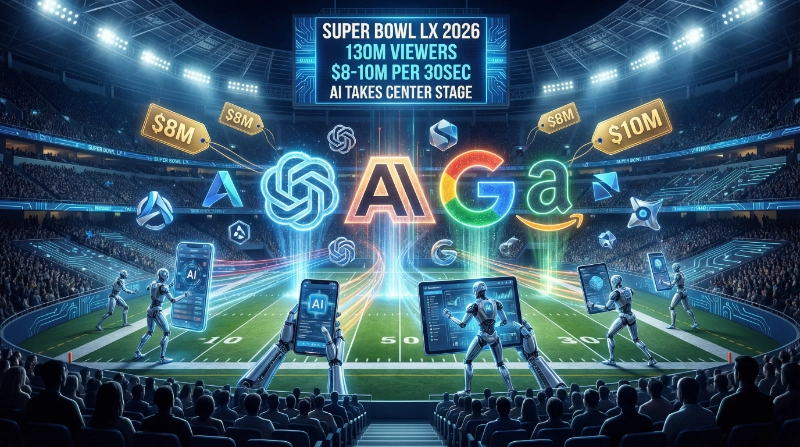
- AI Dominates Super Bowl Ads with record-breaking costs averaging $8 million for 30-second spots, reaching up to $10 million
- Tech giants OpenAI, Google, Amazon, Meta, and Anthropic competed alongside AI startups Genspark, Base44, and Wix for 130 million viewers
- Anthropic sparked controversy with ads mocking OpenAI’s decision to add advertisements to ChatGPT, triggering a public response from CEO Sam Altman
- Super Bowl LX marked the biggest AI advertising presence in the game’s history, with tech spending doubling since 2022’s “Crypto Bowl.”
- AI companies used the platform to showcase productivity tools, home assistants, and business automation solutions to mainstream audiences
Background
The Super Bowl has long been advertising’s most coveted platform, but “AI Dominates Super Bowl Ads” took on new meaning at Super Bowl LX on February 8, 2026. According to NBCUniversal’s Peter Lazarus, who oversees sports advertising and partnerships, tech and AI companies represented the strongest category growth in this year’s advertising lineup (ℹ️ Axios).
The trend marks a dramatic shift from traditional Super Bowl advertising categories like beer, snacks, and automobiles. With ad slots costing a record average of $8 million for 30 seconds—and some reaching $10 million—the stakes have never been higher for brands trying to capture attention (ℹ️ TechCrunch).
What Happened
Artificial intelligence companies dominated Super Bowl LX advertising in unprecedented numbers. Major tech players, including OpenAI, Google, Amazon, Meta, and Anthropic, purchased premium ad slots to showcase their AI productivity tools and consumer applications to an expected audience of 130 million viewers.
The advertising battle extended beyond established tech giants. AI startups entered the high-cost arena, with companies like Genspark featuring actor Matthew Broderick, Base44 promoting its app-development platform, and Wix showcasing its new Harmony AI-powered web design tool (ℹ️ CNBC).
The most notable controversy emerged when Anthropic launched a pre-game and in-game advertising campaign directly challenging OpenAI’s recent decision to introduce ads into ChatGPT. Anthropic’s commercial featured the tagline, “Ads are coming to AI. But not to Claude,” triggering a public response from OpenAI CEO Sam Altman, who called the ad “clearly dishonest.”
Why It Matters
The massive AI presence at Super Bowl LX signals a critical inflection point for artificial intelligence moving from niche technology to mainstream consumer adoption. Tech companies are investing unprecedented sums—with production costs typically starting at $1 million beyond the ad purchase price—to position their AI automation and productivity platforms as essential everyday tools.
Super Bowl advertising presents a crucial chance for startups to establish their brand recognition alongside industry giants. The willingness of emerging AI companies to spend $8–10 million on single ad spots demonstrates both competitive intensity in the AI sector and confidence in near-term market growth.
NBCUniversal’s Lazarus noted that AI companies approached advertising differently than traditional brands: “Each one of them talks a little bit differently about AI and how AI can improve your life and what it can do for you.” (ℹ️ Axios)
The advertising push also reflects strategic positioning as AI companies compete for consumer trust and enterprise adoption. From Google’s Gemini AI to Amazon’s Alexa+ home assistant to Meta’s Oakley AI glasses, companies used the platform to demonstrate practical, time-saving applications rather than abstract technology concepts.
What’s Next
The response to Super Bowl LX’s AI-heavy advertising will likely shape future marketing strategies across the technology sector. If these high-cost campaigns successfully drive user adoption and enterprise subscriptions, expect increased AI advertising in mainstream media throughout 2026.
Several trends emerged that may continue: AI-generated advertising content (like Svedka’s primarily AI-created commercial), direct competitive advertising between AI platforms, and emphasis on productivity enhancement and automation benefits rather than technical specifications.
Tech spending on Super Bowl advertising has doubled since 2022’s “Crypto Bowl,” suggesting sustained investment in mass-market consumer outreach despite the premium costs (ℹ️ Ad Age).
Source: TechCrunch, Axios, CNBC, Ad Age—Published on February 8-9, 2026
Original articles:
About the Author
James Carter is a productivity coach who helps people use AI to save time and boost efficiency. He specializes in breaking down complex AI developments into actionable insights that anyone can understand and apply to their daily work. James focuses on practical strategies for integrating AI tools into professional workflows without requiring technical expertise.