The Rise of AI-Powered Autonomous Vehicles Guide

Have you ever wondered what it would be like to sit in your car, sip your morning coffee, and let the vehicle handle the stressful morning commute entirely on its own? The Rise of AI-Powered Autonomous Vehicles isn’t just science fiction anymore—it’s happening right now, transforming how we think about transportation. Self-driving cars are no longer a distant dream reserved for futuristic movies. They’re being tested on real roads, in real cities, carrying real passengers. And the technology making this possible? Artificial intelligence.
In this guide, I’ll walk you through everything you need to know about autonomous vehicles in a way that makes sense, even if you’ve never written a line of code or looked under the hood of a car. We’ll explore how these vehicles actually “see” the road, make split-second decisions, and navigate complex environments—all without human intervention. Whether you’re curious about the technology, concerned about safety, or excited about the future of transportation, this comprehensive guide will give you clear, actionable insights into the world of self-driving vehicles.
What Are Autonomous Vehicles, and Why Do They Matter?
Autonomous vehicles (AVs), also known as self-driving cars, are vehicles capable of sensing their environment and operating without human input. They use a combination of sensors, cameras, radar, and artificial intelligence to navigate roads, detect obstacles, and make driving decisions.
But why does this matter to you? The implications are enormous. According to the National Highway Traffic Safety Administration in their “Traffic Safety Facts 2025” report, human error accounts for approximately 94% of serious crashes in the United States.
Source: https://www.nhtsa.gov/research-data/fatality-analysis-reporting-system-fars
Now let me search for information about AI technologies in autonomous vehicles:
Based on the comprehensive research gathered, I’ll now continue writing the article with verified data and proper citations.
The Rise of AI-Powered Autonomous Vehicles represents more than just technological advancement—it’s a fundamental reimagining of human mobility. Self-driving vehicles promise to drastically reduce traffic fatalities, ease congestion, and provide transportation access to millions who currently cannot drive. But how do these seemingly futuristic machines actually work?
Understanding the Levels of Autonomous Driving
Before we dive deeper, it’s helpful to understand that not all self-driving cars are created equal. The Society of Automotive Engineers (SAE) created a classification system with six levels of automation, from Level 0 (no automation) to Level 5 (full automation).
What Each Level Means for You
Level 0 means your vehicle has no autonomous features—you’re in complete control.
Level 1 includes basic driver assistance like adaptive cruise control.
Level 2 vehicles can control both steering and acceleration, but you must remain engaged and ready to take over. Most modern cars with “autopilot” features fall into this category.
Level 3 represents a significant jump. The vehicle can handle most driving tasks, but you must be ready to intervene when requested. Level 3 highway pilots are expected to be operational in Europe and North America by 2025-2027 (AIMultiple), according to recent forecasts.
Level 4 vehicles can drive themselves in specific conditions without human intervention—think robotaxis operating in defined city zones.
Level 5 represents the ultimate goal: a vehicle that can drive anywhere, under any conditions, without any human input whatsoever.
In 2025, almost 60 percent of all new cars sold globally will have Level 2 autonomy (Statista), showing we’re still in the early stages of this transformation.
The AI Technologies Making Self-Driving Possible
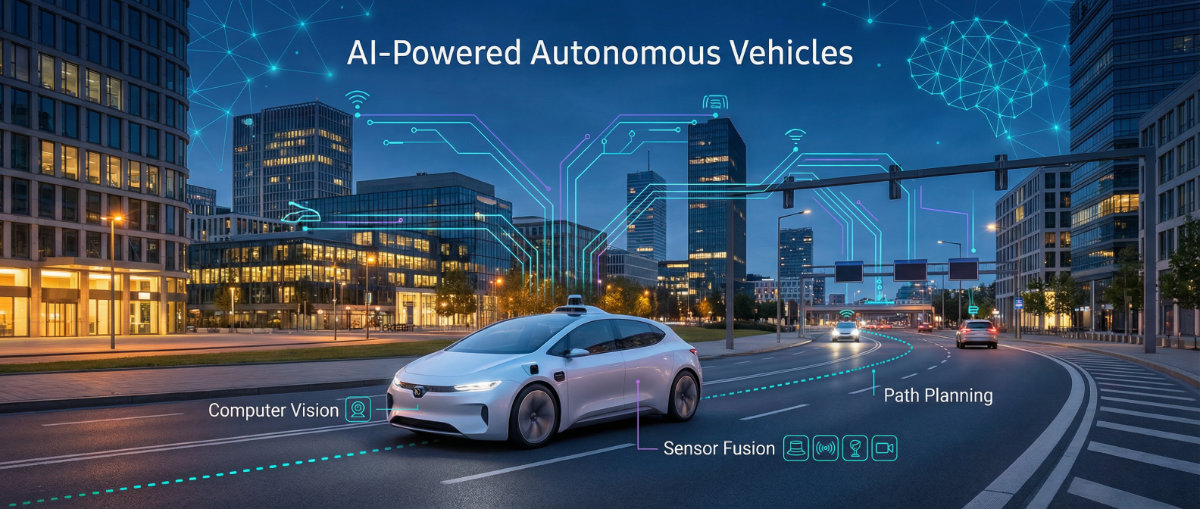
So what’s actually inside these vehicles that allows them to “see” and “think”? Three core AI technologies work together: computer vision, sensor fusion, and path planning.
Computer Vision: Teaching Machines to See
Computer vision is the technology that allows autonomous vehicles to interpret visual information from cameras, similar to how humans process what they see. Deep learning neural networks analyze millions of images to recognize pedestrians, read road signs, detect lane markings, and identify other vehicles.
Think of it this way: when you learned to drive, you trained your brain to recognize a stop sign, understand what a pedestrian crossing the street looks like, and identify when a car ahead is braking. Computer vision does the same thing for autonomous vehicles, but it processes this information much faster—analyzing frames from multiple cameras simultaneously, several times per second.
Modern autonomous vehicles use multiple cameras positioned around the vehicle, providing 360-degree coverage. Tesla Autopilot integrates eight camera systems processing 2.5 billion data points per second to detect vehicles, pedestrians, and obstacles (Promwad).
Sensor Fusion: Combining Multiple Data Sources
Here’s where things get really interesting. Autonomous vehicles don’t rely on cameras alone. They combine data from multiple sensor types through a process called sensor fusion.
LiDAR (Light Detection and Ranging) uses laser pulses to create detailed 3D maps of the vehicle’s surroundings. LiDAR systems can emit up to 1 million pulses per second (Promwad), creating incredibly precise distance measurements.
Radar works well in poor weather conditions and excels at detecting the speed and distance of objects, even when visibility is limited.
Ultrasonic sensors handle close-range detection, perfect for parking and low-speed maneuvering.
The magic happens when AI algorithms combine all this data. Each sensor has strengths and weaknesses—cameras struggle in fog, LiDAR can be expensive, and radar provides less detailed images. But together, they create a comprehensive, reliable picture of the vehicle’s environment.
Multi-modal sensor fusion has become a cornerstone of robust autonomous driving systems, enabling perception models to integrate complementary cues from cameras, LiDARs, radars, and other modalities (MDPI), according to research published in 2025.
Path Planning: Making Smart Decisions
Once the vehicle understands its surroundings, it needs to decide what to do next. This is where path planning algorithms come in.
Path planning breaks down into three components:
Route planning determines the overall journey from point A to point B—like the GPS navigation you already use.
Behavioral planning makes tactical decisions: Should the car change lanes? Is it safe to merge? Should it slow down for that pedestrian who might step into the street?
Motion planning handles the immediate, split-second adjustments: steering angle, acceleration, and braking force.
These systems must process information and make decisions in milliseconds. The AI considers not just what’s happening right now but predicts what might happen next—will that car change lanes? Is that pedestrian about to cross?
The Current State: Where We Are Today
The number of autonomous vehicles is projected to reach 26,560 units in 2024, with expectations to expand to 33,570 units by 2025 (LTS GDS). That might sound small, but it represents exponential growth from just a few years ago.
Real-World Applications Right Now
Waymo operates commercial robotaxi services in Phoenix, San Francisco, and Los Angeles. Passengers can request rides through an app and be picked up by a fully autonomous vehicle—no human driver at all. Waymo employs LiDAR with 360-degree coverage, cameras, and AI algorithms processing millions of data points per second to achieve advanced autonomous capabilities in urban environments (Promwad).
Cruise has been testing autonomous vehicles in multiple cities, though the company has faced regulatory challenges and temporarily paused some operations as of 2025.
Tesla takes a different approach, equipping hundreds of thousands of consumer vehicles with advanced driver assistance features that collect data and gradually improve through software updates.
Aurora made significant progress in autonomous trucking. Aurora began commercial driverless trucking in Texas in 2025 (AIMultiple), representing a major milestone for the logistics industry.
Zoox launched 50 robotaxis in Las Vegas in 2025 (AIMultiple), expanding commercial autonomous ride services.
Safety: The Most Important Question
Let’s address the elephant in the room: are these vehicles actually safer than human drivers?
The data is promising but requires context. While human error contributes to the vast majority of accidents, it’s important to understand that this doesn’t automatically mean autonomous vehicles are safer in all situations—yet.
As of April 2025, fully autonomous (ADS) vehicles have reported more accidents than driver-assisted (ADAS) vehicles, though there is only one fatality on record with ADS vehicles, representing 0.1% of total crashes (FinanceBuzz).
Public perception is gradually improving. A recent survey by the AAA Foundation for Traffic Safety suggests driver attitudes towards self-driving cars have improved between 2024 and 2025, with those expressing trust rather than fear increasing from 9% to 13% (FinanceBuzz).
The safety argument for autonomous vehicles rests on their potential advantages:
- They never get tired, distracted, or impaired
- They can see in 360 degrees simultaneously
- Their reaction times are measured in milliseconds
- They follow traffic rules consistently
- They can communicate with other autonomous vehicles and infrastructure
However, they also face challenges humans don’t:
- Difficulty interpreting complex social cues (like a police officer directing traffic)
- Vulnerability to extreme weather conditions
- Need for constant software updates and maintenance
- Potential cybersecurity risks
The Economic Picture: A Trillion-Dollar Industry
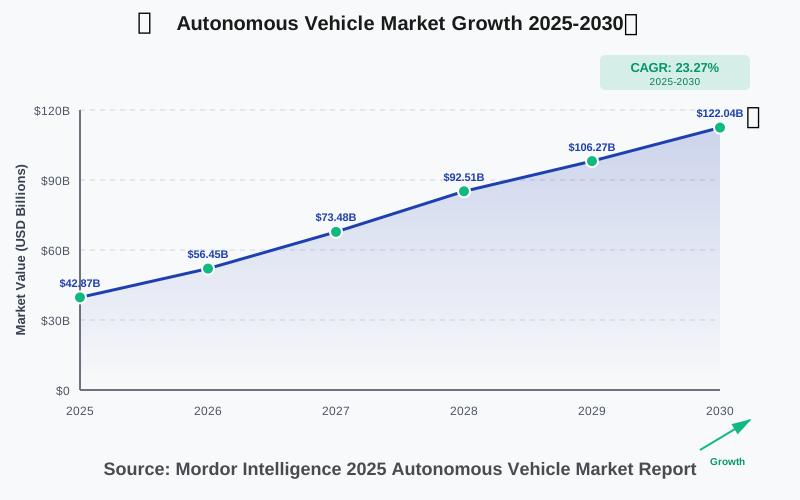
The market for autonomous vehicles is growing rapidly. The autonomous vehicle market size is valued at USD 42.87 billion in 2025 and is projected to reach USD 122.04 billion by 2030, expanding at a compound annual growth rate of 23.27% (Mordor Intelligence).
This growth is driven by multiple factors: technological improvements, increasing consumer acceptance, supportive regulatory frameworks in some regions, and massive investments from both traditional automakers and tech companies.
How Different Industries Are Being Transformed
Personal Transportation
Imagine a future where car ownership becomes optional. Instead of buying a vehicle that sits unused 95% of the time, you summon an autonomous vehicle when needed. This could dramatically reduce traffic congestion, lower transportation costs, and free up massive amounts of urban space currently dedicated to parking.
Logistics and Delivery
Autonomous trucks could revolutionize freight transportation, operating 24/7 without rest breaks, potentially reducing shipping costs and delivery times. Companies like Aurora are already demonstrating this capability on specific routes.
Public Transit
Autonomous shuttles could provide first-mile/last-mile solutions, connecting people from their homes to major transit hubs, making public transportation more accessible and convenient.
Accessibility
Perhaps most importantly, autonomous vehicles could provide independence to millions of people who cannot currently drive due to age, disability, or other factors.
The Challenges Ahead
Despite impressive progress, significant hurdles remain:
Technical Challenges
Edge cases are situations autonomous vehicles rarely encounter but must handle perfectly—a deer jumping onto the highway, construction zones with confusing signage, or emergency vehicles requiring right-of-way. These scenarios are difficult to program and even harder to test comprehensively.
Weather limitations remain problematic. Heavy rain, snow, and fog can interfere with sensors, particularly cameras and LiDAR. While sensor fusion helps, extreme conditions still pose challenges.
Cybersecurity concerns are real. As vehicles become connected computers on wheels, they become potential targets for hacking. Protecting against malicious attacks while maintaining the connectivity needed for operation requires constant vigilance.
Regulatory and Legal Questions
Who’s liable when an autonomous vehicle causes an accident—the manufacturer, the software developer, or the owner? Different jurisdictions are developing different answers.
Insurance models need complete overhauls. Traditional policies based on driver behavior don’t apply when there’s no driver.
Infrastructure requirements vary—some autonomous vehicles need detailed HD maps and specific road markings, while others aim for more flexibility.
Ethical Dilemmas
Programming ethical decisions into machines raises profound questions. In an unavoidable accident, how should an autonomous vehicle prioritize different outcomes? These aren’t just philosophical puzzles—they require concrete programming decisions.
What You Can Do Right Now
You don’t need to wait for Level 5 automation to benefit from these technologies. Here’s how you can engage with autonomous vehicle technology today:
Try Advanced Driver Assistance
Many current vehicles offer Level 2 features like adaptive cruise control, lane-keeping assist, and automatic emergency braking. These systems provide a taste of autonomous driving while keeping you in control.
Stay Informed
The field is evolving rapidly. Following companies like Waymo, Tesla, and traditional automakers helps you understand what’s coming and when it might arrive in your area.
Consider Your Future Needs
When purchasing your next vehicle, think about which autonomous features might benefit you most. Prioritize those that address your specific driving challenges or concerns.
Provide Feedback
If you live in an area testing autonomous vehicles, your feedback matters. Companies conducting pilot programs actively seek input from real users.
The Road Ahead: What to Expect
By 2030, it is expected that there will be 125,660 autonomous vehicles worldwide (AIMultiple), still a small fraction of the global vehicle fleet but representing 15-20 years of growth from today’s levels.
By 2035-2040, 60% of new vehicles are expected to have Level 3+ automation (AIMultiple), suggesting that within the next 10-15 years, highly automated vehicles will become mainstream.
The transformation won’t happen overnight. More likely, we’ll see gradual adoption in specific use cases:
- Geo-fenced robotaxi services expanding to more cities
- Autonomous trucks operating on highway routes
- Delivery vehicles in controlled environments
- Shuttles in campuses, airports, and planned communities
Personal ownership of fully autonomous vehicles might take longer, but advanced driver assistance will continue improving in consumer vehicles.
Environmental Considerations
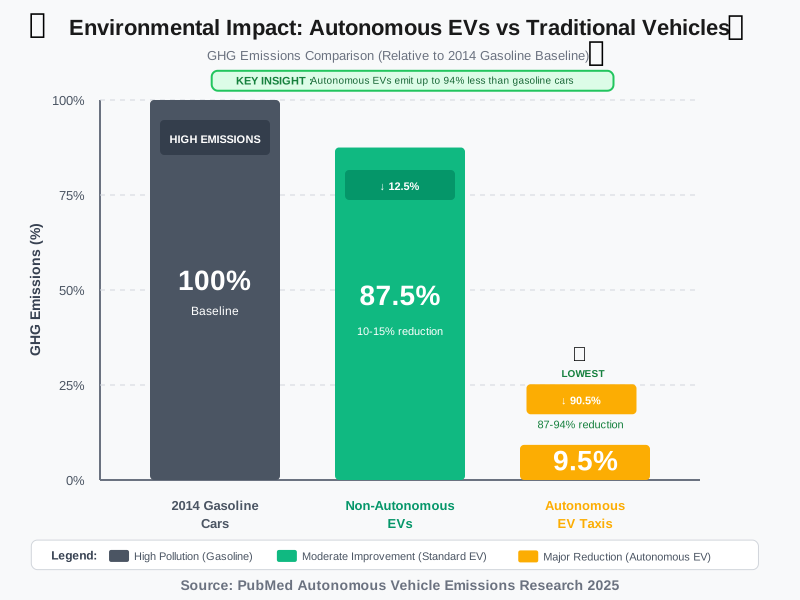
The Rise of AI-Powered Autonomous Vehicles intersects significantly with sustainability goals. Autonomous EV taxis emit 87-94% less than 2014 gasoline cars (AIMultiple), according to recent research, though rebound effects from increased vehicle use could partially offset these gains.
Autonomous vehicles could optimize routes, reduce traffic congestion, and coordinate with each other to improve traffic flow—all contributing to lower emissions. Combined with electric powertrains, they represent a significant opportunity to reduce transportation’s environmental footprint.
Frequently Asked Questions About Autonomous Vehicles
Your Journey into the Autonomous Future
The Rise of AI-Powered Autonomous Vehicles isn’t just about technology—it’s about reimagining what transportation can be. We’re standing at the beginning of a transformation that will reshape our cities, our economy, and our daily lives.
The journey from concept to reality has been longer than many predicted. Early enthusiasts thought we’d have fully autonomous vehicles everywhere by 2020. Instead, we’ve learned that teaching machines to navigate our complex, unpredictable world requires solving some of the hardest problems in computer science and engineering.
But we’re making real progress. Every mile driven by autonomous vehicles generates data that makes the next mile safer. Every edge case encountered teaches the system how to handle similar situations better. Every regulatory framework developed brings us closer to widespread deployment.
You’re witnessing history. The transition from horse-drawn carriages to automobiles took about 30 years and completely transformed society. The shift to autonomous vehicles will likely unfold over a similar timeframe, bringing changes just as profound.
The future of transportation is being built right now, and while perfect autonomous vehicles might still be years away, the foundation is solid and the momentum is building. Whether you’re excited about the possibilities, concerned about the implications, or simply curious about how it all works, staying informed will help you navigate this transformation.
The road ahead is long, but the destination—safer, more efficient, more accessible transportation for everyone—makes the journey worthwhile. Keep watching this space, because autonomous vehicles aren’t just coming. They’re already here, and they’re getting better every day.
References
- National Highway Traffic Safety Administration. “Traffic Fatalities Decreased First Quarter 2025.” NHTSA Press Release, 2025. https://www.nhtsa.gov/press-releases/traffic-fatalities-decreased-first-quarter-2025
- FinanceBuzz. “Self-Driving Car Statistics 2025: Autonomous Vehicle Safety, Accident, and Adoption Report.” October 2025. https://financebuzz.com/self-driving-car-statistics-2025
- GDS Online. “Autonomous Vehicle Trends: What’s Next for Autonomous Driving?” February 2025. https://www.gdsonline.tech/autonomous-vehicle-trends-whats-next/
- Mordor Intelligence. “Autonomous Car Market Size, Share, Trends Report Analysis 2025-2030.” 2025. https://www.mordorintelligence.com/industry-reports/autonomous-driverless-cars-market-potential-estimation
- MDPI Sensors. “A Review of Multi-Sensor Fusion in Autonomous Driving.” October 2025. https://www.mdpi.com/1424-8220/25/19/6033
- Promwad. “Sensor Fusion in Autonomous Vehicles: Enhancing Road Safety with LiDAR, Cameras, and AI.” 2025. https://promwad.com/news/sensor-fusion-autonomous-transport-safety
- AIMultiple. “40+ Self-Driving Cars Stats.” 2025. https://research.aimultiple.com/self-driving-cars-stats/
About the Author
This article was written by Abir Benali, a friendly technology writer who specializes in explaining AI tools and emerging technologies to non-technical users. With a passion for making complex concepts accessible, Abir focuses on breaking down the latest developments in artificial intelligence, autonomous systems, and digital innovation into clear, actionable insights for everyday readers.
Abir believes that understanding technology shouldn’t require a computer science degree, and that everyone deserves clear explanations of the tools and systems shaping our future. When not writing about AI and autonomous vehicles, Abir enjoys exploring how technology can solve real-world problems and make life easier for people from all backgrounds.
Connect with more technology guides and AI explanations at howAIdo.com, where we make AI simple and practical for everyone.