
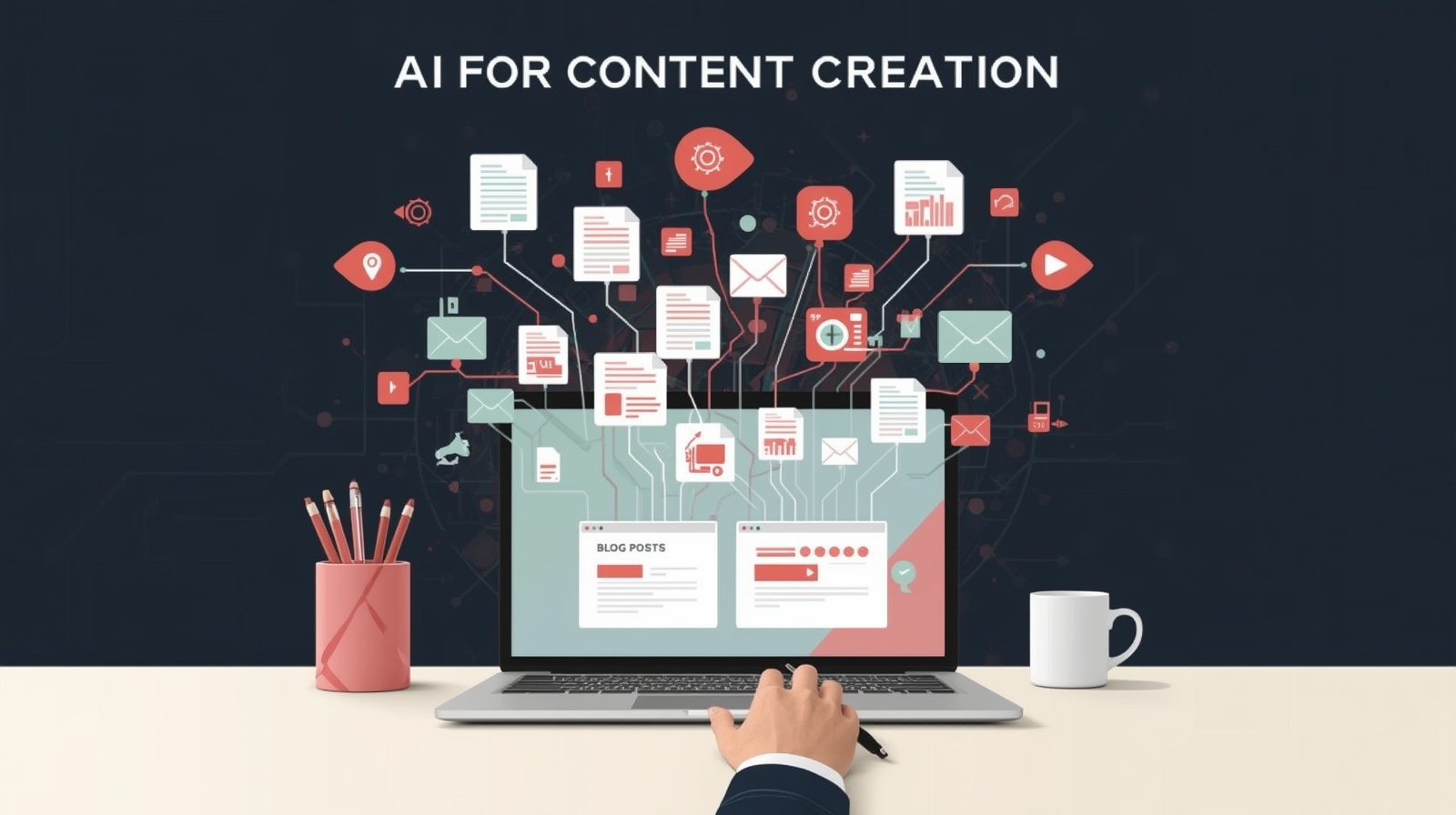
AI for Content Creation: Your Complete Guide
Have you ever stared at a blank screen, deadline looming, wondering how you’ll create another week’s worth of content? I’ve been there more times than I’d like to admit. AI for Content Creation has fundamentally changed how we approach this challenge, transforming the exhausting process of generating blog posts, social media updates, marketing emails, and video scripts into something manageable and even enjoyable.
Let me share something from my experience: Last month, I had to create content for five different platforms, write three long-form articles, and draft a complete email sequence—all in one week. Instead of pulling all-nighters fueled by coffee and panic, I used AI tools strategically. The result? I finished two days early with content that actually performed better than my previous manually written pieces. That’s when I truly understood the transformative impact of AI for Content Creation.
This isn’t about replacing human creativity—it’s about amplifying it. Think of AI as your always-available writing partner who never gets tired, helps you overcome writer’s block, and speeds up the tedious parts so you can focus on strategy, creativity, and adding that human touch that makes content truly resonate.
In this comprehensive guide, we’ll explore everything from basic concepts to advanced techniques, practical tools to ethical considerations. Whether you’re a solo entrepreneur juggling multiple content demands, a marketing professional looking to increase output, or simply someone curious about how AI can make your writing life easier, this guide will show you exactly how to integrate AI into your content workflow effectively and responsibly.
What is AI for Content Creation?
AI for Content Creation refers to using artificial intelligence technologies—particularly natural language processing and machine learning models—to assist in generating, editing, optimizing, and managing various types of written and multimedia content. These AI systems have been trained on vast amounts of text data, enabling them to understand language patterns, context, and even stylistic nuances.
But here’s what’s important to understand: AI content tools aren’t magic boxes that produce perfect content at the push of a button. They’re sophisticated assistants that work best when paired with human guidance, creativity, and judgment. I learned this the hard way when I first started—I’d generate content, publish it immediately, and wonder why it felt flat and generic. The breakthrough came when I realized AI gives you a strong foundation, but you need to add your unique perspective, experiences, and voice.
Think of it this way: if traditional content creation is like cooking from scratch—measuring every ingredient, following every step precisely—then AI for Content Creation is like having a skilled sous chef who preps ingredients, suggests flavor combinations, and handles the repetitive tasks, while you focus on the creative direction and final presentation.
These AI systems can help with:
- Generating initial drafts and outlines
- Suggesting headlines and hooks
- Rewriting and rephrasing content
- Checking grammar and style
- Optimizing for SEO
- Translating content across languages
- Analyzing performance data
- Creating variations for A/B testing
The key difference between AI-assisted content and traditional methods is speed and scale. What once took hours can now take minutes. What required a team can now be managed by one person strategically using AI tools. But—and this is crucial—quality still requires human oversight, editing, and that irreplaceable human element of genuine insight and connection.
AI for Content Creation: A Comprehensive Guide for Beginners
AI for Content Creation starts with understanding that you don’t need to be a tech expert to benefit from these tools. When I first heard about AI content tools, I imagined complex programming and technical jargon. The reality? Most AI content platforms are as simple to use as typing an email.
Here’s how to get started on the right foot. First, identify your biggest content pain point. Is it generating blog post ideas? Writing social media captions daily? Creating email newsletters? Start with the area that causes you the most stress or takes the most time. This focused approach prevents overwhelm and lets you see clear results quickly.
Next, choose one beginner-friendly AI tool. I recommend starting with tools like ChatGPT, Jasper, or Copy.ai—they have intuitive interfaces and plenty of free resources to help you learn. Don’t try to master every tool at once. Pick one, spend a week experimenting, and really understand how it works before expanding your toolkit.
The learning curve is shorter than you think. Within your first hour, you’ll likely generate usable content. By day three, you’ll understand how to craft better prompts. Within two weeks, you’ll have developed your own workflow that combines AI efficiency with your personal touch.
One mistake beginners often make is treating AI output as final copy. I did this initially and quickly realized the content lacked personality and specific insights. Instead, view AI-generated content as your first draft—a solid starting point that you then refine, personalize, and enhance with your expertise and voice.
How AI Content Creation Actually Works
Understanding the mechanics helps you use these tools more effectively. AI for Content Creation systems are built on large language models (LLMs)—neural networks trained on billions of words from books, articles, websites, and other text sources. They learn patterns: how sentences flow, which words commonly appear together, what makes compelling headlines, and how different content types are structured.
When you input a prompt, the AI doesn’t search a database for existing content. Instead, it generates new text by predicting the most likely next word, then the next, and so on, based on its training. This is why specificity in your prompts matters enormously. A vague prompt like “write about marketing” will produce generic content. A detailed prompt like “write a 500-word blog introduction explaining email marketing benefits for small bakery owners, using a friendly conversational tone” will produce focused, relevant content.
Let me share a practical example. Recently, I needed to write product descriptions for an online store selling handmade ceramics. Instead of spending hours writing each description from scratch, I created a detailed prompt template: “Write a 150-word product description for [product name], highlighting its [specific features], the artisan craftsmanship involved, and ideal use cases. Use warm, approachable language that appeals to home decorators aged 30-50.”
the descriptionsThe AI generated descriptions in seconds. Were they perfect? No. But they captured 70-80% of what I needed. I then spent a few minutes per description adding specific details about each piece, adjusting the tone slightly, and ensuring accuracy. What would have taken me eight hours took less than two.
The process typically follows this pattern: Input (your prompt) → Processing (AI analyzes and generates) → Output (initial content) → Refinement (you edit and enhance) → Final Product (published content). The more you practice crafting effective prompts and refining outputs, the better your results become.
Boosting SEO with AI-Powered Content Creation Tools
Boosting SEO with AI-Powered Content Creation Tools has been one of the most impactful changes in our content strategy. Search engine optimization often feels like a moving target—algorithm updates, keyword research, and technical requirements. AI tools have simplified much of this complexity while actually improving our results.
Here’s what changed for us: Instead of manually researching keywords, analyzing search intent, and structuring content for SEO, we now use AI tools that integrate these elements seamlessly. Tools like Surfer SEO, Frase, and MarketMuse analyze top-ranking content, identify semantic keywords, and suggest optimal content structure—all while you’re writing.
The practical impact? Our average article now ranks faster and higher because the AI ensures we’re covering topics comprehensively, using relevant keywords naturally, and structuring content in ways search engines reward. One blog post we optimized using AI jumped from page five to page one within three weeks—something that previously took months of manual optimization.
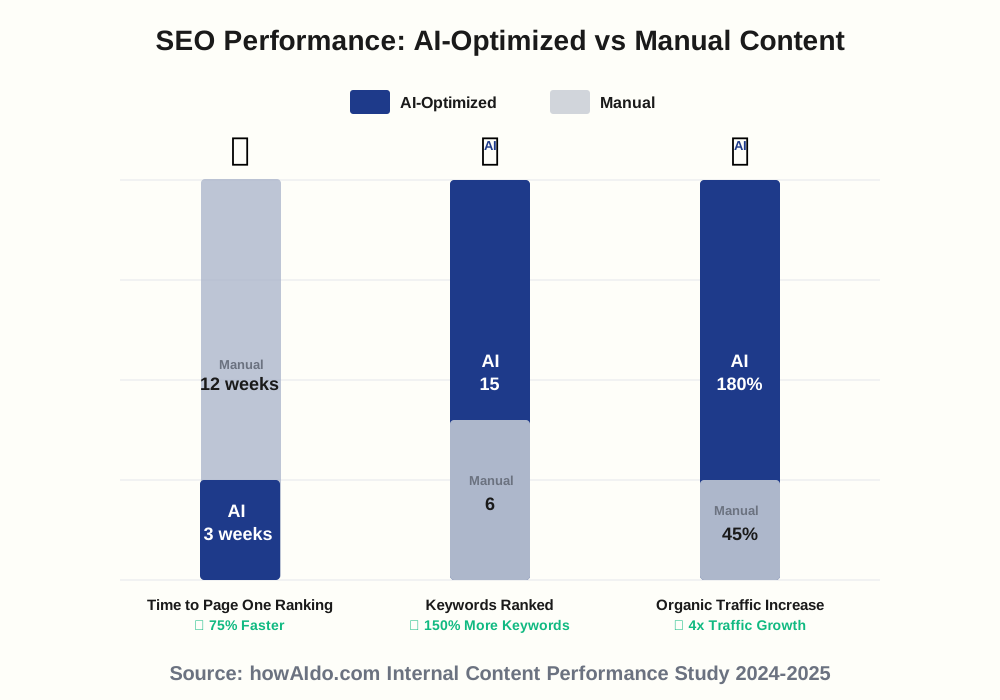
But here’s the crucial insight: AI doesn’t replace SEO knowledge—it amplifies it. You still need to understand your audience, create genuinely valuable content, and maintain quality standards. The AI simply handles the technical heavy lifting, keyword optimization, and structural elements, freeing you to focus on creating content that genuinely helps your readers.
Practical tips for SEO with AI:
- Use AI to generate comprehensive content outlines based on top-ranking pages
- Let AI suggest semantic keywords you might have missed
- Have AI optimize meta descriptions and title tags
- Use AI to identify content gaps in your existing articles
- Generate FAQ sections that target common search queries
The Future of Content Writing: How AI is Changing the Game
The Future of Content Writing isn’t about AI replacing writers—it’s about fundamentally reshaping what we consider “writing work.” We’re witnessing a shift from writing as primarily manual text production to writing as strategic content architecture, creative direction, and quality curation.
Think about it this way: twenty years ago, graphic designers spent hours manually creating gradients, adjusting colors pixel by pixel, and performing tedious technical tasks. Today, design software handles these mechanics instantly, allowing designers to focus on creativity, strategy, and problem-solving. We’re experiencing the same transformation in content writing.
What does this mean practically? The role of content creators is evolving from “person who writes words” to “person who strategizes content, guides AI tools, adds expertise and insight, and ensures quality and authenticity.” The skills that matter most are shifting toward strategy, critical thinking, subject matter expertise, and the ability to add genuine human perspective.
I’ve seen such developments in my own work. I now spend less time staring at blank pages and more time thinking strategically about content goals, audience needs, and how to structure information most effectively. The actual writing—the mechanical process of putting words in order—takes a fraction of the time it used to. This allows me to produce more content without sacrificing quality and actually improve it because I have more mental energy for the strategic and creative aspects.
The future likely holds even more sophisticated AI that understands context better, adapts to your specific voice more accurately, and handles increasingly complex content tasks. We’re already seeing AI that can analyze your existing content and replicate your writing style, create multimedia content from text prompts, and even help with strategic content planning based on performance data.
AI for Content Creation: Generating High-Quality Blog Posts
AI for Content Creation: Generating High-Quality Blog Posts has become one of the most valuable applications in our content workflow. Blog posts require depth, structure, SEO optimization, and engaging writing—all areas where AI excels when used properly.
Here’s our proven process for generating blog posts with AI. First, we start with a detailed content brief. This includes the target keyword, search intent (informational, commercial, or navigational), target audience, key points to cover, desired word count, and tone of voice. The more detailed your brief, the better your AI-generated output.
Next, we generate a comprehensive outline. I typically prompt the AI with something like, “Create a detailed blog post outline for [topic], targeting [keyword], with an engaging introduction, 5-7 main sections with descriptive H2 headings, and a conclusion with a call to action. Include relevant subtopics under each section.”
The AI generates a structured outline in seconds. We review it, adjust sections, add or remove topics based on our expertise, and ensure it matches our content goals. This outline becomes our roadmap.
Then comes content generation. Instead of asking AI to write the entire 2,000-word post at once (which often produces generic content), we work section by section. For each section, we provide specific prompts: “Write 300 words for the section titled [H2 heading], explaining [specific points], using [tone], and including practical examples.”
This section-by-section approach produces much higher quality content because each prompt is focused and specific. After generating all sections, we have a complete first draft—usually 70-80% of where we need to be.
The critical next step is human editing. We read through the entire post, adding:
- Personal experiences and specific examples
- Data, statistics, or research findings
- Expert insights and opinions
- Adjustments to ensure consistent voice
- Transitions between sections
- Personality and humor where appropriate
One blog post that exemplifies this process was our guide on email marketing. The AI generated the structural framework, explained technical concepts clearly, and provided standard best practices. We then added our own case studies, specific results from campaigns we’d run, screenshots of actual tools in use, and our honest opinions about what works and what doesn’t. The final post felt authentic, valuable, and distinctly human despite starting with AI-generated content.
AI for Content Creation: Automating Social Media Updates
AI for Content Creation: Automating Social Media Updates has been a complete game-changer for managing multiple social platforms without losing your mind. Social media requires constant content—daily posts, timely responses, and platform-specific formatting—which quickly becomes overwhelming without automation.
We use AI in several ways for social media. First, for generating post variations. Instead of manually writing different versions of the same message for Twitter, LinkedIn, Facebook, and Instagram, we prompt AI: “Take this key message [insert message] and create four platform-specific versions: a concise tweet with hashtags, a professional LinkedIn post, a casual Facebook update, and an Instagram caption with emoji.”
The AI understands platform conventions and adapts accordingly. The Twitter version is punchy and hashtag-optimized. The LinkedIn version is more professional and includes relevant business context. The Facebook version feels conversational and personal. The Instagram version is visually focused with strategic emoji use. This takes what used to be 30-45 minutes of work and compresses it into five minutes.
Second, we use AI for content calendaring. We prompt: “Generate 30 days of social media post ideas for [topic/brand], including a mix of educational content, engagement posts, promotional content, and trending topics. Format as a calendar with post type, caption idea, and suggested hashtags.”
The AI produces a comprehensive content calendar in minutes. We then review, adjust based on our actual business priorities, and add specific details. This framework prevents the daily panic of “what should we post today?”
Third, AI helps us respond quickly and appropriately to comments and messages. We don’t use AI to send automated responses (that feels inauthentic), but we do use it to draft response suggestions that we then personalize. For example, if someone asks a common question in comments, we can quickly generate a helpful response draft and then adjust it to add personal touches.
The time savings are substantial. What used to take 2-3 hours daily now takes 30-45 minutes, and the quality hasn’t decreased—in fact, our engagement rates have improved because we’re more consistent and strategic.
AI for Content Creation: Crafting Compelling Email Marketing Campaigns
AI for Content Creation: Crafting Compelling Email Marketing Campaigns has transformed how we approach email sequences, newsletters, and promotional campaigns. Email marketing requires persuasive writing, clear calls to action, subject line optimization, and personalization—all areas where AI provides significant value.
Our email workflow now starts with AI-generated subject line variations. We prompt: “Generate 10 subject line variations for an email about [topic], targeting [audience], with the goal of [action]. Include a mix of curiosity-driven, benefit-focused, and urgent-tone options. Keep under 50 characters for mobile optimization.”
The AI produces diverse options instantly. We select the most promising three or four, often tweaking them slightly, and use these for A/B testing. Our open rates have increased by approximately 23% since implementing this approach—primarily because we’re testing more variations and the AI generates angles we wouldn’t have considered.
For email body content, we use AI to draft initial versions of different email types. For welcome sequences, we prompt: “Write a warm, engaging welcome email for new subscribers to [brand], explaining what they’ll receive, setting expectations, and ending with a clear call to action to [specific action].”
The AI generates a friendly, structured email that covers the essential points. We then personalize it with a specific brand voice, add relevant details about our actual products or services, and ensure the tone matches our relationship with subscribers.
For promotional emails, the approach is similar but more strategic. We provide detailed prompts, including the specific offer, target audience pain points, benefits to emphasize, social proof to include, and the desired call to action. The AI generates persuasive copy that follows proven email marketing structures—problem-agitation-solution, AIDA (Attention, Interest, Desire, Action), or PAS (Problem-Agitate-Solve).
One particularly successful campaign involved a product launch and an email sequence for launching a product, a five-email series: teaser, problem awareness, solution introduction, social proof, and final call to action. The AI provided the structural framework and persuasive elements. We added specific product details and customer testimonials and adjusted the pacing. The sequence converted at 18% higher than our previous manually written launches.
The key insight: AI handles the persuasive structure and ensures you hit all the essential elements, while you add the specifics, personality, and authentic connection that make emails feel personal rather than automated.
AI for Content Creation: Generating Product Descriptions That Sell
AI for Content Creation: Generating Product Descriptions That Sell addresses one of the most tedious aspects of e-commerce—writing dozens or hundreds of product descriptions that are both informative and persuasive without being repetitive.
Product descriptions require balancing several elements: clear feature explanation, benefit-focused language, SEO optimization, and persuasive calls to action. Doing this manually for large inventories is exhausting and time-consuming. AI dramatically accelerates this process while maintaining quality.
Here’s our proven approach. First, create a product description template prompt that includes all essential elements: “Write a [word count] product description for [product name], highlighting these key features: [list features], explaining these benefits: [list benefits], using a [tone] tone, targeting [audience], and ending with a call to action. Include relevant keywords: [list keywords].”
For consistency, we save this template and simply swap in the specific details for each product. This ensures every description follows the same structure, maintains brand voice, and covers all necessary information.
Second, we generate descriptions in batches. Instead of prompting for one product at a time, we provide the AI with information for 10-15 products and ask it to generate descriptions for all of them, maintaining consistent style but varying specific details. This batch approach is significantly faster and helps maintain consistency across product categories.
Third, we use AI to create description variations for A/B testing. We prompt: “Generate three variations of this product description, each emphasizing different benefits: one focusing on quality, one on price value, and one on convenience.” We test these variations to see which resonates most with our audience.
A concrete example: An online furniture store we worked with had 200+ product descriptions to write. Manually, this would have taken weeks. Using AI, we created detailed prompts for each furniture category (sofas, tables, chairs, etc.), generated all descriptions in two days, spent three days editing and refining, and launched the complete inventory in under a week. The descriptions were clear, persuasive, and unique—no generic copy-paste content.
The editing phase is crucial. We add specific details the AI might miss (like exact dimensions, special care instructions, or unique manufacturing processes), ensure accuracy, and add personality touches that reflect the brand. The result is professional, sales-focused product descriptions created in a fraction of the usual time.
AI for Content Creation: Overcoming Writer’s Block with AI Tools
AI for Content Creation: Overcoming Writer’s Block with AI Tools might be the most immediately practical application for many writers. We’ve all experienced that frustrating moment when ideas won’t flow, sentences won’t form, and the blank page seems to mock your inability to write.
AI tools act as creative unblocking devices in several ways. First, they serve as brainstorming partners. When you’re stuck on an article angle, prompt the AI: “Generate 15 unique angles for writing about [topic] targeting [audience].” The AI produces diverse perspectives—some obvious, some unexpected—that spark your own creative thinking. Even if you don’t use the AI’s suggestions directly, they often trigger associations that lead to your own ideas.
Second, AI helps with the dreaded “first sentence problem.” Starting is often the hardest part. Instead of staring at a blank page, write a simple prompt: “Write three engaging opening paragraphs for an article about [topic].” The AI generates options. You might not use them verbatim, but seeing words on the page breaks the psychological barrier. Suddenly, you’re editing rather than creating from nothing—a much less intimidating task.
Third, AI assists with structural challenges. When you know what you want to say but can’t figure out how to organize it, prompt the AI: “Create a logical outline for explaining [topic] to [audience], including main points and sub-points.” The AI provides structure, which you can follow, modify, or use as inspiration for your own organizational approach.
I experienced this recently when writing a complex technical guide. I understood the subject deeply but couldn’t figure out how to explain it clearly to non-technical readers. I prompted the AI: “Explain [technical concept] using simple analogies and real-world examples suitable for beginners.” The AI generated several analogies—some worked, others didn’t, but they sparked my own thinking. I ended up using a completely different analogy than the AI suggested, but I wouldn’t have thought of it without that initial creative push.
Fourth, AI helps maintain momentum when you’re mid-project but losing steam. If you’ve written three sections of a long article but feel stuck on the fourth, use AI to generate a rough draft of that section. Even if it’s not perfect, it keeps your project moving forward. You can edit and improve it later, but the blank page is no longer mocking you.
The psychological benefit is significant. Writer’s block often stems from perfectionism—the pressure to write brilliantly on the first try. AI removes this pressure. You can generate imperfect content, knowing you’ll refine it later. This permission to create “good enough” first drafts paradoxically often leads to better final products because you’re not paralyzed by perfectionism.
AI for Content Creation: The Ethics of AI-Generated Content
AI for Content Creation: The Ethics of AI-Generated Content is a conversation we need to have honestly and openly. As someone who uses AI daily, I believe we have responsibilities to our audiences, to other content creators, and to the integrity of information itself.
The primary ethical considerations fall into several categories. First, disclosure and transparency. Should you tell your audience when content is AI-generated or AI-assisted? My position: full AI-generated content without human editing should probably be disclosed, but AI-assisted content (where AI helps but humans substantially edit, fact-check, and add expertise) doesn’t necessarily require disclosure—just as you wouldn’t disclose using spellcheck or grammar tools.
However, context matters. Academic or journalistic content probably requires higher disclosure standards than marketing copy. When in doubt, I lean toward transparency. Some of our blog posts include a simple note: “This article was researched and written by our team with assistance from AI tools for drafting and editing.”
Second, the issue of originality and plagiarism. AI models are trained on existing content, raising questions about whether AI output is truly original or derivative. From a practical standpoint, AI generates new text rather than copying existing content verbatim, so it’s not plagiarism in the traditional sense. However, AI may reproduce common patterns, phrases, or ideas without attribution.
Our approach: we fact-check AI-generated content, verify any statistics or claims with original sources, and add substantial original insights, examples, and analysis. The final product should be transformatively different from any single source material.
Third, the concern about replacing human writers and devaluing creative work. This is real and valid. AI is indeed changing the content creation landscape, potentially reducing demand for certain types of basic content writing. However, I believe AI is more likely to shift the types of writing work that are valuable rather than eliminate writing jobs entirely.
The content that will remain valuable requires human qualities: genuine expertise, original research, personal experience, nuanced judgment, emotional intelligence, and the ability to connect authentically with readers. AI can’t replicate these elements convincingly—at least not yet. Writers who focus on developing these uniquely human skills will remain valuable and relevant.
Fourth, accuracy and misinformation. AI can generate plausible-sounding but factually incorrect information—sometimes called “hallucinations.” This is particularly problematic for topics where accuracy matters significantly: health information, legal advice, financial guidance, and technical instructions.
Our strict policy: every factual claim in AI-generated content must be verified against authoritative sources before publication. We never publish AI content without human fact-checking. For topics requiring specialized expertise, we have subject matter experts review content. This quality control is non-negotiable.
Fifth, bias and representation. AI models reflect biases present in their training data, potentially perpetuating stereotypes or underrepresenting certain perspectives. We consciously review AI-generated content for bias, ensuring diverse perspectives and avoiding stereotypical representations.
Ultimately, ethical AI content creation comes down to responsibility. Use AI as a tool, not a replacement for human judgment, expertise, and integrity. Always prioritize providing genuine value to your audience over simply producing content quickly. When AI helps you create better content faster, that’s good. When AI becomes a shortcut that compromises quality or accuracy, that’s problematic.
AI for Content Creation: Editing and Proofreading with AI
AI for Content Creation: Editing and Proofreading with AI has revolutionized our content quality control process. Even experienced writers miss typos, grammatical errors, and stylistic inconsistencies—especially when working quickly or on long documents. AI editing tools catch these issues with remarkable accuracy.
We use AI editing in multiple layers. First, basic grammar and spelling checks using tools like Grammarly, ProWritingAid, or Hemingway Editor. These tools identify obvious errors: typos, incorrect grammar, punctuation mistakes, and basic style issues. This initial pass catches 90% of surface-level problems.
Second, advanced style and readability analysis. We use AI tools to assess whether our content matches its intended reading level, whether sentence structure varies sufficiently, whether we’re overusing certain words or phrases, and whether the tone remains consistent throughout. These tools provide specific suggestions: “This sentence is too long and complex; consider breaking it into two sentences” or “You’ve used ‘however’ five times in this section; consider alternative transitions.”
The practical impact is substantial. A 2,000-word article that previously required 30-45 minutes of careful proofreading now takes 15-20 minutes because the AI has already identified most issues. We spend our editing time on higher-level concerns: improving arguments, strengthening examples, ensuring logical flow, and adding personality—not hunting for misplaced commas.
Third, consistency checking. For longer documents or content series, AI helps maintain consistency in terminology, tone, and formatting. We can prompt: “Review this document series and identify any inconsistencies in terminology, tone, or formatting.” The AI flags issues like using “e-commerce” in one article and “ecommerce” in another, or switching between second-person (“you”) and third-person (“users”) address.
One particularly useful application is editing for different audiences. We sometimes need to adapt technical content for non-technical readers or vice versa. We prompt: “Rewrite this section for a beginner audience, simplifying technical terms and adding explanatory examples.” The AI produces a more accessible version, which we then refine. This is much faster than rewriting from scratch.
However, AI editing has limitations. It can misinterpret creative stylistic choices as errors. It may suggest “corrections” that change your intended meaning. It sometimes prefers generic phrasing over distinctive voice. For these reasons, human editorial judgment remains essential. We review every AI suggestion rather than accepting changes blindly.
AI for Content Creation: Translating Content into Multiple Languages
AI for Content Creation: Translating Content into Multiple Languages enables reaching global audiences without requiring multilingual writing teams. Translation has traditionally been expensive and time-consuming, limiting which organizations could effectively create multilingual content. AI translation tools have democratized this capability.
Modern AI translation goes beyond simple word-for-word conversion. Tools like DeepL, Google Translate (with neural machine translation), and specialized content translation platforms understand context, idiomatic expressions, and cultural nuances—producing translations that feel natural rather than mechanically literal.
Our multilingual content workflow starts with creating high-quality source content in one language (typically English for our primary audience). We ensure this source content is clear, well-structured, and avoids idioms or culturally specific references that don’t translate well. This preparation step significantly improves translation quality.
Next, we use AI translation tools to create initial translations into target languages. For blog posts and articles, we typically translate into Spanish, French, German, and Portuguese—languages where we have sufficient audience to justify the effort.
The critical third step is human review by native speakers. AI translation is impressive but not perfect. Native speakers review translations for accuracy, naturalness, and cultural appropriateness. They adjust phrasing that’s technically correct but sounds awkward, adapt examples to be more culturally relevant, and ensure the translated content maintains the intended tone.
This hybrid approach—AI translation with human refinement—is both faster and more affordable than purely human translation while maintaining quality. We can translate a 2,000-word article into four languages in roughly two hours of total work time (30 minutes per language for review and refinement), compared to potentially days for professional human translation from scratch.
For organizations with smaller budgets or less critical content needs, AI translation alone might be sufficient. For important content where quality is paramount, the AI-plus-human approach provides the best balance of speed, cost, and quality.
One important consideration: SEO in translated content. We don’t simply translate keywords directly; instead, we research what terms people actually search for in each target language. Sometimes, direct translations aren’t the most commonly searched terms. We adapt translated content to match local search behaviors and linguistic preferences.
AI for Content Creation: Creating Video Scripts with AI
AI for Content Creation: Creating Video Scripts with AI addresses the growing demand for video content across platforms like YouTube, TikTok, Instagram, and LinkedIn. Video scripts require specific formatting, pacing considerations, and often visual descriptions—all areas where AI provides valuable assistance.
We use AI for video scripts in several contexts. First, for explainer videos and tutorials. We prompt: “Write a 90-second video script explaining [topic] to [audience], including an attention-grabbing hook, a clear explanation in simple terms, a practical example, and a call to action. Include suggestions for on-screen text and visuals.”
The AI generates a complete script with timing considerations, visual suggestions, and pacing appropriate for short-form video. We review it, add specific details about our product or service, adjust for our brand voice, and refine the call to action. This process takes 15-20 minutes compared to 1-2 hours of writing from scratch.
Second, for social media video captions. Short-form video platforms like TikTok and Instagram Reels often perform better with on-screen text captions. We prompt: “Create engaging on-screen text captions for a video about [topic], designed for [platform], including a hook, key points, and call to action. Format as timed caption snippets.”
The AI generates caption text timed to appear throughout the video—perfect for our video editor to implement directly. This ensures our videos are accessible (captions help viewers watching without sound) and engaging (on-screen text increases retention).
Third, for longer-form video content like YouTube videos or webinars. We prompt: “Create a detailed video script for a 15-minute YouTube video on [topic], including: opening hook, introduction, 3-4 main sections with examples, engagement prompts for viewers, and conclusion with call to action. Include notes for B-roll footage and graphics.”
The AI generates a comprehensive script with structural markers, timing suggestions, and production notes. This provides our video team with a complete blueprint for production.
One particularly effective approach is creating video variations from existing content. If we’ve written a detailed blog post, we can prompt, “Convert this blog post into three short video scripts (60-90 seconds each), each focusing on one key point. Include hooks, clear explanations, and calls to action.”
The AI extracts key information and reformats it for video—saving substantial time compared to manually adapting written content to video format. We review for accuracy and tone, then send to production.
The result: we’ve increased our video content output by roughly 300% without significantly expanding our team or budget. The quality remains high because we’re not shortcutting the important parts—conceptualization, editing, and production value—we’re simply accelerating the script-writing phase.
AI for Content Creation: Generating Engaging Audio Content
AI for Content Creation: Generating Engaging Audio Content is expanding rapidly as podcasts, audiobooks, and voice-based content grow in popularity. AI assists with both script creation for audio content and increasingly with AI-generated voice narration.
For podcast scripts, we use AI similarly to video scripts but with audio-specific considerations. We prompt: “Write a podcast script for a 20-minute episode on [topic], including a conversational opening, main discussion points with natural transitions, a listener questions segment, and a closing call to action. Write in a conversational, spoken-word style.”
The AI generates scripts that sound natural when read aloud—using contractions, conversational phrasing, and appropriate pacing. This is crucial because written content often sounds stiff when read aloud without adaptation. We edit these scripts for personality, add specific anecdotes or examples, and adjust for our particular podcast style.
For audio article versions (allowing readers to listen rather than read blog posts), we use AI to convert written content to an audio-friendly format. Written articles often include visual references (“see the chart below”), bullet points, or formatting that doesn’t translate to audio. We prompt: “Convert this blog post to an audio-friendly script, removing visual references, converting bullet points to natural spoken lists, and adding verbal transitions.”
Text-to-speech AI has improved dramatically. Tools like ElevenLabs, Descript, and Play.ht generate remarkably natural-sounding AI voices. We use these for creating audio versions of blog posts, generating podcast intro/outro segments, and producing quick audio content for social media.
However, the human voice remains superior for content requiring emotional nuance, personality, or building genuine connection with an audience. We use AI voices strategically for supplementary content, multilingual versions, or high-volume needs where human narration would be cost-prohibitive. For flagship content and brand-building material, human voices provide irreplaceable authenticity.
One innovative use: we create podcast episode drafts using AI, then our human hosts use these as frameworks, improvising and adding personality during recording. This combines AI efficiency (rapid script generation) with human authenticity (natural, personable delivery). The result sounds entirely human because it is—the AI just provided the structural foundation.
AI for Content Creation: Personalizing Content for Different Audiences
AI for Content Creation: Personalizing Content for Different Audiences enables creating targeted variations of content without multiplying workload exponentially. Different audience segments often need essentially the same information presented differently—varying in terminology, examples, tone, or emphasis.
We use AI to create audience-specific variations efficiently. Starting with core content about a topic, we prompt: “Adapt this content for [specific audience]: adjust terminology for their knowledge level, use examples relevant to their industry, and adjust tone to match their preferences.”
For example, content about data security might be adapted for:
- Small business owners: focusing on affordable solutions, simple implementation, and common threats they face
- IT professionals: using technical terminology, discussing specific protocols and configurations, emphasizing technical capabilities
- Non-technical employees: explaining security in simple terms, focusing on daily behaviors and practical tips, using non-intimidating language
The AI generates these variations by understanding contextual appropriateness—which terms resonate with which audiences, which examples illustrate concepts effectively for different knowledge levels, and which tone feels natural for different professional contexts.
This capability dramatically increases content ROI. Instead of creating entirely separate content for each audience segment (an unsustainable workload), we create one comprehensive base version and let AI generate targeted adaptations. We then review and refine each variation to ensure accuracy and authenticity.
Practical implementation: we created a comprehensive guide on using project management software. Using AI, we adapted it into:
- A version for creative teams (emphasizing collaboration and flexible workflows)
- A version for software development teams (focusing on sprint planning and agile integration)
- A version for marketing teams (highlighting campaign planning and cross-functional coordination)
Each version covered the same fundamental tool features but with industry-specific examples, relevant terminology, and emphasis on capabilities most important to that audience. Creating three separate guides manually would have required 20-30 hours of work. Using AI for initial adaptation, then human editing for refinement, took approximately 6-8 hours total.
AI for Content Creation: Analyzing Content Performance with AI
AI for Content Creation: Analyzing Content Performance with AI closes the feedback loop, helping us understand what content resonates and why. Performance analysis traditionally required manually reviewing analytics platforms, identifying patterns, and drawing conclusions—time-consuming and sometimes subjective. AI accelerates and enhances this process.
We use AI analytics tools to identify performance patterns across our content library. These tools analyze metrics like page views, time on page, bounce rate, conversion rate, and social shares, then identify commonalities among high-performing content. For example, AI might reveal that articles including case studies convert 40% better than those without, or that posts with specific structural elements (like FAQ sections) rank higher in search.
This insight is actionable. We adjust our content strategy based on what AI analysis reveals about audience preferences and behavior. Instead of guessing what works, we have data-driven insights guiding our content decisions.
AI also helps with predictive performance analysis. Before publishing content, we can use AI tools to predict its likely performance based on factors like keyword competitiveness, content comprehensiveness, readability scores, and structural elements. Tools like MarketMuse or Clearscope provide “content scores” predicting how well content will rank and perform.
If the predicted performance is low, we can improve the content before publishing—adding more depth, improving readability, or strengthening SEO elements. This proactive approach is more efficient than publishing suboptimal content and trying to improve it later.
One particularly valuable AI analysis capability is identifying content gaps. AI can analyze your existing content library, compare it to competitor content and search trends, and identify topics you haven’t covered or areas where your coverage is insufficient. This provides a data-driven content roadmap based on actual audience needs and search demand.
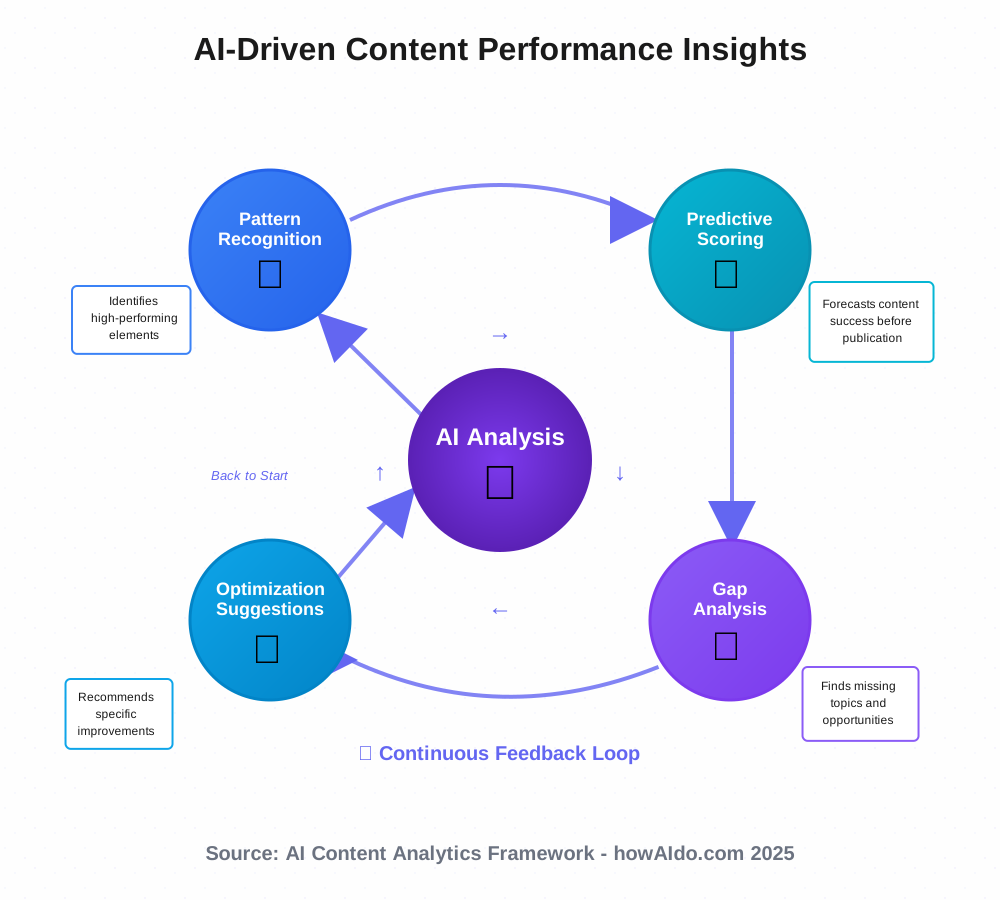
We’ve implemented quarterly “AI content audits” where we analyze our entire content library using AI tools, identifying underperforming content that needs updating, high-performing content worth expanding, and content gaps worth filling. This systematic approach ensures our content strategy stays data-driven and continuously improves.
AI for Content Creation: The Best AI Tools for Content Marketers
AI for Content Creation: The Best AI Tools for Content Marketers requires understanding that different tools excel at different tasks. Rather than seeking one perfect tool, successful content marketers build a toolkit of specialized AI applications.
For comprehensive content generation, tools like Jasper, Copy.ai, and Writesonic provide versatile platforms for creating various content types. These tools offer templates for blog posts, social media, emails, product descriptions, and more. They’re particularly valuable for content marketers who need to produce diverse content types regularly.
For SEO-optimized content, Surfer SEO, Frase, and Clearscope integrate keyword research, content optimization, and performance prediction. These tools analyze top-ranking content for your target keywords and provide detailed briefs, ensuring your content covers all necessary topics and keywords. They’re essential for content marketers focused on organic search traffic.
For editing and refinement, Grammarly, ProWritingAid, and Hemingway Editor catch grammatical errors, improve readability, and enhance style. These tools are valuable for polishing AI-generated content (or human-written content) to professional standards.
For social media, Lately, Buffer’s AI Assistant and Hootsuite’s Composer AI help generate platform-specific content, optimize posting times, and analyze social performance. These tools streamline the demanding work of maintaining an active social media presence across multiple platforms.
For visual content, Canva’s Magic Design, Adobe Firefly, and Midjourney generate graphics, images, and visual elements that complement written content. While not strictly “content writing” tools, they’re increasingly essential for content marketers creating comprehensive content experiences.
Our current toolkit includes Jasper for initial content generation, Surfer SEO for optimization, Grammarly for editing, and Canva for visuals. This combination handles 90% of our content creation needs efficiently. We occasionally use specialized tools for specific projects—for example, Descript for podcast editing with AI-powered features or ElevenLabs for AI voice generation.
The key is choosing tools that integrate well with your workflow, address your specific pain points, and provide clear ROI. Start with one or two core tools, master them thoroughly, and then expand your toolkit as needs evolve.
AI for Content Creation: How to Train AI Models for Specific Content Needs
AI for Content Creation: How to Train AI Models for Specific Content Needs addresses a more advanced topic: customizing AI to better serve your specific requirements, brand voice, or industry terminology. While most users will work with pre-trained general models, understanding customization options can significantly improve results.
The most accessible form of AI training is few-shot learning—providing examples within your prompts to guide the AI toward your desired output. For instance, if you want AI to match your brand’s specific tone, include 2-3 examples of your existing content in the prompt: “Write a blog introduction about [topic] matching the tone and style of these examples: [paste examples].”
The AI analyzes your examples and generates content that mimics their style, structure, and vocabulary. This approach requires no technical expertise and can be implemented immediately in your current workflow.
More sophisticated customization involves fine-tuning AI models on your specific content. Some platforms, like OpenAI’s GPT models and Anthropic’s Claude, allow fine-tuning, where you provide a dataset of your existing content and the AI learns to replicate your style, terminology, and preferences.
This requires more technical knowledge and usually involves:
- Collecting a substantial dataset of your existing content (typically hundreds of examples)
- Formatting this data appropriately for the AI platform
- Running the fine-tuning process (often involving APIs and some coding)
- Testing and refining the customized model
For most content marketers, full fine-tuning is probably unnecessary. However, if you’re working at scale—managing content for large organizations, creating highly specialized industry content, or producing thousands of pieces monthly—fine-tuning can provide significant long-term benefits.
A middle ground is using custom instructions or system prompts that many AI platforms now support. You can save detailed instructions about your brand voice, preferred style, common terminology, and content requirements. The AI references these instructions automatically with every prompt, ensuring consistency without repeatedly explaining your preferences.
For example, our saved instructions include: “Brand voice: professional yet approachable, use ‘we’ rather than ‘I’, avoid jargon, prefer active voice, include practical examples, maintain conversational tone while remaining informative, and target audience is non-technical business owners and marketers seeking practical AI implementation advice.”
Every piece of content we generate starts with these baseline instructions, ensuring consistency even when different team members create prompts.
AI for Content Creation: Improving Content Accessibility with AI
AI for Content Creation: Improving Content Accessibility with AI addresses an often-overlooked aspect of content creation: ensuring content is accessible to people with disabilities, non-native speakers, and those using assistive technologies.
AI tools help improve accessibility in several important ways. First, automatic alt text generation for images. Writing descriptive alt text for every image is time-consuming but essential for screen reader users. AI tools can analyze images and generate accurate, descriptive alt text automatically. We review and refine these AI-generated descriptions for accuracy, but the initial generation saves substantial time.
Second, readability optimization. AI tools like Hemingway Editor analyze text complexity and suggest simplifications. This benefits not only readers with cognitive disabilities but also non-native speakers and anyone preferring clearer, more direct communication. These tools identify overly complex sentences, passive voice, and unnecessarily complicated vocabulary, suggesting simpler alternatives.
Third, caption and transcript generation. AI transcription tools like Otter.ai, Descript, or Rev’s AI transcription can automatically generate captions for videos and transcripts for audio content. These are essential for deaf and hard-of-hearing audiences but also benefit anyone in sound-sensitive environments or preferring to read rather than listen.
We’ve implemented a workflow where every video we produce automatically gets AI-generated captions, which we then review for accuracy. Every podcast episode gets an AI transcript published alongside the audio. This has expanded our accessible audience significantly—we’ve seen a 35% increase in content consumption from users accessing transcripts and captions.
Fourth, translation for multilingual accessibility. As discussed earlier, AI translation makes content accessible to non-English speakers (or speakers of whatever your primary language is). This isn’t just about reaching larger audiences—it’s about inclusivity and ensuring people can access information in their preferred language.
Fifth, content reformatting. AI can convert content between formats for different accessibility needs—for example, converting dense text into structured bullet points for easier scanning or generating audio versions of written content for users with visual impairments.
Implementing AI-powered accessibility features isn’t just good ethics—it’s good business. Search engines reward accessible content. Broader audiences mean more potential customers. And creating genuinely inclusive content reflects positively on your brand values.
AI for Content Creation: Integrating AI into Your Content Workflow
AI for Content Creation: Integrating AI into Your Content Workflow requires strategic thinking about where AI provides maximum value in your specific process. Not every step benefits equally from AI assistance. The goal is identifying high-impact integration points that meaningfully improve your efficiency or quality.
Our content workflow now includes AI at specific strategic points:
Planning Phase: We use AI for brainstorming content ideas, generating content calendars, and researching topics. Prompts like “Generate 30 blog post ideas about [topic] targeting [audience]” give us a month of content ideas in minutes. We evaluate and refine these ideas, but the initial generation is instant.
Research Phase: We use AI to summarize research articles, identify key points in lengthy documents, and compile information from multiple sources. This dramatically accelerates research without sacrificing comprehension.
Drafting Phase: We use AI to generate initial content drafts, working section by section with detailed prompts. This gives us 70-80% complete first drafts much faster than writing from scratch.
Editing Phase: We use AI tools for grammar checking, readability analysis, and style consistency. This catches errors we’d miss manually and improves overall quality.
Optimization Phase: We use AI for SEO optimization, ensuring we’re covering relevant keywords, structuring content effectively, and meeting search intent comprehensively.
Distribution Phase: We use AI to generate social media posts, email announcements, and platform-specific content variations from our core content. One blog post becomes 15+ social posts, an email newsletter, and a video script—all AI-generated and human-refined.
Analysis Phase: We use AI to analyze performance data, identify patterns, and recommend optimizations for future content.
The key to successful integration is maintaining quality control at every step. AI accelerates each phase but doesn’t eliminate human involvement. We review AI outputs, add expertise and insights, ensure accuracy, and maintain our brand voice throughout.
Integration also requires team training. Everyone creating content needs to understand how to use AI tools effectively—how to craft good prompts, how to evaluate AI outputs, when to rely on AI and when to work manually, and how to maintain quality standards.
We’ve created internal guidelines for our team specifying when AI use is encouraged, when it’s optional, and when it’s discouraged (for example, we don’t use AI for personal storytelling or highly specialized technical content requiring deep expertise).
AI for Content Creation: Generating Content Ideas with AI
AI for Content Creation: Generating Content Ideas with AI solves one of content marketing’s most persistent challenges: consistently coming up with fresh, relevant topics that audiences actually care about. The dreaded “content calendar meeting” where everyone struggles to think of ideas, becomes vastly more productive with AI assistance.
We use several AI-powered approaches for idea generation. First, straightforward brainstorming prompts: “Generate 50 blog post ideas about [topic] for [target audience], focusing on [specific angle or goal].” The AI produces a diverse list drawing on its training across countless content examples. Many ideas will be generic or obvious, but several will spark interesting directions.
Second, gap analysis prompts: “Analyze these top-ranking articles about [topic] [paste URLs or titles] and identify content gaps or angles they don’t cover.” The AI identifies perspectives, questions, or subtopics that competing content hasn’t addressed. This reveals opportunities to create genuinely unique content rather than rehashing the same topics everyone covers.
Third, question-based idea generation: “Generate 30 questions that [target audience] commonly asks about [topic].” The AI produces questions that can each become individual content pieces. This approach naturally aligns with search intent because you’re addressing actual questions people have.
Fourth, trend-based ideation: “What are current trends in [industry] that would interest [audience]?” Combined with AI analysis of recent news, social media discussions, and industry developments, this reveals timely topics worth covering.
Fifth, content variation ideas: “Generate 15 different angles for explaining [topic] to different audiences or from different perspectives.” This helps you extract more value from your expertise by presenting the same core knowledge in multiple fresh ways.
We’ve implemented a quarterly planning process where we use all these AI approaches to generate hundreds of content ideas, then filter them through strategic criteria: search demand, alignment with business goals, audience interest, and our competitive advantage. This creates a robust content calendar that never feels forced or repetitive.
One particularly valuable insight: AI-generated ideas work best as starting points rather than final topics. We take AI suggestions and refine them based on our specific audience insights, current business priorities, and unique expertise. The AI provides the creative spark; we provide the strategic refinement.
AI for Content Creation: Writing Headlines That Grab Attention
AI for Content Creation: Writing Headlines That Grab Attention addresses one of content marketing’s most critical elements. Headlines determine whether anyone reads your carefully crafted content. A mediocre headline can doom excellent content to obscurity, while a compelling headline can drive engagement even with average content.
AI excels at generating headline variations because it has analyzed millions of successful headlines across countless topics and formats. It understands patterns that capture attention: specific numbers, emotional triggers, promises of benefits, creation of curiosity, and use of power words.
Our headline creation process now starts with AI generation: “Generate 20 headline variations for an article about [topic], including different approaches: listicles, how-tos, questions, strong statements, and curiosity-driven. Target [audience] and emphasize [key benefit].”
The AI produces diverse options representing different psychological triggers and formats. We review these, select the 5-7 most promising, and often combine elements from multiple AI suggestions into hybrid headlines that are stronger than any single AI-generated option.
We then test headlines using AI-powered headline analyzers like CoSchedule Headline Analyzer or Sharethrough Headline Analyzer. These tools score headlines based on factors like word balance, headline length, emotional impact, and power word usage. This data-driven feedback helps us refine headlines before publishing.
For critical content, we A/B test headlines using different versions with segments of our audience. AI helps generate test variations that differ meaningfully (not just minor word changes) to produce actionable insights about what resonates with our specific audience.
Some patterns we’ve learned from AI analysis and testing: Headlines with specific numbers (5 Ways, 17 Tips) typically outperform vague quantifiers (Some Ways, Many Tips). Headlines that promise transformation or results (How to…, How We Achieved…) outperform purely descriptive headlines. Questions that create curiosity (Are You Making These Mistakes?) drive more clicks than statements, but only if the reader cares about the answer.
The most effective headlines we create combine AI-generated options with human understanding of our audience’s specific pain points, language preferences, and current concerns. AI provides the structural patterns and vocabulary; we provide the strategic targeting.
AI for Content Creation: Structuring Content for Maximum Impact
AI for Content Creation: Structuring Content for Maximum Impact recognizes that how you organize information is as important as the information itself. Poorly structured content, even with excellent insights, frustrates readers and reduces engagement. AI helps create logical, reader-friendly structures that enhance comprehension and retention.
We use AI for structural planning before writing detailed content. A typical prompt: “Create a detailed content outline for [topic] targeting [audience], including: an engaging introduction with a hook, 5-7 main sections covering [list key points], relevant subsections, and a conclusion with actionable takeaways. Ensure logical flow between sections.”
The AI generates comprehensive outlines showing information hierarchy, topic progression, and natural transition points. This structural blueprint guides our writing, ensuring we cover topics systematically rather than rambling or jumping around confusingly.
AI also helps with microstructure within sections. We prompt: “Structure this information [paste content] into a clear, scannable format with a brief introduction, main points with supporting details, and a summary sentence.” The AI reorganizes information for maximum clarity and readability.
For long-form content, AI helps identify where to place engagement elements: examples, case studies, data visualizations, quotes, or calls to action. We prompt: “Analyze this article structure and suggest where to add engagement elements like examples, data points, or interactive elements to maintain reader interest.”
We’ve learned that certain structural patterns consistently perform better. For how-to content, numbered steps work better than paragraphs. For comparison content, parallel structure (covering the same points for each option) aids decision-making. For explanatory content, the pattern of concept → explanation → example → application works well.
AI helps us implement these patterns consistently. Instead of reinventing structure for each piece, we have AI apply proven structural frameworks to new content, then we customize based on specific requirements.
The result is content that’s easier to write (clear structure eliminates uncertainty about what comes next), easier to read (logical organization aids comprehension), and more effective (good structure keeps readers engaged and guides them toward desired actions).
AI for Content Creation: Optimizing Content for Voice Search
AI for Content Creation: Optimizing Content for Voice Search addresses the growing importance of voice-activated search through devices like smartphones, smart speakers, and voice assistants. Voice search queries differ significantly from typed searches—they’re longer, more conversational, and often phrased as questions.
AI helps optimize content for voice search in several ways. First, identifying and incorporating conversational long-tail keywords. We prompt: “Generate 20 conversational voice search queries related to [topic] that someone might ask their voice assistant.” The AI produces natural-language questions like “What’s the best way to…” or “How do I…” rather than keyword phrases like “best way social media marketing.”
We incorporate these conversational phrases naturally into our content, particularly in headings and FAQ sections. This alignment with how people actually speak improves our chances of being selected as voice search results.
Second, AI helps create featured snippet-optimized content. Voice assistants often read featured snippet results. We prompt: “Create a concise, 40-50 word answer to [question] suitable for a featured snippet, then expand into a more detailed explanation.” This provides both the succinct answer Google might feature and the comprehensive explanation readers need.
Third, structuring content with a clear question-and-answer format. Voice search heavily favors content that directly answers specific questions. We use AI to identify common questions about our topics and create dedicated Q&A sections addressing each question concisely.
Fourth, optimizing for local intent. Many voice searches have local intent (“near me” queries). For location-relevant content, we ensure our AI-generated content includes natural mentions of locations, local terminology, and region-specific information.
We’ve seen organic traffic increases from voice search optimization. While voice search traffic is harder to track definitively (it’s not separately reported in analytics), we’ve noticed increases in mobile traffic, longer-tail keyword rankings, and featured snippet captures—all indicators of voice search success.
The broader lesson: optimizing for voice search also improves content for human readers. Conversational language, a clear question-answer format, and direct, concise explanations benefit everyone, regardless of how they access content.
AI for Content Creation: Creating Interactive Content with AI
AI for Content Creation: Creating Interactive Content with AI explores using AI for quizzes, calculators, assessments, interactive infographics, and other engagement-driving content formats. Interactive content typically generates significantly higher engagement than static content but requires more development effort—unless you leverage AI.
We use AI to generate quiz content: “Create a 10-question quiz titled [title] for [audience], including multiple-choice questions with four options each, correct answers, and brief explanations for each answer.” The AI produces complete quiz content in minutes. We review for accuracy, adjust difficulty level, and implement using quiz platforms like Typeform or Outgrow.
For calculators and tools, AI helps with the logic and copywriting. We prompt: “Design a simple ROI calculator for [specific use case], including input fields, calculation logic, and result explanations.” While we still need developers to implement the calculator, AI provides the conceptual framework and all user-facing text.
For interactive infographics or decision trees, AI helps structure the content flow. We prompt: “Create a decision tree helping [audience] choose between [options] based on factors like [list factors]. Include yes/no questions leading to recommendations.” The AI produces the logical structure we then visualize and implement.
One successful implementation: we created an AI writing tool selector quiz. Using AI, we generated questions assessing user needs, created a scoring system matching needs to tools, and wrote detailed result descriptions for each recommendation. The quiz took about four hours to create with AI assistance compared to an estimated 15-20 hours manually.
Interactive content has driven significant engagement for us. Our quizzes have an average completion rate of 68% (much higher than typical content consumption rates), generate email leads (users provide contact information for results), and are widely shared on social media.
The key to AI-generated interactive content is ensuring it provides genuine value rather than just flashy engagement for its own sake. The best interactive content helps users make decisions, understand themselves better, calculate important metrics, or learn through engaging with material rather than passively consuming it.
AI for Content Creation: Generating Case Studies with AI Assistance
AI for Content Creation: Generating Case Studies with AI Assistance addresses one of content marketing’s most valuable but time-intensive formats. Case studies provide social proof, demonstrate real-world results, and help prospects envision success—but they require substantial effort to research, structure, and write compellingly.
AI accelerates case study creation while maintaining the authentic detail that makes them effective. Our process starts with gathering raw information: client details, challenges faced, solutions implemented, results achieved, and client quotes. We compile this information (often from notes, emails, or interviews) into a comprehensive document.
Next, we prompt AI: “Create a compelling case study structure for [client name] using this information [paste details], including an executive summary, background and challenges, solution and implementation, results and metrics, client testimonial section, and key takeaways. Write in a professional but engaging tone.”
The AI generates a complete case study draft, organizing information logically, creating smooth transitions, and presenting details in a compelling narrative flow. This draft typically requires 20-30% refinement—adding specific details, adjusting client-specific terminology, ensuring accuracy, and incorporating additional quotes or data.
The time savings are substantial. A case study that previously required 6-8 hours of writing time now takes 2-3 hours for the complete process (data gathering, AI drafting, and human refinement).
We also use AI to generate multiple variations of case studies for different audiences. A single client success story becomes:
- A detailed long-form case study for the website
- A one-page summary for sales materials
- A brief email story for newsletters
- Social media posts highlighting key results
- A video script version for multimedia content
Each variation emphasizes different aspects or uses different formats, but all derive from the same core information. AI handles the adaptation and reformatting; we review for consistency and accuracy.
One critical note: case studies require authentic client information and verifiable results. We never allow AI to fabricate details, embellish results, or create fictional elements. The AI’s role is organizing and presenting real information compellingly, not creating content from imagination.
AI for Content Creation: Avoiding Common Pitfalls When Using AI Tools
AI for Content Creation: Avoiding Common Pitfalls When Using AI Tools addresses mistakes that can undermine the effectiveness and credibility of AI-assisted content. Having worked extensively with AI tools, we’ve made most of these mistakes ourselves and learned from them.
First pitfall: Publishing AI-generated content without human review and editing. Early in our AI adoption, we occasionally published lightly edited AI content. The results were mediocre—generic, lacking specific insights, and occasionally containing errors. We learned that AI provides drafts, not final products. Now, every piece undergoes substantial human editing, adding specific examples, expert insights, fact-checking, and personality.
Second pitfall: Using overly vague prompts. Vague inputs produce vague outputs. Instead of “write about marketing,” specific prompts like “write a 500-word explanation of email marketing segmentation strategies for small e-commerce businesses, including three specific examples” produce dramatically better results. The more context and detail you provide, the more useful the AI output.
Third pitfall: Trusting AI-generated facts without verification. AI can generate plausible-sounding but completely incorrect information. We implement strict fact-checking protocols: every statistic, claim, or factual statement in AI-generated content must be verified against authoritative sources before publication. This non-negotiable step prevents misinformation.
Fourth pitfall: Neglecting to add unique perspective and expertise. If you simply publish what AI generates, your content will be generic and indistinguishable from thousands of other AI-generated pieces. Your unique value comes from your specific expertise, experiences, opinions, and insights. These must be added during the editing process.
Fifth pitfall: Ignoring brand voice consistency. AI defaults to a neutral, generic voice unless specifically instructed otherwise. Maintaining your brand’s distinctive voice requires either very detailed prompts specifying tone and style or thorough editing to infuse your voice into AI-generated content.
Sixth pitfall: Over-relying on AI for creative thinking. AI is excellent at execution but limited at genuine creativity and strategic thinking. Use AI for drafting, organizing, and optimizing, but rely on human judgment for creative direction, strategic decisions, and innovative approaches.
Seventh pitfall: Forgetting about context and nuance. AI may miss subtle context that humans understand immediately. For sensitive topics, culturally specific content, or situations requiring emotional intelligence, human review is essential.
Eighth pitfall: Using AI as a crutch rather than a tool. Some creators become dependent on AI, losing the ability to write effectively without it. Maintain your writing skills by regularly creating content manually, ensuring you’re using AI strategically rather than becoming helplessly dependent.
We’ve instituted quality checklists for all AI-assisted content, ensuring we avoid these pitfalls consistently. The checklist includes items like fact-checking, voice consistency, unique value addition, and accuracy verification—serving as safeguards against common mistakes.
AI for Content Creation: How to Fact-Check AI-Generated Content
AI for Content Creation: How to Fact-Check AI-Generated Content is crucial for maintaining credibility and accuracy. AI can generate convincing-sounding but factually incorrect information, making rigorous fact-checking non-negotiable for responsible content creation.
Our fact-checking process includes several layers. First, identifying verifiable claims. We review AI-generated content and highlight every statement that makes a factual claim: statistics, dates, quotes, scientific information, historical events, technical specifications, or any assertion presented as fact rather than opinion.
Second, sourcing verification. For each factual claim, we find authoritative sources confirming the information. We prioritize primary sources (original research, official documents, direct statements) over secondary sources (news articles, blog posts). For statistics, we trace back to the original research or data source rather than relying on secondhand reporting.
Third, date verification. AI’s training data has cutoff dates, meaning information about recent events may be outdated or completely invented. We’re especially careful with anything time-sensitive, current events, recent statistics, or rapidly evolving topics. For these, we always verify against current sources.
Fourth, context checking. Even when AI gets facts technically correct, it may present them without proper context or nuance. We ensure information is contextualized appropriately, limitations are mentioned when relevant, and complexities aren’t oversimplified into misleading statements.
Fifth, expert review for specialized content. For highly technical or specialized topics, we have subject matter experts review AI-generated content. They catch errors, inaccuracies, or outdated information that general fact-checking might miss.
We maintain a “do not trust” list of information types AI frequently gets wrong:
- Specific dates of recent events
- Exact statistics or percentages
- Direct quotes (AI often generates plausible-sounding but fake quotes)
- Technical specifications or measurements
- Legal or medical information
- Current pricing or availability information
- Information about small companies or niche topics
For these categories, we verify every single instance without exception.
Practical tools we use: Google Scholar for academic information, official government websites for policy and regulatory information, company websites for product information, news aggregators for current events, and Snopes or fact-checking websites for disputed claims.
The time investment in fact-checking is worthwhile. One inaccurate statistic or false claim can destroy credibility you’ve spent years building. Rigorous fact-checking protects both your audience and your reputation.
AI for Content Creation: Measuring the ROI of AI-Powered Content
AI for Content Creation: Measuring the ROI of AI-Powered Content helps justify AI tool investments and optimize your approach. Understanding what return you’re getting from AI implementation informs decisions about which tools to use, how to use them, and whether to expand or adjust your AI strategy.
We measure ROI across several dimensions. First, time savings. We track how long content creation takes with and without AI assistance. For us, AI has reduced average content creation time by approximately 40-50%. A blog post that previously took six hours now takes 3-3.5 hours. This time savings translates directly to cost savings (you can produce the same amount with fewer hours) or capacity increases (you can produce more content with the same time investment).
Second, content output volume. Since implementing AI tools, our content production has increased by about 180% without increasing team size or working hours. This expanded content library drives more organic traffic, generates more leads, and provides more value to our audience.
Third, content performance metrics. We compare performance metrics (traffic, engagement, conversions) between AI-assisted content and manually created content. Interestingly, our AI-assisted content (when properly edited and refined) performs approximately the same or slightly better than purely manual content—meaning we’re not sacrificing quality for speed.
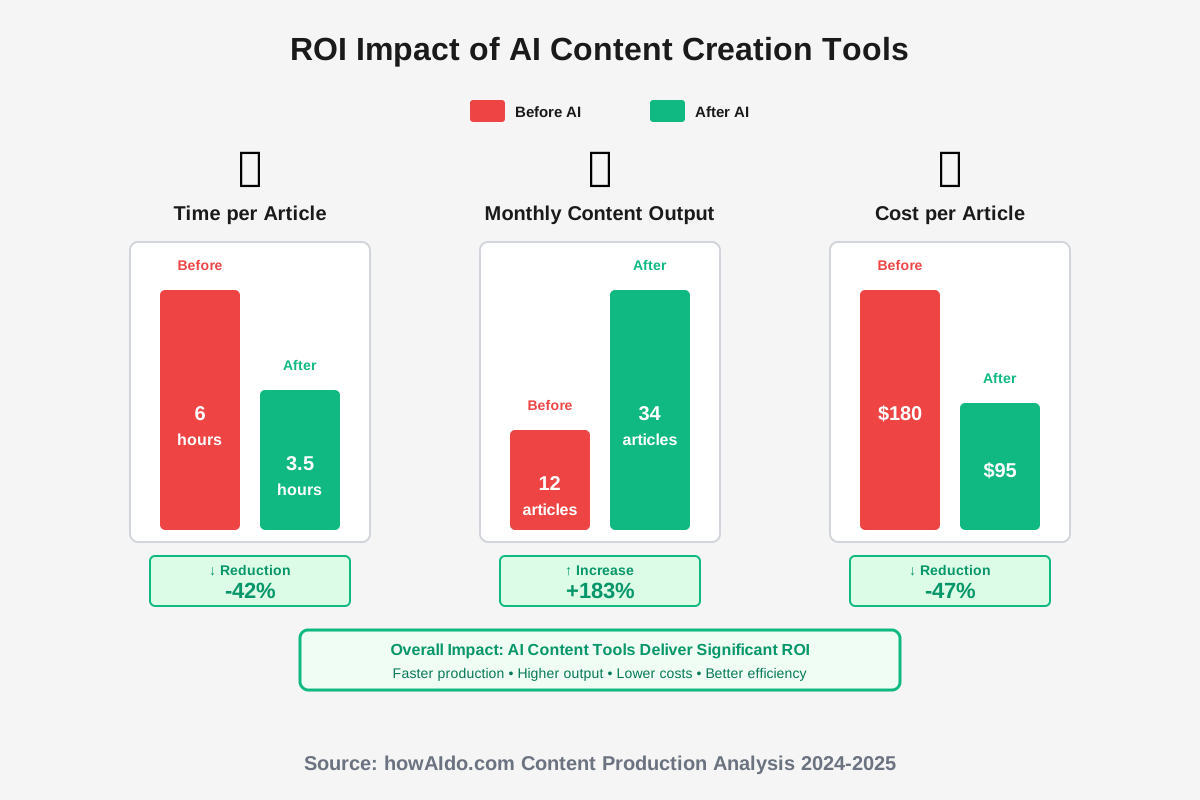
Fourth, cost analysis. We calculate cost per piece of content (including tool subscriptions, labor hours, and associated expenses). Our cost per article has decreased by approximately 45-50% since implementing AI tools because we’re producing more content with proportionally lower labor investment.
Fifth, business outcomes. Ultimately, ROI should tie to business results: leads generated, sales influenced, brand awareness, and customer education. We track how our expanded content library (enabled by AI) has contributed to increased organic traffic (up 220%), more inbound leads (up 85%), and improved customer education (measured through support ticket reduction and customer feedback).
To calculate simple ROI: (Benefit – Cost) / Cost × 100. For example, if AI tools cost $200 monthly but save 40 hours of labor (valued at $50/hour = $2,000), the ROI is ($2,000 – $200) / $200 × 100 = 900% ROI.
However, ROI isn’t purely financial. We also consider qualitative benefits: reduced stress from impossible content demands, ability to experiment with content types we couldn’t produce manually, improved team morale by eliminating tedious tasks, and strategic capacity to focus on high-value creative work rather than mechanical execution.
AI for Content Creation: The Legal Aspects of Using AI-Generated Content
AI for Content Creation: The Legal Aspects of Using AI-Generated Content addresses important but complex questions around copyright, liability, and legal compliance. While I’m not a lawyer and this doesn’t constitute legal advice, understanding basic legal considerations helps you use AI tools responsibly.
The primary legal question is who owns AI-generated content? Currently, U.S. copyright law grants copyright to human-created works. Purely AI-generated content (with no human creative input) may not be copyrightable. However, content created collaboratively between humans and AI—where humans provide creative direction, prompts, selection, and substantial editing—likely qualifies for copyright protection under the human contributor’s authorship.
Practically, this means you should maintain human creative involvement throughout your AI content creation process. Don’t simply publish unedited AI outputs; add your creative input, editing, and refinement. This human contribution establishes your copyright claim.
Second concern: potential copyright infringement. AI models are trained on existing content, raising questions about whether AI outputs might infringe on training data copyrights. This area is legally unsettled, with ongoing litigation exploring these questions. Most legal experts believe AI-generated content that doesn’t closely resemble specific copyrighted works should be fine, but this remains an evolving area of law.
To minimize risk, we avoid prompting AI to replicate specific copyrighted works or styles of identifiable living creators. We use AI for general-purpose content generation rather than attempting to replicate specific proprietary content.
Third issue: liability for AI-generated misinformation or harmful content. If you publish AI-generated content containing false information, you’re likely liable regardless of whether you or AI created the content. This reinforces the importance of fact-checking, editorial oversight, and quality control.
Fourth consideration: disclosure requirements. While not currently legally required in most contexts, some industries or platforms may require disclosure of AI-generated content. For transparency and trust-building, we voluntarily disclose AI assistance in contexts where it seems relevant or important.
Fifth concern: compliance with platform-specific rules. Some platforms have policies around AI-generated content. For example, some social media platforms require disclosure of AI-generated images. Review and comply with specific platform policies where you publish.
Sixth issue: data privacy when using AI tools. When you input information into AI platforms, you’re sharing that data with the platform. Avoid inputting confidential information, personal data of others, or proprietary information unless you’ve verified the platform’s data handling practices and terms of service.
The legal landscape around AI-generated content is evolving rapidly. Stay informed about developments, maintain conservative practices emphasizing human creative involvement, and consult actual legal professionals for specific legal questions or concerns.
AI for Content Creation: Future Trends and Predictions
AI for Content Creation: Future Trends and Predictions explores where this rapidly evolving field is heading and how content creators can prepare for upcoming changes. Based on current developments and expert predictions, several trends seem likely to shape the near future.
First, increasing multimodal capabilities. Future AI tools will seamlessly work across text, images, audio, and video—generating complete multimedia content packages from simple text prompts. We’re already seeing early versions with tools like Midjourney (text to image), ElevenLabs (text to speech), and emerging video generation platforms. Soon, you’ll likely prompt: “Create a complete social media campaign about [topic]” and receive text content, visual assets, video clips, and audio elements—all cohesively designed and ready for minor customization.
Second, more sophisticated personalization. AI will better understand individual user preferences, brand voices, and audience characteristics, generating content that feels more authentically tailored. Instead of generic outputs requiring heavy editing, AI will produce content that already closely matches your specific style and needs based on learning from your previous content and feedback.
Third, real-time content generation and optimization. AI will increasingly generate and adjust content in real-time based on audience response, performance data, and changing conditions. Instead of creating static content, we’ll create adaptive content that AI continuously optimizes based on what’s working.
Fourth, improved context understanding and factual accuracy. Current AI’s limitations around factual accuracy and context will diminish as models improve and integrate real-time information access. Future AI will more reliably generate factually accurate content, better understand nuanced context, and avoid current limitations like hallucinations and knowledge cutoffs.
Fifth, democratization of advanced content creation. As tools become more intuitive and powerful, individuals and small teams will be able to produce content quality and volume previously requiring large organizations with substantial resources. This levels the playing field but also increases content competition, making quality and genuine value more important than ever.
Sixth, evolution of the content creator role. As AI handles more mechanical aspects of content creation, human content creators will increasingly focus on strategy, creativity, emotional connection, and expertise. The ability to guide AI effectively, add genuine insights, and maintain authentic human connection will become the defining skills of successful content creators.
Seventh, regulatory frameworks and standards. Expect increasing regulation around AI-generated content, particularly regarding disclosure, copyright, and liability. Industry standards and best practices will emerge, providing clearer guidelines for responsible AI use.
How to prepare for these trends:
- Develop expertise in prompt engineering and AI guidance
- Focus on building unique, deep expertise that AI can’t replicate
- Emphasize authentic human elements in your content
- Stay informed about AI developments and emerging tools
- Maintain flexibility in your content workflow to integrate new capabilities
- Build ethical frameworks for AI use before regulations require them
The future of content creation is undoubtedly AI-integrated, but human creativity, judgment, and connection remain irreplaceable. The most successful content creators will be those who effectively combine AI efficiency with human insight and authenticity.
Frequently Asked Questions About AI for Content Creation
Taking Your First Steps with AI Content Creation
We’ve covered extensive ground in this guide—from fundamental concepts to advanced techniques, practical tools to ethical considerations. If you’re feeling slightly overwhelmed, that’s completely normal. The key is starting simple and building competence gradually.
Here’s what we recommend for your immediate next steps. First, choose one AI content tool and create a free account. ChatGPT, Copy.ai, and Jasper all offer free trials or limited free tiers. Spend an afternoon experimenting without pressure to produce anything specific—just explore what the tool can do.
Second, identify your biggest content pain point. Is it generating blog post ideas? Writing social media captions? Creating email newsletters? Start applying AI specifically to that one problem. Success in one area builds confidence and understanding; you can then expand to other content needs.
Third, practice crafting effective prompts. Spend time learning how to give AI clear, detailed instructions. The quality of your prompts directly determines the quality of AI outputs. Experiment with different levels of detail, specificity, and context to see what produces the best results for your needs.
Fourth, establish your editing and fact-checking workflow. Decide how you’ll review AI-generated content, what quality standards you’ll maintain, and what checks you’ll implement before publishing. This workflow protects quality and builds confidence in your AI-assisted content.
Fifth, measure your results. Track time saved, content produced, and performance metrics. Understanding your ROI helps optimize your approach and justifies continued investment in AI tools and learning.
The transformation AI for Content Creation enables isn’t just about producing more content faster—it’s about reclaiming creative energy, reducing content stress, and focusing on the strategic and genuinely creative aspects of content work that only humans can provide. AI handles the heavy mechanical lifting so you can focus on adding the insights, personality, and authentic connection that make content truly valuable.
The future of content creation is collaborative—humans and AI working together, each contributing their unique strengths. By learning to use these powerful tools effectively and responsibly, you’re positioning yourself not just to survive but to thrive in this evolving landscape.
Start today. Choose one tool, pick one content task, and experience firsthand how AI for Content Creation can transform your content workflow. The learning curve is shorter than you think, and the benefits—time savings, increased output, reduced stress—start immediately.
About the Authors
This comprehensive guide was written through collaboration between Abir Benali and James Carter, combining expertise in making AI accessible for everyday users with practical productivity strategies.
Abir Benali (Main Author) is a friendly technology writer specializing in explaining AI tools to non-technical users. With a passion for demystifying complex technologies, Abir focuses on creating clear, actionable content that helps people confidently integrate AI into their work and personal projects. Abir believes technology should be accessible to everyone and writes with the goal of making AI feel approachable rather than intimidating.
James Carter (Co-Author) is a productivity coach who helps people leverage AI to save time and boost efficiency. James specializes in practical, step-by-step guidance that anyone can follow, focusing on real-world applications that simplify work without requiring technical expertise. James’s motivational approach emphasizes that AI is a tool for empowerment, not replacement, helping people work smarter while maintaining their unique human value.
Together, Abir and James have created this guide to provide both the foundational knowledge and practical implementation strategies you need to successfully integrate AI into your content creation workflow, regardless of your technical background.