AI for Content Creation: Generate Blog Posts Fast

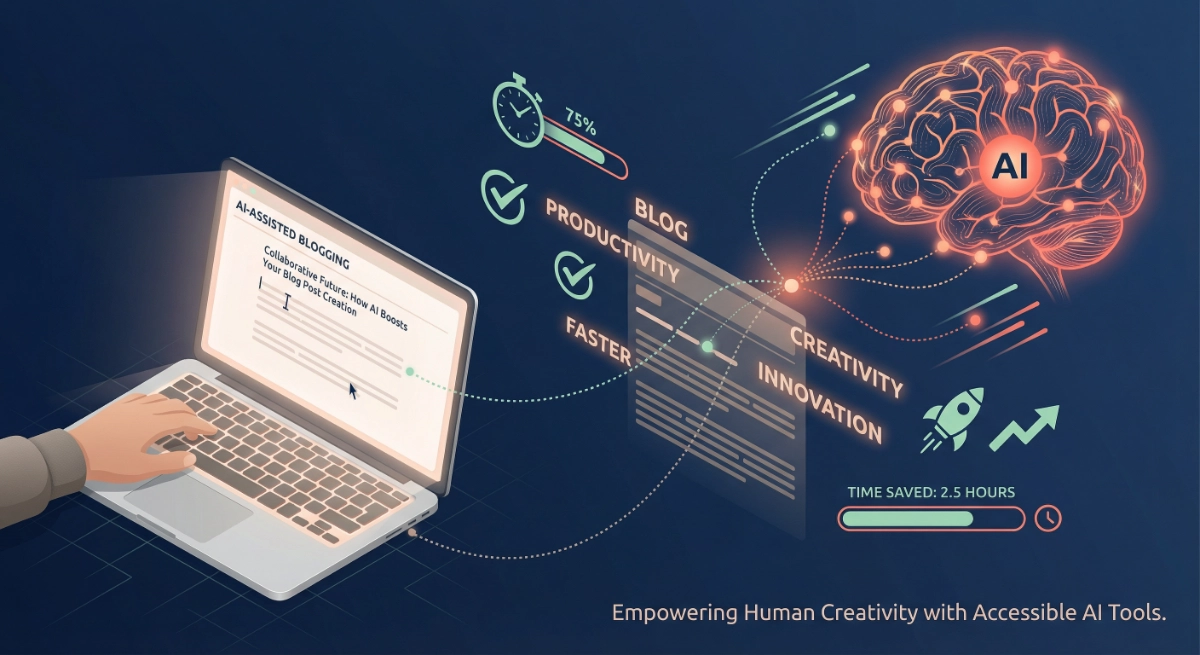
AI for Content Creation has transformed how we approach blog writing, and I’m here to show you exactly how to harness this power to boost your productivity without sacrificing quality. After helping hundreds of content creators streamline their workflows, I’ve discovered that the difference between struggling with writer’s block for hours and publishing high-quality posts in under 90 minutes comes down to mastering a few essential techniques.
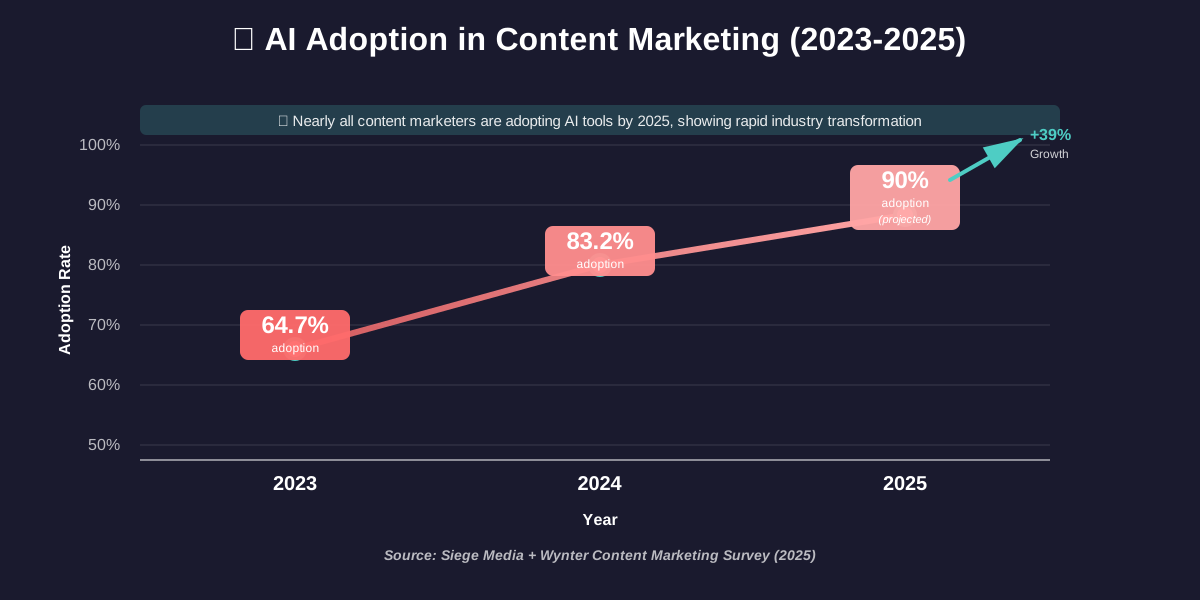
Let me be direct: according to Siege Media’s comprehensive study conducted in partnership with Wynter, 90% of content marketers plan to use AI to support their content marketing efforts in 2025—a significant jump from 83.2% in 2024. The market isn’t just growing; it’s exploding. Grand View Research reports that the global AI-powered content creation market reached USD 2.56 billion in 2025 and is projected to hit USD 10.59 billion by 2033, growing at a staggering 19.4% annually. These aren’t just statistics—they’re proof that AI-powered writing is now the standard, not the exception.
The real question isn’t whether you should use AI for blog creation, but how to use it effectively to save time while maintaining your authentic voice and producing content that genuinely helps your readers.
Why AI Content Creation Tools Are Essential for Your Workflow
Before diving into the tactics, let’s address what makes AI writing tools indispensable in 2025. I work with busy professionals, entrepreneurs, and content teams who are juggling multiple priorities. Time is your most valuable resource, and AI helps you reclaim it.
Research from Forbes Insight found that AI-generated blogs cost 60% less than human-written content while producing up to 40% higher click-through rates when combined with minimal human editing. But here’s what matters more: you’re not replacing your creativity—you’re amplifying it. Think of AI as your research assistant, first-draft writer, and brainstorming partner all rolled into one.
The 2025 Siege Media study revealed that 71.7% of content marketers use AI for outlining, 68% for content ideation, and 57.4% for drafting content. These are the three biggest time-sinks in blog creation, and AI handles them in minutes instead of hours.
10 Powerful Tips for Using AI to Generate High-Quality Blog Posts
Let me walk you through the exact system I teach my clients—the same one that’s helped them cut their content creation time in half while improving quality.
1. Start With Strategic Keyword Research and Topic Selection
Don’t waste AI’s capabilities on random topics. Begin with intentional keyword research that aligns with your audience’s needs. Use AI tools to analyze search trends, but pair this with your understanding of your audience’s pain points.
How to implement this: Ask your AI tool: “Analyze the top 10 ranking articles for [your keyword] and identify gaps in coverage that I can address. What questions are readers still asking that haven’t been fully answered?”
I’ve found that combining AI-powered SEO optimization tools like Surfer SEO or Frase with GPT-4 for ideation creates the perfect foundation. The AI processes thousands of data points instantly, highlighting opportunities you’d miss in manual research.
Time saved: 2-3 hours per article on research alone.
2. Master the Art of Detailed, Context-Rich Prompts
Here’s where most people fail: they give AI vague instructions and wonder why the output is generic. According to research from Lakera’s 2025 Prompt Engineering Guide, clear structure and context matter more than clever wording—most prompt failures come from ambiguity, not model limitations.
Your prompt should include:
– Role assignment: “You are an experienced productivity blogger writing for busy professionals”
– Specific task: “Write a 1500-word blog post about time management strategies”
– Target audience: “For entrepreneurs who struggle to prioritize tasks”
– Tone and style: “Use a conversational, motivational tone with actionable examples”
– Structure requirements: “Include an engaging introduction, 7 practical tips with real-world examples, and a motivating conclusion”
Example prompt template: “You are a [role]. Write a [length] [content type] about [topic] for [target audience]. Use a [tone] tone. Include [structural elements]. Focus on providing [specific value]. Avoid [what to exclude].”
The more specific you are, the better your results. I’ve seen clients reduce editing time by 70% just by improving their prompt quality.
3. Use the “First Draft Plus Human Enhancement” Method
Never publish AI-generated content as-is. The winning formula in 2025 is: AI creates the foundation, and you add the expertise. According to Dr. Ethan Mollick, Wharton Professor of AI and Innovation, “AI can replicate writing mechanics, but the best blog content still reflects human wit, storytelling, and timely judgment.”
My workflow:
– Let AI create the first draft (15 minutes)
– Add personal anecdotes and specific examples from your experience (20 minutes)
– Inject unique insights that only you can provide (15 minutes)
– Polish the voice to match your brand (20 minutes)
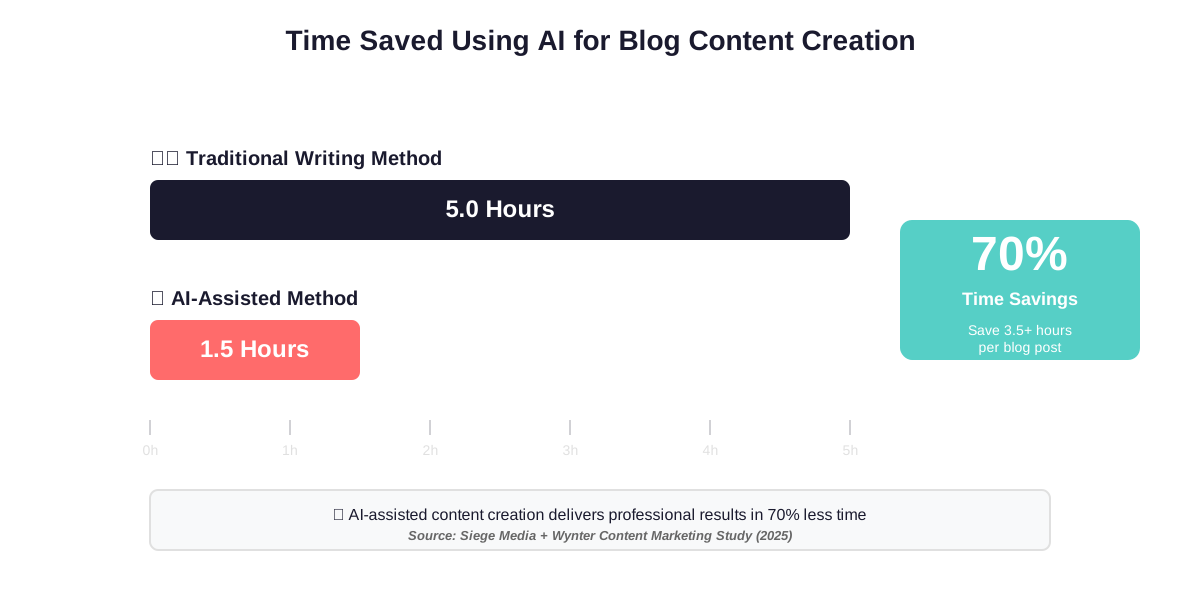
This approach gives you a professional 2000-word blog post in roughly 70 minutes—compared to 4-5 hours writing from scratch.
Pro tip: Create a “voice document” with 5-10 examples of your best writing. Feed this to AI tools with brand voice features (like Jasper AI or Copy.ai) to train them on your style.
4. Implement Iterative Prompt Engineering
Don’t expect perfection on the first try. The best results come from conversational refinement. According to CodeSignal’s 2025 prompt engineering research, breaking complex tasks into smaller, actionable steps helps AI models deliver more accurate responses.
The iterative approach:
– Start with an outline request: “Create a detailed outline for a blog post about [topic] targeting [audience]”
– Refine the outline: “Expand section 3 to include more practical examples. Make section 5 more actionable”
– Generate content section by section: “Write the introduction based on this outline, focusing on hooking the reader with a relatable problem”
– Review and regenerate weak sections: “Rewrite paragraph 2 with more specific data and examples”
This method produces significantly better content than trying to generate everything at once.
5. Integrate Real Data and Verified Sources for Credibility
AI can hallucinate facts and statistics. Always verify information and add current, authoritative sources. According to Google’s official guidance updated in May 2025, AI-generated content is allowed if it’s informative and people-first, but scaled low-value pages without substance will be penalized.
Action steps:
– After AI generates your draft, identify any statistics or claims that require sourcing
– Use search tools to locate recent, authoritative sources (2025 or later)
– Replace generic statements with specific, cited data
– Add “According to [Source] in their [Report Title] ([Year]): [specific finding]. Source: [URL]”
This practice builds trust with readers and search engines. In my experience, well-sourced AI-assisted articles outperform purely human-written content that lacks data backing.
6. Create Reusable Prompt Templates for Different Content Types
Stop reinventing the wheel. Build a prompt library for your most common content types. According to Typeface.ai’s 2025 prompt library research, structured prompts that encode point of view, voice, and citation rules dramatically improve consistency.
Templates to create:
– How-to guides: “Write a comprehensive how-to guide for [topic]. Include an introduction explaining the benefit, 5-7 numbered steps with specific actions, common mistakes to avoid, and a motivating conclusion.”
– Listicles: “Create a listicle titled ‘[Title]’ with 10 items. For each item, include a brief description, practical application, and one specific example.”
– Problem-solution posts: “Write about [problem] that [audience] faces. Start with the pain point, explain why it matters, then provide 3 detailed solutions with implementation steps.”
– Comparison articles: “Compare [Option A] vs [Option B] for [specific use case]. Include pros and cons, best use cases, and a final recommendation.”
Store these in a document and modify them as needed. This system saves 10-15 minutes per article while ensuring consistent quality.
7. Optimize Content for SEO With AI-Powered Analysis
SEO and AI work brilliantly together. Tools like Surfer SEO, Frase, and Clearscope analyze top-ranking content and provide specific optimization recommendations. The key is using these insights to guide your AI-generated content.
The optimization workflow:
– Run your topic through an SEO tool to get keyword targets and content structure
– Include these parameters in your AI prompt: “Include these keywords naturally: [list]. Target word count: [number]. Include H2 headings for: [topics]”
– After generation, use the SEO tool’s grading system to identify gaps
– Ask AI to enhance specific sections: “Add 200 words to section 3 about [subtopic] while naturally incorporating [keywords]”
According to the Siege Media 2025 study, 62.8% of content marketers who use AI reported traffic growth year-over-year, compared to 36.4% who saw declines—and most growth was moderate (1%-24%), proving that consistent, optimized AI content works.
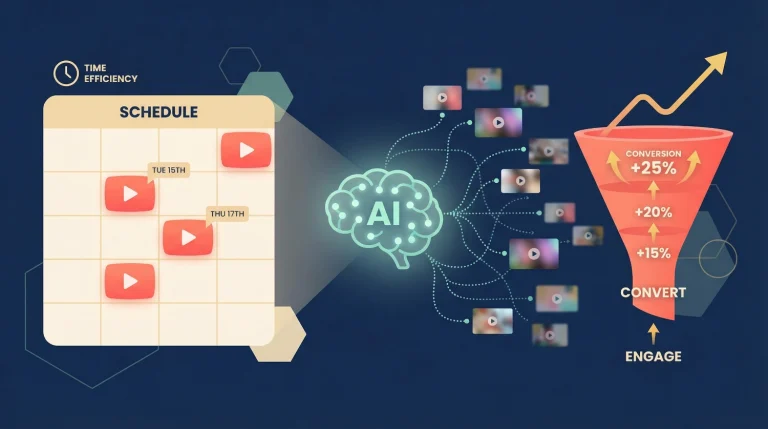
8. Build an Editorial Calendar With AI Assistance
Content planning is where AI truly shines for busy professionals. Instead of staring at a blank calendar wondering what to write next, use AI to generate months of content ideas in minutes.
My monthly planning prompt: “Act as a content strategist for [your niche]. Generate 20 blog post ideas for [target audience] that address [main pain points]. For each idea, include:
– Working title
– Primary keyword
– Search intent (informational/transactional)
– Unique angle that differentiates it from existing content
– Estimated reader value Group these by content pillar: [your main topics]”
Run this prompt at the start of each quarter. You’ll have a complete content roadmap before your first cup of coffee is cold.
Time saved: 4–6 hours per month on planning and ideation.
9. Use AI for Content Repurposing and Updating
Your existing content is a goldmine. Use AI to breathe new life into old posts, transform formats, and maximize the value of everything you’ve created.
Repurposing strategies:
– Blog to social: “Transform this blog post into 10 social media posts for LinkedIn, focusing on professional insights and actionable tips”
– Long-form to short: “Create a 500-word summary of this 2000-word article, maintaining the key takeaways and practical advice”
– Update old content: “Review this article from 2023 and suggest updates: new statistics from 2025, emerging trends, and outdated information to replace”
– Format transformation: “Convert this blog post into a presentation outline with 10 slides, including talking points for each”
I’ve helped clients double their content output without writing new material—just by smartly repurposing with AI.
10. Implement Quality Control Checkpoints
Never skip the human review. Create a consistent quality checklist to ensure every AI-assisted post meets your standards.
My essential checklist:
✅ Accuracy: All statistics verified with sources from 2025 or later
✅ Voice: Content sounds like you, not a robot
✅ Value: Readers can take immediate action from the information
✅ Originality: Unique insights and examples that AI couldn’t generate alone
✅ Readability: Short paragraphs, clear subheadings, logical flow
✅ SEO: Keywords integrated naturally, proper heading structure
✅ Engagement: Strong hook, compelling examples, motivating conclusion
Run every piece through this filter. It takes 10 minutes but ensures quality that builds your reputation.
Best AI Writing Tools for Blog Creation in 2025
While techniques matter more than tools, having the right AI assistants makes your workflow smoother. Here are the platforms I recommend based on extensive testing with my clients:
ChatGPT-4 remains the most trusted option, according to Siege Media’s 2025 study, with a 77.9% selection rate among content marketers. It excels at conversational prompting and maintaining context across multiple revisions. Perfect for iterative content development.
Jasper AI shines for brand consistency with its brand voice training features. If you’re managing multiple writers or need to maintain strict brand guidelines, Jasper’s template library and Surfer SEO integration save tremendous time.
Claude (by Anthropic) handles long-form content exceptionally well and excels at maintaining a natural, conversational tone. I use it for complex articles requiring nuanced explanations.
Copy.ai offers over 90 templates and is incredibly beginner-friendly. If you’re just starting with AI-assisted writing, this is your entry point.
For SEO-focused content, tools like Koala Writer, Surfer SEO, and Frase combine AI writing with real-time optimization. They analyze top-ranking content and guide you to create articles that match search intent.
Common Pitfalls to Avoid When Using AI for Content Creation
I’ve seen these mistakes cost people time, credibility, and rankings. Learn from others’ errors:
❌ Over-reliance on AI without human editing produces generic content that doesn’t stand out. Always add your expertise and personality.
❌ Ignoring fact-checking can damage your reputation. AI models can generate convincing but incorrect information. Always verify statistics, especially dates and numbers.
❌ Using the same prompts repeatedly creates repetitive content. Vary your approach and continuously refine your prompts.
❌ Publishing AI content without optimization misses the entire point. Run it through SEO analysis and enhance weak areas.
❌ Neglecting your authentic voice turns your blog into just another AI-generated site. Your unique perspective is what makes readers return.
Frequently Asked Questions About AI for Blog Writing
Your Action Plan: Getting Started This Week
Knowledge without action is just entertainment. Here’s your concrete roadmap for implementing AI for content creation starting today:
Day 1: Choose one AI writing tool (I recommend starting with ChatGPT if you’re new) and create your account. Write your first prompt using the template I provided in tip #2. Generate a blog outline for your next article.
Day 2: Develop your voice guide. Pull 3-5 examples of your best writing and create a document describing your style (tone, common phrases, and sentence structure preferences). This becomes your reference for all future prompts.
Day 3: Generate your first AI-assisted draft. Use the iterative approach—outline first, then content section by section. Don’t aim for perfection.
Day 4: Edit and enhance. This is where you add your expertise. Include personal examples, verify any statistics, and polish the voice. Run it through an SEO tool if you have one.
Day 5: Create three reusable prompt templates for your most common content types. Store them where you’ll actually use them.
The difference between people who successfully integrate AI into their workflow and those who try once and give up is consistency. Start small, build the habit, and refine your process. Within a month, you’ll wonder how you ever managed without these tools.
Conclusion: Your Productivity Breakthrough Starts Now
We’ve covered a lot, but here’s what really matters: AI for content creation isn’t about replacing your creativity or expertise. It’s about reclaiming your time and amplifying your impact. The 10 tips I’ve shared—from mastering prompt engineering to building quality control systems—have helped my clients cut their content production time in half while improving quality.
The market data shows this isn’t a trend; it’s the new reality. With 90% of content marketers using AI in 2025 and the industry projected to grow to $10.59 billion by 2033, the question isn’t whether to adapt but how quickly you can master these tools.
Start with one tip today. Maybe it’s improving your prompts, or creating that first template, or simply generating an outline for your next post. Small consistent actions compound into massive productivity gains.
Remember, every hour you save on content creation is an hour you can invest in building relationships, refining your strategy, or simply having more time for what matters most in your life. That’s the real promise of AI-assisted writing—not just better content, but a better, more balanced approach to the work you love.
Your next high-quality blog post is 90 minutes away instead of 5 hours. The tools are ready. The techniques are proven. All that’s left is your decision to start.
References
- Siege Media + Wynter. (2025). “Content Marketing Survey 2025.” https://www.siegemedia.com/strategy/ai-writing-statistics
- Grand View Research. (2025). “AI-Powered Content Creation Market Report 2025-2033.” https://www.grandviewresearch.com/industry-analysis/ai-powered-content-creation-market-report
- Lakera. (2025). “The Ultimate Guide to Prompt Engineering in 2025.” https://www.lakera.ai/blog/prompt-engineering-guide
- CodeSignal. (2025). “Prompt Engineering Best Practices 2025.” https://codesignal.com/blog/prompt-engineering-best-practices-2025/
- Anthropic. (2025). “Prompt Engineering Best Practices | Claude.” https://claude.com/blog/best-practices-for-prompt-engineering
- Google Search Central. (2025). “Creating Helpful, Reliable, People-First Content.” Updated May 21, 2025. https://developers.google.com/search/docs/fundamentals/creating-helpful-content
- Next Move Strategy Consulting. (2025). “AI-Powered Content Creation Market Analysis 2025-2030.” https://www.nextmsc.com/report/ai-powered-content-creation-market
About the Author
James Carter is a productivity coach specializing in AI-powered workflows for content creators and entrepreneurs. With over a decade of experience helping professionals optimize their time and amplify their output, James has guided hundreds of businesses through the transition to AI-assisted content creation. His practical, results-focused approach emphasizes sustainable systems that preserve authentic voice while dramatically reducing production time. When he’s not coaching clients or testing the latest AI tools, James writes about productivity strategies that actually work in the real world—no fluff, just proven tactics you can implement today.