
AI and Creative Collaboration: Unleash Innovation
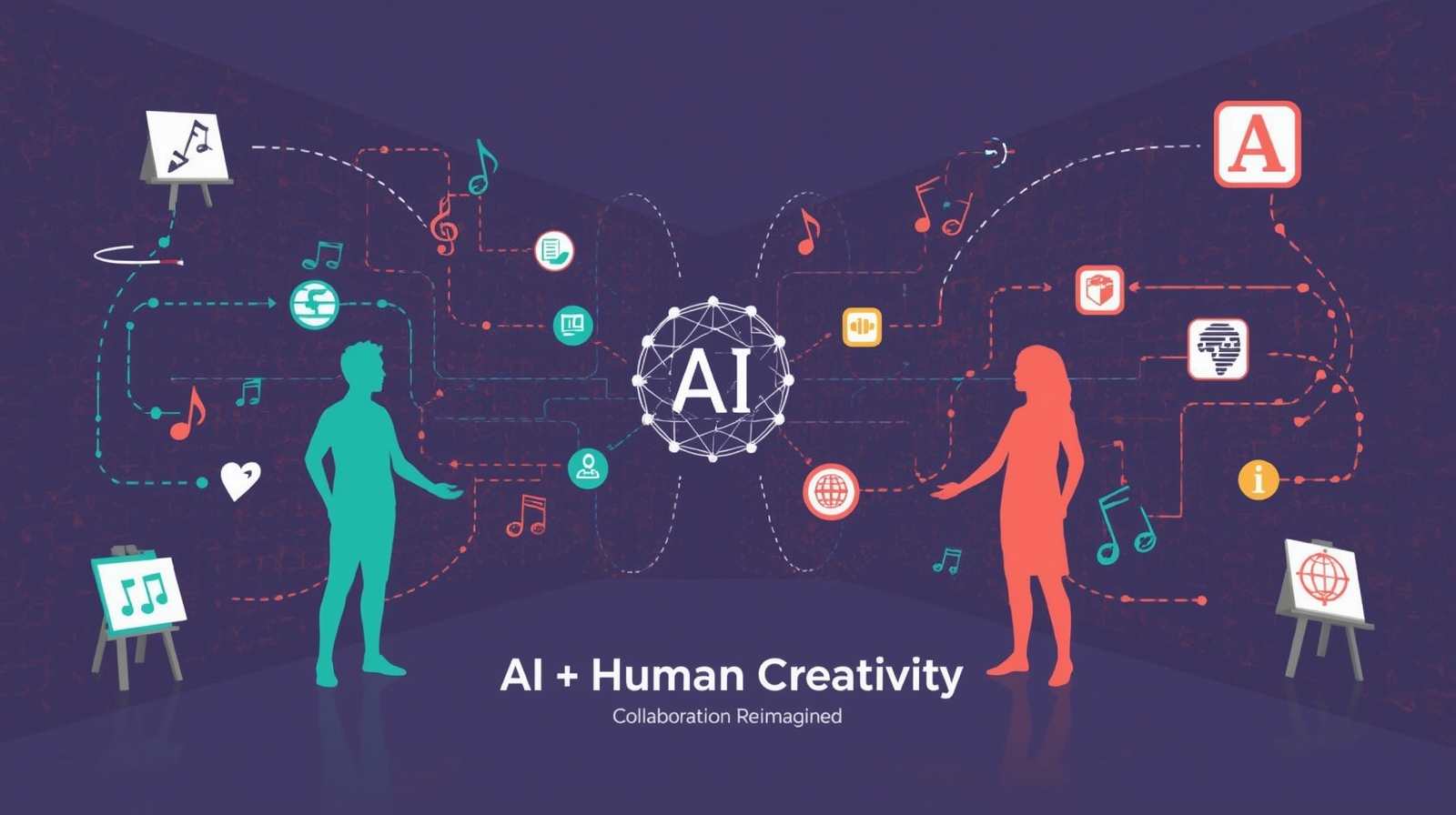
AI and Creative Collaboration is revolutionizing how we create, design, and imagine together. As someone who’s witnessed countless creative teams struggle with communication barriers, differing visions, and workflow bottlenecks, I’ve discovered that artificial intelligence isn’t just a tool—it’s becoming a collaborative partner that bridges gaps and amplifies human creativity in ways we never thought possible.
Imagine this: You’re working on a design project with a teammate across the globe. Time zones make real-time collaboration challenging, and language barriers occasionally cause misunderstandings. Now picture an AI that not only translates your ideas seamlessly but also suggests visual concepts that blend both your styles, learns from your feedback, and helps resolve creative disagreements by offering objective alternatives. This isn’t science fiction—it’s the reality of AI-powered creative collaboration today.
In this comprehensive guide, we’ll explore how AI is transforming collaborative creativity across industries, from art and design to music, storytelling, and beyond. Whether you’re a solo creator looking to expand your capabilities or part of a creative team seeking to enhance your workflow, you’ll discover practical insights, tools, and strategies to harness AI’s potential while maintaining the human touch that makes creative work truly special.
Understanding AI and Creative Collaboration: The Foundation
At its core, AI and Creative Collaboration refers to the integration of artificial intelligence technologies into creative workflows where multiple people—or people and AI systems—work together to produce artistic, design, or innovative outputs. Think of it as having an intelligent assistant that never sleeps, can process vast amounts of creative references instantly, and offers suggestions without ego or fatigue.
Unlike traditional software that simply executes commands, collaborative AI systems can understand context, learn from your preferences, generate original ideas, and adapt to different creative styles. These systems use machine learning algorithms trained on millions of creative works to recognize patterns, suggest alternatives, and even predict what might resonate with your audience.
The magic happens when human intuition, emotional intelligence, and lived experience combine with AI’s computational power, pattern recognition, and tireless iteration capabilities. You bring the vision, taste, and cultural understanding; AI brings speed, scalability, and the ability to explore thousands of variations in seconds.
The Evolution of AI in Creative Collaboration: A Historical Perspective
The Evolution of AI in Creative Collaboration traces back further than most people realize. The journey began in the 1950s when early computer scientists experimented with algorithmic art generation, though these primitive systems could barely create simple geometric patterns.
The real transformation started in the early 2010s when deep learning breakthroughs enabled AI systems to recognize and generate complex patterns in images, text, and sound. By 2017, Generative Adversarial Networks (GANs) were creating artwork that fooled human evaluators, marking a turning point in AI’s creative capabilities.
Today in 2025, collaborative AI has moved far beyond simple task automation. We’re seeing AI act as genuine creative partners—systems that understand context, generate novel ideas, and adapt to individual creative styles. Recent industry analyses show that AI has become mainstream in creative workflows, with professionals no longer viewing it as an external tool but as an integrated part of their creative process.
The concept of human-AI collaboration has evolved from distinct roles (sometimes called “Centaurs,” where humans and AI work separately on different tasks) to more integrated partnerships (termed “Cyborgs”), where AI acts as an extension of human capabilities. This shift represents a fundamental change in how we approach creative work.
AI-Powered Brainstorming: How to Generate Innovative Ideas with AI
AI-Powered Brainstorming transforms the ideation process from a sometimes frustrating solo or group struggle into an expansive exploration of possibilities. Instead of staring at a blank page or whiteboard, you engage with an AI system that can generate hundreds of concept variations in minutes.
Here’s how it works in practice: You start with a seed idea—maybe “a mobile app for urban gardeners.” The AI doesn’t just list obvious features. It explores unexpected angles: gamification elements inspired by social media, community exchange systems, AR visualization for plant placement, weather prediction integration, or even connections to local farmers’ markets. Each suggestion opens new pathways for your thinking.
The real power emerges when you engage in iterative dialogue with the AI. You react to suggestions and refine directions, and the AI learns your preferences in real time. Within 30 minutes, you might explore territory that would take days of traditional brainstorming. The key is using AI not to replace your creative judgment but to exponentially expand the solution space you’re exploring.
AI and the Future of Co-Authorship: Navigating the Ethics and Legalities
AI and the Future of Co-Authorship raises fascinating questions about creativity, ownership, and credit. When you use AI to help write a novel, design a logo, or compose music, who owns the resulting work? How should you credit the AI’s contribution? These aren’t just theoretical concerns—they’re practical issues affecting creators right now.
According to the U.S. Copyright Office’s 2025 report on copyrightability, outputs of generative AI can be protected by copyright only where a human author has determined sufficient expressive elements. Courts have held that works created entirely by AI without human involvement cannot receive copyright protection.
The Office confirms that human-authored work must be perceptible in AI output, OR a human makes creative arrangements/modifications, but NOT mere provision of prompts.
The Library of Congress Copyright Office affirms that existing copyright law principles are flexible enough to apply to generative AI technology. The Office concludes that copyright protection requires human authors to determine sufficient expressive elements.
On May 9, 2025, the U.S. Copyright Office released Part 3 of its “Copyright and Artificial Intelligence” series, offering guidance on whether use of copyrighted works to train generative AI constitutes fair use.
Courts have consistently held that human authorship is essential for copyright eligibility. However, when you collaborate with AI—providing creative direction, making selections, arranging elements, or significantly editing outputs—you may be able to claim copyright on the resulting work.
The U.S. Copyright Office’s 2025 report on copyrightability clarified that the extent of human involvement is crucial. If you provide highly detailed prompts, curate AI-generated options, and shape the final output through your creative decisions, you’re more likely to establish authorship. The key question becomes: did you exercise sufficient creative control, or did the AI autonomously generate the work?
From an ethical standpoint, transparency matters immensely. Many creative professionals now include disclosures when AI significantly contributed to their work. Some adopt language like “created in collaboration with AI” or “AI-assisted” in their credits. This honesty builds trust with audiences and clients while acknowledging the technology’s role.
AI as a Creative Muse: Finding Inspiration and Overcoming Writer’s Block
AI as a Creative Muse represents one of AI’s most personally transformative applications. We’ve all experienced creative blocks—those frustrating moments when ideas refuse to flow, when every concept feels stale, when the blank page becomes an insurmountable obstacle.
AI excels at breaking through these barriers by offering unexpected connections. When you’re stuck writing a story, an AI can generate ten different plot twists in seconds. When designing a logo, it can suggest color combinations you never considered. When composing music, it can propose melodic variations that spark new directions.
The key is using AI strategically. Rather than accepting AI outputs wholesale, treat them as creative provocations. One approach I’ve found effective: ask the AI for deliberately bad ideas. Occasionally the worst suggestions contain kernels of brilliance that your trained eye can extract and refine. Another technique: use AI to explore genres or styles outside your comfort zone, then adapt those influences back into your primary work.
Best AI Tools for Collaborative Art: A Comprehensive Review
Best AI Tools for Collaborative Art spans an impressive range of capabilities, from image generation to 3D modeling to interactive installations. Let me walk you through the standout platforms that will transform artistic collaboration in 2025.
OpenArt leads the pack for comprehensive AI art generation. This platform stands out for its intuitive interface and remarkable versatility—you can create anything from photorealistic portraits to abstract illustrations in seconds. What makes OpenArt particularly valuable for collaboration is its community-driven model library and the ability to train custom models that match your team’s specific aesthetic. Free users get daily credits, while the Starter plan ($10/month) unlocks premium features like Creative Upscaler and advanced editing tools.
Adobe Firefly seamlessly integrates into existing Adobe workflows, making it ideal if your team already uses Photoshop or Illustrator. The standout feature? Firefly trains on Adobe Stock images and public domain content, significantly reducing licensing concerns for commercial projects. You can generate images directly within your design files, maintaining your creative flow without switching applications.
Midjourney remains the go-to choice for concept artists seeking dramatic, visually compelling imagery. Operating through Discord, it excels at rapid ideation—perfect for exploring character designs, environmental concepts, or stylistic directions before committing to final renders. While it won’t replace detailed production work, it accelerates the exploration phase dramatically.
NightCafe distinguishes itself through community features. Beyond being an excellent art generator with access to multiple AI models (Flux, DALL-E 3, Ideogram, and more), it provides chat rooms where creative teams can collaborate in real-time, participate in daily art challenges, and share techniques. The platform’s social dimension makes it feel less like a tool and more like a creative studio where you can learn from others.
Canva’s AI Art Generator offers the most accessible entry point, especially for teams already using Canva for design work. Its integration with Canva’s broader design ecosystem means you can generate AI art and immediately incorporate it into presentations, social posts, or marketing materials. Canva Shield provides indemnification protection, which gives businesses confidence using AI-generated content commercially.
Canva Dominance (Menlo Ventures, Nov. 2025):
According to Menlo Ventures’ 2025 Consumer AI report, Canva dominates specialized AI creative tool adoption at 44%, followed by Gamma AI (20%), Leonardo AI (14%), Midjourney (13%), and Jasper and Runway at 12% each.
Source: https://menlovc.com/perspective/2025-the-state-of-consumer-ai/
AI and Collaborative Music Composition: Creating Harmonious Melodies Together
AI and Collaborative Music Composition opens fascinating possibilities for musicians, producers, and composers working together across distances or disciplines. Modern AI music tools can analyze your musical style, suggest chord progressions, generate melodic variations, and even create entire instrumental arrangements based on your input.
The landscape of collaborative music AI has expanded dramatically. AIVA (Artificial Intelligence Virtual Artist) stands out for composers needing orchestral and cinematic scores. Trained on over 30,000 human compositions, it generates professional-grade music across 250+ genres. The Pro Plan grants full copyright ownership, making it ideal for film scoring and game development, where you need complete control over your compositions.
BandLab SongStarter excels at sparking creative collaboration. This cloud-based platform generates royalty-free song starters and loops based on genre preferences, then provides a collaborative environment where multiple musicians can refine tracks together in real time. The free tier is remarkably functional, making it perfect for remote bands or production teams.
Google’s MusicFX DJ (powered by the Lyria model) represents a breakthrough in interactive music generation. Unlike traditional DJ tools mixing existing tracks, it generates brand-new music in real-time based on text prompts. You can combine genres, instruments, and vibes to create novel styles, and crucially, you can share sessions with collaborators who can jump in and steer the music in new directions. The interface was designed in collaboration with Grammy-winning artist Jacob Collier specifically for creative collaboration.
LANDR offers a comprehensive ecosystem combining AI-powered mastering with collaboration tools and distribution services. Musicians at different stages can share projects, get real-time feedback, and polish tracks with AI-assisted mastering that applies genre-appropriate processing. The platform’s strength lies in supporting the entire workflow from creation through distribution.
For producers working within DAWs, Magenta Studio integrates as an Ableton Live plugin, offering tools like melody continuation, drum pattern generation, and groove transformation. Its melody extension feature analyzes your input and suggests harmonious continuations that feel like genuine collaborative suggestions rather than random outputs.
Human-AI Teams in Creative Agencies: A New Model for Innovation
Human-AI Teams in Creative Agencies represent a paradigm shift in how creative work gets done. Forward-thinking agencies are now structuring their teams to explicitly include AI capabilities as core creative resources, not just technical tools.
In practice, this might mean a campaign team consisting of a creative director who sets strategic vision and makes final decisions, a copywriter who works with AI to rapidly generate and test dozens of headline variations, a designer who uses AI to explore visual directions quickly, and, importantly, someone who specializes in prompt engineering and AI tool optimization to ensure the technology serves the team’s creative goals.
The most successful agencies in 2025 are those embracing hybrid teams where AI handles technical optimization and repetitive tasks while freeing creative professionals to focus on strategic thinking, emotional understanding, and cultural context—qualities that remain exclusively human.
Leading agencies like VML use WPP’s AI-powered platform “WPP Open” to create storyboards, briefs, and creative variations at scale for major brands. Digitas embedded AI agents into strategy and brainstorming processes, reportedly cutting three days from high-pressure brief timelines. At Gut agency, a custom tool called “Unprompt” helps uncover unique insights that spark bold campaign ideas.
In 2025, the conversation will shift. Creative leaders no longer ask, ‘Should we use AI?’ but ‘How do we transform client value with AI?’ Yet while 80% of agencies use AI, only ~5% have moved beyond experimentation to build real competitive advantage.
According to the 2025 Spark AI report on creative agencies, while 80% of agencies now use AI, only approximately 5% have advanced beyond experimentation to establish genuine competitive advantage.
The workflow typically looks like this: AI generates multiple concept directions quickly during ideation, human creatives evaluate and refine the most promising options based on brand strategy and emotional resonance, AI assists with rapid prototyping and asset creation across formats, humans make final creative decisions and inject personality, and teams collaborate to ensure the work aligns with brand values and cultural context.
Critically, agencies are discovering that success requires new hybrid roles: AI specialists who understand both technology and creative processes, data analysts who inform creative strategies, and creative technologists who bridge AI capabilities with human creative vision. The premium now sits on professionals who can effectively prompt and direct AI while maintaining creative excellence.
The Role of AI in Collaborative Storytelling: Building Narratives Together
The Role of AI in Collaborative Storytelling extends beyond simply generating plot ideas—it’s transforming how writers, screenwriters, game designers, and content creators build complex narratives together.
Modern AI storytelling tools can maintain character consistency across long narratives, suggest plot developments that honor established story rules, identify pacing issues, and even help multiple writers maintain narrative cohesion when working on the same project from different locations.
Imagine you’re co-writing a sci-fi novel with a partner. Traditionally, you’d need extensive documentation to track character arcs, plot threads, and world-building details. With AI assistance, the system can read your entire manuscript, remind you when a character’s motivation seems inconsistent, suggest how a subplot could connect to your main narrative, and even generate dialogue variations that match each character’s established voice.
For collaborative game design, AI tools now help teams build branching narratives where player choices have meaningful consequences. The AI can simulate different story paths, identify dead ends, ensure narrative threads resolve satisfyingly, and maintain thematic consistency across hundreds of possible player journeys.
AI-Driven Design Thinking: Enhancing Creativity in Product Development
AI-Driven Design Thinking applies artificial intelligence to the human-centered design process, enhancing how teams ideate, prototype, and test product concepts collaboratively.
In traditional design thinking workshops, teams generate sticky notes full of ideas, cluster them into themes, and vote on directions to explore. AI-powered design thinking improves the process by looking at user research data to find patterns that people might overlook, creating many different ideas based on what was discussed in workshops, simulating how users could use the proposed solutions, and linking ideas from different brainstorming sessions or team members.
Tools like Miro and MURAL now use AI to automatically sort brainstormed ideas, find missing pieces in your thinking, suggest links between unrelated concepts, and create visual images of abstract ideas to help teams agree on a direction.
For product development teams working across time zones, AI acts as a persistent collaborator that keeps ideas alive between synchronous meetings. You can ask the AI to explore a product concept further overnight, and by morning, you have visual mockups, potential user flows, and competitive analysis ready for team review.
AI and Collaborative Game Design: Building Immersive Worlds Together
AI and Collaborative Game Design is revolutionizing how teams create interactive experiences, particularly in building vast, coherent game worlds where multiple designers, artists, programmers, and writers must collaborate seamlessly.
Modern game development teams use AI tools like Promethean AI, which works alongside environment artists to accelerate 3D world creation. Artists use natural language to describe scenes, while the AI creates complete environments that they can refine with additional instructions or direct manipulation. The tool learns individual artists’ styles and preferences, ensuring consistency across massive game worlds while allowing multiple team members to collaborate without stylistic conflicts.
Ludo.ai offers comprehensive game research and design capabilities specifically for collaborative teams. The platform’s Top Charts Blender lets teams deconstruct successful games’ core mechanics and generate innovative concepts with market appeal. Its Game Concept tool acts as an AI-powered co-writer, helping teams structure details with customizable templates while AI suggests mechanics, story elements, and character developments.
Scenario maintains specific art styles across all generated assets by training on existing art or reference materials. This proves invaluable when multiple artists join projects at different stages—the AI ensures visual coherence across large game worlds by enforcing established style guidelines while still allowing creative freedom.
For narrative consistency, Inworld provides tools that give developers precise control over AI-driven NPC personalities, behaviors, and memories. Characters evolve logically within game worlds, and player choices dynamically influence narrative direction. The platform has proven capable of supporting games with millions of players, moving beyond prototype to production-ready implementation.
The teamwork benefits come from using procedural generation to automatically create landscapes and dungeons, AI tools that help fix mistakes and improve performance, level designers testing many layout options with AI, writers using AI to keep stories consistent across different paths, and artists using AI to create different versions of assets while keeping a unified artistic style.
AI for Creative Collaboration: Overcoming Challenges and Maximizing Potential
AI for Creative Collaboration isn’t without challenges. Understanding these obstacles—and strategies to overcome them—separates teams that struggle with AI from those that thrive.
The primary challenges include creative resistance from team members who fear AI threatens their value, workflow disruption when integrating new tools into established processes, quality inconsistency where AI outputs vary unpredictably, copyright uncertainty around ownership of AI-assisted works, and over-reliance on AI leading to generic, soulless outputs.
To maximize potential, successful teams adopt these strategies: Start small by piloting AI tools in non-critical projects before full integration. Build hybrid expertise by training team members who understand both creative craft and AI capabilities. Establish clear guidelines about when to use AI assistance versus pure human creativity. Maintain human oversight with AI augmenting rather than replacing creative judgment. Document learning systematically about what works and what doesn’t with specific AI tools. Create feedback loops where team members share successful AI collaboration techniques. Invest in prompt engineering skills since better prompts yield dramatically better AI outputs.
AI-Assisted Video Editing: Enhancing Collaborative Filmmaking
AI-Assisted Video Editing transforms how editing teams work together, especially on complex projects involving multiple editors, colorists, sound designers, and directors collaborating remotely.
Modern AI video tools can automatically sync multi-camera footage, generate rough cuts based on script analysis, identify the best takes by analyzing facial expressions and emotional delivery, remove unwanted objects or people from scenes, color-match footage from different cameras, and even suggest music that matches the emotional tone of each scene.
Tools like Adobe Premiere Pro’s AI features, DaVinci Resolve’s neural engine, and specialized platforms like Runway enable collaborative workflows where one editor can start a rough cut, AI can organize and tag all footage intelligently, another editor can refine specific sequences while AI maintains continuity, and colorists can apply AI-assisted color matching that works across everyone’s contributions.
The collaborative benefit is profound: teams spend less time on mechanical tasks like sorting footage or finding specific takes and more time on creative decisions about pacing, emotional impact, and storytelling.
The Impact of AI on Creative Collaboration: A Survey of Industry Professionals
The Impact of AI on Creative Collaboration varies significantly across industries, but consistent patterns emerge from professional surveys and case studies conducted in 2025.
According to Adobe’s 2025 Creators’ Toolkit Report, which surveyed 16,000 global creators, 76% of these creators report that creative generative AI has accelerated the growth of their businesses or follower bases.
Source: https://news.adobe.com/news/2025/10/adobe-max-2025-creators-survey
The ‘AI in the Creative Industries 2025’ report, which surveyed over 1,002 professionals, found that while 70% believe AI will positively support their roles, individual adoption is still in the early stages, with only 10% using AI for more than half of their weekly work.
Source: https://www.majorplayers.co.uk/insights/ai-in-the-creative-industries-2025—preliminary-findings
This efficiency gain allows creators to focus on higher-value creative activities rather than mechanical tasks.
According to Adobe’s 2025 Creators’ Toolkit Report, 86% of global creators now actively use creative generative AI in their workflows.
Source: https://news.adobe.com/news/2025/10/adobe-max-2025-creators-survey
According to Menlo Ventures’ 2025 State of Consumer AI report, 25-32% of creative professionals use specialized AI creative tools, marking the highest adoption rate for any AI category.
Source: https://menlovc.com/perspective/2025-the-state-of-consumer-ai/
However, the relationship isn’t about replacement—it’s about collaboration. Creative professionals who view AI as a collaborative tool rather than replacement technology report the greatest success.
The most successful practitioners develop what researchers call “AI-creative intelligence”—the ability to leverage AI capabilities while maintaining human creative vision and authenticity. Studies from Hunan University’s School of Design found that designers who began with traditional brainstorming before incorporating AI demonstrated greater creative agency and achieved better results than those relying solely on AI from the start.
Key findings from professional surveys include AI saves creative professionals up to 11 hours weekly on brainstorming, prototyping, and content refinement. Creative work is shifting from technical execution toward strategic thinking and conception. The premium value lies in uniquely human skills: emotional nuance, cultural insight, humor, and storytelling resonance that AI cannot replicate. Concerns persist about copyright, originality, and fair compensation, with creative professionals increasingly demanding stronger protections for their work used in AI training.
Looking forward, industry experts predict AI will transform processes but emphasize that human creativity remains irreplaceable. The future belongs to professionals who master the collaboration between human intuition and computational power.
AI and Collaborative Scriptwriting: Developing Screenplays Together
AI and Collaborative Scriptwriting addresses one of the most challenging aspects of screenwriting: maintaining consistency, pacing, and character development across long projects, especially when multiple writers contribute.
Modern AI scriptwriting tools can analyze screenplay structure, identify pacing issues, suggest dialogue that matches established character voices, generate scene variations for writers to choose from, and help maintain continuity across complex storylines with multiple timelines.
For writing teams, AI acts as a persistent memory that tracks every detail. If Writer A establishes that a character has a fear of heights in Scene 12, and Writer B forgets this detail in Scene 47, the AI can flag the inconsistency. It can also suggest how character development from earlier scenes should influence later dialogue and actions.
Tools like specialized scriptwriting AI can generate multiple dialogue options for the same emotional beat, allowing writing teams to quickly explore different tonal approaches. The collaborative workflow might involve AI generating initial scene outlines based on story structure, human writers fleshing out dialogue and character moments, AI checking for consistency and pacing, writers refining based on AI feedback, and the team making final creative decisions together.
AI in Collaborative Fashion Design: Creating Innovative Styles Together
AI in Collaborative Fashion Design enables design teams to explore aesthetic possibilities at an unprecedented scale while maintaining a cohesive brand identity.
Fashion design involves balancing creativity with practical constraints—fabrics must drape properly, patterns must scale correctly, colors must work in different lighting, and layouts must align with brand aesthetics. AI helped navigate these complexities collaboratively.
Teams can use AI to generate hundreds of pattern variations from a single concept sketch, visualize how fabrics will drape without creating physical prototypes, predict trend compatibility by analyzing market data, and ensure designs maintain brand consistency across collections.
For geographically distributed design teams, AI serves as a visual communication bridge. A designer in Milan can sketch a concept, AI can generate multiple variations considering different fabric properties, a designer in New York can select promising directions and refine them, and AI can ensure all variations maintain the collection’s cohesive aesthetic—all happening asynchronously yet collaboratively.
AI-Powered Remote Collaboration for Creative Teams: Best Practices
AI-Powered Remote Collaboration for Creative Teams has become essential as creative work increasingly spans continents and time zones.
Best practices include using AI-enhanced communication tools that automatically transcribe and summarize meetings for team members in different time zones. Implement AI project management systems that predict potential bottlenecks and suggest resource reallocation. Leverage AI for asynchronous collaboration where team members contribute at different times while AI maintains project coherence. Deploy AI-powered feedback systems that organize and prioritize input from multiple stakeholders. Use AI to bridge language barriers with real-time translation that preserves creative nuance.
The key is maintaining human connection despite physical distance. AI handles logistical complexity—scheduling across time zones, tracking project status, and organizing feedback—freeing humans to focus on creative connection and collaboration.
AI and Collaborative Product Design: From Concept to Prototype
AI and Collaborative Product Design accelerates the journey from initial idea to testable prototype while enabling seamless collaboration among designers, engineers, and product managers.
Modern AI tools can create 3D models from drawings, show how products will work before making physical prototypes, spot possible manufacturing problems early in the design process, suggest ways to make products more comfortable based on human data, and allow team members to work together in real-time on the same 3D model.
For product teams, this means designers can quickly try out different shapes, engineers can check if ideas are practical right away, product managers can see how products might fit in the market with AI-made options, and manufacturers can find production issues before starting the actual work.
The collaborative workflow compresses what traditionally took months into weeks, improving communication between disciplines that often speak different professional languages.
The Future of AI in Creative Collaboration: Trends and Predictions
The Future of AI in Creative Collaboration points toward increasingly sophisticated partnerships between human creativity and machine intelligence.
Emerging trends include: More seamless multimodal AI that understands and generates text, images, audio, and video simultaneously. Improved emotional intelligence where AI better understands creative intent and emotional context. Enhanced real-time collaboration with AI mediating between team members working synchronously. Personalized AI assistants that learn individual creative styles and adapt accordingly. Stronger ethical frameworks and legal clarity around AI-assisted creative work.
The trajectory suggests AI will become more intuitive and integrated, fading into creative workflows like electricity—always present, quietly empowering, rarely noticed. The creative professionals who thrive will be those who develop strong collaborative relationships with AI while maintaining the irreplaceable human elements: emotional depth, cultural understanding, ethical judgment, and authentic creative vision.
AI for Collaborative Content Creation: Automating and Enhancing Workflows
AI for Collaborative Content Creation streamlines production workflows that involve writers, editors, designers, videographers, and marketers working together to produce content at scale.
Content creation workflows benefit from AI that can generate initial drafts from outlines, suggest headlines optimized for engagement, create image variations matching content themes, repurpose content across formats automatically (blog to video, script to social posts), and maintain brand voice consistency across multiple creators.
For content teams, this means faster production cycles without sacrificing quality, easier collaboration across specialties, and a better ability to respond quickly to trending topics or time-sensitive opportunities.
AI and Collaborative Architectural Design: Building Sustainable Structures Together
AI and Collaborative Architectural Design enables architects, engineers, and sustainability consultants to create better buildings through enhanced collaboration.
AI helps by creating design choices that balance different requirements at the same time, testing how buildings will perform in terms of energy use, strength, and comfort for people, finding eco-friendly materials, showing designs alongside nearby buildings, and allowing everyone involved to look at different design options together in virtual reality.
The collaborative power emerges when AI handles complex calculations and simulations while humans make aesthetic and experiential decisions based on client needs and cultural context.
AI as a Mediator in Creative Conflicts: Resolving Disputes Objectively
AI as a Mediator in Creative Conflicts offers an intriguing application—using AI to help teams resolve disagreements about creative direction.
When creative teams can’t agree on which idea to follow, AI can look at different options using clear standards, show data on how each idea might appeal to the target audience, find shared interests between differing opinions, and propose compromise solutions that respect all viewpoints.
The key advantage is objectivity. AI doesn’t have ego invested in any particular approach, allowing teams to discuss options based on data rather than personal preference or office politics. However, humans must still make the final creative decisions, using AI insights to inform rather than dictate choices.
AI-Driven Feedback Systems for Creative Collaboration: Improving Quality
AI-Driven Feedback Systems for Creative Collaboration transform how teams review, critique, and improve work together.
Traditional feedback processes involve lengthy review cycles where stakeholders provide disconnected, sometimes contradictory input. AI-powered feedback systems can automatically sort feedback by topic, point out conflicting comments for discussion, recommend ways to handle different feedback efficiently, keep track of whether changes have been made, and show how the work has changed over time.
For creative teams, this means less time managing feedback logistics and more time actually improving the work based on insights gathered.
AI and Collaborative Marketing Campaigns: Personalizing Customer Experiences
AI and Collaborative Marketing Campaigns enables marketing teams to create personalized experiences at scale while maintaining campaign coherence.
Teams can use AI to create different versions of ads for various audience groups, automatically test changes in messaging to see what works best, keep the brand message consistent across many ad versions, analyze how well the campaign is doing in real-time and recommend improvements, and synchronize timing across different channels for the best results.
The collaborative aspect comes when strategists define campaign goals, AI generates variations at scale, creative directors ensure quality and brand alignment, analysts interpret performance data, and the team iterates based on real-world results.
AI for Collaborative Scientific Research: Accelerating Discoveries Together
AI for Collaborative Scientific Research extends beyond traditional creative industries but follows similar collaborative principles—teams working together to explore unknowns and generate new knowledge.
Research teams use AI to analyze vast datasets for patterns, generate hypotheses for testing, model complex systems and predict outcomes, facilitate collaboration across institutions and specialties, and help teams stay current with rapidly expanding research literature.
The collaborative dynamic involves scientists bringing domain expertise and research questions while AI provides computational power and pattern recognition that would be impossible manually.
AI-Enhanced Communication Tools for Creative Teams: Staying Connected
AI-Enhanced Communication Tools for Creative Teams improve how distributed teams share ideas, provide feedback, and maintain creative momentum.
Modern tools use AI to automatically write down and translate conversations for teams around the world, summarize meetings by pointing out important decisions and tasks, help search through all team messages, send smart notifications that minimize distractions, and analyze feelings to notice when team spirit or stress needs to be addressed.
Despite physical distance and asynchronous schedules, these tools maintain the smooth flow of creative collaboration.
AI and Collaborative Dance Choreography: Exploring New Movement Possibilities
AI and Collaborative Dance Choreography represents an exciting frontier where technology meets physical artistry.
Choreographers are experimenting with AI that can generate movement sequences based on music analysis, suggest variations on established choreography, visualize formations and spacing, enable remote collaboration where dancers in different locations contribute to the same piece, and even respond to live dancer movements to create interactive performances.
The collaborative potential lies in AI offering movement possibilities humans might not conceive while dancers bring interpretation, emotional expression, and the physical reality of how bodies move through space.
AI-Powered Project Management for Creative Collaboration: Staying on Track
AI-Powered Project Management for Creative Collaboration keeps complex creative projects organized when multiple disciplines and team members contribute.
AI project management tools can foresee possible delays by looking at how tasks are connected, recommend how to use resources to meet deadlines, spot when team members have too much work, automatically create status updates, and alert when creative ideas might clash with technical or budget limits.
This allows project managers to focus on supporting their teams rather than tracking spreadsheets while ensuring creative work stays aligned with practical realities.
AI and Collaborative Language Translation for Global Creative Projects
AI and Collaborative Language Translation for Global Creative Projects enables creative teams to work across language barriers more effectively.
Modern AI translation goes beyond word-for-word conversion to preserve creative intent, cultural context, and emotional tone. Teams can collaborate where writers create content in their native language, AI translates while maintaining style and voice, native speakers review and refine translations, and cultural consultants ensure appropriate localization.
This enables truly global creative collaboration where language differences become manageable obstacles rather than insurmountable barriers.
The Dark Side of AI in Creative Collaboration: Bias and Misinformation
The Dark Side of AI in Creative Collaboration requires honest discussion about potential harms alongside benefits.
Risks include AI perpetuating biases present in training data, leading to discriminatory or stereotypical outputs. Misinformation spreads when AI generates plausible but factually incorrect content. If teams rely too heavily on AI suggestions, it could lead to creative homogenization. Job displacement concerns are creating fear and resistance. Privacy violations when collaborative tools mishandle sensitive creative work. Over-reliance erodes human creative skills over time.
Working together with AI in education means using a variety of training data and checking for bias, carefully verifying what AI produces, letting AI help with different ideas while humans keep the true voice, being clear about what AI can and cannot do, protecting data well, and finding a satisfactory balance between AI help and developing human skills.
AI for Collaborative Education: Enhancing Learning Experiences Together
AI for Collaborative Education transforms how educators and students work together, creating personalized learning experiences that adapt to individual needs while maintaining group cohesion.
AI improves educational teamwork by customizing learning plans for each student, supporting group projects, creating practice problems that match skill levels, giving quick feedback on assignments, helping teachers spot students who need extra help, and encouraging students to work together by pairing them with others who have different strengths.
The future of education involves AI handling personalization and administrative tasks while teachers focus on mentorship, inspiration, and the human connections that make learning meaningful.
Conclusion: Embracing AI as Your Creative Partner
We’ve explored AI and Creative Collaboration across countless applications—from music composition to game design, from scriptwriting to scientific research. The throughline connecting every example is clear: AI works best not as a replacement for human creativity but as a powerful collaborative partner that amplifies what we can achieve together.
The most successful creative collaborations happen when we understand AI’s strengths and limitations. AI excels at generating variations quickly, processing vast amounts of data, maintaining consistency across large projects, and handling repetitive technical tasks. Humans bring irreplaceable qualities: emotional intelligence, cultural understanding, ethical judgment, taste, and the lived experiences that give creative work authentic meaning.
As you integrate AI into your collaborative workflows, remember these principles: Start small with low-stakes projects to build confidence and understanding. Focus on augmentation rather than automation—use AI to enhance human creativity, not replace it. Maintain human oversight, with AI suggesting but humans deciding. Document your learnings to help your team develop collective expertise. Stay ethically grounded by considering the broader implications of AI-assisted work. Keep experimenting, as AI tools evolve rapidly and new collaborative possibilities emerge constantly.
The future of creative collaboration is already here, and it’s more exciting than ever. Whether you’re an artist, designer, writer, musician, marketer, or any other creative professional, AI offers unprecedented opportunities to explore ideas, collaborate across distances, and bring visions to life that would be impossible alone.
The question isn’t whether to embrace AI in creative collaboration—it’s how to do so thoughtfully, ethically, and in ways that celebrate both technological capability and irreplaceable human creativity. Start today, stay curious, and discover what you can create when human imagination partners with artificial intelligence.
About the Authors
This article was written through the collaborative efforts of Alex Rivera and Abir Benali, both passionate advocates for accessible AI in creative fields.
Alex Rivera (Main Author) is a creative technologist who helps non-technical users unlock the potential of AI in content creation. With a background spanning design, education, and technology, Alex believes AI should be a fun, empowering tool that anyone can master with the right guidance and encouragement.
Abir Benali (Co-Author) is a technology writer who specializes in making complex AI concepts clear and actionable for everyday users. Abir’s approachable writing style and practical focus help beginners feel confident experimenting with new tools and techniques.
Together, we believe that AI and Creative Collaboration represents one of the most exciting developments in modern creative work—and that everyone deserves to participate in this transformation, regardless of technical background.