
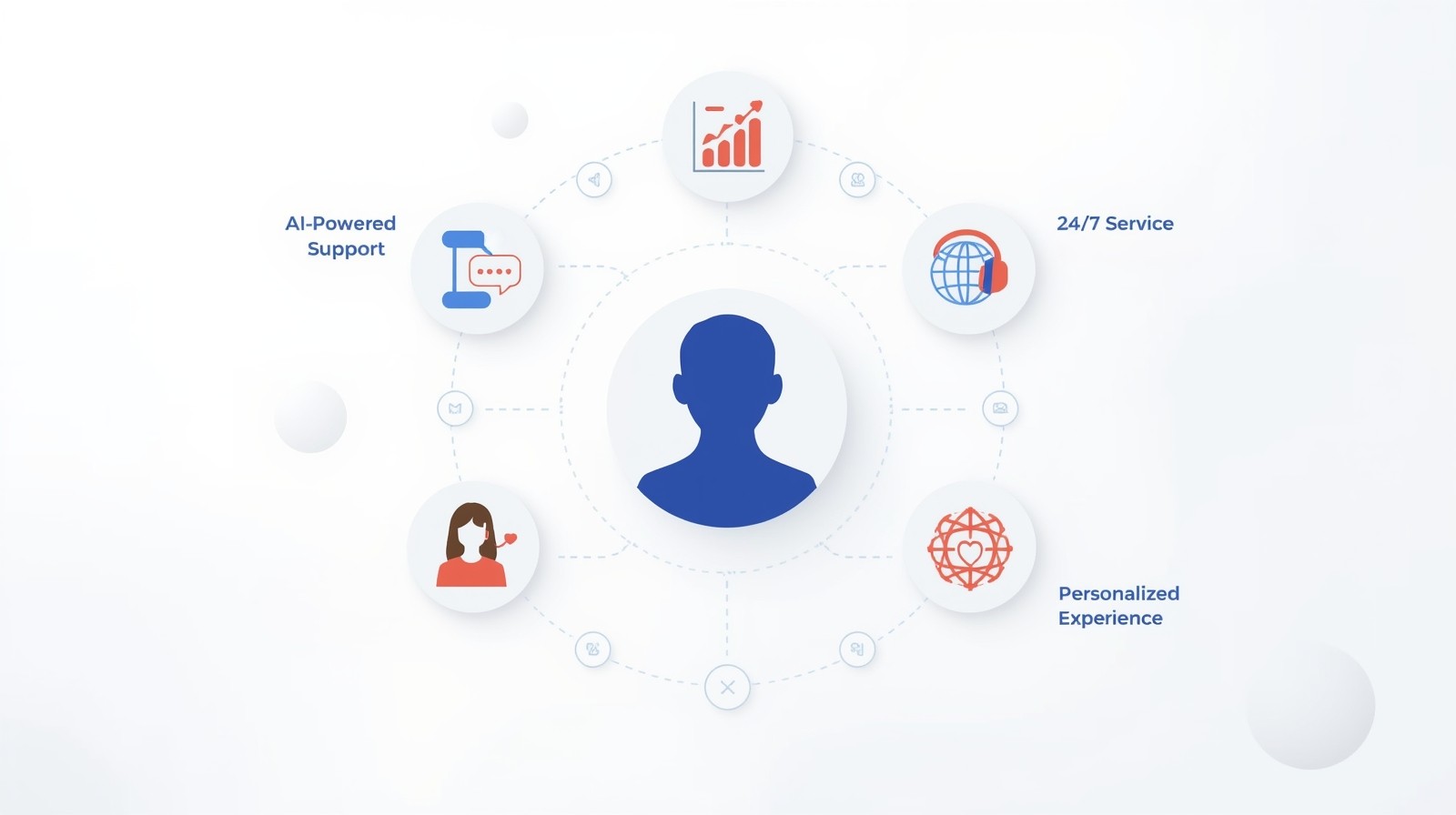
AI in Customer Service: Transform Your Business Today
Have you ever waited on hold for what felt like hours, only to repeat your problem multiple times to different agents? We’ve all been there, and it’s frustrating. But here’s the good news: AI in Customer Service and Support is changing everything about how businesses help their customers. I’m excited to share with you how this technology is making customer interactions faster, smarter, and more personal than ever before.
As someone who’s watched customer service evolve from call centers to chatbots, I can tell you that we’re living through a remarkable transformation. Whether you’re a business owner looking to improve your customer experience or simply curious about how AI is reshaping our daily interactions, this guide will walk you through everything you need to know—no technical jargon required.
AI in Customer Service and Support isn’t about replacing human agents with robots. It’s about giving businesses the tools to serve customers better, faster, and more efficiently. Think of AI as the ultimate support assistant that never sleeps, never gets tired, and learns from every interaction to become even more helpful.
Understanding the Foundation: What Is AI in Customer Service?
Let me break this down in simple terms. When we talk about AI in Customer Service and Support, we’re referring to intelligent systems that can understand customer questions, provide helpful answers, and even predict what customers might need before they ask. These systems use technologies like machine learning, natural language processing, and data analytics to create experiences that feel surprisingly human.
Imagine having a team member who instantly knows every customer’s history, can speak dozens of languages fluently, and handles routine questions while your human agents focus on complex problems that truly need a personal touch. That’s the power of AI in action.
The beauty of modern AI-powered customer service is that it works alongside your existing team, not instead of them. I’ve seen small businesses and large corporations alike discover that the right AI tools actually make their human agents more effective, not redundant.
How AI Is Revolutionizing Customer Interactions
The Technology Behind the Magic
Let’s pull back the curtain on how this actually works. AI customer service systems learn from massive amounts of conversation data. Every time someone asks a question, the AI analyzes the words, understands the intent, and matches it to the best possible response. Over time, these systems get better at recognizing patterns and providing more accurate, helpful answers.
What makes modern AI particularly impressive is its ability to understand context. If a customer says, “This isn’t working,” the AI doesn’t just respond with a generic answer. It considers what product the customer purchased, when they bought it, their previous interactions, and even the sentiment behind their message to provide a truly relevant solution.
Real-World Applications You’re Already Using
You’ve probably interacted with AI in Customer Service and Support more than you realize. That helpful chat window that pops up when you’re shopping online? Often powered by AI. The voice assistant that helps you check your bank balance? AI at work. Even the email responses that seem to anticipate exactly what you need? You guessed it—AI assistance.
I recently helped a friend’s small online boutique implement a simple AI chatbot, and the results were eye-opening. Within the first month, the bot handled over 60% of customer inquiries instantly—questions about shipping times, return policies, and size charts. This freed up my friend to focus on the complex custom orders and building genuine relationships with her most loyal customers.
AI Chatbots: Revolutionizing Customer Service Interactions
AI Chatbots have become the friendly face of modern customer service, and they’re far more sophisticated than you might think. These digital assistants can hold natural conversations, understand customer emotions, and provide instant help 24 hours a day, seven days a week.
What I find most impressive about today’s chatbots is their ability to learn from every conversation. Unlike the frustrating automated phone systems of the past that forced you through endless menus, modern AI chatbots can understand free-form questions just like a human would.
Let me share a practical example. When you ask a chatbot, “I need to return this shirt because it doesn’t fit,” a well-designed AI system understands that you’re initiating a return, identifies the product type, and recognizes the reason. It can then guide you through the return process step-by-step, even generating a return label automatically.
The key to successful chatbot implementation is starting simple and scaling up. We recommend beginning with the most common customer questions—those repetitive inquiries that consume your team’s time. As the chatbot proves its value, you can gradually expand its capabilities to handle more complex scenarios.
The Role of AI in Sentiment Analysis for Customer Feedback
Here’s where things get really interesting. The Role of AI in Sentiment Analysis for Customer Feedback goes beyond simply reading what customers say—it’s about understanding how they feel. This technology analyzes the emotional tone behind customer messages, helping businesses identify unhappy customers before a small issue becomes a major problem.
Think about it this way: if a customer writes, “I guess the product is fine,” the words seem neutral, but the sentiment suggests disappointment. AI sentiment analysis picks up on these subtle cues, flagging the interaction for special attention from a human agent who can turn the situation around.
We’ve seen companies use sentiment analysis to transform their customer service approach. By monitoring the emotional trends in customer conversations, they can identify training opportunities for agents, spot product issues early, and even predict which customers are at risk of leaving.
The practical application is straightforward. AI systems scan every customer interaction—whether it’s a chat message, email, social media comment, or survey response—and categorize the sentiment as positive, negative, or neutral. More advanced systems can even detect specific emotions like frustration, joy, confusion, or urgency.
AI-Powered Knowledge Bases: Empowering Customer Self-Service
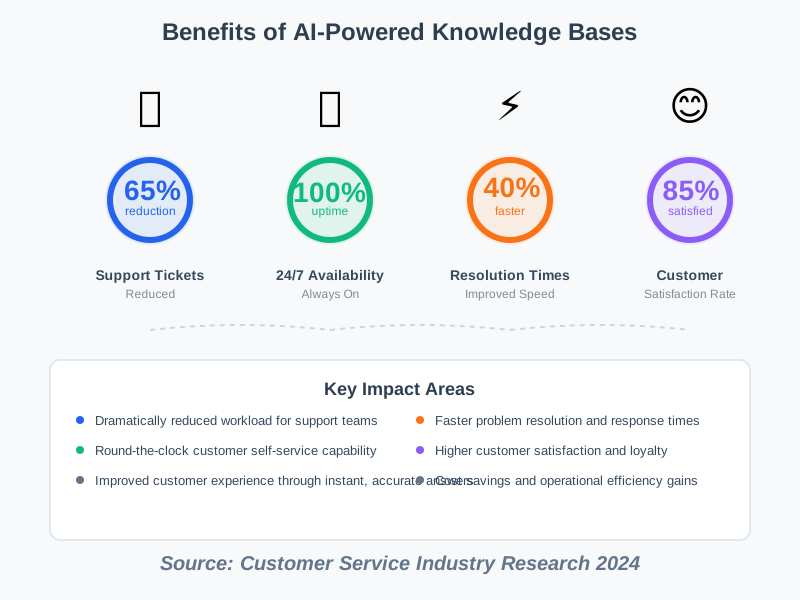
AI-Powered Knowledge Bases are transforming how customers find answers on their own. Instead of searching through static FAQ pages hoping to stumble upon the right article, customers can now ask questions in natural language and get pointed directly to the most relevant information.
I’ve watched customers interact with these intelligent knowledge bases, and it’s like having a knowledgeable librarian who instantly knows exactly which book contains the answer you need. The AI understands what you’re asking, considers the context of your question, and presents the information in a way that makes sense for your specific situation.
What makes these systems particularly powerful is their ability to learn from user behavior. If customers consistently click on a particular article after asking a certain question, the AI learns that connection and makes it even easier for future customers to find that information.
For businesses, implementing an AI-powered knowledge base means customers can solve problems independently at any time, reducing the load on your support team while improving customer satisfaction. It’s a win-win situation that we’ve seen work across industries, from software companies to retail businesses.
AI for Predictive Customer Service: Anticipating Customer Needs
Imagine knowing what your customer needs before they even reach out to you. That’s the promise of AI for Predictive Customer Service—and it’s not science fiction anymore. This technology analyzes patterns in customer behavior, purchase history, and interaction data to anticipate issues and proactively offer solutions.
Let me give you a real-world example that illustrates this beautifully. A software company I work with uses predictive AI to monitor how customers use their product. When the system notices a customer struggling with a particular feature—maybe they’ve attempted the same action multiple times without success—it automatically triggers a helpful message offering assistance or directing them to a tutorial video.
The magic of predictive customer service lies in its ability to prevent frustration before it happens. Instead of waiting for a customer to become so confused or annoyed that they reach out for help, the AI identifies the struggle early and steps in with relevant guidance.
For businesses implementing this technology, the key is collecting and analyzing the right data points. We recommend starting with high-impact scenarios where early intervention can make the biggest difference—like preventing cart abandonment in e-commerce or reducing churn in subscription services.
AI in Customer Service: A Guide to Implementation and Best Practices
Now let’s talk about the practical side: AI in Customer Service: A Guide to Implementation and Best Practices. If you’re thinking about bringing AI into your customer service operations, you’re probably wondering where to start. Let me walk you through a step-by-step approach that we’ve seen work time and again.
Step 1: Identify Your Pain Points
Before rushing to implement any AI solution, take a clear-eyed look at your current customer service challenges. Are customers waiting too long for responses? Is your team overwhelmed with repetitive questions? Do you struggle to provide support outside business hours? Understanding your specific problems will help you choose the right AI tools.
Step 2: Start Small and Focused
One of the biggest mistakes we see businesses make is trying to automate everything at once. Instead, pick one area where AI can make an immediate impact. Maybe it’s handling password reset requests, or answering basic product questions, or routing tickets to the right department. Starting small allows your team to learn and adapt without overwhelming them.
Step 3: Choose the Right Technology
There are countless AI customer service platforms available, and they’re not all created equal. Look for solutions that integrate easily with your existing systems, offer good training and support, and can scale as your needs grow. Don’t be swayed by fancy features you’ll never use—focus on functionality that addresses your specific challenges.
Step 4: Train Your AI System Properly
This is crucial: your AI is only as good as the data you train it with. Spend time feeding it examples of real customer conversations, teaching it about your products and policies, and refining its responses. We recommend dedicating at least a few weeks to this training phase before going live.
Step 5: Maintain Human Oversight
Even the best AI systems need human guidance. Establish clear protocols for when conversations should be escalated to human agents, regularly review AI interactions for quality, and continuously update the system based on new products, policies, or customer feedback patterns.
Step 6: Measure and Optimize
Set clear metrics to evaluate your AI’s performance—response times, resolution rates, customer satisfaction scores, and cost savings. Use this data to continually improve the system, expanding its capabilities as it proves its value.
AI-Driven Personalization: Tailoring Customer Service Experiences
AI-Driven Personalization is what transforms good customer service into exceptional customer service. Instead of treating every customer the same, AI analyzes individual preferences, history, and behavior to create uniquely tailored experiences.
Think about how Netflix recommends shows you might like or how Amazon suggests products based on your browsing history. That same personalization technology is now revolutionizing customer service. When a customer contacts your business, the AI can instantly pull up their entire history—what they’ve purchased, what issues they’ve had, their communication preferences—and use that context to provide more relevant, helpful assistance.
We’ve helped businesses implement personalization in ways that feel natural and helpful, not creepy. For example, if a customer always prefers email communication over phone calls, the AI remembers that preference. If someone typically shops for a particular type of product, the AI can proactively suggest related items or notify them about relevant sales.
The key to effective personalization is balance. You want to use customer data to improve their experience, but you also need to respect privacy and avoid being overly intrusive. Transparency is essential—let customers know how their data is being used to serve them better, and give them control over their preferences.
AI and the Future of Customer Service Jobs: Augmentation, Not Replacement
Let’s address the elephant in the room: AI and the Future of Customer Service Jobs. There’s a lot of fear and misinformation floating around about AI replacing human workers. Having worked with numerous companies through this transition, I can tell you confidently that the reality is much more nuanced—and actually quite positive.
AI and the Future of Customer Service Jobs is fundamentally about augmentation, not replacement. The most successful implementations we’ve seen use AI to handle routine tasks, freeing human agents to focus on the complex, emotionally nuanced situations where human empathy and problem-solving skills are irreplaceable.
I’ve watched customer service agents transform from spending 70% of their time answering the same basic questions repeatedly to focusing almost entirely on challenging problems that require creativity and emotional intelligence. This shift doesn’t just make their jobs more interesting—it makes them more valuable to their companies and more satisfying for customers who need real help.
The jobs aren’t disappearing; they’re evolving. Modern customer service professionals need new skills—understanding how to work alongside AI tools, interpreting data insights, and focusing on relationship building. But these skills can be learned, and many companies are investing in training programs to help their teams adapt.
For businesses, the message is clear: invest in your people as you invest in AI. The combination of artificial intelligence and human intelligence creates a customer service powerhouse that neither could achieve alone.
AI for Automated Customer Service Ticket Routing
AI for Automated Customer Service Ticket Routing might not sound exciting, but it’s one of those behind-the-scenes improvements that dramatically impacts customer satisfaction. Instead of tickets sitting in a general queue or being manually assigned by a manager, AI instantly analyzes each incoming request and routes it to the agent best equipped to handle it.
The system considers multiple factors: the nature of the problem, the complexity level, the customer’s priority status, agent expertise and availability, and even which agents have successfully resolved similar issues in the past. This intelligent routing means customers get faster, more accurate help, and agents spend less time on issues outside their expertise.
I’ve seen the impact firsthand. One company we worked with reduced their average resolution time by 35% simply by implementing smarter ticket routing. Customers were happier because their problems got solved faster, and agents were more confident because they were handling issues that matched their skills.
The beauty of this system is that it learns and improves over time. As the AI observes which agents excel at which types of problems, it gets better at making routing decisions. It can even predict which new issues might become complex cases requiring senior agents, routing them appropriately before they escalate.
AI in Voice Assistants: Enhancing Customer Service Through Voice
AI in Voice Assistants has come a long way from the robotic phone menus that everyone dreads. Modern voice AI can understand natural speech, detect emotion, and hold genuinely helpful conversations. This technology is particularly valuable for customers who prefer speaking to typing or who need hands-free support.
The latest voice assistants can handle complex multi-turn conversations, understanding context from earlier in the dialogue. If a customer says, “Actually, I changed my mind about that,” the AI knows what “that” refers to without needing clarification. This conversational ability makes voice interactions feel natural rather than frustrating.
We’re seeing voice AI used creatively across industries. Banks use it for account inquiries and transaction verification. Healthcare providers use it for appointment scheduling and prescription refills. Retailers use it for order tracking and product information. The key advantage is accessibility—voice interfaces remove barriers for people who struggle with typing, have visual impairments, or simply prefer verbal communication.
For businesses implementing voice AI, the focus should be on natural conversation flow and clear escalation paths. Customers should always have an easy way to reach a human agent when needed, and the voice AI should be transparent about being an automated system rather than trying to fool customers into thinking they’re talking to a person.
AI-Powered Customer Service Analytics: Measuring Performance and Identifying Trends
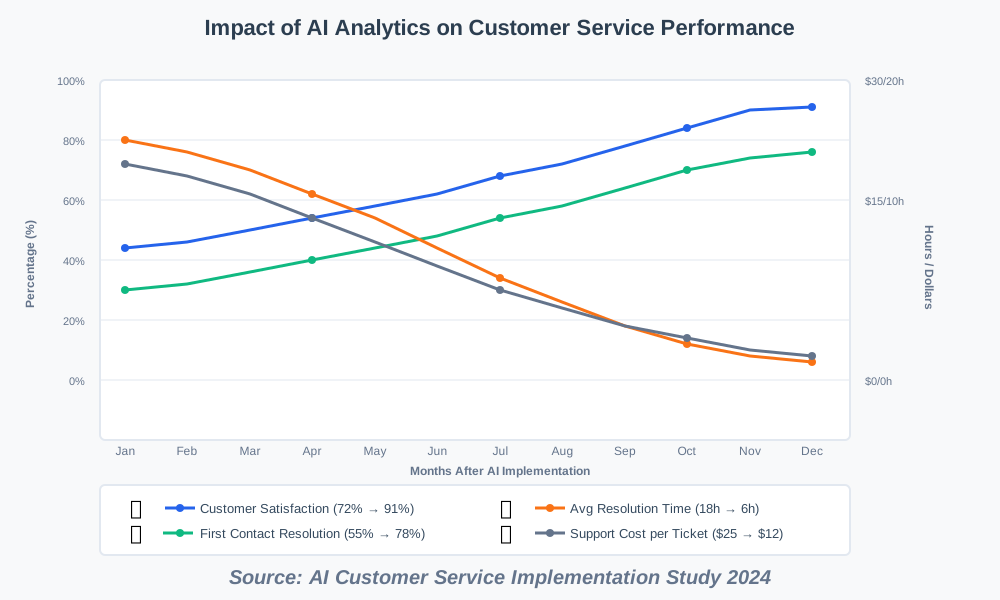
AI-Powered Customer Service Analytics transforms mountains of data into actionable insights. Instead of manually reviewing hundreds of customer interactions to spot patterns, AI does this instantly and continuously, identifying trends that humans might miss.
These analytics systems track everything: which issues are most common, which time periods see the highest volume, which agent responses get the best results, which customers are at risk of churning, and which products generate the most support requests. This information helps businesses make smarter decisions about staffing, training, product improvements, and customer communication.
I particularly love how these systems can predict future trends. By analyzing historical patterns, AI can forecast upcoming busy periods, allowing businesses to schedule staff appropriately. It can also identify emerging issues before they become widespread problems—like if a new product is generating unusual amounts of confusion or frustration.
The practical value is enormous. One e-commerce company we worked with used AI analytics to discover that 40% of their support requests were about a confusing checkout process. They redesigned the checkout flow based on these insights, and support volume dropped by a third almost immediately.
AI for Fraud Detection in Customer Service Interactions
AI for Fraud Detection in Customer Service Interactions is protecting businesses and customers from increasingly sophisticated scams. Fraudsters constantly develop new tactics, but AI systems can analyze patterns across millions of interactions to spot suspicious behavior that human agents might miss.
These systems look at multiple signals: inconsistencies in account information, unusual request patterns, attempts to rush through security protocols, language patterns associated with social engineering, and even subtle behavioral cues that indicate deception. When the AI detects potential fraud, it can flag the interaction for additional verification or automatically implement enhanced security measures.
What’s particularly impressive is how quickly these systems adapt to new fraud tactics. Traditional rule-based fraud detection requires manual updates when new scams emerge, but AI learns from each attempted fraud, continuously improving its ability to spot evolving threats.
For customers, this increased security happens seamlessly in the background. Legitimate interactions flow smoothly, while suspicious ones receive appropriate scrutiny. This balance is crucial—overly aggressive fraud detection frustrates honest customers, while insufficient detection leaves businesses and customers vulnerable.
AI and Multilingual Customer Service: Breaking Down Language Barriers
AI and Multilingual Customer Service is democratizing global business by breaking down language barriers. Modern AI translation and interpretation tools allow businesses to serve customers in dozens or even hundreds of languages without maintaining massive multilingual support teams.
The technology has improved dramatically in recent years. Early machine translation was clunky and often embarrassing, but today’s AI understands context, idioms, and cultural nuances. It can translate customer queries accurately and generate responses that sound natural in the customer’s language.
I’ve watched small businesses use this technology to expand into international markets they never thought they could serve. One online retailer I worked with used AI translation to offer customer service in 15 languages, opening up entirely new customer bases without hiring additional staff.
The key to success is combining AI translation with human oversight, especially for complex or sensitive interactions. Use AI to handle routine multilingual support, but have native speakers available to handle nuanced conversations or review AI translations for quality. This hybrid approach provides language accessibility while maintaining the personal touch that customers value.
AI in Customer Service: Addressing Ethical Considerations and Bias
We need to talk honestly about AI in Customer Service: Addressing Ethical Considerations and Bias. AI systems are trained on data created by humans, which means they can inadvertently learn and perpetuate human biases. As we implement these powerful tools, we have a responsibility to ensure they treat all customers fairly and respectfully.
Bias can manifest in subtle ways: an AI system might provide less helpful responses to certain names, give different quality service based on language patterns, or make assumptions about customer knowledge or sophistication based on demographic indicators. These problems aren’t intentional, but they’re real and can cause significant harm.
The solution starts with awareness and intentional design. We recommend regularly auditing AI systems for bias, using diverse training data that represents your entire customer base, and establishing clear ethical guidelines for AI behavior. It’s also crucial to maintain human oversight and easy escalation paths when customers feel they’re being treated unfairly.
Transparency is equally important. Customers should know when they’re interacting with AI rather than a human, and they should understand how their data is being used. This openness builds trust and allows customers to make informed choices about their interactions with your business.
AI-Driven Customer Service Training: Improving Agent Performance
AI-Driven Customer Service Training is revolutionizing how businesses develop their support teams. Instead of generic training programs, AI analyzes each agent’s performance to identify specific strengths and areas for improvement, then delivers personalized training content targeting their individual needs.
The system can review agents’ actual customer interactions, identifying patterns in communication style, problem-solving approaches, and customer satisfaction outcomes. It might notice that an agent excels at technical troubleshooting but struggles with de-escalating angry customers, then recommend specific training modules on conflict resolution and empathy.
What makes this particularly powerful is the real-time feedback. Rather than waiting for quarterly reviews, agents receive immediate insights after each interaction. The AI might suggest alternative responses that would have been more effective or highlight moments where they successfully handled a difficult situation.
We’ve seen this personalized approach dramatically improve training efficiency. Instead of sitting through hours of generic training sessions, agents focus on skills they actually need to develop. One call center we worked with reduced training time by 40% while simultaneously improving customer satisfaction scores by 25%.
AI and the Evolution of Customer Service Metrics: What to Measure Now
AI and the Evolution of Customer Service Metrics challenge us to rethink how we measure success. Traditional metrics like average handle time and first call resolution are still relevant, but AI capabilities enable us to track more sophisticated indicators of customer experience quality.
Customer effort score—how easy it is for customers to get their problems solved—becomes measurable at scale through AI analysis of interaction complexity and resolution paths. Emotional journey tracking reveals how customer sentiment changes throughout an interaction, highlighting which agent behaviors most effectively improve customer mood.
Predictive metrics become possible: AI can identify which customers are at risk of churning based on their service interactions, allowing proactive intervention. It can predict which new issues might become trending problems, enabling preemptive action before they impact many customers.
The key is not drowning in data but focusing on metrics that drive meaningful improvements. We recommend establishing a balanced scorecard that includes traditional efficiency metrics, quality indicators, customer sentiment measures, and predictive insights. This comprehensive view provides a true picture of customer service performance and opportunities for enhancement.
AI for Proactive Customer Service: Preventing Problems Before They Occur
AI for Proactive Customer Service represents a fundamental shift from reactive problem-solving to preventive care. Instead of waiting for customers to encounter issues and reach out for help, AI monitors signals that indicate potential problems and takes action before customers even realize something might go wrong.
This might mean detecting that a customer’s subscription payment is about to fail and proactively reaching out with updated payment options. Or noticing that a customer is using a product in a way likely to cause issues and sending helpful guidance before frustration sets in. Or identifying customers who received potentially defective products and offering replacements before they experience problems.
The impact on customer experience is profound. Imagine how differently you’d feel about a company that contacts you to say, “We noticed your shipment might be delayed, so we’ve already expedited it and added a discount to your next order”, versus having to contact them yourself to complain about a late delivery.
Implementing proactive service requires careful data analysis to identify the right triggers and appropriate responses. We recommend starting with high-impact scenarios where prevention has clear benefits for both customers and the business—like preventing churn, avoiding negative reviews, or reducing warranty claims.
AI-Powered Customer Service Automation: Streamlining Processes
AI-Powered Customer Service Automation extends beyond just answering customer questions. It encompasses automating entire workflows and processes that previously required manual human intervention. This comprehensive automation dramatically improves efficiency while reducing errors.
Consider the traditional order modification process: a customer emails to change their shipping address, a support agent reads the email, logs into the order management system, updates the address, confirms inventory availability for the new location, recalculates shipping costs, processes any necessary refund or charge, and emails the customer confirmation. With AI automation, this entire process happens instantly when the customer submits their request through a chatbot or self-service portal.
The beauty of modern automation is its intelligence. These aren’t rigid, rule-based systems that break when something unexpected happens. AI-powered automation can handle variations, exceptions, and edge cases, escalating to humans only when truly necessary.
We’ve helped businesses automate processes ranging from returns and exchanges to appointment scheduling to account updates. The key is identifying processes that are frequent enough to provide significant time savings, predictable enough to automate reliably, and low-risk enough that occasional errors won’t cause major problems.
AI in Customer Service for E-commerce: Enhancing the Online Shopping Experience
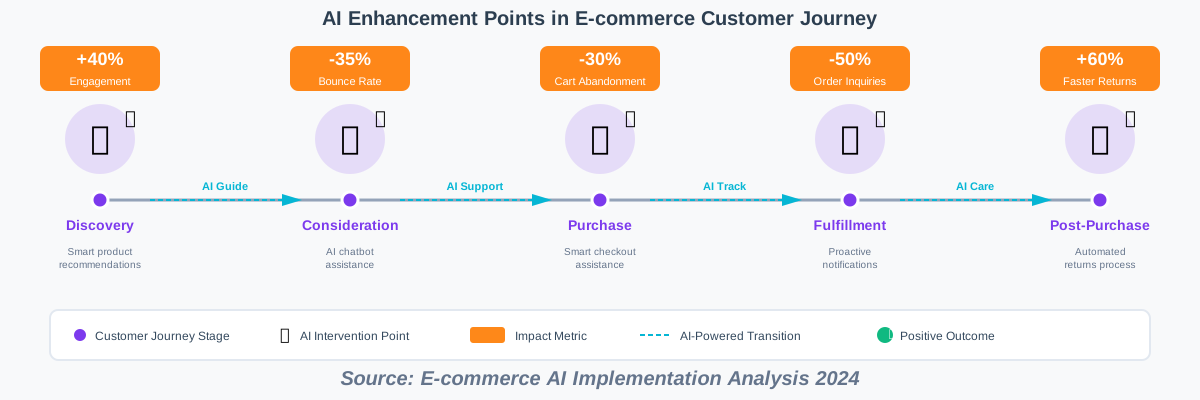
AI in Customer Service for E-commerce is specifically transforming how online shoppers get help and information. From the moment a customer lands on a website through post-purchase support, AI enhances every step of the shopping journey.
During browsing, AI chatbots answer product questions instantly, helping customers make confident purchase decisions without leaving the site to search for information elsewhere. They can provide sizing guidance, suggest complementary products, and explain features in ways that address individual customer concerns.
At checkout, AI can intervene to prevent cart abandonment by addressing common concerns—offering shipping cost information, highlighting return policies, or providing discount codes for first-time buyers. If a customer hesitates, the AI might proactively offer assistance or incentives to complete the purchase.
Post-purchase, AI continues supporting customers through order tracking, delivery updates, and issue resolution. If a package is delayed, the AI proactively notifies the customer and offers solutions before they have to reach out with concerns.
One fashion retailer we worked with implemented comprehensive e-commerce AI and saw remarkable results: a 30% reduction in cart abandonment, a 45% increase in conversion rate for customers who engaged with the AI assistant, and a 50% decrease in post-purchase support tickets. The AI essentially created a personal shopping assistant experience at scale.
AI and Customer Service: Common Challenges and How to Overcome Them
Let’s be realistic about AI and Customer Service: Common Challenges and How to Overcome Them. Implementing AI isn’t always smooth sailing, and understanding potential pitfalls helps you avoid them or address them effectively when they arise.
Challenge 1: Customer Resistance to AI Interactions
Many customers prefer speaking with humans, especially for complex or emotional issues. The solution isn’t forcing AI interactions but offering choice and ensuring seamless escalation. Make it easy for customers to reach human agents when they want to, and ensure the transition includes context from the AI interaction so customers don’t have to repeat themselves.
Challenge 2: Integration with Legacy Systems
Older customer service systems weren’t designed to work with AI, creating technical integration challenges. We recommend taking an incremental approach: start with AI tools that can work alongside existing systems through APIs, then gradually modernize infrastructure as you prove value and secure additional investment.
Challenge 3: Maintaining AI Accuracy
AI systems can provide incorrect information, especially when dealing with complex or ambiguous questions. Regular monitoring, continuous training, and clear confidence thresholds help minimize these errors. Program your AI to admit uncertainty and escalate to humans rather than guessing when it’s not confident in an answer.
Challenge 4: Data Privacy and Security Concerns
Customer service AI requires access to sensitive customer data, raising legitimate privacy concerns. Address these through robust security measures, transparent data policies, and compliance with regulations like GDPR and CCPA. Be clear with customers about how their data is used and give them control over their information.
Challenge 5: Change Management and Team Adoption
Your support team might feel threatened by AI or resistant to changing established workflows. Successful adoption requires clear communication about AI’s role as an assistant rather than a replacement, comprehensive training on working with AI tools, and involving team members in the implementation process to address their concerns and incorporate their expertise.
AI for Customer Service Scripting: Creating Effective and Consistent Interactions
AI for Customer Service Scripting helps maintain quality and consistency while allowing for personalization. Unlike rigid scripts that make agents sound robotic, AI-assisted scripting provides dynamic guidance that adapts to each unique customer situation.
The system analyzes the conversation in real-time and suggests appropriate responses, empathy statements, or problem-solving approaches based on the specific context. An agent helping an angry customer receives different guidance than one assisting someone with a technical question, even if the underlying issue is similar.
This technology is particularly valuable for training new agents. Instead of memorizing scripts or fumbling through knowledge bases, they receive contextual guidance that helps them sound knowledgeable and confident from their first customer interactions. As they gain experience, they rely less on the suggestions and more on their own expertise.
For businesses, AI scripting ensures brand consistency across all customer interactions while allowing for the human flexibility that creates genuinely helpful conversations. It’s the best of both worlds: the consistency of scripted responses with the adaptability of freestyle conversation.
AI-Driven Customer Service Reporting: Gaining Actionable Insights
AI-Driven Customer Service Reporting transforms raw interaction data into strategic insights that drive business decisions. Traditional reporting tells you what happened; AI-driven reporting tells you why it happened and what you should do about it.
These systems automatically generate reports highlighting key trends, emerging issues, performance patterns, and improvement opportunities. Instead of spending hours analyzing data, managers receive clear, actionable insights: “Product X is generating 40% more support requests this month due to confusion about feature Y” or “Agent performance improves 25% after specialized training on topic Z.”
The predictive capabilities are particularly valuable. AI can forecast future support volume based on factors like marketing campaigns, product launches, and seasonal patterns, enabling better resource planning. It can identify which agents are at risk of burnout based on workload and satisfaction indicators, allowing proactive intervention.
We recommend establishing regular reporting rhythms—daily operational reports for immediate issues, weekly tactical reports for team management, and monthly strategic reports for business planning. Customize each report level to provide the right information at the right detail for its intended audience.
AI in Customer Service for the Healthcare Industry
AI in Customer Service for the Healthcare Industry requires special consideration due to strict privacy regulations, the sensitive nature of health information, and the critical importance of accuracy. However, when implemented thoughtfully, AI can dramatically improve healthcare customer service while maintaining compliance and care quality.
Healthcare AI assistants can handle appointment scheduling, prescription refill requests, insurance questions, and basic medical information inquiries—all while maintaining HIPAA compliance and protecting patient privacy. They can triage incoming requests, routing urgent medical concerns to healthcare professionals immediately while handling routine administrative matters automatically.
One area where we’ve seen particularly strong results is reducing no-shows through AI-powered appointment reminders and rescheduling assistance. The AI can send personalized reminders through patients’ preferred channels, answer questions about appointment preparation, and make rescheduling easy when needed—reducing missed appointments by up to 40% in some practices.
The key to successful healthcare AI implementation is maintaining the human touch for medical matters while automating administrative tasks. Patients should never feel that AI is making medical decisions or preventing them from accessing human healthcare providers when needed. The technology should enhance care accessibility, not create barriers.
AI and Customer Service: Integrating AI with Existing CRM Systems
AI and Customer Service: Integrating AI with Existing CRM Systems is crucial for creating seamless experiences. Your AI tools need access to customer history, interaction records, and account details stored in your CRM to provide truly personalized, context-aware service.
Modern AI platforms offer robust integration capabilities with major CRM systems like Salesforce, HubSpot, Zendesk, and Microsoft Dynamics. These integrations allow bidirectional data flow: the AI can read customer information from the CRM to inform its responses, and it can write new interaction records back to the CRM for complete customer history tracking.
The practical benefits are substantial. When a customer contacts you, the AI instantly has access to their purchase history, previous support tickets, communication preferences, and any notes from past interactions. This context enables more relevant, efficient support without customers having to explain their entire history every time they reach out.
For businesses evaluating AI solutions, integration capabilities should be a primary consideration. Ask potential vendors about native integrations with your existing systems, API flexibility for custom integrations, data synchronization frequency, and security measures for data transfer. A powerful AI tool that can’t integrate with your infrastructure will create more problems than it solves.
AI for Customer Service Quality Assurance: Ensuring Consistent Excellence
AI for Customer Service Quality Assurance transforms quality monitoring from a sampling-based process to a comprehensive evaluation of every customer interaction. Traditional QA involves managers reviewing a small percentage of interactions, missing issues that fall outside the sample, and creating inconsistent feedback for agents.
AI quality assurance analyzes 100% of customer interactions in real-time, evaluating them against defined quality standards. It assesses factors like adherence to company policies, accuracy of information provided, appropriate use of empathy and communication skills, successful problem resolution, and customer satisfaction indicators.
The system can identify both excellent interactions worthy of recognition and problematic ones requiring coaching. It flags compliance violations immediately, preventing small issues from becoming major problems. For agents, this means more frequent, specific feedback that helps them improve continuously rather than waiting for periodic reviews.
One contact center we worked with implemented AI quality assurance and saw dramatic improvements: agent performance scores increased 30% within six months, customer satisfaction improved 20%, and compliance violations dropped by 65%. The key was using AI insights to provide constructive, timely coaching rather than punitive evaluations.
AI in Customer Service: The Impact of Natural Language Processing (NLP)
AI in Customer Service: The Impact of Natural Language Processing cannot be overstated. NLP is the technology that allows AI to understand human language in all its messy, ambiguous, context-dependent complexity. Without sophisticated NLP, AI customer service tools would be limited to recognizing specific keywords rather than truly understanding what customers are saying.
Modern NLP enables AI to comprehend intent behind questions, recognize entities and relationships, understand context from previous conversation turns, detect sentiment and emotion, and handle variations in how different people phrase the same request. This understanding makes AI interactions feel natural rather than frustrating.
The technology continues advancing rapidly. Recent developments in large language models have dramatically improved AI’s ability to engage in nuanced conversations, understand cultural context and idioms, and generate human-like responses. These improvements make AI customer service increasingly indistinguishable from human assistance for many types of interactions.
For businesses implementing AI customer service, staying current with NLP advancements is important. Today’s best practices might be obsolete in a year as the technology improves. We recommend choosing AI platforms that regularly update their NLP capabilities and provide transparent information about their underlying technology.
AI-Powered Customer Service Surveys: Gathering Meaningful Feedback
AI-Powered Customer Service Surveys are making feedback collection more effective and less annoying. Traditional surveys often suffer from low response rates, survey fatigue, and data that’s difficult to analyze at scale. AI is addressing all these challenges.
Smart surveys adapt their questions based on previous responses, creating conversational experiences rather than long lists of rating scales. If a customer indicates dissatisfaction, the survey might ask follow-up questions to understand the specific issue. If they’re extremely satisfied, it might ask what delighted them most.
AI also makes surveys less intrusive by choosing optimal timing and channels. Instead of sending a survey immediately after every interaction, the system might identify particularly meaningful interactions where feedback would be most valuable and time the request when customers are most likely to respond.
Perhaps most importantly, AI analyzes survey responses to identify patterns and actionable insights automatically. It can categorize open-ended feedback, identify trending issues, correlate satisfaction scores with specific agent behaviors or processes, and predict which improvements would have the greatest impact on customer satisfaction.
The result is richer feedback, higher response rates, and insights that actually drive improvements rather than sitting unused in a database.
AI and Customer Service: Building Trust Through Transparency
AI and Customer Service: Building Trust Through Transparency is essential for customer acceptance and satisfaction. Many people feel uncomfortable with AI interactions, especially when they’re not aware they’re talking to a machine. Transparency builds trust and improves customer experience.
Best practices include clearly identifying AI interactions at the start of conversations, explaining how customer data is being used, providing easy access to human agents when desired, and being honest about AI capabilities and limitations. When the AI doesn’t know something, it should say so rather than guessing or providing potentially incorrect information.
Transparency also means being clear about how AI decisions are made, especially when they impact customers directly. If an AI system denies a request or makes a recommendation, customers should understand why—and have recourse to appeal or receive a human review if they disagree.
We’ve seen that transparent AI implementations actually increase customer satisfaction compared to trying to hide AI involvement. Customers appreciate honesty and are often impressed by AI capabilities when they understand what they’re experiencing. The key is framing AI as a helpful tool that improves their experience rather than a cost-cutting measure that diminishes service quality.
AI for Customer Service in the Financial Services Industry
AI for Customer Service in the Financial Services Industry combines powerful capabilities with stringent regulatory requirements. Financial institutions use AI to provide 24/7 account support, fraud detection, personalized financial guidance, and efficient transaction processing—all while maintaining compliance with complex regulations.
Banking AI can handle routine inquiries like balance checks, transaction history, bill payments, and fund transfers securely through voice or text interfaces. It can explain fees, help customers understand their statements, and guide them through online banking features. For more complex matters like loan applications or investment advice, the AI gathers information and routes customers to appropriate specialists.
Security is paramount in financial services AI. These systems implement multi-factor authentication, detect suspicious behavior patterns, and protect sensitive financial information through encryption and strict access controls. They also maintain detailed audit trails of all interactions for regulatory compliance.
One particularly valuable application is financial education. AI can provide personalized guidance on budgeting, saving, and financial planning based on individual circumstances, making financial literacy more accessible without requiring expensive human advisors for every customer.
The challenge is balancing automation efficiency with the human judgment needed for complex financial decisions and the regulatory requirements that limit what automated systems can do. Success requires close collaboration between technology teams, compliance departments, and customer service operations.
AI-Driven Customer Service Escalation: Handling Complex Issues Effectively
AI-Driven Customer Service Escalation ensures that complex or sensitive issues reach the right human experts efficiently. Not all problems can or should be handled by AI, and knowing when and how to escalate is crucial for customer satisfaction.
Smart escalation systems consider multiple factors: issue complexity, customer emotion level, customer value or status, regulatory requirements, and AI confidence in handling the situation. They don’t just dump difficult conversations on humans indiscriminately but match each situation with the most appropriate resource.
When escalation occurs, context preservation is essential. The human agent should receive complete information about the customer’s issue, what the AI has already attempted, customer sentiment throughout the interaction, and any relevant history or account details. This seamless handoff prevents customers from having to repeat themselves—one of the most frustrating aspects of traditional customer service.
Progressive escalation is another important concept. The AI might first try handling an issue itself, then escalate to a standard support agent, and finally reach a senior specialist or manager if needed. Each escalation level has appropriate context about previous attempts, enabling more efficient resolution.
We’ve helped businesses implement escalation frameworks that improved both efficiency and satisfaction. Customers reach the right resource faster, agents spend time on issues matching their expertise, and overall resolution rates improve.
AI in Customer Service: Preparing for the Future of Customer Interactions
AI in Customer Service: Preparing for the Future of Customer Interactions requires thinking beyond current capabilities to anticipated developments. The technology is evolving rapidly, and businesses that position themselves strategically will gain competitive advantages.
Emerging trends include increasingly sophisticated emotional intelligence in AI systems, enabling more empathetic responses to customer distress. Voice AI is becoming indistinguishable from human speech, with natural conversational flow and appropriate emotional tone. Multimodal AI combining text, voice, visual, and sensor data will create richer understanding of customer needs.
Augmented reality and virtual reality integration will enable new forms of customer support—imagine an AI guiding you through product troubleshooting with visual overlays showing exactly what to do, or virtual showrooms where AI assistants help you visualize products in your space.
To get ready for these changes, businesses need to create adaptable AI systems that can add new features, train their teams to use advanced AI tools, set up ethical guidelines for new AI abilities before they are released, and keep the focus on customers as technology changes to make sure improvements truly enhance their experience.
The businesses that thrive will be those that view AI not as a destination but as a constantly evolving tool for better serving customers. Stay curious, experiment thoughtfully, and always prioritize customer needs over technological novelty.
Frequently Asked Questions About AI in Customer Service
Taking Your First Steps with AI Customer Service
You’ve made it through this comprehensive guide, and I hope you’re feeling excited—and maybe a little overwhelmed—about the possibilities of AI in Customer Service and Support. Let me leave you with some practical advice for taking your first steps.
Start small and specific. Don’t try to revolutionize your entire customer service operation overnight. Identify one pain point—maybe it’s after-hours support, or handling password resets, or answering basic product questions—and implement AI to address that specific challenge. Learn from this experience before expanding.
Involve your team from the beginning. Your customer service agents have invaluable insights about common customer issues, pain points in current processes, and what would actually help them serve customers better. Their buy-in is essential for successful implementation, and their expertise will make your AI tools more effective.
Focus on customer experience, not just cost savings. Yes, AI can reduce support costs, but that should be a beneficial side effect, not the primary goal. The real value comes from helping more customers more effectively, creating experiences that build loyalty and drive business growth.
Stay humble and keep learning. AI technology is evolving rapidly, and best practices today might be obsolete tomorrow. Maintain curiosity, experiment thoughtfully, and always prioritize your customers’ needs over technological novelty.
Remember that AI in Customer Service and Support is ultimately about people—helping real humans solve real problems. The technology is just a tool. Use it wisely, ethically, and always in service of creating better experiences for the people who trust you with their business.
Whether you’re just starting to explore AI customer service or looking to enhance existing implementations, the future is bright. The combination of artificial intelligence and human expertise creates customer service experiences that neither could achieve alone. Take that first step today, and you’ll be amazed at what becomes possible.
We’re here to help you navigate this exciting journey. Feel free to revisit sections of this guide as you progress, and remember: every expert was once a beginner. You’ve got this!
About the Authors
This article was written through the combined expertise of Abir Benali and James Carter, bringing together perspectives on accessible technology explanation and productivity-focused implementation strategies.
Abir Benali (Main Author) is a friendly technology writer who specializes in making AI tools understandable and accessible for non-technical users. With a passion for clear communication and practical guidance, Abir breaks down complex technologies into actionable steps that anyone can follow. Their approach emphasizes real-world applications and beginner-friendly explanations that help readers confidently embrace new technologies.
James Carter (Co-Author) is a productivity coach dedicated to helping people use AI to save time and boost efficiency. James focuses on strategic implementation, workflow optimization, and measurable results. Their expertise in process improvement and change management brings a practical business perspective to technology adoption, ensuring that AI implementations deliver real value for organizations and their customers.
Together, we’ve created this comprehensive guide to help you understand and successfully implement AI in Customer Service and Support, combining technical accessibility with strategic business insights.