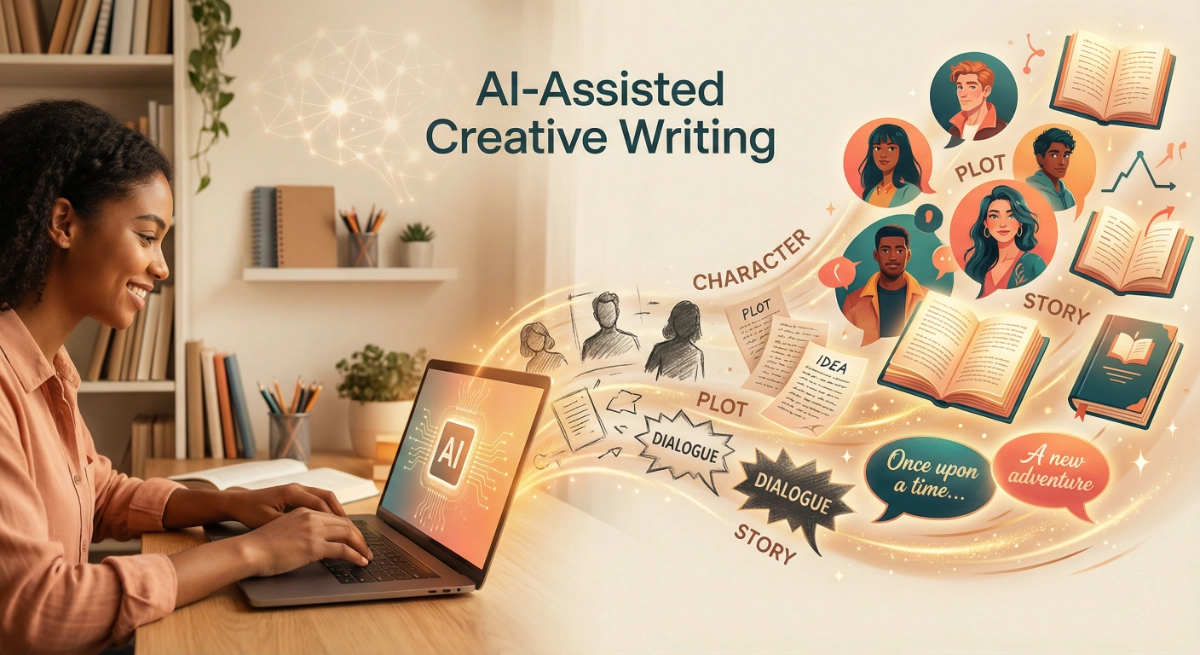
AI Creative Writing: Enhance Your Storytelling

AI-Assisted Creative Writing is transforming how students like us develop our storytelling abilities. I’ve spent countless nights staring at blank pages, wondering how to bring my characters to life or structure a plot that actually makes sense. If you’ve ever felt stuck trying to craft compelling dialogue or build a world readers can believe in, you’re not alone. The good news? AI tools can become your creative writing partner, helping you overcome blocks and strengthen your storytelling skills without replacing your unique voice.
As someone who’s navigated the difficulties associated with creative writing while juggling coursework and life responsibilities, I’ve discovered that AI-Assisted Creative Writing isn’t about letting machines write your stories. Instead, it’s about using intelligent tools to amplify your creativity, organize your ideas, and learn storytelling techniques faster. According to Oregon State University researchers J.T. Bushnell and Wayne Harrison in their 2025 study published through the OSU Ecampus Research Unit, when students receive proper instruction on using AI for creative writing, there’s a significant increase in creativity compared to both writing without AI and using AI without guidance. [ℹ️Source]
Understanding AI-Assisted Creative Writing
Before we dive into practical techniques, let’s clarify what AI-Assisted Creative Writing actually means. These are intelligent software tools powered by advanced language models that can help you with various aspects of storytelling—from brainstorming initial concepts to refining character voices and polishing dialogue. Think of them as creative collaborators that never sleep, never judge your messy first drafts, and always have suggestions when you’re stuck.
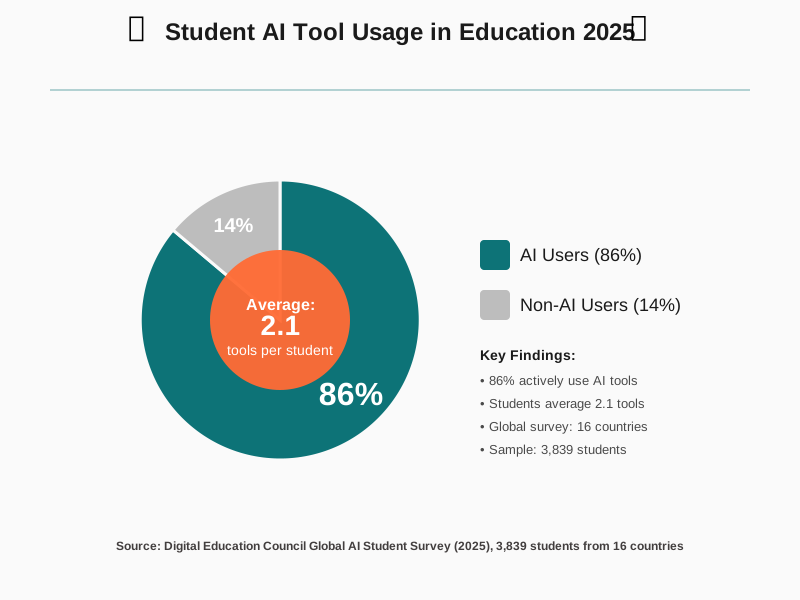
The landscape has evolved dramatically. As of 2025, 86% of students use AI globally for studies, with creative writing emerging as one of the primary applications. According to research from the Digital Education Council’s Global AI Student Survey covering 3,839 students from 16 countries, students on average use 2.1 AI tools for their courses, demonstrating how integrated these technologies have become in educational settings.
What makes AI-Assisted Creative Writing particularly powerful for students is its accessibility. Unlike expensive writing courses or hard-to-schedule tutoring sessions, AI tools are available 24/7, often at little to no cost. Whether you’re writing at 2 AM before a deadline or brainstorming during your lunch break, these tools are ready to assist.
Why AI-Assisted Creative Writing Matters for Students
Recent research challenges the traditional view that AI threatens creativity. The Oregon State University study found something fascinating: when students used AI with proper instructor guidance, creativity scores increased significantly, with the greatest improvements among students who initially scored lowest in creativity. This issue isn’t about AI doing the creative work for you—it’s about AI helping you unlock creative potential you already possess.
A February 2025 OpenAI report on ChatGPT use among college-aged users found that more than one-quarter of their ChatGPT conversations were education-related, with the top five uses being writing-centered: starting papers and projects (49%), summarizing long texts (48%), brainstorming creative projects (45%), exploring new topics (44%), and revising writing (44%) [ℹ️Source].
For us as students and lifelong learners, this represents a fundamental shift in how we approach creative challenges. Instead of struggling alone with writer’s block or character inconsistencies, we now have tools that can suggest possibilities, offer feedback, and help us see our work from new angles.
Step-by-Step Guide to Using AI for Creative Writing
Let me walk you through practical steps I’ve learned for integrating AI-Assisted Creative Writing into your storytelling process. Each step builds on proven techniques while maintaining your creative control.
Step 1: Start with Character Development
Characters are the heart of any good story, but creating believable, multi-dimensional characters can be challenging. This is where AI truly shines as a brainstorming partner.
How to do it: Open your preferred AI writing tool (ChatGPT, Claude, or specialized tools like Sudowrite). Instead of asking AI to “create a character,” be specific about what you need. Try prompts like,
- “I’m writing a fantasy story about a reluctant hero. Help me brainstorm five unique personality traits that would make this character intriguing but flawed.”
- “My main character is a college student dealing with imposter syndrome. What are three backstory elements that could explain this fear?”
Why the structure matters: By framing specific questions, you guide the AI to generate ideas that spark your own creativity rather than replacing it. The OSU study showed that when students received just 20 minutes of instruction on how to interact with AI creatively, their outputs improved dramatically.
Common mistake to avoid: Don’t copy AI-generated character descriptions directly into your story. Instead, use them as inspiration. If the AI suggests your character “fears abandonment due to childhood trauma,” ask yourself, “How would this fear manifest in my specific story context?” Make it your own.
Personal insight: I once struggled with a secondary character who felt flat. AI suggested giving her an unusual hobby—competitive bird watching—which I then adapted to fit my story’s setting. The AI didn’t write my character, but it broke through my mental block.
Step 2: Structure Your Plot with AI Assistance
Plot structure can feel overwhelming, especially when you’re juggling multiple storylines or trying to maintain narrative tension. AI tools excel at helping you visualize story arcs and identify potential plot holes.
How to do it: Share your basic story premise with the AI and ask for structural guidance.
- “I have a mystery story where [describe your setup]. Using the three-act structure, what plot points should I hit?”
- “My romance novel features specific characters and a central conflict.” Help me identify potential plot holes in this outline.”
Many specialized tools like Plottr or PlotDrive offer visual timelines specifically designed for this purpose. According to a September 2025 review by film writer Neil Chase, PlotDrive provides guided frameworks and built-in tools for tracking character arcs alongside plot structure.
Why this matters: Plot structure is teachable, and AI can serve as an always-available instructor. You learn story architecture principles while applying them to your unique narrative.
Tip for students: Save your AI-generated plot outlines in a separate document. As you write, refer back to them, but don’t feel bound by them. Your story may evolve in unexpected ways, and that’s perfectly fine.
Step 3: Craft Authentic Dialogue
Dialogue that sounds natural yet serves your story is one of the hardest aspects of creative writing. Each character needs a distinct voice, and conversations must feel authentic while advancing the plot or revealing character.
How to do it: Use AI to test different dialogue approaches:
- “Here’s a conversation between two characters [provide context]. Rewrite this dialogue to sound more natural for teenagers.”
- “My character is from [specific background]. How might they express frustration differently than someone from [different background]?”
Why this aspect matters: AI has been trained on millions of conversations and writing samples. While it can’t replicate genuine human experience, it can suggest patterns and variations you might not have considered.
Important note: Always read dialogue aloud after refining it. Your ear will catch awkwardness that looks fine on screen. AI suggestions should pass the “sounds like a real person” test.
Step 4: World-Building and Setting Details
Creating immersive fictional worlds requires consistency and rich detail. AI can help you maintain continuity and generate sensory descriptions that bring settings to life.
How to do it: Build a “story bible” with AI’s help:
- “I’m creating a sci-fi world where [describes a core concept]. What are ten technological implications I should consider?”
- “Describe what my characters would hear, smell, and feel walking through a medieval marketplace at dawn.”
Tools like Novelcrafter are specifically designed for managing world-building elements alongside your manuscript. As noted in a December 2025 review on Kindlepreneur, Novelcrafter excels at managing characters, lore, and long-form story structure, making it ideal for complex fictional worlds.
Why this matters: Consistency in world-building makes stories believable. When readers notice contradictions, it breaks immersion. AI can help you track details you might forget.
Student tip: Create a master document for your world’s rules and refer to it regularly. Ask AI to check new scenes against established world logic.
Step 5: Overcome Writer’s Block Strategically
We’ve all faced that paralyzing moment when words won’t come. AI-Assisted Creative Writing offers practical ways to break through blocks without compromising your creative ownership.
How to do it: Use AI as a brainstorming partner rather than as a replacement for a writer.
- “I’m stuck on this scene where [describe situation]. Give me five different ways this scene could unfold.”
- “My character needs to make a difficult choice here. What are three unexpected but logical options they might consider?”
Why the choice matters: The Oregon State study found that AI assistance in the “finding opportunities” and “brainstorming” phases of creative work led to the most significant creativity improvements. You’re using AI for ideation, not generation.
Personal experience: When facing a deadline, I once asked AI to suggest three possible endings for my short story. I didn’t use any of them directly, but they sparked a fourth option I wouldn’t have considered otherwise—one that felt authentically mine.
Step 6: Revise and Refine with AI Feedback
Revision is where excellent writing becomes great, but it’s difficult to see our own work objectively. AI can provide a fresh perspective on your drafts.
How to do it: Share specific passages and ask targeted questions:
- “Does this opening paragraph hook readers effectively? What could make it stronger?”
- “This description feels flat. Suggest three ways to add more sensory detail without overwriting.”
- “Read this dialogue exchange. Does each character have a distinct voice?”
Why this issue matters: Research on university students’ AI adoption shows that students use AI to save time and streamline work processes, with particular emphasis on using AI for “Independent Ideas” and “Independent Writing,” suggesting that AI tools are perceived as facilitators of creativity and independent thought rather than mere aides for rote tasks
[ℹ️Source].
Critical reminder: AI feedback should inform your revision choices, not dictate them. You’re the author. If an AI suggestion doesn’t align with your vision, trust your instincts.
Step 7: Learn Craft Through AI Interaction
One unexpected benefit of AI-Assisted Creative Writing is how much you can learn about writing techniques through the process.
How to do it: Ask AI to explain writing concepts as you work:
- “Explain show vs. tell with examples from my scene.”
- “What is foreshadowing, and where could I add it in this chapter?”
- “Analyze the pacing in this action scene. Is it too slow?”
Why this exercise matters: You’re not just getting help with your current project—you’re building writing knowledge for future work. This learning-while-doing approach is particularly effective for student writers.
Advanced technique: After completing a story, ask AI to analyze what worked and what didn’t. Compare this feedback with your own assessment and feedback from human readers to develop your critical eye.
Best AI Tools for Creative Writing in 2025
Based on current research and user experiences, here are the most effective AI-Assisted Creative Writing tools for students:
Sudowrite remains the top choice for fiction writers, according to a December 2025 analysis on Kindlepreneur. It offers specialized features for prose generation and scene-level writing and has a model specifically designed for natural-sounding fiction. The platform understands scene structure and blocking better than general AI tools. Through a special partnership, new users can access bonus credits.
Novelcrafter excels at long-form projects, offering robust tools for managing characters, lore, and complex narrative structures. It’s particularly valuable for students working on extended projects like novels or series.
ChatGPT and Claude serve as versatile, accessible options for brainstorming, revision, and general writing assistance. With ChatGPT maintaining 310 million unique monthly web visitors and 250 million monthly app users as of 2025, it has become the most widely adopted AI tool for various writing tasks.
Plottr provides visual outlining tools perfect for plotters and pantsers alike, offering templates, character sheets, and timeline features to help visualize story structure.
For students on tight budgets, Raptor Write offers free creative writing assistance without content restrictions, making it accessible for exploring different genres and styles.
Common Challenges and How to Overcome Them
Challenge 1: Over-Reliance on AI Suggestions
The biggest trap is letting AI do too much of your thinking. The Oregon State study revealed a “flattening effect” when students used AI without guidance—it boosted lower performers but diminished creativity in stronger writers.
Solution: Establish a personal rule: For every AI suggestion you use, generate three of your own. This maintains the balance between AI assistance and your creative development.
Challenge 2: Maintaining Your Unique Voice
AI suggestions can sound generic or overly polished, potentially diluting your authentic writing voice.
Solution: Use AI for structure and ideation, but always rewrite generated text in your words and style. Think of AI output as a rough sketch you’ll paint over with your unique colors.
Challenge 3: Ethical Concerns and Academic Integrity
Students seem to have internalized the belief that using AI for coursework is somehow wrong, with many afraid to admit they use ChatGPT despite most college students actively using it. [ℹ️Source]
Solution: Be transparent about your AI use. Most educational institutions accept AI as a learning tool when properly disclosed. Document your process—save prompts and AI responses to show how you used AI as a brainstorming partner rather than a replacement writer.
Challenge 4: Technical Overwhelm
With so many AI tools available, choosing and learning them can feel daunting.
Solution: Start simple. Pick one general AI tool (like ChatGPT or Claude) and master basic interactions before exploring specialized creative writing software. Focus on quality of use over quantity of tools.
Measuring Your Progress
As you integrate AI-Assisted Creative Writing into your practice, track your improvement:
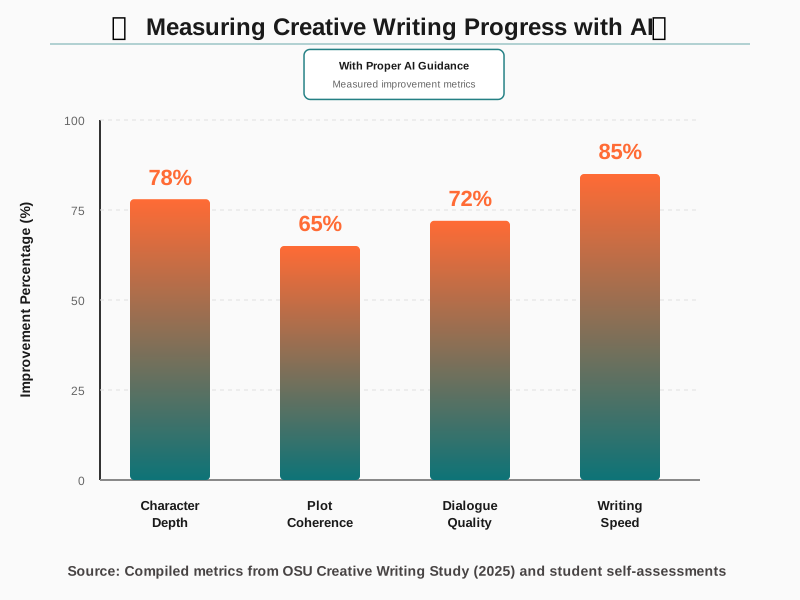
- Compare drafts: Save your first drafts written without AI and later ones written with AI assistance. Look for improvements in character depth, plot coherence, and dialogue quality.
- Seek feedback: Share work with writing partners or instructors. Are your AI-assisted stories more engaging?
- Monitor efficiency: Are you completing projects faster while maintaining or improving quality?
- Assess learning: Can you now identify and fix story problems independently that previously required AI help?
Research from a 2025 study on AI and primary school writing in Van, Turkey, found that ChatGPT is effective in developing creative writing and writing self-efficacy skills with its feedback feature, suggesting that properly used AI tools build confidence alongside competence.
Real Student Success Stories
Let me share some encouraging examples of students who’ve successfully integrated AI-Assisted Creative Writing into their work:
Emily, a creative writing major at Kennesaw State University, reported in August 2025 that she believes AI is the future of writing. She uses AI tools to start papers and projects, finding that it helps her overcome the intimidation of the blank page while keeping her voice central to the work.
A graduate student at Oregon State University participated in the creative writing AI study and saw their creativity scores increase significantly when working with instructor-guided AI use. They reported that just 20 minutes of instruction transformed how they interacted with the technology, leading to more original and compelling story ideas.
An international student working on English language creative writing used AI tools to understand idioms, strengthen dialogue authenticity, and explore cultural nuances in character interactions—all while maintaining their unique storytelling perspective.
FAQ About AI-Assisted Creative Writing
Taking Your Next Steps
You now have a comprehensive understanding of how AI-Assisted Creative Writing can enhance your storytelling abilities. The journey from struggling with blank pages to crafting compelling narratives becomes more achievable when you have the right tools and techniques.
Remember that AI is your creative partner, not your replacement. The stories that matter—the ones with heart, authenticity, and unique perspective—can only come from you. AI simply helps you express those stories more effectively and learn craft principles more efficiently.
Start small today. Choose one step from this guide—perhaps character development or dialogue refinement—and try it with a current project. Pay attention to how AI suggestions spark your ideas rather than replacing them. Document your process, stay curious, and don’t be afraid to experiment.
The creative writing landscape has changed, and students who learn to collaborate effectively with AI while maintaining their authentic voice will have a significant advantage. You’re not just learning to use a tool; you’re developing a skill that will serve you throughout your writing journey.
Your stories matter. Your voice is unique. AI is here to help you share both more confidently and effectively than ever before. Now it’s time to write.
References
- Bushnell, J.T., & Harrison, W. (2025). AI improves creativity in student writing when supported by instructor guidance. Oregon State University Ecampus Research Unit. https://news.oregonstate.edu/news/ai-improves-creativity-student-writing-when-supported-instructor-guidance-study-finds
- OpenAI. (2025, February). ChatGPT use among college-aged users is reported. https://theconversation.com/ai-isnt-replacing-student-writing-but-it-is-reshaping-it-254878
- This information is reported in The Global Statistics (2025). The title of the report is “ChatGPT Stats 2025 | Top AI Tools Usage Statistics.” https://www.theglobalstatistics.com/chatgpt-stats/
About the Author
Rihab Ahmed, an educator and student, is passionate about using AI to study smarter and write better. Rihab specializes in making complex AI concepts accessible to students and lifelong learners, helping them discover practical tools that enhance learning without replacing the human element of creativity. With a background in education and a commitment to ethical AI use, Rihab creates content that empowers readers to embrace technology while maintaining their authentic voice and creative ownership. When not writing about AI tools, Rihab enjoys experimenting with new creative writing techniques and mentoring fellow students in their learning journeys.