
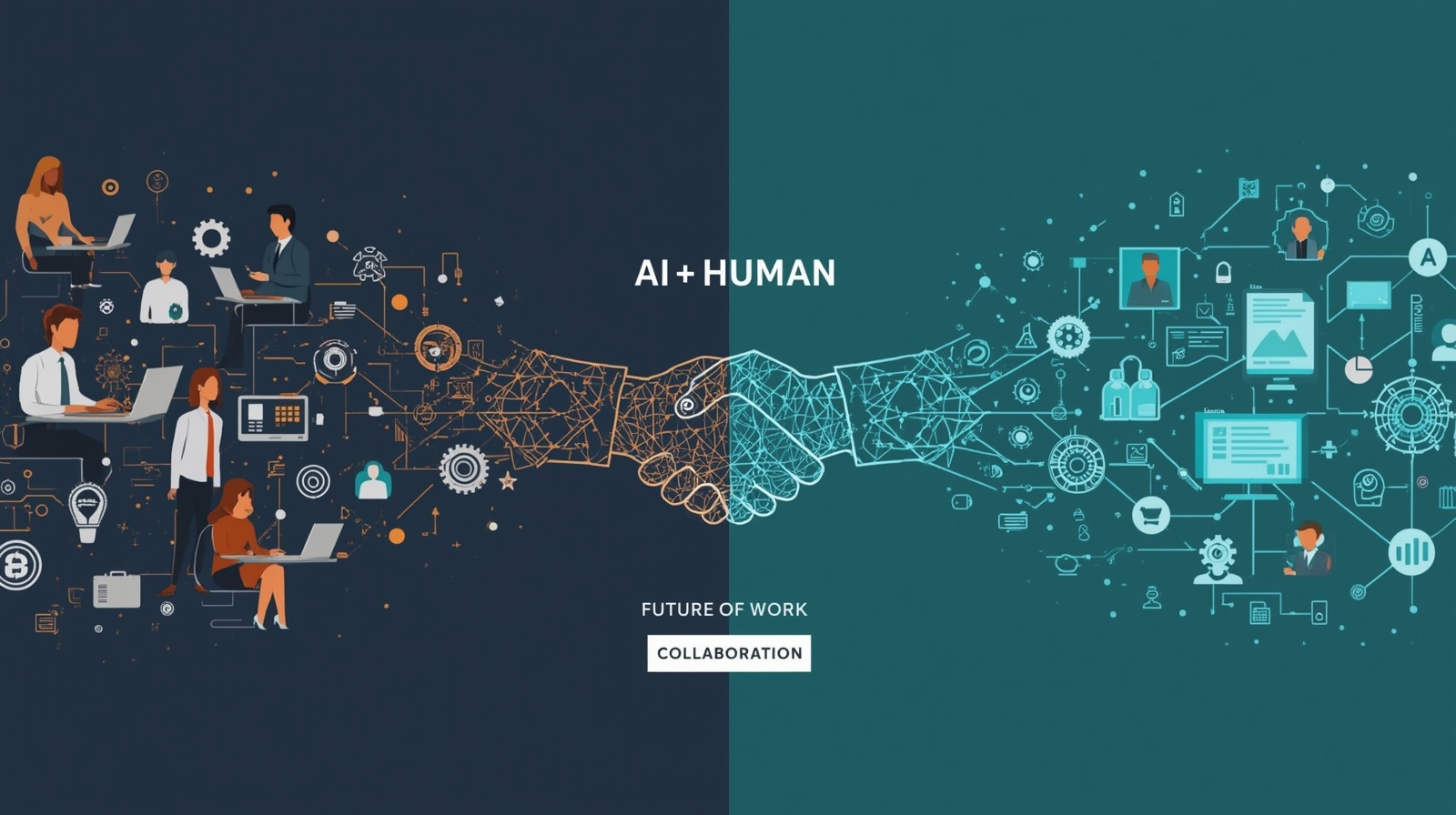
AI and the Future of Work: Your Complete Guide
AI and the Future of Work isn’t just another technological shift—it’s a fundamental transformation of how we approach employment, productivity, and professional fulfillment. As professionals navigating this landscape ourselves, we’ve witnessed firsthand how artificial intelligence reshapes everything from daily tasks to career trajectories. The question isn’t whether AI will change your work; it’s how you’ll adapt to harness its power while maintaining your competitive edge and ethical responsibility.
This transformation brings both exciting opportunities and legitimate concerns. We’ll guide you through understanding what AI and the Future of Work truly mean for your career, explore the real risks and rewards, and provide actionable strategies to thrive in this new era. Whether you’re worried about job security, curious about emerging roles, or ready to upskill, this comprehensive guide offers the clarity and direction you need.
Understanding the Landscape: What AI Means for Your Career
Artificial intelligence has evolved from science fiction to workplace reality faster than most of us anticipated. When we talk about AI and the Future of Work, we’re discussing technologies that can learn patterns, make decisions, and perform tasks that previously required human intelligence. But here’s what matters most: AI isn’t a single technology—it’s an ecosystem of machine learning algorithms, natural language processing, computer vision, and robotics working together.
The workplace AI revolution differs fundamentally from previous technological disruptions. Unlike the industrial revolution’s mechanical automation, AI can handle cognitive tasks: analyzing data, making recommendations, understanding language, and even creating content. This means both routine and complex work face transformation. Understanding this distinction helps you prepare strategically rather than reactively.
AI’s Impact on Job Displacement: Understanding the Risks and Opportunities
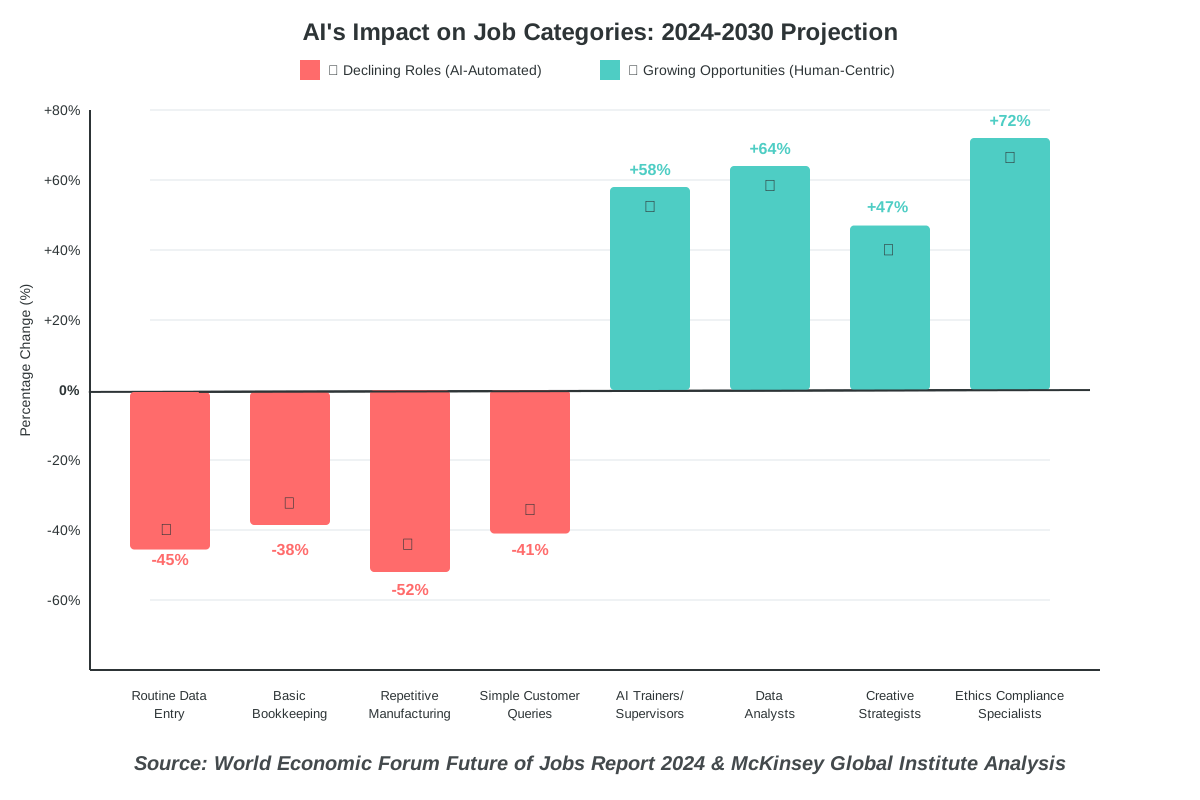
Let’s address the concern keeping many professionals awake at night: AI’s Impact on Job Displacement: Understanding the Risks and Opportunities requires honest examination of both threats and possibilities. Yes, certain roles face automation risk—particularly those involving repetitive, predictable tasks. Data entry specialists, basic bookkeepers, and routine customer service positions are already experiencing AI integration.
However, the narrative of widespread job elimination oversimplifies reality. Historical evidence from previous technological revolutions shows that while some jobs disappear, new categories emerge. The key difference? The pace of change has accelerated dramatically. We estimate that approximately 85 million jobs may be displaced by 2025, but simultaneously, 97 million new roles could emerge that are better adapted to the new division of labor between humans, machines, and algorithms.
Your opportunity lies in positioning yourself for these emerging roles. Jobs requiring creativity, complex problem-solving, emotional intelligence, and ethical judgment remain distinctly human domains. Rather than competing with AI on computational speed, focus on developing skills that complement artificial intelligence. The professionals thriving today aren’t fighting automation—they’re leveraging it.
The Rise of the AI-Powered Workforce: Collaboration Between Humans and Machines
The Rise of the AI-Powered Workforce: Collaboration Between Humans and Machines represents the most promising aspect of this transformation. We’re not heading toward a workforce of robots replacing humans—we’re building collaborative environments where AI handles computational heavy lifting while humans provide strategic direction, creative insight, and ethical oversight.
Think of AI as the ultimate assistant that never sleeps, processes information at incredible speeds, and identifies patterns invisible to human perception. Meanwhile, you bring contextual understanding, emotional intelligence, and the ability to navigate ambiguity—skills that remain uniquely human. This partnership, often called “augmented intelligence,” amplifies human capabilities rather than replacing them.
In practical terms, we see this collaboration everywhere. Radiologists use AI to detect anomalies in medical imaging faster and more accurately, but they interpret findings within patient history and make final diagnostic decisions. Financial analysts leverage AI for data processing and pattern recognition, but they provide strategic investment advice based on market intuition and risk assessment. Content creators use AI tools for research and initial drafts, but they inject authentic voice, cultural understanding, and emotional resonance.
The professionals succeeding in this new landscape aren’t resisting AI—they’re learning to direct it effectively. This requires developing what we call “AI literacy”: understanding what AI can and cannot do, knowing when to trust its outputs, and recognizing its limitations and biases.
AI and the Future of Leadership: Adapting Management Styles for an AI-Driven World
AI and the Future of Leadership: Adapting Management Styles for an AI-Driven World challenges traditional hierarchical structures and demands new competencies from leaders. We’ve observed that effective leaders in AI-integrated workplaces focus less on directing tasks and more on cultivating environments where humans and AI systems work synergistically.
Tomorrow’s leaders need technical fluency without necessarily being programmers. They must understand AI’s capabilities and limitations to make informed decisions about implementation and oversight. More importantly, they need to manage the human side of AI adoption—addressing anxiety, facilitating retraining, and maintaining team morale during transitions.
Leadership now includes ethical responsibility for AI deployment. You must ensure AI systems operate fairly, respect privacy, and maintain accountability. This means asking critical questions: Does our AI recruiting tool perpetuate historical biases? Are we transparent about when customers interact with AI versus humans? Have we established clear protocols for AI decision-making oversight?
The most effective leaders we’ve worked with focus on building adaptive, learning-oriented cultures. They encourage experimentation, normalize failure as part of the learning process, and invest consistently in team development. They recognize that managing AI-powered teams requires balancing efficiency gains with human needs for meaningful work and professional growth.
Upskilling for the Age of AI: Essential Skills for the Future of Work
Upskilling for the Age of AI: Essential Skills for the Future of Work isn’t optional—it’s a survival strategy. But here’s encouraging news: the skills most valuable in an AI-driven workplace are learnable, and many build on capabilities you already possess.
Start with data literacy. You don’t need to become a data scientist, but understanding how to interpret data visualizations, recognize patterns, and make data-informed decisions is crucial. Pair this with AI literacy—knowing when AI provides reliable insights versus when it requires human verification.
Critical thinking and complex problem-solving remain irreplaceable. AI excels at processing information and identifying patterns but struggles with novel situations, ethical dilemmas, and problems requiring contextual understanding. Strengthen your ability to ask the right questions, challenge assumptions, and synthesize information from diverse sources.
Emotional intelligence and interpersonal skills grow more valuable as routine tasks automate. Your ability to build relationships, navigate difficult conversations, demonstrate empathy, and lead through change becomes a competitive advantage. AI cannot replicate the trust built through authentic human connection.
Creativity and innovation complete the essential skill set. While AI can generate variations on existing themes, breakthrough innovation requires human imagination, risk-taking, and the ability to connect seemingly unrelated concepts. Focus on developing creative problem-solving approaches and staying curious about emerging possibilities.
Finally, cultivate adaptability itself as a skill. The pace of change will accelerate, not slow down. Professionals who thrive view learning as continuous, embrace change as opportunity, and remain flexible in their career approaches.
AI in Healthcare: Transforming Patient Care and the Role of Medical Professionals
AI in Healthcare: Transforming Patient Care and the Role of Medical Professionals demonstrates how AI augmentation elevates rather than eliminates human expertise. We’ve witnessed AI revolutionize diagnostic accuracy, personalize treatment plans, and streamline administrative burdens—all while expanding rather than reducing the need for skilled healthcare professionals.
AI-powered diagnostic tools analyze medical images with remarkable precision, detecting early-stage cancers, identifying cardiac abnormalities, and spotting conditions human eyes might miss. However, these tools enhance rather than replace physicians. Doctors interpret AI findings within comprehensive patient contexts, considering medical histories, lifestyle factors, and patient preferences that algorithms cannot fully capture.
Predictive analytics help healthcare providers identify at-risk patients before conditions become critical, enabling preventive interventions. AI chatbots handle routine patient inquiries, freeing nurses and staff for complex care requiring human judgment and compassion. Drug discovery accelerates as AI analyzes molecular interactions, potentially cutting development time from years to months.
For healthcare professionals, this transformation means shifting from information processors to strategic decision-makers and compassionate caregivers. The time AI saves on routine tasks creates space for what brought many into healthcare originally: meaningful patient interactions, complex case management, and the deeply human aspects of healing.
AI and the Gig Economy: Opportunities and Challenges for Freelancers
AI and the Gig Economy: Opportunities and Challenges for Freelancers creates a fascinating paradox. AI tools democratize capabilities previously requiring extensive training or expensive software, enabling freelancers to compete with larger firms. Simultaneously, AI-powered platforms reshape how gig work gets distributed and compensated.
The opportunities are substantial. Freelance writers access AI tools for research, outlining, and editing, allowing faster turnaround on projects. Designers use AI for rapid prototyping and variation generation. Developers leverage AI coding assistants that suggest solutions and catch errors. Small business consultants employ AI analytics tools previously affordable only to large corporations.
This technological leverage allows skilled freelancers to punch above their weight class. A solo graphic designer can now produce the volume of work that once required a small team. A freelance marketer accesses the same sophisticated analytics platforms that enterprise companies use.
However, challenges exist. AI-powered gig platforms increasingly use algorithms to match workers with opportunities, assign projects, and even evaluate performance. This raises concerns about transparency, fairness, and whether these systems perpetuate biases. Freelancers face the additional challenge of distinguishing themselves in markets where AI handles routine work, requiring them to emphasize specialized expertise, creative approaches, or superior client relationships.
The successful gig workers we know treat AI as a force multiplier for their unique human skills rather than viewing it as competition. They focus on building personal brands, developing specialized niches, and delivering value that goes beyond what AI alone can provide.
Ethical Considerations for AI in the Workplace: Bias, Privacy, and Accountability
Ethical Considerations for AI in the Workplace: Bias, Privacy, and Accountability cannot be afterthoughts—they must be foundational to responsible AI adoption. As professionals implementing or working alongside AI systems, we share responsibility for ensuring these technologies serve humanity ethically.
Algorithmic bias presents the most insidious challenge. AI systems learn from historical data, potentially perpetuating past discrimination. We’ve seen AI recruiting tools that favored male candidates because they were trained on historically male-dominated hiring data. Credit scoring algorithms that disadvantaged certain demographic groups. Facial recognition systems with significantly lower accuracy for people with darker skin tones.
Addressing bias requires proactive measures: diverse training data, regular auditing of AI outputs for discriminatory patterns, and including diverse perspectives in AI development and oversight. When you notice AI recommendations that seem questionable, speak up. Question the data sources and assumptions underlying AI decisions in your workplace.
Privacy protection demands vigilance. AI systems often require vast amounts of data to function effectively, raising questions about data collection, storage, and use. We must ensure transparency about what data gets collected, how it’s used, and who has access. Employees deserve to know when AI monitors their performance, analyzes their communications, or influences decisions affecting their careers.
Accountability structures must evolve to address AI-enabled decision-making. When an AI system makes an error—denying someone a loan, overlooking a qualified job candidate, or misdiagnosing a medical condition—who bears responsibility? Clear accountability chains, human oversight mechanisms, and the ability to appeal AI decisions are essential safeguards.
The ethical framework guiding your workplace’s AI use should prioritize human welfare, fairness, transparency, and accountability. Push for policies that embed these values into AI implementation from the start.
AI’s Role in Automating Repetitive Tasks: Freeing Up Human Potential
AI’s Role in Automating Repetitive Tasks: Freeing Up Human Potential represents the most immediately tangible benefit of workplace AI. We spend staggering amounts of time on routine activities: scheduling meetings, processing invoices, responding to common questions, updating databases, and generating standard reports. AI excels at precisely these tasks.
Consider the impact: automated scheduling tools that find meeting times across multiple calendars in seconds, eliminating the back-and-forth email chains that waste hours weekly. AI-powered document processing that extracts and categorizes information from invoices, receipts, and forms, reducing data entry time by 80% or more. Chatbots handling tier-one customer support queries, resolving routine issues instantly, and escalating complex problems to human specialists.
This automation doesn’t eliminate jobs as much as it restructures them. Customer service representatives shift from answering the same questions repeatedly to handling nuanced situations requiring problem-solving and empathy. Administrative professionals move from routine data entry to strategic coordination and project management. Accountants spend less time on transaction processing and more time on financial planning and advisory services.
The liberation from repetitive tasks allows us to engage in work that’s more cognitively stimulating, creative, and meaningful. It addresses a fundamental insight: humans aren’t well-suited for endless repetition. We make errors when bored, find routine tasks demotivating, and crave variety and challenge. AI handles the repetitive work with tireless consistency, freeing us for activities that require judgment, creativity, and human insight.
For organizations, the productivity gains are substantial. For individual workers, the benefit comes in reclaiming time for higher-value activities that better utilize our capabilities and provide greater job satisfaction.
The Future of Education in the Age of AI: Preparing Students for a Changing World
The Future of Education in the Age of AI: Preparing Students for a Changing World requires fundamental rethinking of what and how we teach. The traditional model—transferring standardized knowledge that students memorize and regurgitate—fails spectacularly in an era when AI can access and process information instantaneously.
Educational institutions must shift from knowledge transfer to capability development. Students need to learn how to learn, think critically, solve novel problems, work collaboratively, and adapt to changing circumstances. They need hands-on experience with AI tools so they understand both capabilities and limitations. They need ethical frameworks to navigate AI’s societal implications.
We advocate for curriculum integration that teaches AI literacy across disciplines, not just in computer science classes. Business students should understand AI’s implications for strategy and operations. Healthcare students need exposure to diagnostic AI tools. Liberal arts students should explore AI’s social, philosophical, and ethical dimensions.
Project-based learning that mirrors real-world challenges prepares students better than lecture-based instruction. Let them use AI tools to solve problems, then critically evaluate the results. Teach them to formulate questions that AI helps answer, rather than simply accepting AI-generated outputs.
The goal isn’t producing human calculators who compete with AI—it’s developing creative problem-solvers, ethical decision-makers, and adaptive learners who leverage AI effectively. Educational systems must evolve as quickly as the workplace they’re preparing students to enter.
AI and the Evolution of Customer Service: Enhancing Experiences and Efficiency
AI and the Evolution of Customer Service: Enhancing Experiences and Efficiency showcases how technology improves rather than diminishes human connection when implemented thoughtfully. We’ve moved beyond the frustrating automated phone systems that trapped customers in endless loops toward AI that genuinely enhances service quality.
Modern AI chatbots handle routine inquiries instantly: checking order status, resetting passwords, providing basic product information, and processing simple returns. They operate 24/7, eliminating wait times for straightforward issues. Natural language processing enables conversational interactions that feel increasingly natural rather than robotic.
The key improvement lies in intelligent routing. AI analyzes customer inquiries, determines complexity and emotional tone, and routes accordingly. Simple questions get instant AI resolution. Complex issues, frustrated customers, or situations requiring empathy get escalated to human agents—along with context from the AI interaction, so customers don’t repeat themselves.
This creates a better experience for everyone. Customers get quick resolution for simple issues and human attention for complex ones. Customer service representatives escape the burnout of answering identical questions hundreds of times daily, focusing instead on challenging problems where their expertise and empathy matter.
Forward-thinking organizations use AI to analyze customer service interactions at scale, identifying common pain points, improving products and processes, and personalizing service approaches. They balance efficiency gains with the recognition that certain situations demand human connection that AI cannot provide.
The evolution continues toward predictive service: AI that identifies potential issues before customers even reach out, enabling proactive problem-solving. Imagine your airline rebooking you automatically when it predicts your connecting flight will be missed, or your software provider fixing a bug you encountered before you report it.
The Impact of AI on Creativity and Innovation: Augmenting Human Imagination
The Impact of AI on Creativity and Innovation: Augmenting Human Imagination challenges the assumption that creativity is a purely human domain. We’ve discovered that AI serves as a remarkable creative catalyst, generating ideas, variations, and combinations that spark human imagination in unexpected directions.
AI creative tools generate thousands of design variations in seconds, write multiple content versions, compose music in different styles, or create visual art based on text descriptions. Rather than replacing human creativity, these tools expand the possibility space creators explore. A designer might generate hundreds of logo concepts via AI, then apply human judgment to select and refine the most promising. A writer uses AI to brainstorm angles on a topic, then develops the most compelling approach with authentic voice and insight.
The creative process transforms from starting with a blank page to starting with abundant raw material requiring curation, refinement, and direction. This shift suits many creative professionals who find the initial ideation phase challenging. AI helps break through creative blocks and overcome the intimidation of starting.
However, AI-generated creativity has limits. It excels at recombining existing elements in novel ways but struggles with truly breakthrough innovation that requires reimagining fundamental assumptions. It produces outputs that are statistically likely based on training data, which can result in work that feels generic or derivative without human direction.
The most innovative work emerges from human-AI collaboration: humans providing strategic vision, emotional intelligence, cultural context, and bold new directions, while AI handles rapid iteration, variation generation, and pattern exploration. This partnership allows creators to work at unprecedented speed and scale while maintaining the authentic human perspective that resonates emotionally with audiences.
AI and the Future of Manufacturing: Optimizing Production and Supply Chains
AI and the Future of Manufacturing: Optimizing Production and Supply Chains demonstrates how intelligent systems revolutionize physical production. We’ve watched AI transform manufacturing from rigid assembly lines to adaptive, efficient systems that respond dynamically to changing conditions.
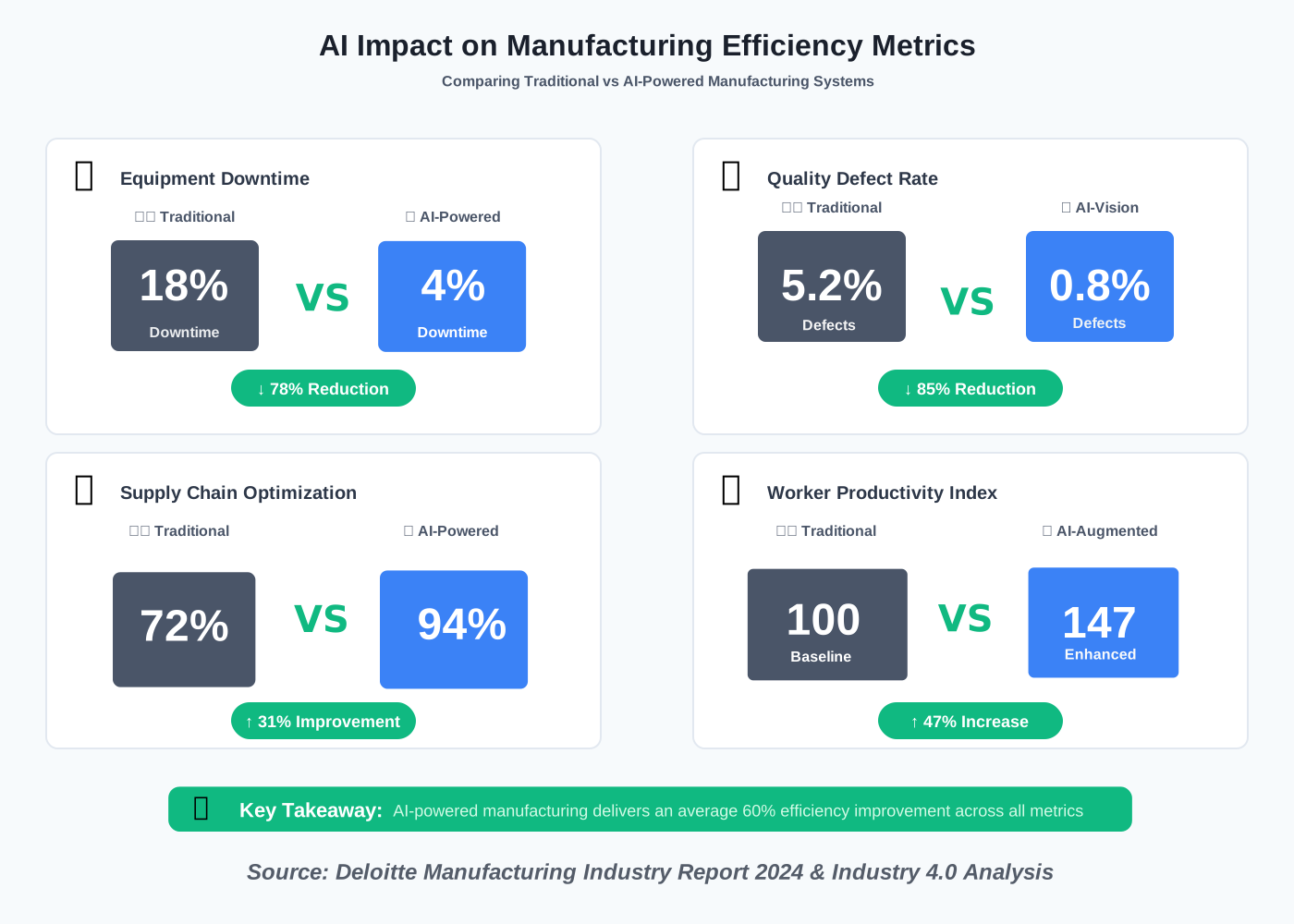
Predictive maintenance powered by AI analyzes sensor data from equipment, identifying potential failures before they occur. This prevents costly unplanned downtime, extends equipment life, and optimizes maintenance scheduling. Quality control systems using computer vision inspect products at speeds and accuracy levels impossible for human inspectors, catching defects in real time.
Supply chain optimization becomes dramatically more sophisticated with AI. Algorithms analyze countless variables—supplier reliability, transportation costs, weather patterns, geopolitical risks, and demand fluctuations—to optimize inventory levels, routing, and scheduling. This reduces waste, lowers costs, and improves resilience against disruptions.
Collaborative robots, or cobots, work alongside human workers, handling physically demanding or dangerous tasks while humans manage complex assembly, quality assurance, and process optimization. This partnership improves both productivity and worker safety.
For manufacturing professionals, these changes mean transitioning from routine machine operation to oversight roles requiring technical knowledge, problem-solving abilities, and the capacity to work effectively with AI systems. The jobs that remain and emerge require higher skills but offer better working conditions and compensation.
AI in Finance: Transforming Banking, Investment, and Risk Management
AI in Finance: Transforming Banking, Investment, and Risk Management reshapes one of the world’s most data-intensive industries. We observe AI analyzing market trends at speeds impossible for human traders, detecting fraudulent transactions in real-time, and personalizing financial advice for millions of customers simultaneously.
Algorithmic trading uses AI to execute trades based on complex patterns and market conditions, operating in milliseconds. While this increases market efficiency, it also introduces new risks requiring careful oversight. Risk assessment models analyze countless data points to evaluate creditworthiness, investment risks, and insurance premiums with unprecedented accuracy.
Fraud detection systems monitor transaction patterns across millions of accounts, flagging suspicious activity instantly. These systems learn continuously, adapting to new fraud techniques faster than rule-based systems. The result: better protection for consumers and reduced losses for financial institutions.
For financial professionals, AI becomes an analytical partner. Advisors use AI to analyze client portfolios, model scenarios, and identify opportunities, then apply human judgment to recommend strategies aligned with individual goals, risk tolerance, and values. Loan officers leverage AI risk assessments while considering personal circumstances and community factors that algorithms might miss.
The ethical responsibilities are substantial. Financial AI must operate fairly across demographic groups, protect sensitive personal data, and maintain transparency about how decisions get made. We advocate for explainable AI in finance—systems that can show why they made particular recommendations or decisions, enabling both professional oversight and consumer understanding.
The Role of AI in Cybersecurity: Protecting Against Evolving Threats
The Role of AI in Cybersecurity: Protecting Against Evolving Threats creates an ongoing arms race between attackers using AI to find vulnerabilities and defenders using AI to protect systems. We’ve entered an era where cybersecurity increasingly depends on AI’s ability to detect threats that would overwhelm human security teams.
AI-powered security systems monitor network traffic patterns, identifying anomalies that might indicate breaches or attacks. They analyze millions of log entries, finding the subtle indicators of compromise that human analysts would miss in the sheer volume of data. When threats emerge, AI responds in real-time, containing threats before they spread.
Machine learning models identify new malware variants by recognizing patterns and behaviors rather than relying solely on signatures of known threats. This proves crucial as attackers constantly evolve their techniques. AI also strengthens authentication systems, analyzing behavioral biometrics—how you type, move your mouse, or hold your phone—to detect when someone else tries accessing your accounts.
However, attackers also leverage AI. They use it to craft more convincing phishing emails, find vulnerabilities in code, and adapt attacks to evade detection. This creates an escalating technological competition requiring constant innovation.
For cybersecurity professionals, AI changes the role from manual log analysis to strategic threat hunting and system architecture. The demand for skilled cybersecurity experts continues growing despite automation because AI requires human expertise to direct, interpret, and override when necessary. The field needs professionals who understand both security principles and AI capabilities and limitations.
AI and the Legal Profession: Automating Tasks and Enhancing Legal Services
AI and the Legal Profession: Automating Tasks and Enhancing Legal Services transforms one of the most tradition-bound professions. We’ve witnessed AI handle document review, legal research, and contract analysis tasks that once consumed thousands of billable hours from junior attorneys.
AI-powered legal research tools search through millions of case files, statutes, and precedents in seconds, finding relevant citations and analyzing how different jurisdictions have ruled on similar issues. Contract analysis AI reviews agreements, identifying standard clauses, flagging unusual terms, and comparing provisions against templates or regulations.
Due diligence in mergers and acquisitions, traditionally requiring teams of lawyers reviewing documents for weeks, now involves AI systems processing thousands of files to identify risks, inconsistencies, and important clauses. This dramatically reduces costs and timeline while improving thoroughness.
For legal professionals, this transformation means junior roles focused on document review may decline while demand grows for attorneys who can handle complex negotiation, courtroom advocacy, client counseling, and strategic legal advice. The profession shifts toward work requiring judgment, persuasion, and relationship-building—distinctly human capabilities that complement AI’s analytical power.
Ethical considerations loom large. AI legal tools must maintain client confidentiality, avoid conflicts of interest, and operate within professional responsibility requirements. When AI assists in legal decision-making, lawyers remain responsible for outcomes, requiring them to understand AI recommendations well enough to evaluate and override when appropriate.
Access to justice could improve significantly as AI reduces costs for routine legal services, making legal assistance more affordable for individuals and small businesses. However, we must ensure these tools remain accessible rather than benefiting only large firms with resources to implement them.
AI’s Impact on Marketing and Advertising: Personalization and Targeted Campaigns
AI’s Impact on Marketing and Advertising: Personalization and Targeted Campaigns enables unprecedented understanding of consumer behavior and preferences. We’ve moved from broad demographic targeting to individualized experiences that adapt in real time to user responses.
AI analyzes customer data to predict purchasing behavior, identify high-value prospects, and determine optimal timing for outreach. Recommendation engines suggest products based on browsing history, past purchases, and patterns from similar customers. Dynamic pricing adjusts in real-time based on demand, competition, and individual customer price sensitivity.
Content personalization delivers different website experiences, email messages, and advertisements to different users based on their interests and behaviors. A/B testing happens continuously at a massive scale, with AI identifying which headlines, images, or calls to action perform best for different audience segments.
Programmatic advertising uses AI to bid on ad placements in real-time auctions, targeting specific individuals across websites and platforms based on extensive behavioral profiles. This increases advertising efficiency but raises privacy concerns, requiring careful ethical consideration.
For marketing professionals, success requires combining AI-powered insights with creative strategy and authentic brand storytelling. AI tells you what resonates; humans determine what to say and how to say it in ways that build trust and emotional connection. The marketers thriving today use AI for data analysis and optimization while bringing creative vision, cultural understanding, and ethical judgment.
We encourage marketers to consider the fine line between helpful personalization and invasive surveillance. Transparency about data use, respect for privacy preferences, and restraint in targeting approaches maintain consumer trust and comply with evolving regulations.
AI and the Future of Transportation: Autonomous Vehicles and Smart Logistics
AI and the Future of Transportation: Autonomous Vehicles and Smart Logistics promises to revolutionize how people and goods move. We’re witnessing gradual deployment of autonomous vehicle technology that could dramatically improve safety, reduce congestion, and transform industries built around human drivers.
Self-driving technology uses AI to process sensor data from cameras, radar, and lidar, identifying obstacles, predicting other vehicles’ movements, and making split-second driving decisions. While fully autonomous vehicles remain years from widespread adoption, driver assistance features using the same technology—automatic braking, lane keeping, and adaptive cruise control—already prevent thousands of accidents.
The transportation and logistics industries face significant disruption. Long-haul trucking could eventually automate, though regulatory, technical, and infrastructure challenges mean this transition will happen gradually. Delivery services experiment with autonomous vehicles and drones for last-mile delivery.
Route optimization AI analyzes traffic patterns, weather, road conditions, and delivery priorities to determine the most efficient routing for vehicle fleets. This reduces fuel costs, delivery times, and environmental impact while improving service reliability.
For transportation professionals, preparation matters. Truck drivers might transition to roles monitoring autonomous vehicle fleets, handling complex urban driving, or managing cargo logistics. The industry needs safety engineers, AI system supervisors, and maintenance technicians for increasingly sophisticated vehicles.
We emphasize the ethical responsibility of deploying autonomous vehicles that make life-or-death decisions in accident scenarios. How should a self-driving car prioritize safety when a collision becomes unavoidable? These aren’t just technical questions—they’re profound ethical dilemmas requiring public input and careful regulation.
The Potential for AI-Driven Bias in Hiring: Identifying and Mitigating Risks
The Potential for AI-Driven Bias in Hiring: Identifying and Mitigating Risks requires urgent attention as more organizations adopt AI recruiting tools. We’ve documented numerous cases where AI hiring systems perpetuated or amplified existing biases, disadvantaging qualified candidates based on gender, race, age, or other protected characteristics.
AI bias in hiring typically stems from training data reflecting historical discrimination. If an AI learns from a company’s past hiring decisions that favored certain demographic groups, it replicates those patterns. Resume screening AI might downgrade applications mentioning women’s colleges or minority professional organizations. Interview analysis AI might score candidates based on speech patterns correlated with demographic factors rather than job-relevant skills.
Identifying bias requires systematic auditing of AI hiring tools. Regular analysis of which candidates AI systems recommend, advance, or screen out—broken down by demographic categories—can reveal discriminatory patterns. Testing systems with equivalent resumes differing only in demographic signals exposes bias.
Mitigation strategies include using diverse, representative training data; removing demographic information from initial screening; setting fairness constraints in algorithms; and maintaining human oversight throughout the hiring process. AI should assist rather than make final hiring decisions, with humans responsible for ensuring fair outcomes.
For HR professionals and hiring managers, this means developing AI literacy around bias detection and advocating for responsible AI implementation. Push for transparency about how AI hiring tools work, what data they use, and how they’ve been validated for fairness. Ensure your organization has clear policies about AI use in hiring and meaningful accountability when bias occurs.
The stakes are high. Biased AI hiring systems don’t just perpetuate past discrimination—they can amplify it at scale, affecting thousands of job seekers before anyone notices the problem.
AI and the Future of Agriculture: Optimizing Crop Yields and Resource Management
AI and the Future of Agriculture: Optimizing Crop Yields and Resource Management addresses one of humanity’s most essential challenges: feeding a growing population sustainably. We observe AI helping farmers increase productivity while reducing environmental impact through precision agriculture techniques.
AI analyzes satellite imagery, drone footage, and sensor data to monitor crop health across large areas, identifying disease, pest infestations, or water stress in specific field sections before problems become visible to human observers. This enables targeted interventions—applying pesticides only where needed, irrigating drought-stressed areas, or adjusting fertilizer based on soil nutrient levels.
Predictive models help farmers make better decisions about planting times, crop selection, and harvest scheduling based on weather forecasts, market prices, and historical data. Autonomous tractors and harvesting equipment use AI vision systems to navigate fields, recognize crops versus weeds, and optimize harvesting patterns.
Livestock management benefits from AI systems monitoring animal health, detecting illness early, and optimizing feeding schedules. AI helps manage entire supply chains, predicting demand, coordinating logistics, and reducing food waste.
For agricultural professionals, this technology requires new skills—data interpretation, technology management, and understanding how to integrate AI insights with traditional agricultural knowledge. The most effective farmers combine AI recommendations with their deep understanding of local conditions, crop characteristics, and seasonal patterns.
We’re encouraged by AI agriculture’s potential to increase food security while promoting sustainability—using water, fertilizer, and pesticides more efficiently, reducing agriculture’s environmental footprint, and helping farmers adapt to climate change’s unpredictable impacts.
The Impact of AI on Remote Work: Enhancing Collaboration and Productivity
The Impact of AI on Remote Work: Enhancing Collaboration and Productivity has become especially relevant as remote and hybrid work models become permanent fixtures. We’ve discovered AI tools that address remote work’s biggest challenges: maintaining collaboration, managing productivity, and creating connection across distributed teams.
AI-powered collaboration platforms provide real-time translation during international meetings, transcribe conversations with action item extraction, and summarize lengthy discussion threads for team members in different time zones. Smart scheduling tools find meeting times across time zones and working preferences while minimizing schedule fragmentation.
Productivity tools use AI to prioritize tasks, suggest time blocking, and analyze where time gets spent. Virtual assistants handle routine coordination, freeing workers for deep focus. AI can analyze communication patterns to identify when team members become overwhelmed or disconnected, alerting managers to check in.
Background noise suppression, video enhancement, and virtual backgrounds powered by AI improve the remote meeting experience. AI can even detect meeting fatigue or disengagement, suggesting breaks or format changes.
However, we caution against over-reliance on AI monitoring in remote settings. While productivity analytics provide insights, excessive surveillance erodes trust and creates anxiety. The most effective remote teams use AI as a supportive tool—handling logistics, improving communication, and providing insights—while maintaining human-centered management approaches that trust employees and focus on outcomes rather than constant monitoring.
For remote workers, AI tools can enhance productivity and work-life balance when used thoughtfully. They handle coordination overhead, reduce time spent in meetings through better preparation and summarization, and help maintain boundaries between work and personal time.
AI and the Future of Retail: Personalized Shopping Experiences and Automation
AI and the Future of Retail: Personalized Shopping Experiences and Automation transforms both online and physical shopping. We see AI creating seamless, personalized experiences while optimizing inventory, pricing, and operations behind the scenes.
Online retail uses AI extensively for product recommendations, dynamic pricing, and personalized marketing. Virtual try-on technology uses computer vision and augmented reality to show how clothing, furniture, or cosmetics look on customers. Chatbots handle customer service inquiries and guide product selection.
Physical stores incorporate AI through smart shelves that detect when items need restocking, cashierless checkout systems that track what customers take and charge automatically, and in-store navigation apps that guide shoppers to products. AI analyzes foot traffic patterns to optimize store layouts and staffing.
Inventory management becomes dramatically more sophisticated with AI predicting demand at individual product and location levels, optimizing ordering, and reducing both stockouts and excess inventory. Supply chain coordination improves as AI anticipates disruptions and dynamically reroutes shipments.
For retail workers, these changes shift roles toward customer consultation, complex problem-solving, and creating engaging shopping experiences. The human element remains crucial for building customer relationships, handling unique situations, and providing expertise that AI cannot replicate.
We encourage retailers to balance personalization with privacy, efficiency with employment, and automation with human connection. The most successful retailers use AI to enhance rather than replace the human elements that create loyal customers.
The Role of Government in Regulating AI in the Workplace: Balancing Innovation and Protection
The Role of Government in Regulating AI in the Workplace: Balancing Innovation and Protection grows increasingly critical as AI deployment accelerates. We advocate for regulatory frameworks that encourage beneficial innovation while protecting workers, consumers, and societal interests.
Effective regulation addresses algorithmic transparency, requiring organizations to explain how AI systems make decisions affecting employment, credit, housing, and other significant life outcomes. Workers deserve to know when AI monitors their performance or influences management decisions about them.
Data privacy regulations must evolve to address AI’s voracious appetite for data. Clear rules about what data employers can collect, how they can use it, and how long they can retain it protect worker privacy while allowing legitimate business uses.
Anti-discrimination protections need updating for the AI era. Regular auditing requirements for AI systems used in hiring, promotion, and termination decisions can catch bias before it affects thousands of people. Penalties for deploying biased AI systems create accountability.
Worker retraining and transition support require government investment. As AI disrupts certain jobs, public programs can help workers acquire new skills and transition to emerging opportunities. Unemployment insurance and safety nets may need adjustment for an economy with more frequent career transitions.
International coordination matters because AI development and deployment cross borders. Regulatory fragmentation creates compliance challenges and potentially allows “race to the bottom” dynamics where companies operate from jurisdictions with the weakest protections.
We emphasize that regulation should enable rather than stifle innovation. Well-designed rules create fair competition, build public trust, and prevent harmful practices without micromanaging technical implementation details.
AI and the Future of Journalism: Automating News Gathering and Content Creation
AI and the Future of Journalism: Automating News Gathering and Content Creation presents both opportunities and concerns for information ecosystems. We observe AI handling routine reporting while raising questions about journalism’s role as democracy’s watchdog.
AI already writes basic news stories: earnings reports, sports scores, weather updates, and other data-driven content that follows predictable templates. This frees journalists for investigative reporting, in-depth analysis, and storytelling requiring human insight and source cultivation.
News gathering benefits from AI tools that monitor social media for emerging stories, analyze documents at scale for investigative reporting, and verify facts by cross-referencing claims against databases. AI helps detect deepfakes and manipulated media, important capabilities as misinformation becomes more sophisticated.
Personalized news delivery uses AI to curate content based on reader interests and behavior. While this increases engagement, it raises concerns about filter bubbles and echo chambers where people encounter only information confirming existing beliefs.
For journalists, AI serves as a research assistant and productivity tool rather than a replacement. The core journalistic functions—conducting interviews, providing context, holding power accountable, and explaining complex issues—remain human responsibilities requiring judgment, ethics, and courage that AI cannot replicate.
We worry about AI-generated news erodingjournalism’s credibility if not clearly disclosed. Readers deserve to know whether content comes from human reporters or AI systems. Maintaining journalism’s role as a trusted information source requires transparency about AI’s role in newsgathering and production.
Economic pressures facing journalism make AI attractive for reducing costs, but we caution against cutting human journalists to levels that undermine the quality and diversity of coverage. Democracy needs robust, human-driven journalism even as AI handles routine tasks.
The Impact of AI on Mental Health: Opportunities and Challenges
The Impact of AI on Mental Health: Opportunities and Challenges presents a complex picture. We see AI expanding access to mental health support while recognizing it cannot replace human therapeutic relationships for serious conditions.
AI-powered mental health apps provide accessible, affordable support for common issues like stress, anxiety, and mild depression. Chatbots offer 24/7 availability for people who struggle to access traditional therapy due to cost, location, insurance, or stigma. Some users find it easier to open up to AI without fear of judgment.
Predictive analytics identify individuals at risk for mental health crises by analyzing patterns in electronic health records, social media activity, or smartphone usage. Early intervention can prevent escalation, though this raises significant privacy concerns requiring careful ethical boundaries.
AI assists mental health professionals by transcribing and analyzing therapy sessions, tracking treatment progress, and suggesting interventions based on evidence-based protocols. This administrative support allows therapists to focus on the human connection central to effective treatment.
However, limitations are substantial. AI lacks genuine empathy, cannot understand complex human experiences deeply, and may miss subtle cues that trained therapists recognize. For serious mental health conditions, AI should supplement rather than replace human care.
We emphasize the ethical responsibility of AI mental health tools. They must protect privacy rigorously, avoid causing harm through inappropriate responses, clearly communicate limitations, and facilitate connection to human professionals when needed. Users must understand they’re interacting with AI, not a human therapist.
The mental health profession faces decisions about integrating AI therapeutically while preserving the human elements that make therapy effective: genuine empathy, unconditional positive regard, and the healing power of authentic human connection.
AI and the Future of Design: Automating and Enhancing the Design Process
AI and the Future of Design: Automating and Enhancing the Design Process revolutionizes creative workflows while sparking debates about originality and authenticity. We watch designers use AI to generate variations, automate repetitive tasks, and explore possibilities faster than ever before.
Generative design AI creates thousands of design options based on specified parameters—whether product designs optimized for weight and strength, architectural layouts maximizing natural light and efficiency, or graphic designs exploring different color schemes and layouts. This expands the solution space designers consider.
AI tools automate tedious aspects of design work: removing backgrounds from images, resizing designs for different formats, ensuring accessibility compliance, or maintaining brand consistency across materials. This efficiency allows designers to focus on strategic and creative aspects.
User experience benefits from AI analyzing how people interact with designs, identifying friction points, and suggesting improvements. A/B testing at scale determines which design choices work best for different user segments.
For designers, AI becomes a creative partner that generates raw material requiring human curation, refinement, and strategic direction. The designer’s role evolves toward being a creative director—setting vision, making aesthetic and strategic choices, and ensuring designs serve their intended purposes effectively.
We observe tension around AI-generated art and design. Questions about originality, copyright, and the value of human creativity persist. Can AI truly create, or does it only recombine existing elements? When AI generates designs trained on human-created work, what credit or compensation do original creators deserve?
The designers thriving in this environment embrace AI as a tool while maintaining their unique perspectives, aesthetic sensibilities, and ability to understand client needs and cultural contexts that AI cannot replicate.
The Use of AI in Human Resources: Streamlining Processes and Improving Employee Experience
The Use of AI in Human Resources: Streamlining Processes and Improving Employee Experience transforms how organizations manage their workforce. We see AI handling administrative HR tasks while creating opportunities for more strategic, people-focused HR work.
AI-powered recruiting tools screen resumes, schedule interviews, and even conduct initial assessments, dramatically reducing time-to-hire. Chatbots answer employee questions about benefits, policies, and procedures instantly rather than requiring HR staff time for routine inquiries.
Performance management systems use AI to gather continuous feedback from multiple sources, identify patterns in employee performance, and suggest development opportunities. Predictive analytics identify employees at risk of leaving, enabling proactive retention efforts.
Learning and development benefit from AI that personalizes training recommendations based on career goals, skill gaps, and learning styles. AI tutors provide customized instruction and adapt difficulty based on progress.
Employee engagement tools analyze survey responses and communication patterns to gauge morale, identify issues, and measure the impact of interventions. This helps HR teams understand organizational health and respond to problems proactively.
However, we caution that HR AI requires particularly careful ethical oversight. These systems affect people’s livelihoods, career progression, and workplace well-being. They must operate fairly, respect privacy, and maintain human judgment in consequential decisions.
For HR professionals, AI changes the role from administrative processing to strategic people management. The demand grows for HR practitioners who understand both human behavior and AI capabilities, ensuring technology serves human well-being rather than just efficiency.
AI and the Future of Scientific Research: Accelerating Discovery and Innovation
AI and the Future of Scientific Research: Accelerating Discovery and Innovation opens new frontiers across disciplines. We witness AI analyzing data at scales impossible for human researchers, identifying patterns in complex systems, and generating hypotheses that humans might never conceive.
In drug discovery, AI analyzes molecular structures to predict which compounds might effectively target diseases, drastically reducing the time and cost of bringing new medications to market. AI predicted protein structures with remarkable accuracy, solving problems that stumped researchers for decades.
Climate science uses AI to analyze vast environmental datasets, improve weather forecasting, and model climate change scenarios with greater precision. AI helps identify patterns in satellite imagery tracking deforestation, ice sheet changes, and environmental degradation.
Materials science leverages AI to design new materials with specific properties—batteries with higher energy density, building materials with better strength-to-weight ratios, or catalysts that make chemical processes more efficient.
Scientific literature analysis uses AI to connect findings across millions of research papers, identifying relationships and contradictions that individual researchers cannot track. This accelerates knowledge synthesis and highlights promising research directions.
For scientists, AI serves as a powerful analytical tool, while the human researcher provides theoretical understanding, experimental design, and interpretation within broader contexts. The scientific method—hypothesis formation, experimental design, critical analysis, and peer review—remains fundamentally human even as AI enhances each step.
We emphasize that AI should augment rather than replace scientific expertise. The judgment to determine which questions matter, design appropriate experiments, and interpret findings requires deep domain knowledge and creativity that AI currently lacks.
The Impact of AI on Small Businesses: Opportunities and Challenges
The Impact of AI on Small Businesses: Opportunities and Challenges levels the playing field in unexpected ways. We observe small businesses accessing AI capabilities that previously required corporate-scale resources, enabling them to compete more effectively with larger organizations.
Cloud-based AI services provide small businesses with sophisticated tools for customer relationship management, marketing automation, inventory optimization, and financial forecasting at affordable prices. A solo entrepreneur can now use the same caliber of business intelligence tools that Fortune 500 companies employ.
Marketing personalization, once requiring expensive teams and technology, becomes accessible through AI platforms that segment audiences, optimize ad spending, and personalize communications automatically. Customer service chatbots handle routine inquiries 24/7 without additional staffing costs.
Administrative automation AI handles bookkeeping, scheduling, email management, and document processing, allowing small business owners to focus on strategy, customer relationships, and growth rather than paperwork.
However, challenges exist. Small businesses often lack the technical expertise to implement AI effectively or evaluate which tools genuinely deliver value versus hype. They may struggle with data privacy compliance and cybersecurity as they adopt new technologies. The pace of AI change can overwhelm resource-constrained small business owners trying to stay current.
We encourage small businesses to start with specific, well-defined problems rather than trying to implement AI broadly. Choose tools with intuitive interfaces and strong support. Focus on AI applications that provide clear returns on investment—time saved, revenue increased, or costs reduced.
The small businesses succeeding with AI treat it as a competitive advantage that allows them to operate with the efficiency and capabilities of much larger organizations while maintaining the agility and customer focus that are their natural strengths.
AI and the Future of Art: Exploring Generative Art and Creative Collaboration
AI and the Future of Art: Exploring Generative Art and Creative Collaboration challenges fundamental questions about creativity, authorship, and artistic value. We navigate fascinating territory where AI generates images, music, and poetry that can be beautiful, thought-provoking, or technically impressive—while sparking vigorous debate about whether AI can truly create art.
Generative AI trained on millions of artworks can produce images in any style, combine artistic movements, or create entirely novel aesthetics. Musicians use AI to compose melodies, generate harmonies, or create accompaniments. Writers experiment with AI poetry and narrative generation.
Some artists embrace AI as a new medium or collaborator, incorporating it into their creative process while maintaining artistic vision and intent. They use AI-generated elements as raw material, curating, modifying, and combining outputs to create works expressing their unique perspectives.
The controversy is substantial. When AI generates art trained on human-created works, does it violate original artists’ rights? Can AI-generated art be copyrighted, and if so, who owns it—the person who wrote the prompt, the AI’s creator, or no one? Does AI art devalue human creativity or simply expand what art can be?
We observe that AI-generated content often lacks the intentionality, emotional depth, and cultural meaning that define significant art. It can create technically proficient works that feel empty or derivative. Yet, in skilled hands, AI becomes a tool for exploring aesthetic possibilities and creating works that wouldn’t exist otherwise.
For artists, the question isn’t whether to compete with AI but how to use it while maintaining what makes human art meaningful: personal vision, emotional authenticity, cultural commentary, and the connection between creator and audience that transcends technique.
The art world continues grappling with these questions, and we expect the conversation to evolve as both AI capabilities and artistic practices develop.
The Long-Term Societal Impacts of AI on Employment and the Economy
The Long-Term Societal Impacts of AI on Employment and the Economy require us to think beyond individual career adaptation to systemic changes in how society organizes work, distributes prosperity, and defines human purpose.
Economic forecasts vary widely regarding AI’s employment impact. Optimistic scenarios envision productivity gains creating prosperity that generates new job categories we can’t yet imagine, similar to previous technological revolutions. Pessimistic scenarios warn of persistent unemployment as AI capabilities expand faster than new jobs emerge, concentrating wealth among those owning AI systems while displacing workers.
The distribution question looms large: even if AI increases overall economic productivity, how do those benefits get shared? Without deliberate policy choices, AI could exacerbate inequality, with high-skilled workers and capital owners prospering while others struggle.
Work’s social role beyond income deserves consideration. Employment provides structure, purpose, social connection, and identity for many people. If AI significantly reduces work availability, how do we ensure people live fulfilling, meaningful lives? Some advocate for universal basic income or reduced workweeks; others emphasize the need to create new forms of meaningful contribution.
Education systems must evolve to prepare people for a more dynamic employment landscape. Rather than training for specific jobs that may not exist in a decade, education should develop adaptability, creativity, ethical reasoning, and the capacity for continuous learning.
We believe the long-term outcomes depend on choices made now. Will we use AI to enhance human flourishing—reducing drudgery, expanding capabilities, and creating prosperity widely shared? Or will we allow it to concentrate power and wealth while leaving many behind? These aren’t technical questions but moral and political ones requiring democratic deliberation and decisive action.
The future isn’t predetermined. Through thoughtful policy, ethical AI development, investment in education and retraining, and commitment to inclusive prosperity, we can shape AI’s impact on employment and the economy in ways that benefit humanity broadly.
Frequently Asked Questions
Taking Action: Your Next Steps
The AI and the Future of Work landscape may seem overwhelming, but you have agency in shaping your experience of this transformation. Start by honestly assessing your current role against automation trends. Identify which aspects of your work AI could handle and which require human judgment, creativity, or interpersonal skills.
Commit to continuous learning. Dedicate time weekly to developing new skills, experimenting with AI tools, or understanding emerging trends in your industry. This doesn’t require returning to formal education—online courses, professional workshops, and hands-on experimentation all contribute to your development.
Engage actively with AI technologies relevant to your work. Overcome apprehension by starting with simple tools that solve specific problems. Notice where AI enhances your productivity and where human insight remains essential. This practical experience builds both competence and confidence.
Advocate for responsible AI implementation in your workplace. Raise concerns about bias, privacy, or accountability. Push for transparency about how AI systems work and affect employment decisions. Your voice matters in ensuring AI serves human interests rather than just efficiency metrics.
Build networks with others navigating similar transitions. Share experiences, resources, and opportunities. The most successful professionals we know treat career development as collaborative rather than competitive, recognizing that we navigate this transformation together.
Finally, maintain perspective. While AI changes work profoundly, human capabilities remain remarkable and valuable. The goal isn’t competing with artificial intelligence but developing the distinctly human skills that, combined with AI’s computational power, create outcomes neither could achieve alone.
The future of work is being written now, and you’re among its authors. Your choices about learning, adaptation, and advocacy shape not just your career but the broader transformation unfolding. Embrace the challenge with clear-eyed realism about both risks and opportunities, grounded in confidence in human potential.
References:
– World Economic Forum. (2024). Future of Jobs Report 2024. Retrieved from https://www.weforum.org/publications/future-of-jobs-report-2024/
– McKinsey Global Institute. (2024). The Future of Work After COVID-19. Retrieved from https://www.mckinsey.com/featured-insights/future-of-work
– Deloitte. (2024). Manufacturing Industry Outlook: Industry 4.0 and AI Integration. Retrieved from https://www2.deloitte.com/us/en/insights/industry/manufacturing
– MIT Work of the Future Task Force. (2023). The Work of the Future: Building Better Jobs in an Age of Intelligent Machines. Retrieved from https://workofthefuture.mit.edu
– OECD. (2024). Artificial Intelligence in Society. Retrieved from https://www.oecd.org/digital/artificial-intelligence
– Stanford University Human-Centered AI Institute. (2024). AI Index Report 2024. Retrieved from https://aiindex.stanford.edu
– Brookings Institution. (2024). Automation and Artificial Intelligence: How Machines Are Affecting People and Places. Retrieved from https://www.brookings.edu/research/automation-and-artificial-intelligence
About the Authors
This article was written as a collaboration between Nadia Chen and James Carter.
Main Author: Nadia Chen is an expert in AI ethics and digital safety, dedicated to helping non-technical professionals navigate artificial intelligence responsibly. With a background in technology policy and human-centered design, Nadia focuses on making AI accessible while emphasizing privacy protection, bias mitigation, and ethical implementation. She believes that everyone can benefit from AI when approached thoughtfully and with proper safeguards. Nadia writes to empower readers to engage with AI confidently while maintaining critical awareness of its societal implications.
Co-Author: James Carter is a productivity coach who helps professionals leverage AI to work smarter, not harder. With extensive experience in workplace transformation and organizational development, James specializes in translating complex technological changes into practical strategies anyone can implement. He’s passionate about showing people how AI simplifies work rather than replacing human value, emphasizing that the most successful professionals treat AI as a powerful tool that amplifies their unique capabilities. James writes with an encouraging, motivational approach that builds confidence in readers navigating career transitions and technological change.