
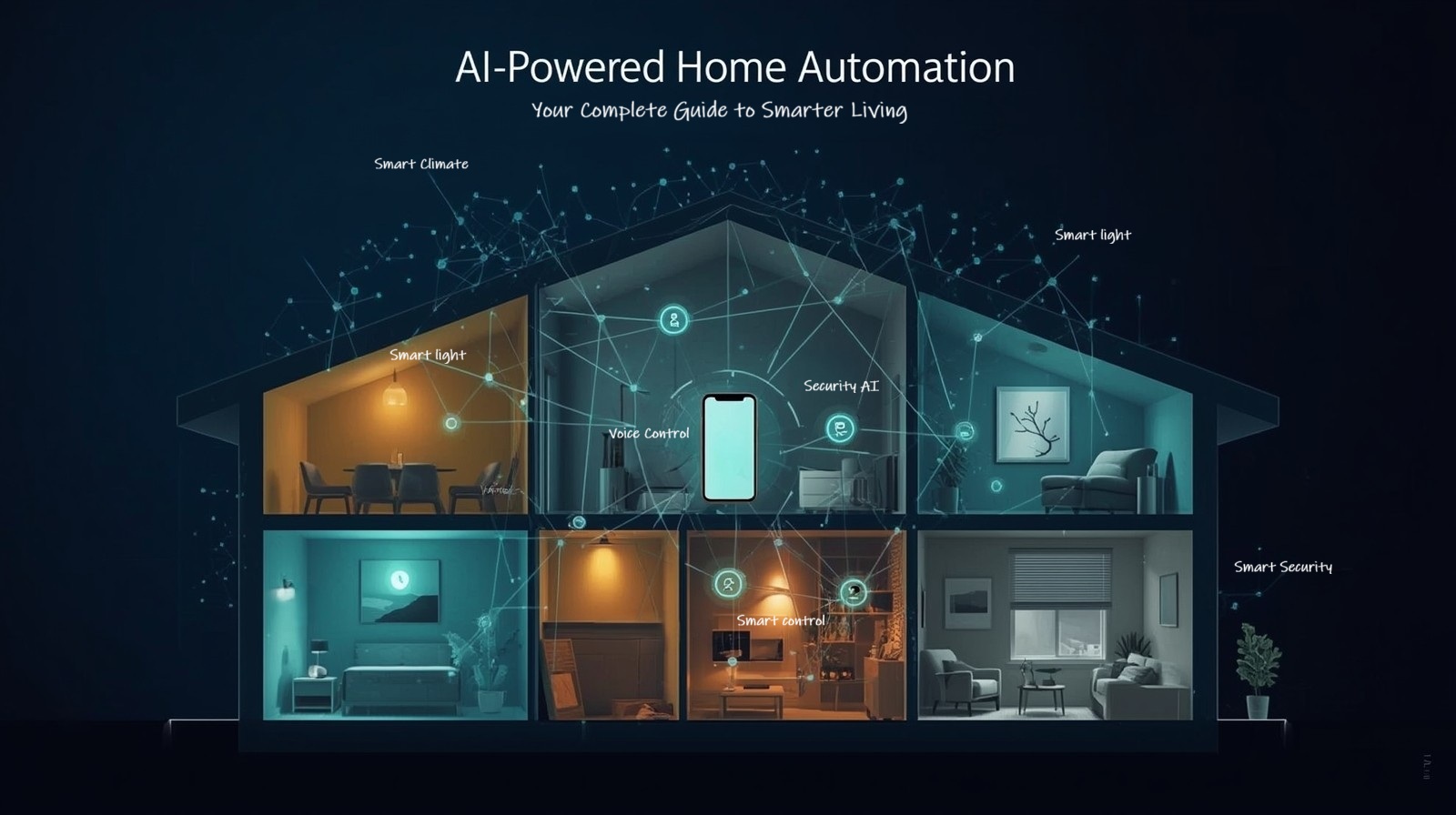
AI-Powered Home Automation: Complete Guide to Smart Living
Welcome to the future of living. AI-Powered Home Automation isn’t just about flipping switches with your voice anymore—it’s about creating a home that genuinely understands you, anticipates your needs, and works tirelessly in the background to make your life easier, safer, and more efficient.
I’ve spent years testing smart home devices, and I can tell you firsthand: Modern AI-powered home automation has evolved significantly from basic programmable devices, with systems now capable of learning patterns and making autonomous decisions. Today’s AI systems learn your routines, predict your preferences, and make intelligent decisions that save you time, money, and energy. Whether you’re looking to reduce your electricity bills, enhance your home security, or simply enjoy the convenience of a home that adapts to you, this guide will walk you through everything you need to know.
The best part? You don’t require technical expertise to initiate the process. AI home automation has become remarkably accessible, with systems designed specifically for everyday users. Let me show you how to transform your living space into an intelligent home that works for you.
What is AI-Powered Home Automation?
AI-Powered Home Automation uses artificial intelligence and machine learning to create smart homes that don’t just respond to commands—they learn, adapt, and make autonomous decisions based on your habits and preferences.
Traditional home automation follows simple “if-this-then-that” rules. You set a schedule, and devices follow it rigidly. AI takes this several steps further by analyzing patterns in your behavior, environmental data, and even external factors like weather forecasts to make nuanced decisions.
For example, an AI-powered thermostat doesn’t just learn that you prefer 68°F in the evening. It learns that on rainy days, you tend to set it slightly warmer. It notices when you’re running late from work and delays heating the house. It understands the thermal characteristics of your specific home and adjusts preheating times accordingly.
This intelligence extends across your entire home ecosystem: AI-Powered Smart Lighting that adjusts based on natural light levels and your activities, AI and Home Security systems that distinguish between family members and strangers, and Voice Assistants and AI that understand context rather than just keywords.
How Does AI Transform Your Home? The Core Technologies
Three key technologies power modern AI home automation: machine learning, natural language processing, and computer vision. Let me break down how each one works in practical terms.
Machine learning enables devices to improve over time. Your smart home observes what you do, when you do it, and under what conditions. Over weeks and months, it builds a model of your preferences and routines. This method isn’t programmed—it’s learned through experience, just like you might learn a new skill.
Natural Language Processing (NLP) powers your interactions with voice assistants. Modern systems don’t just match keywords—they understand context, intent, and even conversational nuance. You can say “it’s too cold” without specifying a temperature, and your system understands to raise the heat.
Computer vision allows cameras and sensors to recognize objects, people, and situations. Your security system can tell the difference between your teenager arriving home and an unknown person approaching your door. Your smart doorbell knows when a package is delivered versus when someone’s just walking by.
These technologies work together, sharing data and insights across devices to create a cohesive, intelligent system rather than a collection of isolated gadgets.
AI-Powered Smart Lighting: Beyond On/Off
AI-Powered Smart Lighting represents one of the most immediately noticeable improvements in home automation. Modern systems do far more than remote control—they create dynamic lighting environments that enhance your well-being and save energy.
AI lighting systems use sensors and learning algorithms to understand your daily patterns. They adjust color temperature throughout the day to support your natural circadian rhythm—cooler, energizing light in the morning and warmer, relaxing tones in the evening. This happens automatically, without you programming schedules or manually adjusting settings.
The energy savings are substantial. AI systems detect occupancy at a granular level, turning off lights in truly empty rooms while keeping them on when you’re present but stationary. They adjust brightness based on available natural light, maintaining comfortable illumination while minimizing electricity use.
What I find particularly impressive is contextual awareness. Your lighting system can recognize activities—reading requires different illumination than watching TV—and adjust accordingly. When you start a movie, lights dim automatically. The lights around you soften and your reading lamp brightens when you open a book.
AI and Home Security: Proactive Protection
AI and Home Security systems have evolved from simple motion detectors to sophisticated guardians that understand normal patterns and identify genuine threats. This represents a fundamental shift from reactive to proactive protection.
Modern AI security cameras use facial recognition and behavioral analysis to distinguish between family members, expected visitors, and unknown individuals. They learn what normal activity looks like around your home—the mail carrier’s daily visit, your neighbor’s dog walking past—and alert you only when something genuinely unusual occurs.
The reduction in false alarms is transformative. Traditional systems triggered notifications for every detected movement. AI systems understand context: a tree branch swaying in the wind isn’t a security threat, but someone lingering near your door at 2 AM definitely warrants attention.
These systems also predict potential security issues. By analyzing patterns, they might notice that your garage door was left open—unusual for this time of night—and notify you proactively. Some advanced systems even detect unusual sounds like glass breaking or shouting, adding another layer of protection.
Privacy remains a critical consideration. The best AI security systems process sensitive data locally on the device rather than sending everything to the cloud, protecting your family’s privacy while maintaining security functionality.
AI-Driven Climate Control: Optimizing Comfort and Energy Savings
AI-Driven Climate Control delivers both enhanced comfort and significant energy savings by learning the thermal characteristics of your home and your family’s preferences.
Smart thermostats equipped with AI don’t just follow schedules—they predict your needs. They learn how long your home takes to heat or cool under different conditions, accounting for factors like outdoor temperature, humidity, and even sunlight exposure. This enables precise preheating or pre-cooling that ensures comfort when you arrive home without wasting energy when you’re away.
Occupancy detection adds another layer of intelligence. The system knows which rooms are actively used and adjusts heating or cooling accordingly. Why heat an empty bedroom to 70°F when no one’s there? AI climate systems can create comfort zones that follow you through your home.
Energy optimization happens continuously. The system analyzes your utility rates—including time-of-use pricing if applicable—and adjusts operation to minimize costs while maintaining comfort. It might pre-cool your home during cheaper off-peak hours before temperatures (and electricity rates) rise in the afternoon.
Integration with weather forecasts enables even smarter decisions. Your system might delay heating if sunny weather will naturally warm your home in a few hours or pre-cool before an incoming heatwave.
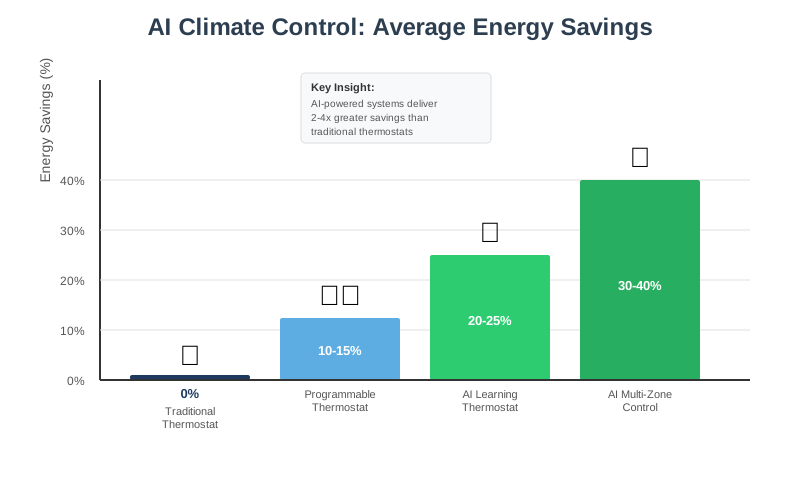
programmable represents scheduled thermostats;
AI learning represents ENERGY STAR certified smart thermostats;
AI multi-zone represents comprehensive AI home energy management systems with multiple integrated technologies.
Smart Kitchens: AI’s Role in Automated Cooking and Meal Planning
Smart Kitchens powered by AI are transforming how we plan, prepare, and enjoy meals. This goes well beyond smart refrigerators that track expiration dates—we’re talking about integrated systems that actively support your cooking journey.
AI-powered refrigerators now recognize individual items, track quantities, and suggest recipes based on what you have available. They can automatically generate shopping lists, accounting for your dietary preferences and upcoming meal plans. Some systems even learn your family’s eating patterns and suggest when to purchase items before you run out.
Automated cooking appliances use AI to perfect your meals. Smart ovens with internal cameras monitor food as it cooks, adjusting temperature and timing to achieve optimal results. They can recognize different foods and apply appropriate cooking methods automatically. Tell your oven you’re cooking chicken breast, and it selects the right temperature profile without you consulting a cookbook.
Meal planning assistants integrate with your calendar, dietary restrictions, and taste preferences to suggest weekly menus. They balance nutrition, variety, and your available time for cooking. On busy nights, they suggest quick meals; when you have more time, they might recommend trying something new.
The learning aspect is key. Over time, your kitchen AI understands which recipes your family loves, which ingredients you always have on hand, and even your skill level. Suggestions become increasingly personalized and practical.
AI-Enhanced Entertainment Systems: Personalized Viewing and Listening
AI-Enhanced Entertainment Systems create truly personalized media experiences that adapt to your preferences, mood, and even the time of day.
Modern streaming services use sophisticated AI recommendation engines, but smart home integration takes this further. Your entertainment system can adjust audio settings based on what you’re watching—dialogue enhancement for dramas, dynamic range for action movies. It recognizes who’s in the room and suggests content appropriate for that audience.
Ambient lighting integration creates immersive experiences. Your AI system analyzes video content in real-time and adjusts room lighting to match the on-screen mood and colors. This happens seamlessly, enhancing engagement without distraction.
Smart audio systems use room acoustics mapping and AI processing to deliver optimal sound quality. They automatically adjust based on room occupancy and listener positions, ensuring everyone gets the best possible experience whether you’re hosting a party or enjoying a quiet evening.
Voice control has evolved beyond simple commands. You can ask for “something funny we haven’t watched” or “relaxing music for working,” and your system understands these natural requests, offering genuinely relevant suggestions.
Voice Assistants and AI: The Command Center of Your Smart Home
Voice Assistants and AI serve as the central nervous system of modern smart homes, coordinating devices and providing an intuitive interface for control.
Modern voice assistants use advanced natural language processing to understand context and intent. You don’t need to memorize specific commands—just speak naturally. “I’m cold” works as well as “increase temperature by two degrees.” The system understands both.
These assistants act as automation hubs, creating connections between different devices and services. You might say “goodnight,” triggering a routine that locks doors, adjusts thermostats, turns off lights, and arms security systems—all with a single phrase.
Multimodal interaction is emerging as a key feature. Voice assistants now work with smart displays, showing relevant visual information alongside voice responses. Ask about the weather, and you see a forecast. Request a recipe, and step-by-step instructions appear with accompanying images.
Proactive assistance represents the next evolution. Your voice assistant might notify you when it’s time to leave for an appointment based on current traffic, remind you to close the garage door when everyone’s left home, or suggest ordering more coffee when your smart kitchen notices you’re running low.
AI-Powered Home Automation for Seniors and People with Disabilities
AI-Powered Home Automation for Seniors and People with Disabilities provides enhanced independence, safety, and quality of life through thoughtfully designed intelligent systems.
Voice control eliminates the need for physical dexterity with switches or remotes. Seniors with limited mobility can control lighting, temperature, entertainment, and security simply by speaking. This restores autonomy in daily activities that might otherwise require assistance.
Fall detection and health monitoring systems use AI to recognize emergencies and alert caregivers or medical services automatically. Cameras with computer vision can detect if someone has fallen and remained motionless, triggering immediate responses.
Medication reminders and health tracking integrate with smart home systems, providing gentle prompts and monitoring compliance. AI assistants can answer health-related questions, schedule appointments, and maintain communication with healthcare providers.
Adaptive learning is particularly valuable for this demographic. Systems can adjust sensitivity and behavior based on individual capabilities and needs. For someone with hearing impairment, visual alerts might accompany audio notifications. For those with cognitive challenges, routines can be simplified and supported with step-by-step guidance.
Social connection features help combat isolation. Video calling becomes accessible through simple voice commands, and AI assistants can facilitate communication with family members, sharing updates and maintaining regular contact.
The Ethics of AI in Home Automation: Privacy and Security Concerns
The Ethics of AI in Home Automation demands careful consideration, particularly regarding privacy, data security, and algorithmic decision-making.
Privacy concerns are paramount when devices continuously monitor your activities, conversations, and routines. Every smart camera, voice assistant, and sensor potentially collects sensitive information about your daily life. Understanding what data is collected, how it’s stored, and who has access is essential.
Data encryption and local processing offer important protections. The best systems process sensitive information on-device rather than transmitting everything to cloud servers. When cloud processing is necessary, end-to-end encryption ensures your data remains private even from the service provider.
Transparency in AI decision-making is crucial. You should understand why your system made particular choices—why lights dimmed, why temperature adjusted, and why you received a security alert. Explainable AI helps build trust and enables you to refine system behavior.
Control and consent matter. You should be able to easily view, modify, or delete collected data. Clear opt-in mechanisms for different features—rather than default surveillance—respect user autonomy.
Security vulnerabilities present real risks. Poorly secured smart home devices can become entry points for hackers, potentially compromising your home network and personal information. Regular security updates, strong authentication, and network segmentation provide essential protections.
DIY AI Home Automation: Tools and Platforms for Beginners
DIY AI Home Automation has become surprisingly accessible, with user-friendly platforms that don’t require programming expertise or professional installation.
Home Assistant stands out as a powerful open-source platform supporting thousands of devices from different manufacturers. It runs locally on affordable hardware like a Raspberry Pi, giving you complete control over your data and automation logic. The platform includes AI-powered features for presence detection, voice processing, and automated pattern recognition.
SmartThings offers an accessible entry point with excellent device compatibility and intuitive mobile apps. Samsung’s platform includes AI features like automatically learning your routines and suggesting helpful automations based on your device usage patterns.
Google Home and Amazon Alexa ecosystems provide the easiest starting points for beginners. Both platforms offer AI-powered voice assistants, extensive device compatibility, and simple setup processes. Their machine learning capabilities enable features like routine suggestions and automated scene creation.
Starting small is the best approach. Begin with a single room or specific use case—perhaps smart lighting for your living room or a smart thermostat. Learn how the system works, then gradually expand. This builds expertise without overwhelming you with complexity.
Hub selection matters. Some devices require specific hubs to function, while others connect directly via WiFi or Bluetooth. Understanding compatibility before purchasing prevents frustrating incompatibilities.
The Future of AI and Home Robotics: What to Expect Next
The Future of AI and Home Robotics promises increasingly capable machines that handle physical tasks throughout your home, moving beyond today’s vacuuming robots to genuinely versatile assistants.
Advanced manipulation capabilities are emerging. Robots are learning to handle delicate objects, operate household appliances, and perform complex tasks like folding laundry or loading dishwashers. This requires sophisticated computer vision, precise motor control, and AI planning systems that understand physical constraints.
Embodied AI—systems that learn through physical interaction rather than just data analysis—will enable robots to adapt to your specific home environment. Rather than requiring precise programming, future robots will explore, learn, and improve through experience.
Human-robot collaboration will become seamless. Robots will understand social cues, work safely alongside people, and communicate naturally about tasks and goals. You might work together with a robot assistant on meal preparation, with the robot handling tedious prep work while you focus on creative aspects.
Multimodal sensing integration—combining vision, audio, touch, and other sensors—will create truly context-aware robots. They’ll understand not just what objects are present, but how to interact with them appropriately based on material, fragility, and purpose.
Personalization through continuous learning means your home robot will become increasingly tailored to your specific needs, preferences, and environment over time. It’s not a generic appliance but an assistant that knows your home intimately.
AI-Powered Home Automation: Reducing Your Carbon Footprint
AI-Powered Home Automation offers significant environmental benefits through intelligent energy management and resource optimization that goes beyond what manual control can achieve.
Energy consumption optimization happens continuously. AI systems analyze your usage patterns, utility rates, weather forecasts, and grid demand to minimize environmental impact. They shift energy-intensive activities to times when renewable energy is most available on the grid, and they eliminate waste from unnecessary heating, cooling, or lighting.
Predictive maintenance reduces resource waste. Your AI system monitors appliances for efficiency degradation and alerts you to problems before they cause failures. A refrigerator running inefficiently might be flagged for service, preventing it from consuming excess energy for months before completely failing.
Water conservation benefits from AI integration. Smart irrigation systems analyze soil moisture, weather forecasts, and plant needs to deliver precise watering that maintains healthy landscapes while minimizing consumption. Some systems reduce water usage by 30-50% compared to traditional timers.
Renewable energy integration becomes more practical with AI management. Smart systems maximize the value of solar panels by shifting consumption to match production, charging electric vehicles during peak solar hours, and using battery storage intelligently.
Lifecycle considerations extend environmental benefits. AI-powered systems help appliances last longer through optimal operation and preventative maintenance, reducing electronic waste from premature replacement.
Troubleshooting AI Home Automation: Common Issues and Solutions
Troubleshooting AI Home Automation systems involves addressing connectivity problems, learning accuracy issues, and integration challenges that can frustrate even experienced users.
Connectivity problems are the most common issue. Devices losing connection to your WiFi or hub disrupt automation routines. Start by checking your router placement—many smart home devices struggle with weak signals. Consider adding WiFi mesh nodes to ensure robust coverage throughout your home. Reducing network congestion by separating smart home devices onto a dedicated network band can also improve reliability.
Learning accuracy issues occur when AI systems make incorrect predictions about your preferences. This typically happens when patterns aren’t consistent enough for the system to identify reliably. You can improve accuracy by manually reinforcing desired behaviors—confirming when the system gets something right and correcting when it’s wrong. Most platforms allow you to review and refine learned routines.
Integration conflicts arise when devices from different manufacturers don’t communicate properly. Check for firmware updates first—compatibility often improves with updates. Using a comprehensive hub platform that supports multiple protocols can bridge compatibility gaps. When integration simply isn’t possible, automation platforms like IFTTT can create workarounds.
Voice recognition problems frustrate users when assistants misunderstand commands. Background noise often contributes—try relocating voice assistants away from TVs or appliances. Retraining voice profiles and using more specific commands improves accuracy. Remember that AI assistants improve over time as they learn your speech patterns.
Privacy concerns about data collection warrant attention. Review device settings to limit data sharing, disable features you don’t need, and ensure firmware stays current for security patches. Consider implementing network segmentation to isolate smart home devices from computers containing sensitive information.
Comparing AI Home Automation Platforms: Which is Right for You?
Comparing AI Home Automation Platforms requires evaluating device compatibility, AI capabilities, privacy policies, and overall ecosystem strengths to find the best fit for your needs.
Amazon Alexa excels in voice control and third-party device support. Alexa’s natural language processing handles conversational commands well, and the platform supports the broadest range of smart home devices. Amazon’s AI features include routine suggestions based on usage patterns and Hunches—proactive alerts about unusual device states. Privacy considerations include extensive data collection, though users can review and delete recordings.
Google Home offers superior contextual understanding through Google Assistant. The platform integrates seamlessly with Google services, providing excellent calendar integration, traffic-aware routines, and smart display experiences. AI strengths include predictive actions and highly accurate voice recognition. Privacy policies are comprehensive but involve significant data collection for service improvement.
Apple HomeKit prioritizes privacy and security with local processing and end-to-end encryption. The platform requires manufacturers to meet strict security standards, which limits device selection but ensures quality. Siri’s AI capabilities lag competitors in some areas, but HomeKit Secure Video offers excellent privacy-focused camera features. Best for users already invested in the Apple ecosystem.
Samsung SmartThings provides excellent flexibility and device compatibility without locking you into a single ecosystem. The platform supports both cloud and local processing, offers strong automation capabilities, and includes AI-powered features like location-based routines. Good middle ground for users who want options.
Home Assistant gives you complete control and privacy through local processing and open-source architecture. This platform demands more technical knowledge but rewards you with powerful customization, no cloud dependencies, and no subscription fees. AI capabilities come through integrations and add-ons. Best for users who value autonomy and don’t mind technical complexity.
Platform capabilities and features are based on manufacturer specifications current as of November 2025. Users should verify current features and compatibility with specific devices before purchase, as platform capabilities evolve rapidly (Connectivity Standards Alliance, 2025).
AI-Driven Home Maintenance: Predictive and Preventative Care
AI-Driven Home Maintenance shifts from reactive repairs to predictive prevention, identifying potential problems before they become expensive emergencies.
Smart leak detection systems monitor water flow patterns throughout your home, using AI to distinguish between normal usage and potential leaks. These systems detect subtle changes—a toilet that continues running after flushing, a pipe developing a slow drip—and alert you immediately. Early detection prevents minor issues from becoming major water damage.
HVAC system monitoring analyzes performance metrics to identify efficiency degradation or component wear. Your smart thermostat might notice that your system is running longer to achieve the same temperature change, indicating dirty filters, refrigerant leaks, or failing components. Addressing these issues early prevents complete system failure and reduces energy waste.
Appliance health monitoring uses power consumption analysis and operational patterns to predict failures. A washing machine drawing more power than normal might indicate bearing wear. A refrigerator compressor cycling too frequently suggests efficiency problems. AI systems learn baseline performance and flag deviations that warrant attention.
Structural monitoring in advanced systems uses sensors to detect foundation settling, roof leaks, or structural issues. Temperature and humidity sensors can identify conditions conducive to mold growth before visible problems appear.
Automated service scheduling connects monitoring systems with maintenance providers. When your HVAC filter needs changing or your system requires professional service, AI platforms can schedule appointments automatically, ensuring timely maintenance.
Enhancing Home Automation with Machine Learning: A Deep Dive
Enhancing Home Automation with Machine Learning involves understanding how different AI approaches create increasingly intelligent and personalized home systems.
Supervised learning enables systems to recognize patterns from labeled examples. Your security camera learns to identify family members by being shown labeled photos. Your voice assistant improves command recognition through corrected transcriptions. This approach requires initial training data but produces reliable results for well-defined tasks.
Unsupervised learning discovers patterns without explicit labeling. Your smart home might notice that lights in certain rooms tend to be used together—suggesting they should be grouped for control. Anomaly detection identifies unusual patterns that might indicate security issues or system problems.
Reinforcement learning enables systems to improve through trial and error. Your climate control AI might experiment with different heating schedules, learning which approaches most effectively balance comfort and energy efficiency for your specific home and preferences.
Transfer learning accelerates improvement by applying knowledge from other homes to yours. Your new smart thermostat doesn’t start completely ignorant—it begins with general knowledge about efficient heating strategies learned from millions of other installations, then refines this with your specific preferences.
Federated learning enables AI improvement while preserving privacy. Your devices contribute to model improvement without sharing raw data. Only anonymized insights about what works well are shared, allowing collective learning while protecting individual privacy.
Edge computing brings AI processing directly to your devices rather than relying on cloud servers. This reduces latency—your smart camera can identify a person instantly rather than waiting for cloud analysis—and enhances privacy since video doesn’t leave your home.
AI-Powered Home Automation for Pet Care: Automated Feeding and Monitoring
AI-Powered Home Automation for Pet Care helps ensure your pets receive consistent, personalized care even when you’re away, while providing peace of mind through intelligent monitoring.
Smart feeders equipped with AI maintain optimal feeding schedules and portion control. These systems can adjust serving sizes based on your pet’s weight management goals, preventing overfeeding or underfeeding. Computer vision capabilities enable feeders to recognize individual pets, ensuring each animal receives the correct food type and quantity in multi-pet households.
Activity monitoring uses AI to track your pet’s movement patterns and behavior. Systems can detect changes that might indicate health issues—reduced activity might signal illness, while unusual restlessness could indicate stress or discomfort. Some platforms provide veterinary-approved insights about concerning behavioral changes.
Interactive pet cameras with treat dispensers let you check on pets remotely and provide positive reinforcement. AI features include barking detection for dogs or motion alerts when your cat enters restricted areas. Two-way audio enables communication, helping anxious pets feel connected to you throughout the day.
Automated litter boxes use sensors and AI to monitor usage patterns, alerting you to potential health issues indicated by changes in frequency or duration. Some systems can even distinguish between multiple cats and track individual patterns.
Smart pet doors use facial recognition or microchip reading to control access, preventing wildlife or neighborhood animals from entering while allowing your pets freedom to move between indoors and outdoors.
The Cost of AI Home Automation: Is It Worth the Investment?
The Cost of AI Home Automation varies dramatically based on your approach, but understanding the full financial picture—including long-term savings—is essential for making informed decisions.
Initial investment ranges from modest to substantial. A basic setup with smart lighting, a voice assistant, and a smart thermostat might cost between $300 and $500. Comprehensive systems covering security, climate control, entertainment, and appliances can reach $5,000-15,000 or more for professional installation in larger homes.
Energy savings provide measurable returns. According to the U.S. Environmental Protection Agency’s ENERGY STAR program, certified smart thermostats save an average of approximately 8% of heating and cooling bills, or about $50 per year for typical households, with actual savings varying based on climate, personal comfort preferences, occupancy, and HVAC equipment efficiency (ENERGY STAR, 2025). Research published in the Clean Energy journal demonstrates that AI-powered neural network systems can achieve significantly higher savings—ranging from 8% to 16% in optimized conditions—through dynamic temperature set-point adjustment and predictive energy management (Alayed et al., 2025). Industry analysis indicates that comprehensive AI-optimized home systems incorporating multiple technologies can reduce annual energy consumption by approximately 30% when combining smart climate control with intelligent lighting, appliance management, and renewable energy integration (AI Tech Decoded, 2025).
Sources:
– ENERGY STAR. (2025). “Smart Thermostats FAQs for EEPS.” U.S. Environmental Protection Agency. https://www.energystar.gov/products/heating_cooling/smart_thermostats/smart_thermostat_faq
– Alayed, W., Akhtar, A., Hassan, W. U., & Zeeshan, A. (2025). “Maximizing energy savings in smart homes through artificial neural network-based artificial intelligence solutions.” Clean Energy, 9(2), 140–149. https://doi.org/10.1093/ce/zkae113
Maintenance and subscription costs deserve consideration. Many AI platforms require monthly subscriptions for advanced features or cloud storage. Security cameras might charge $3–$10 monthly per camera for video storage. Some voice assistants require subscriptions for music streaming or premium features. Budget $10-50 monthly for ongoing costs depending on your system complexity.
Home value impact varies by market. Installing smart home systems can increase property appeal and value, particularly for energy-efficient features. However, overly customized or complex systems might deter buyers unfamiliar with the technology. Focus on widely compatible, mainstream platforms if resale value matters.
Payback periods typically range from 3 to 7 years when accounting for energy savings alone. When you factor in convenience benefits, security improvements, and quality of life enhancements, many users find the investment worthwhile regardless of strict financial ROI.
AI and Smart Gardens: Automated Watering and Plant Health Monitoring
AI and Smart Gardens bring precision agriculture concepts to home gardening, optimizing plant health while conserving water and reducing maintenance burdens.
Intelligent irrigation systems analyze multiple data sources to deliver precisely calibrated watering. Soil moisture sensors provide real-time ground truth about water needs. Weather forecasts prevent watering before rain. Plant databases ensure different species receive appropriate care. Some advanced systems even account for sun exposure, temperature, and seasonal growth patterns.
Plant health monitoring uses computer vision to detect disease, pest infestations, or nutrient deficiencies before visible symptoms become severe. AI systems trained on extensive plant pathology databases can identify problems from leaf discoloration, spotting, or growth patterns, suggesting targeted interventions.
Automated nutrient management tracks fertilization schedules and can even integrate with automated dispensers to maintain optimal soil chemistry. Systems learn your specific garden conditions—soil type, sun exposure, drainage characteristics—and adjust recommendations accordingly.
Growth tracking provides insights into what works in your specific environment. By monitoring plant development over time, AI systems identify which varieties thrive, optimal planting times, and effective care strategies for your unique conditions.
Integration with home automation enables sophisticated scenarios. Your garden system might request additional watering during heatwaves, alert you when harvesting is optimal, or adjust lawn irrigation to avoid watering before outdoor entertaining.
Integrating AI with Existing Home Automation Systems: A Step-by-Step Guide
Integrating AI with Existing Home Automation Systems doesn’t require replacing everything you own—modern platforms excel at incorporating legacy devices and bridging different ecosystems.
Step 1: Assess your current system. Document all existing smart devices, their communication protocols (WiFi, Zigbee, Z-Wave, etc.), and any hubs or controllers already in use. Understanding what you have prevents compatibility surprises.
Step 2: Choose an AI platform compatible with your devices. Research which platforms support your existing equipment. Home Assistant offers the broadest compatibility, supporting virtually everything. SmartThings works well for mixed ecosystems. Google Home and Alexa support most mainstream devices.
Step 3: Set up your chosen platform. Follow manufacturer instructions for your selected hub or controller. This typically involves downloading an app, creating an account, and connecting the hub to your WiFi network.
Step 4: Add existing devices to the new platform. Most platforms include discovery features that automatically find compatible devices on your network. For devices that don’t appear automatically, manual addition requires following specific pairing procedures.
Step 5: Organize devices into rooms and zones. Logical organization simplifies control and automation. Group devices by physical location (living room, bedroom) and by function (lighting, climate).
Step 6: Create initial automations. Start simple—perhaps lights turning on at sunset or temperature adjusting when you leave home. Test thoroughly before adding complexity.
Step 7: Enable AI features. Activate learning modes, routine suggestions, and predictive features. These often require several weeks of normal usage before producing useful results.
Step 8: Refine and expand. Monitor system behavior, correct errors, and gradually add more sophisticated automations as you become comfortable with the platform.
AI-Powered Home Automation and the Internet of Things (IoT)
AI-Powered Home Automation and the Internet of Things (IoT) represent converging technologies that create homes far smarter than the sum of their individual devices.
IoT provides the foundational connectivity—billions of devices networked together, sharing data and coordinating actions. Your thermostat knows when your car approaches home. Your refrigerator communicates with your meal planning app. Your security system shares information with your lighting controller.
AI transforms this connectivity into intelligence. Rather than simple data sharing, AI systems analyze information from multiple sources to understand context and make sophisticated decisions. Your home doesn’t just know you’re approaching—it understands that you’re arriving earlier than usual, infers you might have left work sick, and adjusts accordingly.
Interoperability standards like Matter enable devices from different manufacturers to work together seamlessly. This industry-wide collaboration ensures you’re not locked into a single ecosystem and can choose best-in-class devices for each function.
Edge-to-cloud architecture balances local processing with centralized intelligence. Time-critical decisions happen locally for immediate response—detecting people with security cameras, for instance. Long-term pattern analysis and complex reasoning happen in the cloud, where computational resources are abundant.
Data aggregation across devices creates unprecedented insights. Your home understands your routines at a holistic level, recognizing patterns that span multiple systems and optimizing globally rather than locally.
AI in Home Automation: Object Recognition and Context Awareness
AI in Home Automation leverages computer vision and object recognition to create contextually aware systems that understand what’s happening in your home, not just when and where.
Object recognition enables cameras and sensors to identify specific items and activities. Your kitchen camera might recognize when you’re cooking, your living room camera notices when children are playing, and your entryway camera identifies when packages are delivered. This contextual understanding enables appropriate, nuanced responses.
Activity recognition goes beyond identifying objects to understanding actions and situations. AI systems can distinguish between someone walking through a room versus someone searching for something and between normal pet movement and unusual behavior that might indicate distress.
Pose estimation and gesture recognition enable natural interaction. Future systems might adjust lighting based on your hand gestures or recognize when someone has fallen and needs assistance. These capabilities make smart homes more accessible and responsive.
Semantic understanding combines object recognition with relational reasoning. Your system doesn’t just know there’s a person and a stove—it understands that a person standing near an active stove is likely cooking, and this context influences appropriate responses from other systems.
Privacy-preserving computer vision processes video locally, extracting meaning without transmitting images. Advanced systems can recognize activities and objects using skeletal tracking or thermal imaging rather than visible light cameras, providing functionality while protecting visual privacy.
AI-Driven Home Automation for Vacation Homes: Remote Management and Security
AI-Driven Home Automation for Vacation Homes addresses unique challenges of properties that sit empty for extended periods while requiring protection and maintenance.
Remote environmental monitoring prevents costly damage from undetected problems. AI systems track temperature, humidity, and water sensors continuously, alerting you immediately if conditions indicate potential pipe freezing, HVAC failure, or water leaks. Since you’re not present to notice gradual changes, AI’s pattern recognition becomes essential.
Intelligent security systems distinguish between legitimate access (cleaning services, property managers, renters) and potential intrusions. Facial recognition can verify authorized individuals, while behavioral analysis detects unusual patterns like someone repeatedly visiting without authorization.
Occupancy simulation creates the appearance of active residence even when properties are vacant. Rather than simple light timers, AI systems vary patterns realistically—lights in different rooms at different times, blinds opening and closing, TVs and radios cycling on and off—making empty homes less obvious targets.
Energy management becomes crucial when homes sit empty for weeks or months. AI systems maintain minimal climate control to prevent damage while minimizing energy waste, adjusting intelligently based on weather forecasts and scheduled occupancy.
Automated preparation for arrival makes vacation homes immediately comfortable. Your system can begin heating or cooling the property when you start your journey, ensuring comfortable temperatures upon arrival without conditioning an empty house for days.
The Impact of 5G on AI-Powered Home Automation
The Impact of 5G on AI-Powered Home Automation will transform what’s possible through dramatically increased bandwidth, reduced latency, and support for massive device connectivity.
Ultra-low latency enables real-time AI applications currently limited by network delays. Security systems can process video in the cloud with response times rivaling local processing. Voice assistants can access complex AI models without perceptible lag. Automation triggers can execute nearly instantaneously.
Massive device connectivity solves one of the current smart home’s limitations—WiFi network congestion. 5G networks can support exponentially more devices than current home WiFi, enabling sensor-rich environments without connectivity bottlenecks.
Enhanced mobile connectivity means your smart home remains accessible with consistent, fast connections regardless of location. Remote management, video streaming, and complex automations work reliably whether you’re across town or across the country.
Bandwidth abundance enables applications impossible with current connectivity. High-resolution video analysis, AR/VR interfaces for home control, and continuous whole-home monitoring become practical when bandwidth constraints disappear.
Edge computing infrastructure bundled with 5G deployment brings powerful AI processing closer to your home. This enables sophisticated AI capabilities without depending on distant data centers, reducing latency while improving reliability.
AI-Enhanced Home Automation: Creating Personalized Ambiance
AI-Enhanced Home Automation excels at creating and maintaining personalized ambiance that adapts to activities, moods, and preferences throughout your day.
Contextual scene creation goes beyond static presets. AI systems learn which combinations of lighting, temperature, audio, and even scent create optimal environments for different activities and times. Your “reading” scene might differ between morning and evening, adjusted automatically based on natural light levels and your historical preferences.
Mood detection through behavioral cues enables proactive ambiance adjustment. If your system notices you’re having a restless evening—perhaps checking your phone frequently, adjusting the thermostat repeatedly—it might subtly shift lighting to warmer tones and suggest calming music, supporting relaxation without explicit commands.
Multi-sensory integration coordinates lighting, audio, temperature, and potentially scent or air quality to create cohesive experiences. Movie watching might include dimmed lighting, enhanced bass, and a slightly cooler temperature for alertness. Meal times could feature warmer lighting, subtle background music, and improved air circulation.
Circadian rhythm optimization adjusts your environment throughout the day to support natural biological patterns. Energizing cooler lighting and slightly cooler temperatures during morning hours shift to warmer, dimmer, comfortable settings in the evening, supporting better sleep.
Guest adaptation recognizes when visitors are present and adjusts ambiance appropriately. Systems might default to more mainstream preferences, adjust temperature for comfort zones that work for larger groups, or enable privacy-respecting modes that limit monitoring.
Training Your AI Home Assistant: Customizing for Optimal Performance
Training Your AI Home Assistant involves actively guiding the learning process to align system behavior with your specific preferences and needs.
Explicit feedback teaches your system faster than passive observation alone. When your assistant gets something right, confirm it. When it makes mistakes, correct them immediately. Most platforms allow you to review and modify suggested automations, reinforcing good predictions and preventing bad ones from recurring.
Voice training improves recognition accuracy. Many assistants offer voice profile features where you read sample phrases, helping the system learn your specific speech patterns, accent, and pronunciation. This significantly improves command accuracy.
Routine documentation creates learning opportunities. Manually creating routines for your most common activities provides templates that AI can refine and optimize. Start with simple automations, then allow the system to suggest improvements based on actual usage.
Negative examples prevent unwanted behavior. If your system creates automations you don’t want, disable them rather than just ignoring them. This teaches the AI what not to do, which is often as important as learning what you prefer.
Consistency in usage helps AI identify reliable patterns. If your schedule and preferences vary wildly week to week, systems struggle to learn. Establishing some consistency—even if it’s consistently different patterns for weekdays versus weekends—improves AI performance.
Privacy settings balance functionality with data collection. Review what information your system collects and retains. Some AI features require extensive data collection; others work with minimal information. Adjust settings to match your comfort level.
AI-Powered Home Automation and Data Security: Best Practices
AI-Powered Home Automation and Data Security requires vigilance and proactive measures to protect your privacy and prevent unauthorized access to your home systems.
Network segmentation isolates smart home devices from computers and phones containing sensitive information. Create a separate WiFi network specifically for IoT devices. If a smart bulb gets compromised, attackers can’t reach your financial data or work files.
Strong authentication prevents unauthorized access. Enable two-factor authentication on all platforms that support it. Use unique, complex passwords for each service—password managers make this practical. Avoid default passwords on devices.
Regular firmware updates patch security vulnerabilities. Enable automatic updates where available, or establish monthly reminders to verify for updates manually. Outdated firmware is among the most common security weaknesses.
Encryption protects data in transit and at rest. Choose devices and platforms that encrypt communications between them and cloud services. For maximum security, prefer systems that offer end-to-end encryption, where even the service provider cannot decrypt your data.
Local processing minimizes cloud dependencies and potential data breaches. Platforms that process sensitive data locally—on your hub or on individual devices—reduce exposure. Your video footage never leaves your home if cameras process it locally.
Privacy reviews should be conducted quarterly. Check which devices have access to cameras, microphones, location, or other sensitive data. Disable unnecessary permissions. Review sharing settings to ensure you’re not inadvertently allowing third-party access.
Physical security matters for smart home hubs and devices. Place hubs in secure locations where visitors can’t easily access them. Disable physical reset buttons when possible, or secure them with tamper-evident tape.
The Role of Natural Language Processing (NLP) in AI Home Automation
The Role of Natural Language Processing (NLP) in AI Home Automation transforms how we interact with our homes, enabling natural, conversational control that adapts to individual communication styles.
Intent recognition enables systems to understand what you want regardless of how you phrase requests. “Make it brighter,” “I need more light,” and “increase illumination” all convey the same intent. NLP systems extract meaning rather than matching keywords.
Context awareness distinguishes between ambiguous commands. “Turn on the lights” means something different when you’re in the bedroom versus the garage. NLP systems use location, time, recent activities, and other contextual clues to interpret commands correctly.
Multi-turn conversations enable more natural interactions. You might ask, “What’s the weather?” followed by “What about tomorrow?” Your assistant understands “tomorrow” refers to weather without you repeating the full question. This conversational continuity makes interactions feel natural.
Sentiment analysis detects emotion in your voice and adjusts responses appropriately. If you sound frustrated, your assistant might simplify explanations or offer to help differently. If you’re pleased, it might save the current approach as a preference.
Language personalization adapts to your vocabulary, idioms, and communication style. Over time, your assistant learns the specific phrases you use for different actions and recognizes your personal shorthand.
Disambiguation capabilities handle unclear requests gracefully. When a command could mean multiple things, your assistant asks clarifying questions rather than guessing wrong. “Turn on the TV—which TV, bedroom or living room?”
AI Home Automation and Smart Energy Grids: A Symbiotic Relationship
AI Home Automation and Smart Energy Grids create mutually beneficial relationships that optimize energy distribution while reducing costs and environmental impact for homeowners.
Demand response programs compensate homeowners for adjusting consumption during peak periods. Your AI system can automatically shift flexible loads—preheating or pre-cooling your home, running dishwashers, charging electric vehicles—to off-peak times, reducing grid strain while lowering your energy bills.
Grid integration enables your home to participate actively in energy management. During periods of excess renewable energy generation, your system might increase consumption—charging batteries, running appliances—taking advantage of cheap, clean electricity. During peak demand, it reduces consumption or even sells stored energy back to the grid.
Predictive load balancing uses AI to forecast your consumption patterns and coordinate with grid requirements. Your system might charge your electric vehicle more slowly during high-demand evenings or pre-condition your home before peak hours when electricity is cheaper and cleaner.
Renewable energy optimization becomes more valuable with grid integration. Your solar panels generate the most power midday, but you might need the most electricity in the morning and evening. AI coordination with smart grids enables virtual net metering or community solar sharing, maximizing renewable energy value.
Resilience during outages improves through intelligent battery and generator management. AI systems can prioritize essential loads during power failures, extending backup power duration. They can also predict outages based on weather forecasts and storm tracking, preemptively charging batteries.
Beyond Convenience: The Transformative Potential of AI-Powered Home Automation
Beyond Convenience lies the transformative potential of AI-powered home automation to fundamentally reshape how we live, work, and interact with our living spaces.
Health and wellness integration transforms homes into proactive health partners. Air quality monitoring that cleans the air automatically, lighting that helps regulate sleep patterns, sleep tracking with adjustable bedroom settings, and activity tracking that promotes movement—these systems actively help improve health instead of just following instructions.
Aging in place becomes more viable through intelligent assistance and monitoring. As populations age, home AI can provide the support needed for seniors to maintain independence longer. Fall detection, medication reminders, health monitoring, and simplified interfaces extend the time people can live independently in familiar surroundings.
Environmental sustainability scales through collective action. Millions of homes intelligently optimizing energy use, shifting demand to match renewable generation, and maintaining efficient operation create measurable environmental benefits. Individual smart homes become nodes in a larger sustainability network.
Work-from-home optimization addresses the reality that homes now serve as both living spaces and offices. AI systems can create appropriate environments for different work modes—focus time with minimal distractions, collaborative video calls with optimal audio and lighting, and breaks with environment shifts to prevent burnout.
Educational opportunities emerge as homes become intelligent learning environments. Children can interact with AI tutors, spaces can adapt to support different learning activities, and parents receive insights about how their children learn best.
Accessibility transformation makes independent living possible for people with various disabilities. Voice control, automated physical assistance, customized interfaces, and intelligent prediction of needs remove barriers that might otherwise require human assistance.
AI-Powered Home Automation: Integration with Wearable Technology
AI-Powered Home Automation achieves new levels of personalization and responsiveness through integration with wearable technology that provides continuous insights into your state and preferences.
Physiological monitoring from fitness trackers and smartwatches enables homes that respond to your physical state. Heart rate variability indicating stress might trigger calming lighting and temperature adjustments. Poor sleep quality detected by your wearable could prompt your home to optimize the evening environment for better rest.
Location-based automation becomes more sophisticated with wearables. Your home knows not just that someone arrived, but specifically who arrived and their current state. If your smartwatch shows you had a stressful commute, your home might prepare a more relaxing environment than usual.
Activity recognition from wearables informs home automation. Your fitness tracker knows you just finished an intense workout; your home might lower the temperature, prepare a cold beverage alert, and suggest recovery-optimized lighting. Your watch knows you’re sleeping; your home enters deep quiet mode automatically.
Health emergency detection combines wearable sensors with home automation for rapid response. A fall detected by your smartwatch triggers home cameras to record, doors to unlock for emergency responders, and automated calls to emergency services—all within seconds.
Personalized multi-user environments use wearable identification to customize spaces for whoever’s present. When you enter a room, lighting, temperature, and audio adjust to your preferences. When your partner enters, settings shift to theirs, or find a mutually comfortable compromise.
Frequently Asked Questions About AI-Powered Home Automation
Start Your AI Home Automation Journey Today
We’ve covered extensive ground exploring AI-Powered Home Automation—from basic concepts to advanced implementations, from practical benefits to important considerations. The technology has matured to the point where anyone can create a smarter, more efficient, more comfortable home.
The best approach is starting small and expanding gradually. Choose one area where automation would make the most significant difference in your daily life. Perhaps it’s climate control to reduce energy bills, smart lighting for convenience and ambiance, or security cameras for peace of mind. Master that single system, understand how it works, and then expand to other areas.
Remember that AI home automation is a journey, not a destination. Your system will continuously learn and improve, adapting to your changing needs and preferences. Be patient during the initial learning period, provide feedback to guide the AI, and don’t hesitate to adjust settings as you discover what works best for you.
The future of home living is intelligent, adaptive, and personalized. By starting today, you’re not just adding convenience—you’re investing in a more sustainable, secure, and comfortable way of living. Your smart home journey begins with a single device. Where will you start?
This article derives its energy savings figures from multiple peer-reviewed studies, government reports, and industry analyses published in 2025. Actual savings vary significantly based on home size, climate zone, existing equipment efficiency, occupancy patterns, and user behavior. The U.S. EPA ENERGY STAR program provides certified baseline savings data for individual smart thermostats (averaging 8% of HVAC costs), while comprehensive AI home automation systems incorporating multiple technologies show potential for higher total energy reductions when properly configured and maintained. Readers should consult qualified professionals to assess potential savings for their specific circumstances.
References:
Energy Management & Savings:
- Alayed, W., Akhtar, A., Hassan, W. U., & Zeeshan, A. (2025). “Maximizing energy savings in smart homes through artificial neural network-based artificial intelligence solutions.” Clean Energy, Volume 9, Issue 2, April 2025, Pages 140–149. https://doi.org/10.1093/ce/zkae113
- Market Research Report (2025). “Smart Home Energy Management System Market to Reach USD 12.3 Billion by 2033.” Market Research Intellect, November 27, 2025. https://www.prnewswire.com/news-releases/smart-home-energy-management-system-market-to-reach-usd-12-3-billion-by-2033–fueled-by-rising-home-electrification-ai-driven-energy-optimization—market-research-intellect-302627640.html
- Systematic Literature Review (2025). “Future of Energy Management Models in Smart Homes: A Systematic Literature Review.” Process Integration and Optimization for Sustainability, April 2025. https://link.springer.com/article/10.1007/s41660-025-00506-x
AI Home Security:
- Electronics Journal (2025). “Artificial Intelligence-Based Smart Security System Using Internet of Things for Smart Home Applications.” Electronics, 14(3), 608, February 4, 2025. https://doi.org/10.3390/electronics14030608
- Zia, M. F., Siddiqua, M., Ouameur, M. A., Bagaa, M., & Turjman, F. A. (2025). “Securing the Future: A Survey on Smart Home Security in IoT-Integrated Smart Cities.” Advances in Networks, Volume 12, Issue 1, March 2025. https://www.sciencepublishinggroup.com/article/10.11648/j.net.20251201.11
- Jeon, G. et al. (2025). “Multiple Spectrogram Fusion Network (MSF-Net) for WiFi-based Human Activity Recognition.” IEEE Internet of Things Journal, Volume 11, Issue 24, December 2024 (published online May 13, 2024). Retrieved from ScienceDaily, February 10, 2025. https://www.sciencedaily.com/releases/2025/02/250210132542.htm
- SafeHome.org (2025). “AI-Powered Home Security: 2026 Predictions.” Updated August 4, 2025. https://www.safehome.org/security-systems/ai-powered-security/
Matter Smart Home Standard:
- Connectivity Standards Alliance (2025). “Matter 1.4.2: Enhancing Security and Scalability for Smart Homes.” August 11, 2025. https://csa-iot.org/newsroom/matter-1-4-2-enhancing-security-and-scalability-for-smart-homes/
- Connectivity Standards Alliance (2025). “Matter 1.5 Specification Release.” November 20, 2025. Information available at https://csa-iot.org/all-solutions/matter/
- 9to5Mac (2025). “Matter 1.5 adds security cameras and much more for the first time.” November 20, 2025. https://9to5mac.com/2025/11/20/matter-1-5-adds-security-cameras-and-much-more-for-the-first-time/
ENERGY STAR. (2025). “Smart Thermostats FAQs for Energy Efficiency Programs.” U.S. Environmental Protection Agency. https://www.energystar.gov/products/heating_cooling/smart_thermostats/smart_thermostat_faq
ENERGY STAR. (2025). “ENERGY STAR Certified Smart Thermostats.” U.S. Environmental Protection Agency. https://www.energystar.gov/products/smart_thermostats
AI Tech Decoded. (2025). “Smart Homes in 2025: How AI is Running Our Households.” October 19, 2025. https://aitechdecoded.com/smart-homes-in-2025-how-ai-is-running-our-households/
About the Authors
This article was written through the collaborative efforts of Abir Benali and James Carter for howAIdo.com.
Main Author – Abir Benali is a friendly technology writer who specializes in making AI tools accessible to non-technical users. With a passion for clear communication and practical guidance, Abir helps readers understand complex technologies through simple language, real examples, and actionable advice. Abir’s approach focuses on empowering readers to confidently adopt new technologies that improve their daily lives.
Co-Author – James Carter is a productivity coach dedicated to helping people use AI to save time and boost efficiency. James brings expertise in step-by-step processes, time-saving strategies, and practical integration techniques that make technology work seamlessly within daily routines. His motivational and reassuring tone emphasizes that AI simplifies work without requiring technical expertise, making advanced technology accessible to everyone.