AI’s Long-Term Impact on Employment: What You Need to Know

AI’s Long-Term Impact on Employment is reshaping how we work, what skills we need, and which careers will thrive in the coming decades. As someone who has spent years studying AI ethics and digital safety, I’ve watched this transformation unfold with both concern and cautious optimism. The question isn’t whether AI will change employment—it already has. The real question is: how can we navigate this shift safely and strategically?
Understanding artificial intelligence’s effect on jobs requires looking beyond the headlines about robots replacing workers. The reality is far more nuanced, complex, and surprisingly manageable when you know what to expect and how to prepare.
What Does AI’s Long-Term Impact on Employment Really Mean?
At its core, AI’s Long-Term Impact on Employment refers to the comprehensive changes artificial intelligence will bring to the job market over the next 10 to 30 years. This includes jobs that will disappear, new positions that will emerge, and existing roles that will transform significantly.
Imagine it as a more rapid version of the Industrial Revolution. Just as factories didn’t simply eliminate farm jobs—they created manufacturing positions, transportation careers, and entirely new industries—AI automation and job displacement will follow a similar pattern of creative destruction and opportunity creation.
What is the key difference? This transformation is happening in years rather than decades, which means we need to be more proactive about understanding and adapting to these changes.
The Two Sides of the Employment Equation
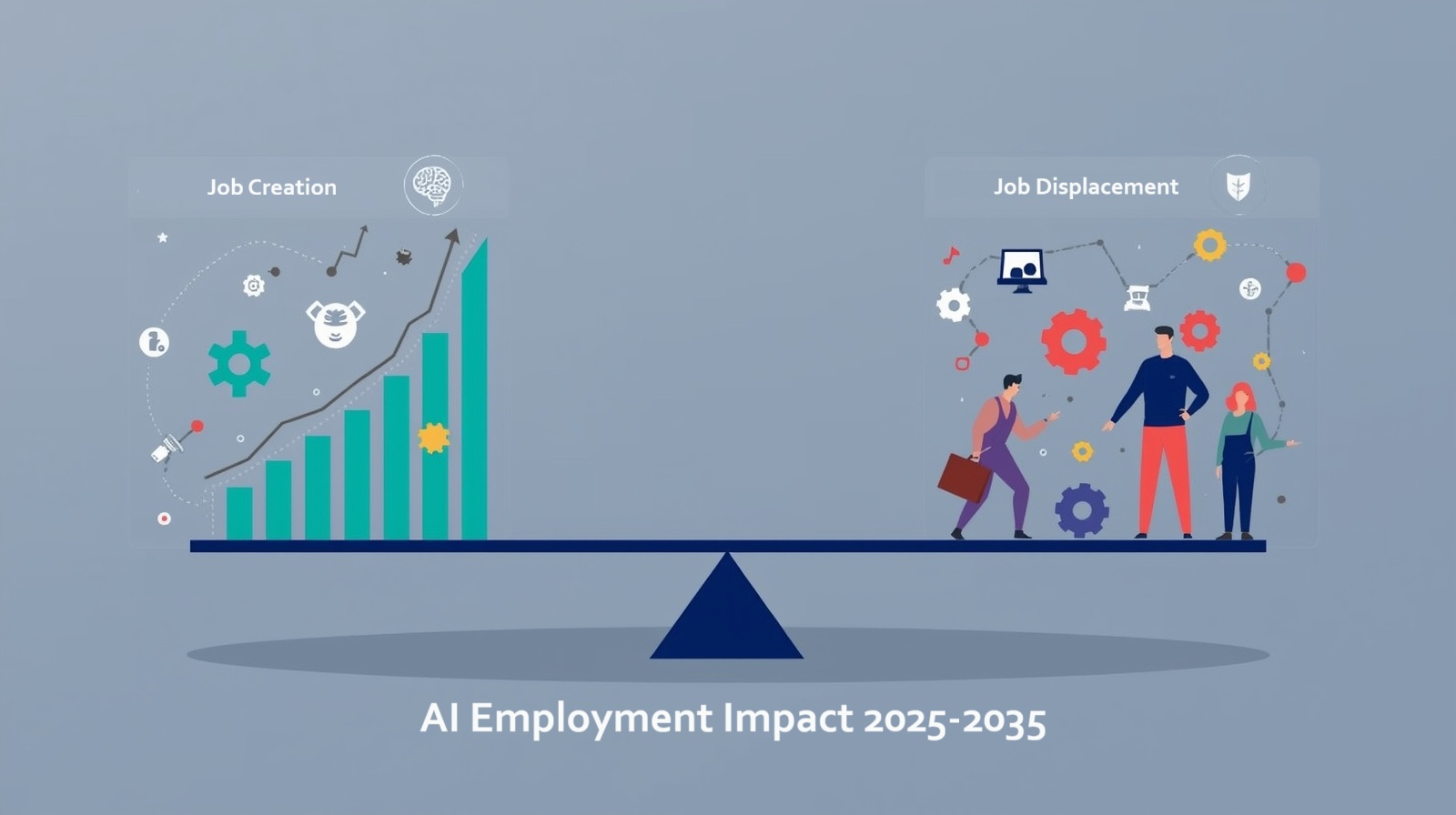
When experts discuss employment disruption by AI, they’re really talking about two simultaneous processes:
Job Displacement: Some roles will become automated or significantly reduced. These typically involve repetitive tasks, predictable patterns, or rule-based decision-making that AI can handle efficiently.
Job Creation: New positions will emerge that didn’t exist before, requiring skills in AI management, data interpretation, human-AI collaboration, and creative problem-solving that machines can’t replicate.
What is the critical insight? These processes don’t cancel each other out neatly. Different industries, regions, and skill levels will experience vastly different outcomes.
How AI Changes Employment: The Practical Mechanics
Understanding how AI reshapes the workforce helps you anticipate changes before they affect you directly. Let me walk you through the actual mechanisms at play.
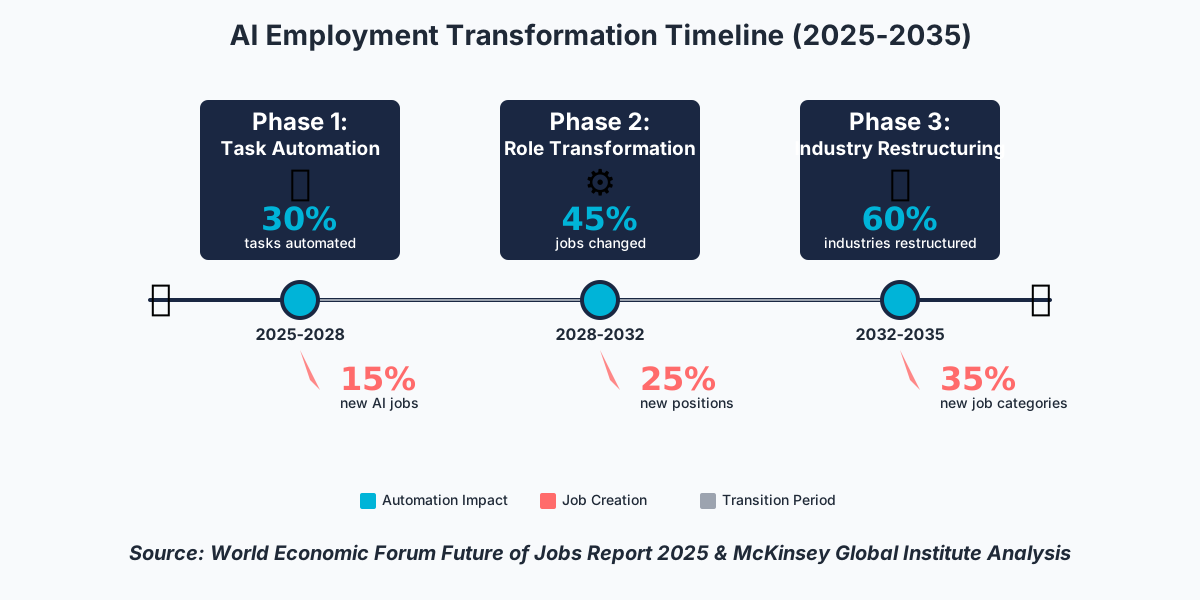
Phase 1: Task Automation (What’s Happening Now)
AI doesn’t replace entire jobs overnight. Instead, it automates specific tasks within jobs. This phase is already well underway across multiple sectors.
For example, radiologists aren’t being replaced—but AI now handles the initial screening of X-rays, flagging potential issues for human review. This changes the radiologist’s role from examining every single image to focusing on complex cases and final decision-making.
Similarly, customer service representatives now have AI handling routine inquiries, freeing them to manage complicated issues requiring empathy and nuanced judgment.
Why this is relevant for you: Even if your job title remains the same, your daily tasks and required skills will likely shift. The professionals who thrive are those who learn to work alongside AI tools rather than compete against them.
Phase 2: Role Transformation (The Current Transition)
As more tasks become automated, job roles themselves begin to change. This is where AI’s impact on jobs becomes more visible and sometimes uncomfortable.
Administrative assistants, for instance, spend less time scheduling and more time on strategic coordination. Accountants focus less on data entry and more on financial analysis and advisory services. Writers use AI for research and drafting, concentrating their human expertise on strategy, voice, and editorial judgment.
This transformation requires upskilling—but it also creates opportunities for those willing to adapt. The professionals who master both their traditional expertise and AI collaboration tools become invaluable.
Phase 3: Industry Restructuring (The Near Future)
Looking ahead, entire industries will restructure around AI-driven workforce changes. This doesn’t mean mass unemployment—it means different employment patterns.
Consider transportation: as autonomous vehicles mature, we’ll see fewer traditional drivers but more positions in fleet management, vehicle monitoring, AI system maintenance, safety oversight, and passenger experience design. The number might not be equal, but the quality and requirements of these jobs will differ significantly.
Manufacturing has already experienced this shift. Modern factories employ fewer assembly line workers but more robotics technicians, quality control specialists, and logistics coordinators. These positions often pay better but require different skills.
Real-World Examples: AI’s Employment Impact Across Sectors
Allow me to share concrete examples from different industries to help you understand what the future of work with AI actually looks like in practice.
Healthcare: More Jobs, Different Skills
Healthcare demonstrates how AI and employment trends can create net positive outcomes when managed thoughtfully. AI diagnostic tools haven’t reduced healthcare employment—they’ve shifted it.
Hospital systems now employ AI specialists who maintain diagnostic algorithms, data analysts who interpret population health trends, and patient navigators who help people understand AI-generated health insights. Meanwhile, doctors and nurses spend more time on patient interaction and complex decision-making rather than routine diagnostics.
The lesson? Technology and job market shifts in healthcare show that human expertise becomes more valuable when AI handles routine tasks, freeing professionals for work requiring empathy, ethical judgment, and creative problem-solving.
Retail: Transformation, Not Elimination
E-commerce and AI-powered inventory systems have indeed reduced traditional retail positions. However, they’ve also created new roles: user experience designers, data analysts, supply chain optimizers, and customer success specialists.
Amazon, despite heavy automation in warehouses, employs more people now than ever—but in different capacities. Warehouse workers increasingly supervise robots rather than manually moving products. This shift requires training and adjustment, but it doesn’t mean disappearing jobs.
Creative Industries: Augmentation Over Replacement
As someone deeply invested in ethical AI use, I consider the creative sector particularly instructive. AI writing tools, image generators, and music creation software haven’t eliminated creative professionals—they’ve changed how we work.
Graphic designers now use AI to rapidly prototype concepts, spending more time on strategy and refinement. Writers employ AI for research and drafting, focusing their expertise on voice, narrative structure, and emotional resonance. Marketing teams generate more content with the same headcount by leveraging AI for routine posts while humans handle strategic campaigns.
The workforce automation consequences here aren’t job losses—they’re productivity gains that create opportunities for those who adapt while potentially leaving behind those who resist.
Financial Services: The Hybrid Model
Banking and finance show how AI job market analysis reveals both displacement and creation simultaneously. Routine transaction processing and basic customer service have largely been automated, reducing entry-level positions.
However, financial institutions now need more cybersecurity experts, AI ethics officers, algorithmic bias auditors, and financial wellness advisors who combine data insights with human judgment. The net employment might be lower, but average wages and job satisfaction in remaining positions tend to be higher.
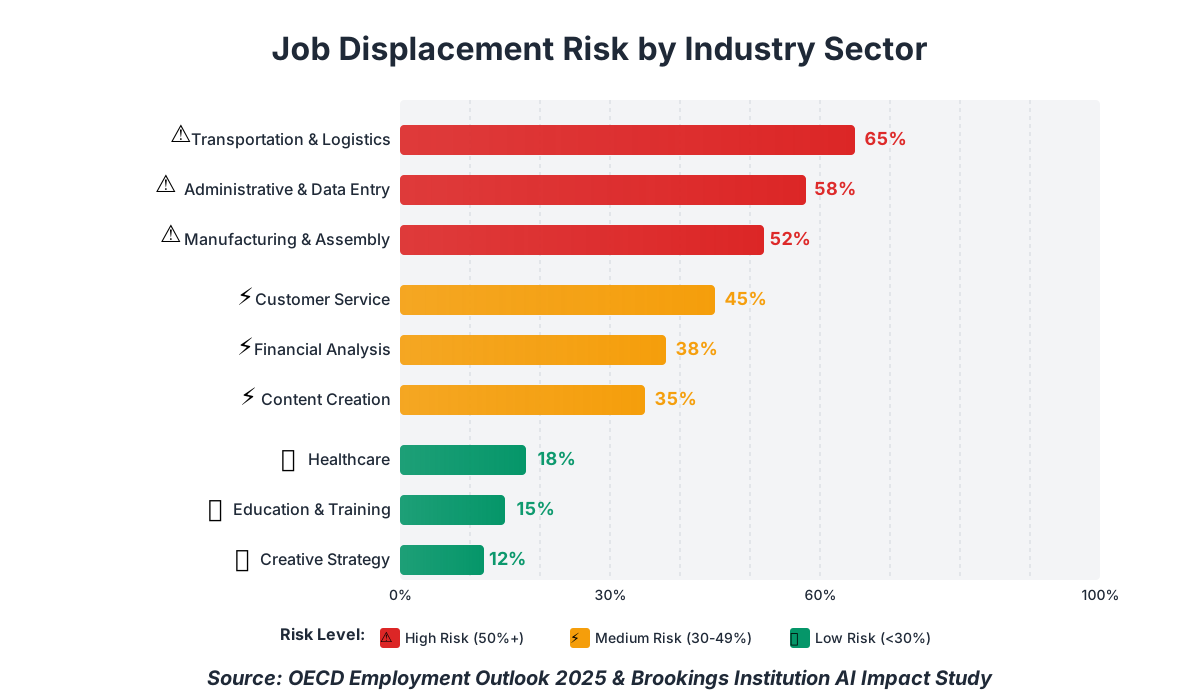
The Jobs Most at Risk: What You Should Know
Being honest about job displacement from AI is essential for making smart career decisions. Some positions face significant risk, and recognizing this early gives you time to adapt.
High-Risk Categories
Routine Cognitive Tasks: Data entry, basic bookkeeping, simple scheduling, routine customer service inquiries, and standard report generation face the highest automation risk. These tasks follow predictable patterns that AI excels at replicating.
Transportation and Delivery: As autonomous vehicle technology matures, traditional driving positions—from truckers to taxi drivers—will face substantial pressure. This won’t happen overnight, but the trajectory is clear.
Basic Administrative Work: Filing, basic document processing, simple research tasks, and routine communication management are increasingly handled by AI assistants and automation tools.
Repetitive Manufacturing: Assembly line positions involving predictable physical tasks continue to automate, though this trend predates AI’s current wave.
Why this matters: If your current role consists primarily of these tasks, now is the time to develop complementary skills that AI cannot easily replicate.
Medium-Risk Categories
Specialized Analysis: Some specialized analysis work—legal document review, preliminary medical diagnosis, financial planning—will see significant AI augmentation. These jobs won’t disappear but will transform dramatically.
Technical Support: First-level technical support increasingly uses AI chatbots, though complex troubleshooting still requires human expertise.
Content Creation: Basic content writing, simple graphic design, and routine video editing face AI competition, though quality and strategic creative work remain solidly human.
Jobs AI Will Create: The Opportunity Side
While discussions of AI employment disruption often focus on losses, the creation side deserves equal attention. History shows that technological revolutions create more jobs than they eliminate—though rarely in the same sectors or requiring the same skills.
Emerging Job Categories
AI Trainers and Supervisors: Someone needs to teach AI systems, correct their mistakes, and ensure they align with human values. These positions require domain expertise plus a basic understanding of how AI learns.
Human-AI Collaboration Specialists: As AI becomes ubiquitous, we need people who can design workflows where humans and AI work together optimally. This bridges technical and human-centered design skills.
Ethics and Bias Auditors: My field—AI ethics—is growing rapidly. Organizations need professionals who can identify algorithmic bias, ensure privacy compliance, and maintain ethical AI deployment.
Data Stewardship Roles: As AI depends on quality data, positions focused on data curation, validation, privacy protection, and governance are expanding across industries.
AI-Enhanced Service Professionals: Positions like “AI-assisted financial advisor,” “data-informed healthcare navigator,” or “algorithmic transparency consultant” combine traditional service skills with AI literacy.
The Skill Shift: What Employers Actually Want
Understanding employment changes from AI means recognizing that even traditional jobs now require new competencies. Employers increasingly seek candidates who can:
- Work comfortably alongside AI tools
- Interpret and question AI-generated insights
- Focus on strategic thinking over routine execution
- Demonstrate strong communication and empathy
- Adapt quickly to new technologies and workflows
These “hybrid skills”—combining traditional expertise with AI literacy—define the future job market with AI.
Protecting Your Career: Actionable Steps You Can Take Now
Knowledge without action doesn’t protect anyone. Here are concrete, safe steps to future-proof your career against AI workforce transformation.
Step 1: Assess Your Current Position Honestly
Take inventory of your daily tasks. What percentage is involved?
- Repetitive, rule-based work that follows clear patterns?
- Creative problem-solving requiring judgment and context?
- Interpersonal interaction requiring empathy and relationship-building?
- Strategic thinking and long-term planning?
The higher your percentage in the first category, the more urgently you need to develop additional skills. This isn’t about panic—it’s about informed preparation.
Step 2: Develop AI Literacy (Without Becoming a Programmer)
You don’t need to code to thrive in an AI-driven economy. You need to understand:
- What AI can and cannot do reliably
- How to evaluate AI tool outputs critically
- When to trust AI versus when to apply human judgment
- Basic concepts like training data, bias, and limitations
Start with free resources like Google’s AI Essentials course or LinkedIn Learning’s AI fundamentals. Dedicate 30 minutes weekly to learning—consistency matters more than intensity.
Step 3: Cultivate Distinctly Human Skills
Focus on capabilities AI struggles to replicate:
- Emotional intelligence: Reading situations, managing relationships, navigating complex social dynamics
- Creative synthesis: Connecting disparate ideas in novel ways
- Ethical reasoning: Making judgment calls involving values, trade-offs, and human impact
- Strategic vision: Setting direction amid ambiguity and uncertainty
- Adaptive learning: Quickly mastering new domains and integrating diverse knowledge
These skills provide career resilience regardless of technological change.
Step 4: Learn to Collaborate With AI Tools
Rather than fearing AI, become proficient in using it as a productivity amplifier. Experiment with:
- AI writing assistants for routine communication
- AI research tools for information gathering
- AI data analysis tools for pattern recognition
- AI design tools for rapid prototyping
The goal isn’t AI expertise—it’s comfortable, critical collaboration.
Step 5: Build a Diverse Skill Portfolio
Career diversification protects against sector-specific disruption. Develop capabilities in at least two different but complementary areas. For example:
- Marketing skills + data analysis
- Healthcare knowledge + AI literacy
- Customer service expertise + process optimization
- Technical writing + user experience design
This flexibility allows pivoting if your primary field faces significant automation.
Step 6: Stay Connected to Industry Trends
Set up Google Alerts for “AI automation” plus your industry name. Follow thought leaders on LinkedIn. Join professional groups discussing technology’s impact on careers. Awareness buys you time to adapt before changes directly affect you.
Why this step matters: I’ve watched colleagues who actively monitor trends adapt smoothly while others caught off guard face difficult transitions. Information provides agency.
Step 7: Consider Reskilling or Upskilling Programs
Many organizations, governments, and educational institutions now offer AI transition programs. These range from community college certificates to employer-sponsored training to online bootcamps.
Research options before you need them. Know what’s available, how long programs take, and what financial support exists. Having this information ready reduces panic if your field shifts unexpectedly.
The Policy Dimension: What Governments and Organizations Must Do
While individual preparation matters, responsible AI employment policy is equally crucial. As someone focused on ethical technology deployment, I believe we need systemic solutions alongside personal adaptation.
Essential Policy Responses
Retraining Infrastructure: Governments should fund accessible, practical reskilling programs targeting displaced workers. These must be affordable, flexible, and connected to actual job opportunities.
Social Safety Nets: Enhanced unemployment benefits, portable healthcare, and income support during transition periods help workers adapt without falling into poverty. This isn’t about permanent dependency—it’s about supporting people during inevitable transition periods.
Education Reform: Schools must integrate AI literacy, adaptability skills, and human-centered capabilities into curricula. We’re training students for jobs that don’t yet exist using methods designed for yesterday’s economy.
Ethical AI Standards: Organizations deploying AI should be required to conduct employment impact assessments, provide advance notice of major automation initiatives, and contribute to worker retraining funds.
Your Role in Policy
You can influence these outcomes by:
- Voting for candidates supporting worker transition programs
- Advocating within your organization for ethical automation policies
- Supporting legislation requiring corporate transparency about AI employment impacts
- Participating in community discussions about technological change
Frequently Asked Questions About AI’s Employment Impact
The Bottom Line: Navigating Change With Confidence
AI’s Long-Term Impact on Employment represents one of the most significant workforce transformations in human history. The scale and speed of change can feel overwhelming, but understanding the mechanisms, recognizing the patterns, and taking proactive steps puts you in control.
Remember these core principles as you navigate this transition:
Adaptation beats resistance. Technology doesn’t care about our preferences—it advances based on capability and economics. The professionals who thrive are those who learn to work with AI rather than against it.
Human skills remain valuable. Empathy, creativity, ethical judgment, strategic thinking, and relationship-building aren’t being automated. In fact, as routine tasks disappear, these distinctly human capabilities become more valuable, not less.
Preparation provides peace of mind. You don’t need to predict exactly how your field will change. You need basic AI literacy, diverse skills, and the confidence that you can adapt to whatever comes. This psychological resilience matters as much as specific technical knowledge.
Systemic solutions matter. Individual preparation is essential, but we also need good policy. Advocate for retraining programs, safety nets, and ethical AI deployment standards. Your voice matters in shaping how this transition unfolds.
The timeline is now. This isn’t a distant future scenario—it’s happening now. The advantage goes to people who start preparing today rather than waiting until changes directly impact them.
I won’t pretend employment transformation through AI will be painless or equally distributed. Some people and communities will face genuine hardship. But history shows humans are remarkably adaptable when given time, information, and support.
You have more agency than you might think. Start with one small step—take an AI literacy course, experiment with an AI tool in your field, or assess which of your daily tasks are most automatable. Build from there.
The future of employment with artificial intelligence isn’t predetermined. It depends on choices we make individually and collectively. Choose to engage thoughtfully, adapt proactively, and advocate for systems that support workers through transition.
You can do this. We can do this. Let’s approach this transformation with both realism about challenges and confidence in human resilience.
References:
– World Economic Forum. (2025). Future of Jobs Report 2025. Retrieved from weforum.org
– McKinsey Global Institute. (2025). AI and the Future of Work: Analysis and Recommendations. Retrieved from mckinsey.com
– OECD. (2025). Employment Outlook 2025: AI Impact Assessment. Retrieved from oecd.org
– Brookings Institution. (2024). Automation and Artificial Intelligence: How Machines Are Affecting People and Places. Retrieved from brookings.edu
– MIT Task Force on the Work of the Future. (2024). Final Report on Technology and the American Workforce. Retrieved from workofthefuture.mit.edu
About the Author
Nadia Chen is an expert in AI ethics and digital safety, dedicated to helping everyday people navigate technological change safely and confidently. With a background in technology policy and workforce development, Nadia focuses on translating complex AI trends into practical guidance for non-technical audiences. Her work emphasizes responsible technology adoption, privacy protection, and ensuring AI serves human flourishing rather than diminishing it. Through clear, trustworthy writing, Nadia empowers readers to make informed decisions about their careers and digital lives in an AI-transformed world.