AI’s Impact on Job Displacement: Risks & Opportunities

AI’s Impact on Job Displacement isn’t just another trending topic—it’s a fundamental shift that’s already reshaping how we work, what we earn, and how we define career success. I’ve spent years studying AI ethics and helping everyday people navigate technological change safely, and I can tell you this: understanding what’s really happening with automation is the first step toward protecting your future.
The conversation around artificial intelligence and employment often feels polarized. Some voices predict a jobless dystopia where machines do everything. Others promise a utopian future where AI frees us all to pursue creative passions. The truth? It’s far more nuanced, and understanding that nuance is essential for making informed decisions about your career.
Whether you’re a factory worker concerned about robotic automation, an office professional watching AI handle tasks you once did manually, or a young person choosing a career path, this article will help you understand the real risks, identify genuine opportunities, and develop practical strategies to thrive in an AI-augmented workplace.
What Does AI’s Impact on Job Displacement Actually Mean?
Let’s start with clarity. Job displacement occurs when automation or technological advancement makes certain roles obsolete or significantly reduces the need for human workers in specific positions. But here’s what many headlines miss: displacement doesn’t necessarily mean permanent unemployment—it often means transformation.
Artificial intelligence and machine learning are fundamentally different from previous waves of automation. Traditional automation replaced physical labor with machines that performed repetitive tasks. AI can now handle cognitive tasks: analyzing data, making decisions, recognizing patterns, and even creating content. This broader capability means AI’s reach extends far beyond manufacturing floors into offices, creative studios, and service industries.
The scope is significant. According to research from McKinsey Global Institute, by 2030, between 400 and 800 million jobs worldwide could be displaced by automation. However—and this is crucial—the same research indicates that sufficient new jobs could be created to offset those losses, particularly in sectors requiring human creativity, emotional intelligence, and complex problem-solving.
Think of it this way: when spreadsheet software emerged in the 1980s, many predicted the end of accounting jobs. Instead, accountants who adapted now analyze more complex financial scenarios, provide strategic advice, and focus on high-value interpretation rather than manual calculation. The job transformed rather than disappeared.
How AI-Driven Automation Actually Works in the Job Market
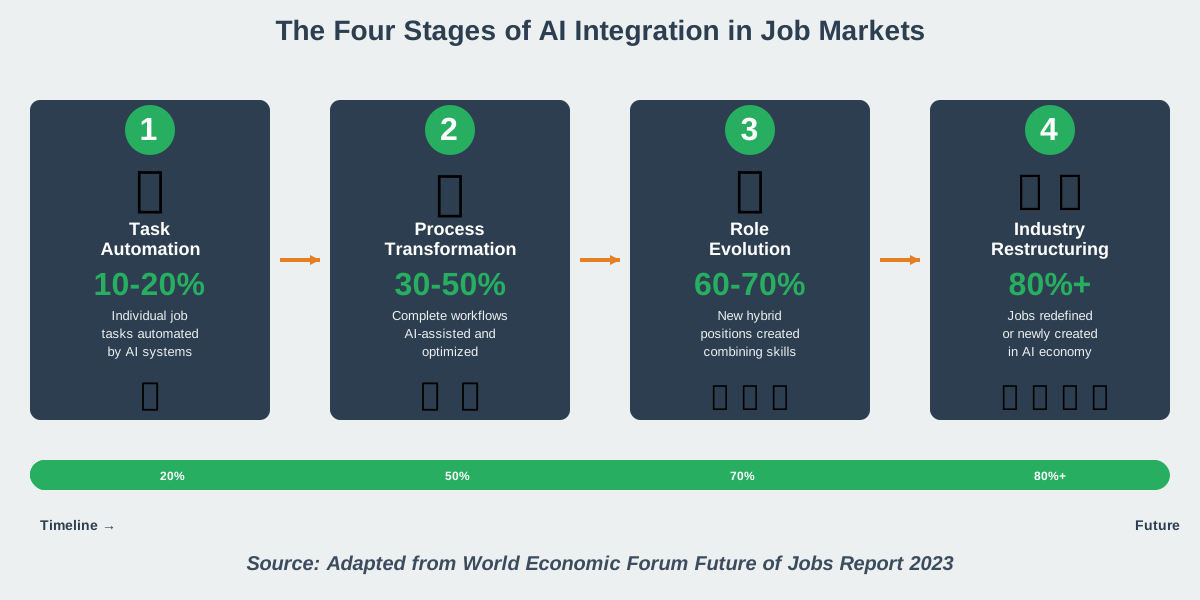
Understanding the mechanics helps us prepare more effectively. AI automation doesn’t typically replace entire jobs overnight. Instead, it follows a pattern:
Task-Level Automation: AI first handles specific tasks within a job. A customer service representative might use AI chatbots to handle routine inquiries, freeing them to manage complex complaints requiring empathy and judgment.
Process-Level Transformation: Multiple automated tasks combine to transform entire workflows. In manufacturing, AI-powered quality control systems, predictive maintenance algorithms, and robotic assembly work together to reshape production processes.
Role Evolution: As AI handles routine elements, job descriptions evolve. The remaining human work becomes more strategic, creative, or interpersonal. This is where we see new hybrid roles emerging—positions that didn’t exist five years ago.
Industry Restructuring: Eventually, entire industries reorganize around AI capabilities, creating completely new sectors and job categories.
Here’s what matters: AI systems learn patterns from data, apply those patterns to make predictions or decisions, and improve through feedback. When these systems can perform a task faster, cheaper, or more accurately than humans, economic pressure drives adoption. This isn’t about malicious intent—it’s about competitive reality.
Which Jobs Face the Highest Displacement Risk?
Being honest about vulnerability is the first step toward adaptation. Not all jobs face equal risk. Research consistently identifies several high-risk categories:
Routine Cognitive Work
Jobs involving predictable, rule-based mental tasks are particularly vulnerable. This includes data entry clerks, basic bookkeeping, simple financial analysis, and routine report generation. Why? AI algorithms excel at pattern recognition and applying consistent rules to structured information.
I’ve worked with professionals in these roles, and the key word is “routine.” If your job involves applying the same analytical process repeatedly to similar inputs, AI can likely learn that process.
Repetitive Physical Labor
Manufacturing assembly line workers, warehouse pickers (though this is evolving), and basic food preparation face significant automation pressure. Robotics combined with AI vision systems can now handle tasks requiring hand-eye coordination that once seemed uniquely human.
Basic Customer Service
First-level phone support, simple inquiry handling, and appointment scheduling are increasingly managed by AI chatbots and virtual assistants. These systems handle routine questions 24/7 without fatigue, learning from each interaction.
Routine Transportation
Long-haul trucking, taxi services, and delivery driving face medium-term disruption from autonomous vehicles. While full automation remains years away, partial automation (like highway autopilot) is already changing these roles.
Administrative Support
Scheduling, basic document preparation, email sorting, and meeting coordination are increasingly handled by AI-powered tools. Virtual assistants now perform tasks that once required dedicated administrative staff.
But here’s the crucial caveat: even in high-risk categories, not all aspects of these jobs face equal vulnerability. The interpersonal elements, judgment calls, creative problem-solving, and adaptation to novel situations remain challenging for AI. A customer service representative who builds relationships and handles complex complaints adds value that chatbots can’t replicate.
The Jobs and Opportunities AI Creates
Now for the encouraging reality: AI’s Impact on Job Displacement comes with a counterbalancing force—job creation. History shows that technological revolutions eliminate certain roles while creating others, often in greater numbers.
AI Development and Maintenance Roles
Every AI system requires humans to build, train, monitor, and improve it. This creates demand for:
- Machine learning engineers who design AI algorithms
- Data scientists who prepare and analyze training data
- AI ethics specialists who ensure responsible deployment
- AI trainers who teach systems to recognize patterns accurately
- Algorithm auditors who check for bias and errors
These aren’t exclusively technical positions. AI trainers often come from domain expertise rather than computer science—a radiologist might train medical imaging AI, while a customer service veteran might train support chatbots.
Augmented Professional Roles
Rather than replacing professionals, AI often augments their capabilities, creating demand for hybrid expertise:
- AI-assisted designers who use generative AI for rapid prototyping
- Data-informed marketers who leverage AI analytics for campaign optimization
- Augmented clinicians who use AI diagnostic tools while providing personal care
- Enhanced educators who use adaptive learning platforms to personalize instruction
These roles pay well because they combine domain expertise with technological fluency—a powerful, currently scarce combination.
Human-Centric Service Positions
As routine tasks get automated, distinctly human capabilities become more valuable. Growing sectors include:
- Healthcare workers providing hands-on care, empathy, and complex decision-making
- Creative professionals in art, writing, design, and entertainment
- Mental health counselors and therapists
- Skilled trades requiring physical dexterity and adaptive problem-solving (plumbers, electricians, HVAC technicians)
- Education and training specialists who teach skills machines can’t
The common thread? These roles require creativity, emotional intelligence, physical adaptability, or complex judgment that AI struggles to replicate.
Green Economy Jobs
The transition to sustainable energy and practices, often enabled by AI optimization, creates millions of positions:
- Solar and wind energy technicians
- Environmental data analysts using AI for climate modeling
- Sustainable agriculture specialists
- Green building designers and retrofitters
AI Ethics and Governance
As AI becomes pervasive, society needs people ensuring it’s used responsibly:
- AI policy advisors working with governments
- Algorithmic fairness specialists preventing discriminatory outcomes
- AI transparency advocates explaining systems to the public
- Digital rights lawyers specializing in AI-related issues
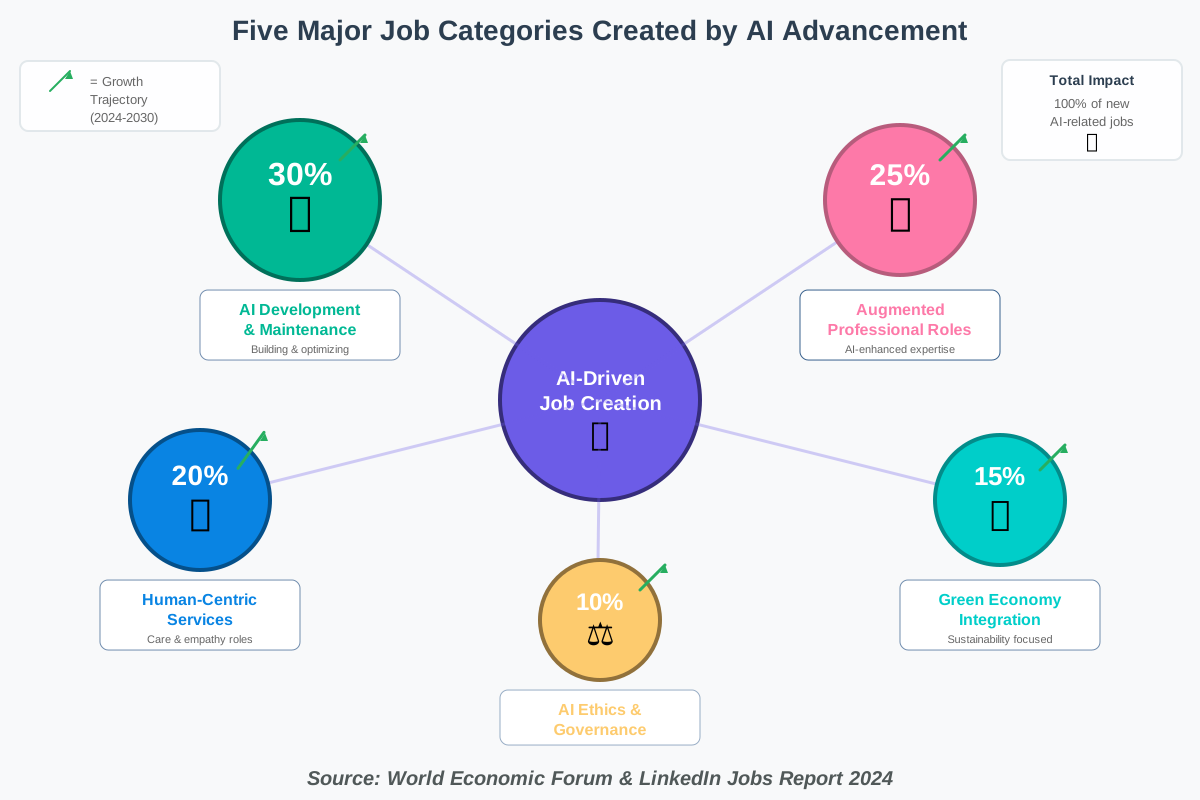
The pattern is clear: as AI handles routine work, human value concentrates in areas requiring judgment, creativity, empathy, ethics, and adaptability.
Real-World Examples of Job Market Transformation
Abstract statistics help, but real examples bring clarity. Let me share what I’ve observed studying AI deployment across industries:
Manufacturing: The BMW Story
BMW’s factories use collaborative robots (cobots) working alongside human assemblers. Rather than replacing workers, cobots handle ergonomically challenging tasks—lifting heavy parts and holding components in precise positions—while humans perform fine assembly requiring judgment and adaptability. The result? Productivity increased 85%, but BMW didn’t reduce headcount. Instead, they retrained workers for quality control, machine programming, and process optimization roles. Workers who adapted report higher job satisfaction and better pay.
Healthcare: Radiologists Augmented, Not Replaced
Five years ago, headlines screamed about AI replacing radiologists. What actually happened? AI systems now detect anomalies in medical images with impressive accuracy, but radiologists use these systems as “second opinions” that catch things human eyes might miss. Their role evolved from pure image analysis to patient consultation, treatment planning, and quality oversight. Demand for radiologists has actually grown because AI enables them to handle higher patient volumes while providing better care.
Retail: Amazon’s Complex Reality
Amazon’s warehouses showcase both displacement and creation. Robots now move products through facilities, reducing demand for pickers walking miles daily. However, Amazon simultaneously created thousands of positions: robot maintenance technicians, inventory algorithm specialists, customer experience designers, and logistics coordinators. The net effect? Fewer entry-level positions, but more mid-skill technical jobs with better pay. The challenge lies in helping displaced workers transition to these new roles.
Financial Services: JPMorgan’s COiN System
JPMorgan Chase deployed an AI program called COiN (Contract Intelligence) that reviews commercial loan agreements—work that consumed 360,000 hours of lawyers’ and loan officers’ time annually. Did they fire lawyers? No. They redirected them to advisory roles, complex negotiations, and relationship management—higher-value work that AI can’t handle. Junior associate positions decreased, but demand for experienced advisors increased.
Creative Industries: The Writer’s Assistant Model
Content creation tools like Jasper AI and Claude don’t replace writers—they function as assistants handling first drafts, research summaries, and structure suggestions. Professional writers I’ve worked with use AI to increase output while focusing on strategic messaging, brand voice refinement, and emotional resonance. Freelance writers who adopted AI tools report earning 30-50% more because they complete projects faster without sacrificing quality.
The pattern across examples? Displacement happens when workers can’t or won’t adapt. Opportunity emerges when people leverage AI as a collaborative tool rather than viewing it as a competitor.
Understanding the Risks: What Could Go Wrong?
Optimism requires honesty about genuine risks. Several scenarios concern me as someone focused on responsible technology:
Unequal Access to Adaptation Resources
Workers in developing nations and lower-income communities often lack access to retraining programs, fast internet, modern computers, and quality education needed to transition to AI-augmented roles. This creates a risk of widening inequality where advantaged workers capture AI benefits while disadvantaged workers bear displacement costs.
The solution involves policy intervention: governments and companies must invest in accessible retraining, not assume market forces alone will solve the problem.
The Skills Gap Widens
AI creates jobs requiring new competencies, but our education systems lag behind. There’s explosive demand for data literacy, AI tool proficiency, and human skills like critical thinking and emotional intelligence—yet traditional education still emphasizes memorization and routine problem-solving that AI handles better than humans.
This mismatch between available jobs and worker skills could leave millions unemployed despite labor shortages in AI-augmented fields. Closing this gap requires reimagining education from K-12 through professional development.
Wage Pressure in Transitioned Roles
When workers from displaced industries flood into remaining human-centric sectors, basic economics suggests wage pressure. If thousands of former truck drivers compete for healthcare aide positions, wages in that sector may stagnate or decline despite growing demand.
Labor market disruptions can take a decade or more to stabilize. During that transition, many workers may experience downward mobility even as aggregate economic statistics improve.
Algorithmic Bias Amplification
AI systems trained on historical data often perpetuate existing biases in hiring, lending, and resource allocation. Automated resume screening might systematically disadvantage women or minorities. Credit algorithms might deny loans to qualified applicants from certain zip codes.
These biases don’t just disadvantage individuals—they restrict economic opportunity, reducing the pool of workers who can adapt to new roles. Addressing algorithmic fairness isn’t just ethical; it’s economically necessary.
Winner-Take-All Dynamics
AI development concentrates in a few large technology companies and wealthy nations. This creates a risk of extreme wealth and power concentration, where AI benefits accrue primarily to shareholders of major tech firms while displaced workers struggle.
Breaking this dynamic requires antitrust enforcement, AI democratization through open-source tools, and policies ensuring broad benefit distribution rather than narrow wealth accumulation.
Mental Health and Identity Impacts
Jobs provide more than income—they offer purpose, social connection, and identity. Rapid displacement can trigger depression, anxiety, and loss of self-worth, especially for workers who built careers around expertise that suddenly becomes obsolete.
The psychological dimension of job displacement deserves more attention. Retraining programs must address not just skills but the emotional reality of career disruption.
Practical Strategies: How to Adapt and Thrive
Understanding risks and opportunities means little without actionable strategies. Here’s what actually helps, based on research and real experiences:
Strategy 1: Develop AI Literacy (But You Don’t Need to Code)
You don’t need to become a programmer, but understanding AI basics provides an enormous advantage. Specifically:
Learn what AI can and can’t do well. Spend a few hours experimenting with ChatGPT, Claude, or other accessible AI tools. See where they excel and where they fail. This intuition helps you identify tasks worth automating versus those where human judgment adds irreplaceable value.
Understand your industry’s AI adoption trajectory. Follow industry publications, attend webinars, and join LinkedIn groups discussing AI in your field. You need visibility into which tasks will automate first so you can position yourself in areas remaining valuable longer.
Experiment with AI tools relevant to your work. If you’re in marketing, try AI design tools. In finance? Explore AI-powered analytics platforms. Hands-on familiarity transforms you from “worker threatened by AI” to “worker leveraging AI,” making you more valuable, not less.
This doesn’t require technical expertise—just curiosity and willingness to experiment. Most AI tools now feature user-friendly interfaces designed for non-technical users.
Strategy 2: Cultivate Distinctly Human Skills
As routine cognitive and physical tasks automate, human competitive advantage shifts toward capabilities AI struggles to replicate:
Emotional intelligence: Develop your ability to read social cues, build relationships, navigate conflict, and provide emotional support. These skills make you invaluable in management, sales, healthcare, education, and client services.
Creative problem-solving: Practice tackling novel challenges without clear procedures. AI excels at applying known solutions to familiar problems but struggles with genuine innovation and adaptive thinking.
Ethical judgment: Complex decisions involving competing values, stakeholder interests, and long-term consequences require human wisdom. Position yourself as someone who navigates these gray areas thoughtfully.
Communication and persuasion: Translating technical information for non-technical audiences, crafting compelling narratives, and persuading diverse stakeholders remain human strengths.
Physical adaptability: If your work involves unpredictable physical environments (construction, repair work, artisan crafts), you have natural protection against automation since robots struggle with unstructured spaces.
These skills transfer across roles and industries, providing career resilience even as specific jobs evolve.
Strategy 3: Embrace Continuous Learning
The half-life of job skills is shrinking. Knowledge that once lasted a career now becomes outdated in five years. Adapting requires learning to become a permanent lifestyle rather than something that ends with formal education.
Micro-credentials and online courses: Platforms like Coursera, edX, and LinkedIn Learning offer targeted, affordable training. A three-month course in data analysis or digital marketing can open new career paths without requiring a new degree.
Learn adjacent skills: If you’re an accountant, learn data visualization and business intelligence. If you’re a nurse, learn healthcare IT and medical informatics. These adjacent skills position you for hybrid roles combining your core expertise with new capabilities.
Teach yourself using AI: Ironically, AI tools like Claude can serve as personal tutors, explaining concepts, generating practice problems, and answering questions as you learn new skills. Take advantage of this free, patient, always-available learning resource.
Join professional communities: Online forums, local meetups, and professional associations keep you connected to evolving best practices and emerging opportunities. These networks often provide job leads and collaboration opportunities.
The key mindset shift? Career growth doesn’t stop when you land a good job—that’s when it begins.
Strategy 4: Position Yourself as a Bridge
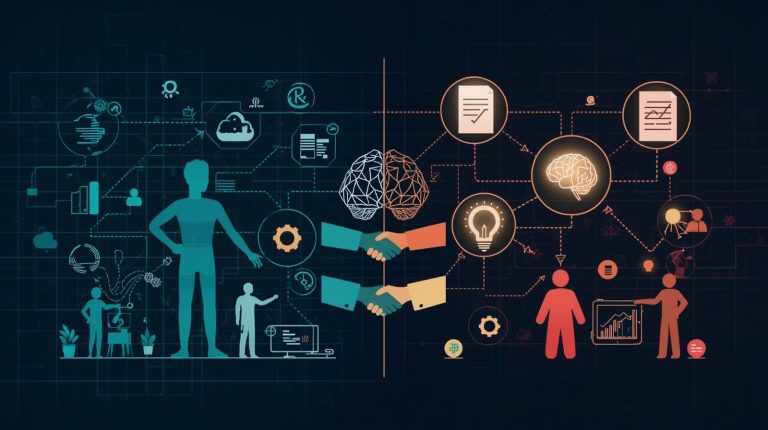
Some of the most valuable workers in AI-augmented workplaces serve as translators between technical and non-technical worlds:
Become the team member who can explain AI capabilities to colleagues. Your employer values workers who help others adapt, not just those who adapt themselves.
Learn enough technical vocabulary to communicate effectively with data teams. You don’t need to write code, but understanding terms like “training data,” “algorithm,” and “machine learning model” lets you participate in strategic discussions.
Identify automation opportunities in your workflow. Rather than waiting for management to impose automation, proactively suggest tasks worth automating, freeing your team for higher-value work. This positions you as a leader rather than a victim of change.
Advocate for responsible AI use. As someone who understands both the work and the technology, you can flag when automation might harm quality, customer relationships, or ethical standards. This protective role becomes increasingly valuable.
Bridge roles—people who connect domains—are consistently among the last to automate because they require broad contextual understanding that AI lacks.
Strategy 5: Consider Adjacent or Growing Industries
If your current industry faces significant disruption, research sectors with strong growth trajectories:
Healthcare and eldercare: Aging populations drive massive demand for hands-on care workers, therapists, and specialized medical professionals. Many positions offer on-the-job training or relatively short certification programs.
Green energy and sustainability: The transition away from fossil fuels creates millions of jobs in solar installation, wind turbine maintenance, energy efficiency consulting, and environmental remediation.
Education and training: As others need to reskill, demand grows for instructors, curriculum designers, and learning experience specialists across corporate, nonprofit, and educational settings.
Skilled trades: Electricians, plumbers, HVAC technicians, and construction workers remain in high demand. These roles combine physical and cognitive skills in unpredictable environments that resist automation.
Switching industries feels daunting, but transferable skills often apply more broadly than we realize. Your problem-solving abilities, work ethic, customer service experience, and interpersonal skills translate across sectors.
Strategy 6: Build a Financial Buffer
Practical adaptation requires economic security to take risks:
Emergency fund: Aim for 3-6 months of expenses saved. This buffer provides breathing room to retrain, search for better opportunities, or weather temporary unemployment without desperation.
Reduce financial rigidity: High fixed costs (large mortgage, expensive car payments) limit your ability to adapt. Building flexibility into your lifestyle provides options during career transitions.
Side income streams: Freelancing, consulting, or small business ventures diversify your income sources. If your primary job disappears, alternative income streams soften the blow and might become your new primary career.
Invest in yourself: Spending money on courses, certifications, or professional development isn’t an expense—it’s insurance against obsolescence.
Financial preparation is unsexy compared to learning AI, but it’s often the difference between successfully navigating transition versus struggling through it.
Strategy 7: Advocate for Systemic Support
Individual adaptation is essential, but systemic challenges require collective solutions:
Support policies for retraining and education. Advocate for publicly funded job training programs, tuition assistance, and portable benefits not tied to specific employers.
Push for stronger social safety nets. Unemployment insurance, healthcare access, and income support programs help people weather transitions without devastation.
Demand corporate responsibility. Companies deploying automation should invest in retraining displaced workers, not simply extracting efficiency gains while externalizing human costs.
Engage in community planning. Local governments need input on how AI affects their regions. Participate in civic discussions about economic development and workforce planning.
Individual strategies work better when embedded in supportive systems. We need both personal adaptation and policy solutions.
Frequently Asked Questions About AI and Job Displacement
Taking Action: Your Next Steps
Understanding AI’s Impact on Job Displacement is crucial, but knowledge without action provides little protection. Here’s what to do starting today:
This Week:
- Spend two hours experimenting with an AI tool (ChatGPT, Claude, or industry-specific AI). Notice what it does well and where it struggles.
- Research how AI is being deployed in your industry. Read three recent articles or watch industry webinars.
- Identify three core tasks in your current role that you believe AI could automate in the next 3-5 years.
This Month:
- Enroll in one online course developing either AI literacy or a complementary skill for your field.
- Update your resume to emphasize judgment, creativity, and interpersonal capabilities—not just technical task completion.
- Join a professional community or online forum where people discuss AI adoption in your industry.
- Have a conversation with your manager about how the company is thinking about AI and how you can contribute to implementation.
This Quarter:
- Complete a significant skill-building project—either learning an AI tool deeply or developing an adjacent capability.
- Identify two or three backup career paths you could pivot toward if your primary industry faces serious disruption.
- Build or expand your professional network, particularly connecting with people working in AI-augmented roles.
- Create a financial buffer if you don’t have one—even starting with $500 provides more options than nothing.
This Year:
- Achieve intermediate proficiency in at least one AI-relevant skill for your field.
- Position yourself as a bridge person in your organization—someone who helps others adapt.
- Explore at least one potential career pivot through informational interviews or project volunteering.
- Evaluate whether your current employer takes workforce adaptation seriously. If not, consider moving to an organization investing in employee development.
The future of work isn’t predetermined. Yes, AI and automation will transform employment, displacing some roles while creating others. But within that broad trend, your specific outcome depends largely on choices you make now. Informed preparation beats anxious avoidance.
Final Thoughts: Embracing Responsible Adaptation
I’ve spent years helping people navigate technological change ethically and safely. Here’s what I’ve learned: the workers who thrive aren’t necessarily the most technically skilled or naturally talented. They’re the ones who stay curious, embrace learning, seek collaboration over competition, and view change as an opportunity rather than a threat.
AI’s Impact on Job Displacement is real and significant, but it’s not destiny. History shows that technological revolutions create more prosperity and opportunity than they destroy—but not automatically and not equally. The benefits go to individuals, communities, and nations that adapt proactively rather than reactively.
Your adaptation matters not just for your own career but for society’s broader response. Every worker who successfully transitions weakens the narrative that AI inevitably harms employment. Every person who uses AI responsibly demonstrates that technology can enhance human capability rather than replace it. Every community that supports its workers through change proves that disruption doesn’t require devastation.
The path forward requires courage, honesty, and action. Start today, stay persistent, and remember: you’re not alone in this transition. Millions of workers worldwide are navigating the same challenges, and together we’re shaping what the AI-augmented workplace becomes.
Your future is not something happening to you—it’s something you’re creating through the choices you make now.
References:
McKinsey Global Institute, “Jobs Lost, Jobs Gained: Workforce Transitions in a Time of Automation” (2021)
World Economic Forum, “Future of Jobs Report 2023”
MIT Work of the Future Task Force, “The Work of the Future: Building Better Jobs in an Age of Intelligent Machines” (2020)
Brookings Institution, “Automation and Artificial Intelligence: How Machines Are Affecting People and Places” (2019)
PwC, “Will Robots Really Steal Our Jobs? An International Analysis of the Potential Long-term Impact of Automation” (2018)
Harvard Business Review, “Collaborative Intelligence: Humans and AI Are Joining Forces” (2018)
Oxford Martin School, “The Future of Employment: How Susceptible Are Jobs to Computerization?” (2013)
About the Author
Nadia Chen is an expert in AI ethics and digital safety, dedicated to helping everyday people navigate technological change responsibly. With a background in technology policy and years of experience guiding workers through digital transitions, Nadia specializes in making complex AI topics accessible to non-technical audiences. She believes that understanding AI’s true impact—both risks and opportunities—empowers individuals to make informed decisions about their careers and futures. Through clear, trustworthy guidance, Nadia helps readers adapt to technological change while maintaining their values and protecting their interests. Her work focuses on the human side of AI adoption, ensuring that technology serves people rather than displacing them.
When not writing about AI and the future of work, Nadia advises organizations on responsible AI deployment and speaks at conferences about building human-centered technology policies. She holds degrees in computer science and public policy and has worked with both Fortune 500 companies and nonprofit organizations to create more equitable technological futures.
You can connect with Nadia through howAIdo.com, where she continues to explore practical strategies for thriving in our AI-augmented world.