AI for Language Learning: Top Apps Compared

AI for Language Learning has transformed how millions of people worldwide acquire new language skills, offering unprecedented access to personalized instruction, real-time feedback, and conversation practice that was once only available through expensive tutors. As someone deeply committed to helping people use AI tools safely and effectively, I’ve spent considerable time testing these platforms to understand not just what they promise but how they actually perform—and crucially, what safety considerations you need to keep in mind.
The global online language learning market reached $21.06 billion in 2025 and continues expanding rapidly, driven primarily by AI innovations that make language acquisition more accessible and effective than ever before. But with so many options available, how do you choose the right platform while protecting your privacy and ensuring responsible use? This comprehensive comparison will help you navigate the landscape of AI language learning apps, understand their strengths and limitations, and make informed decisions about which tools deserve your time and trust.
Understanding AI-Powered Language Learning
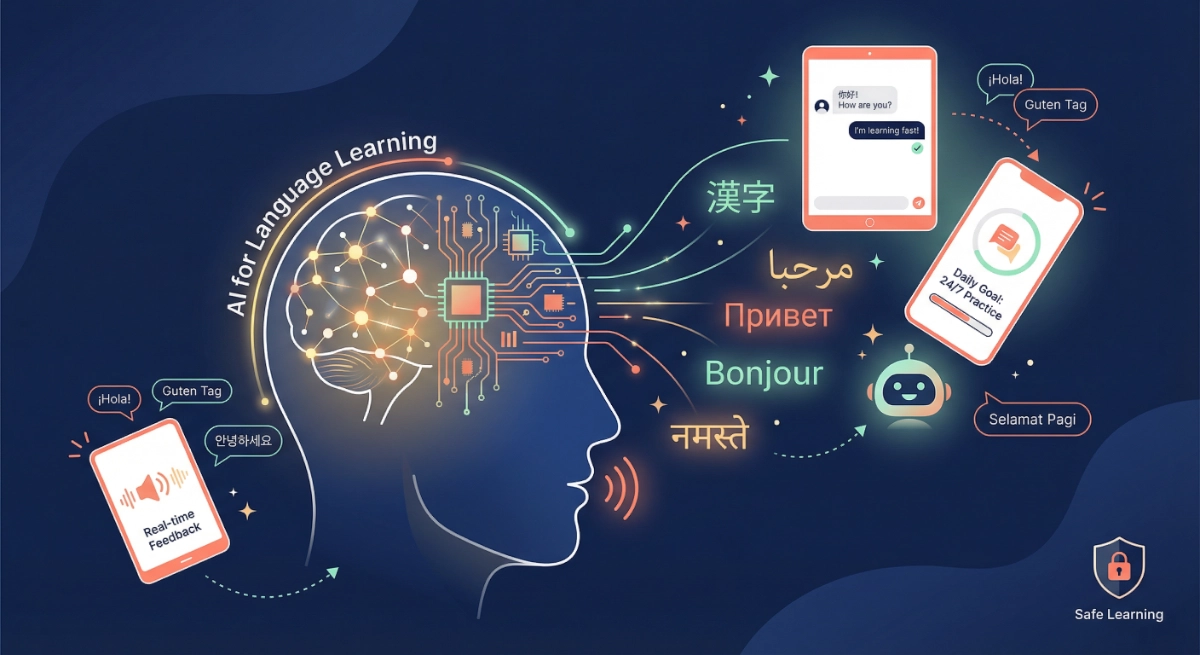
Traditional language learning relied heavily on textbooks, classroom instruction, and the occasional language exchange partner. AI for Language Learning fundamentally changes this equation by providing
24/7 access to conversation practice, instant pronunciation feedback, and adaptive lessons that adjust to your specific skill level and learning pace. These platforms use advanced technologies, including natural language processing, speech recognition, and machine learning, to create personalized learning experiences.
Research consistently demonstrates the effectiveness of these tools. A 2025 meta-analysis examining 31 studies found that chatbots have a medium effect on second language learning outcomes, with an effect size of g = 0.608. Notably, AI-powered chatbots that incorporate generative AI technology and support voice input showed significantly larger effect sizes on language learning compared to rule-based systems.
However, it’s essential to understand that AI language learning tools work best as part of a comprehensive learning strategy, not as complete replacements for human interaction. While these platforms excel at providing structured practice, pronunciation guidance, and grammar feedback, achieving true fluency still requires real conversations with native speakers and cultural immersion.
Top AI Language Learning Platforms Compared
Duolingo Max: Gamification Meets Advanced AI
Duolingo has dominated the language learning landscape for years, and with Duolingo Max—launched in 2023 and continuously expanded through 2025—the platform leverages GPT-4 technology to offer significantly enhanced AI features.
- Free tier available (with ads and limited features)
- Super Duolingo: $6.99/month or $84/year
- Duolingo Max: $29.99/month or $167.99/year for individual plans; $240/year for family plans (up to 6 users)
- Video Call practice with Lily, an AI character, for face-to-face conversation practice
- Roleplay scenarios covering real-world situations like ordering food, booking hotels, or casual conversations
- Explain My Answer feature, which provides detailed explanations of grammar rules and mistakes
- Adventures mode offering simulation-style immersive scenarios
- Highly gamified interface keeps learners motivated through streaks, leaderboards, and achievements
- Large user community provides social motivation
- AI conversations feel surprisingly natural with GPT-4 integration
- Excellent for building consistent daily habits
- Free tier offers substantial value for beginners
- Premium Max tier is relatively expensive at $30/month
- AI features not available for all language courses yet
- Can feel repetitive for advanced learners
- Limited focus on deep grammar explanations until Max tier
- Some users report AI occasionally missing pronunciation errors
Languages Supported: 40+ languages, though AI features are currently available primarily for English speakers learning Spanish, French, German, Italian, and Portuguese
Best For: Beginners and intermediate learners who thrive on gamification and need motivation to practice daily. The platform works particularly well for building vocabulary and basic conversation skills.
Safety Considerations: Duolingo collects extensive usage data to personalize lessons. Review privacy settings carefully, particularly if children are using the platform. The app is generally safe for young learners, but parents should monitor screen time and ensure balanced learning approaches.
Babbel: Structured Learning with AI Enhancement
Babbel takes a more traditional, curriculum-based approach enhanced with AI technology, focusing on practical conversation skills developed by over 150 linguists and language experts.
- 3-month subscription: $15/month
- 6-month subscription: $13/month
- 12-month subscription: $8/month
- Lifetime subscription: $299 (occasional promotions)
- Babbel Live (with live classes): $99-149/month
- AI-Enhanced Speech Recognition providing improved pronunciation feedback
- AI Conversation Partner for practicing real-time dialogues
- Everyday Conversations feature for realistic social scenarios
- Personalized review sessions based on your mistakes
- Expert-created content ensures high educational quality
- Strong focus on practical, real-world vocabulary
- Grammar explanations integrated naturally into lessons
- 20-day money-back guarantee provides risk-free trial
- Cultural context woven throughout lessons
- More affordable than competitors for annual subscriptions
- AI features less advanced than Duolingo Max or newer platforms
- Speech recognition limited compared to specialized conversational apps
- Less helpful for advanced learners beyond intermediate level
- No live tutors in basic subscription (requires Babbel Live upgrade)
- Interface less engaging than gamified competitors
Languages Supported: 14 languages including Spanish, French, German, Italian, Portuguese, Dutch, Swedish, Turkish, Russian, Polish, Indonesian, Norwegian, Danish, and English
Best For: Learners who prefer structured, curriculum-based education with clear progression paths. Excellent for those who want expert-designed content and practical conversation skills without overwhelming gamification.
Safety Considerations: Babbel maintains ISO 27001 certification for data security, making it particularly suitable for corporate training programs. The platform collects learning data for personalization but offers transparent privacy policies and data management options.
Langua: Conversation-First AI Learning
Langua represents a newer generation of AI-first language learning tools, built specifically around conversational practice with highly realistic AI tutors.
- Free account available for exploration
- Premium plans: Approximately $10-15/month (monthly or annual subscriptions available)
- 30-day money-back guarantee
- Human-like conversations with AI tutors using cloned voices from native speakers
- Multiple feedback methods: written corrections with explanations, verbal corrections, and detailed post-conversation reports
- Vocabulary integration: AI intelligently incorporates your saved words into future conversations
- Translation support: Speak in your native language when stuck, and AI understands
- Dialect selection for most languages
- Most realistic conversational AI experience available
- Excellent for overcoming speaking anxiety in a judgment-free environment
- Flexible conversation topics tailored to interests
- Natural voice quality superior to many competitors
- Strong focus on practical speaking skills
- AI may occasionally miss corrections (common across all AI platforms)
- Can be challenging for absolute beginners
- Limited structured curriculum compared to traditional apps
- Smaller language selection than comprehensive platforms
- Newer platform with smaller user community
Languages Supported: 23 officially launched languages, including all major ones (Spanish, French, English, German, Italian, Japanese, Chinese)
Best For: Intermediate and advanced learners who need extensive conversation practice and want to build confidence before speaking with native speakers. Excellent for those who struggle with speaking anxiety.
Safety Considerations: Langua’s conversation-focused approach means extensive voice data collection. Ensure you’re comfortable with voice data storage policies. The platform is transparent about AI limitations and doesn’t claim perfection—an honest approach I appreciate from a safety perspective.
TalkPal: AI Roleplay and Debate Practice
TalkPal leverages advanced natural language processing to offer diverse conversational practice modes, including unique debate features for critical thinking development.
- Free tier available
- Premium: $8-15/month depending on subscription length
- AI-powered conversations with personalized responses based on language level
- Roleplay scenarios for immersive practice in various real-life situations
- Debate mode to enhance language skills through argumentative discussions
- Photo mode for describing images and receiving real-time feedback
- Advanced speech recognition analyzing pronunciation with instant feedback
- Widest language selection among major platforms
- Unique debate feature develops critical thinking alongside language skills
- Photo description mode effectively builds vocabulary in context
- Affordable pricing compared to premium tiers of competitors
- Flexible conversation topics and scenarios
- Interface less polished than established platforms
- AI sometimes struggles with complex grammatical explanations
- Smaller content library for less common languages
- Limited structured curriculum for beginners
- Customer support response times can be slow
Languages Supported: 57+ languages
Best For: Adventurous learners who want to explore less common languages and those interested in developing argumentation skills in their target language. Good for intermediate learners seeking diverse practice methods.
Safety Considerations: As a smaller platform, verify TalkPal’s data handling practices carefully. The extensive language support is impressive, but always check privacy policies for specific details on voice data retention and usage.
Speak: Voice-First AI Tutoring
Speak differentiates itself through an AI tutor called “Speak Tutor” that creates deeply personalized learning paths and focuses intensively on speaking practice.
- 7-day free trial
- Premium: Approximately $15-20/month
- Speak Tutor: Personal AI language coach available 24/7
- Personalized curriculum that adapts based on deep understanding of your motivations and goals
- Free-talking mode allowing open-ended conversations on any topic
- Detailed feedback explaining why expressions are awkward, not just corrections
- Ensures mastery before progression
- Most personalized curriculum among AI platforms
- Exceptional focus on ensuring concept mastery
- Detailed explanations of “why” behind mistakes
- Free-talking feels natural and less structured
- Strong accountability features to maintain motivation
- Higher price point than some competitors
- Limited language selection currently
- May feel too speaking-focused for learners who also need reading/writing practice
- Newer platform with fewer proven outcomes
- Some users report occasional AI misunderstandings in free-talk mode
Languages Currently Available: Primarily English, Spanish, French, German, Japanese, Korean (expanding)
Best For: Learners who struggle with speaking confidence and need intensive conversational practice with detailed feedback. Excellent for those who have tried other methods unsuccessfully.
Safety Considerations: Speak’s deep personalization requires extensive data collection about your learning patterns and motivations. While this enables powerful customization, review what personal information you’re comfortable sharing during onboarding.
Memrise: Native Speaker Videos with AI Integration
Memrise combines authentic video content from native speakers with AI-powered features, particularly through its MemBot chatbot.
- Free tier available
- Premium: Approximately $9-15/month
- MemBot: AI language partner powered by GPT-3
- Stress-free practice environment with no corrections during conversations
- AI intelligently weaves saved vocabulary into future conversations
- Native language support when stuck
- Authentic native speaker videos provide cultural context
- MemBot responds accurately and realistically
- Attention to detail in written corrections
- Unlimited chat time in premium version
- Strong vocabulary building through spaced repetition
- Video content quality varies by language
- Less comprehensive grammar instruction
- AI features less advanced than GPT-4-powered competitors
- Interface can feel cluttered
- Limited structured progression path
Languages Supported: 20+ languages
Best For: Visual and auditory learners who benefit from seeing and hearing native speakers in authentic contexts. Good for building cultural understanding alongside language skills.
Safety Considerations: Memrise’s video content featuring real people is generally appropriate, but parental guidance is recommended for younger learners to ensure content alignment with family values. Standard data collection for personalization applies.
Privacy and Safety Best Practices
As someone focused on AI ethics and digital safety, I want to emphasize critical considerations when using AI language learning platforms:
1. Understand Data Collection
All AI language learning apps collect extensive data about your learning patterns, voice recordings, and usage habits. This data fuels the AI’s personalization capabilities. Before selecting a platform:
- Read privacy policies carefully, particularly sections on voice data storage
- Check how long your data is retained
- Understand whether your data trains AI models
- Verify if data is shared with third parties
- Look for platforms with ISO 27001 or similar certifications
2. Protect Children’s Privacy
If children are using these platforms:
- Use parental controls and monitoring features
- Review age-appropriate content settings
- Limit personal information shared during account creation
- Monitor conversation topics in AI chat features
- Set screen time boundaries to ensure balanced learning
3. Manage Voice Data Carefully
Voice-based AI features require recording and analyzing your speech:
- Use platforms with clear voice data policies
- Consider using headphones in public spaces for privacy
- Delete old recordings if platforms offer this option
- Be aware that voice data may be more identifying than text
4. Avoid Over-Reliance on AI
While AI tools are powerful, remember:
- They cannot fully replace human interaction for fluency
- AI may miss cultural nuances or context-specific language use
- Pronunciation feedback, while helpful, isn’t always perfectly accurate
- Real conversations introduce unexpected elements AI cannot fully simulate
5. Verify Information Accuracy
AI-generated content can occasionally be incorrect:
- Cross-reference grammar explanations with trusted resources
- Use multiple platforms to verify new concepts
- Consult native speakers for confirmation when possible
- Report obvious AI errors to platform developers
Effectiveness: What Research Tells Us
Multiple studies validate the effectiveness of AI for Language Learning:
A comprehensive 2025 systematic review examining chatbot-assisted language learning found students in AI-supported environments demonstrated higher confidence in language proficiency, increased willingness to communicate, greater enjoyment during learning, and stronger motivation compared to traditional methods.
Another 2025 meta-analysis showed AI-enabled assessment tools in language education achieved a medium overall effect size (Hedges’s g = 0.390, p < 0.001) for enhancing students’ language learning outcomes. The study emphasized that effectiveness depends on proper implementation design and integration.
Research on AI-driven language learning in higher education revealed that corrective AI-powered feedback (grammar and vocabulary corrections) combined with motivational feedback (encouragement and progress tracking) significantly improved learners’ self-reflection, creativity, anxiety reduction, and emotional resilience.
Pricing Comparison Summary
| Platform | Entry Level | Mid-Tier | Premium | Best Value |
|---|---|---|---|---|
| Duolingo | Free (ads) | $6.99/month | $29.99/month (Max) | $167.99/year (Max) |
| Babbel | No free tier | $8/month (annual) | $149/month (Live) | $8/month annual |
| Langua | Free trial | $10-15/month | N/A | Annual discount available |
| TalkPal | Free tier | $8-15/month | N/A | Varies by plan |
| Speak | 7-day trial | $15-20/month | N/A | Check for promotions |
| Memrise | Free tier | $9-15/month | N/A | Annual discount |
Making Your Decision: Which Platform is Right for You?
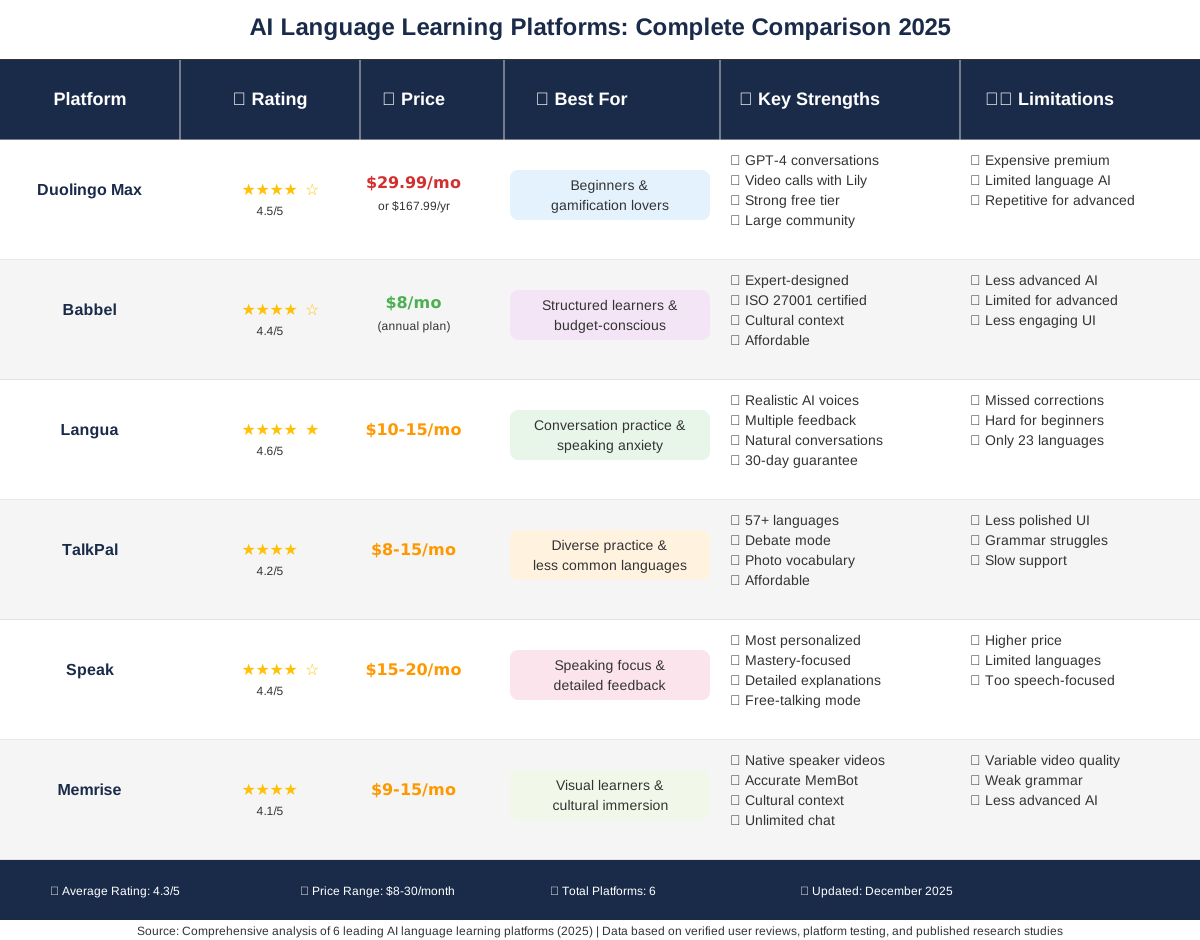
Choose Duolingo Max if you:
- Need gamification to stay motivated
- Want the most comprehensive free option with upgrade path
- Prefer working with recognizable characters
- Learn best with daily streaks and competition
- Are comfortable with a higher price for premium AI features
Choose Babbel if you:
- Prefer expert-designed, structured curriculum
- Want strong grammar foundations
- Value practical, real-world conversation focus
- Need budget-friendly annual options
- Prefer traditional learning approaches enhanced with AI
Choose Langua if you:
- Prioritize conversation practice above all else
- Experience speaking anxiety
- Want the most realistic AI conversations
- Are at intermediate level or above
- Need dialect-specific practice
Choose TalkPal if you:
- Want to learn less common languages
- Enjoy debate and critical thinking exercises
- Like diverse practice modalities
- Seek affordable pricing
- Want flexibility in conversation topics
Choose Speak if you:
- Need intensive speaking focus
- Want deeply personalized learning paths
- Struggled with other methods
- Value detailed explanations of mistakes
- Can invest in premium pricing for specialized support
Choose Memrise if you:
- Learn best from native speaker videos
- Want cultural immersion alongside language
- Prefer visual and auditory learning
- Like spaced repetition for vocabulary
- Want balance between content and AI features
Final Recommendations
After extensive testing and research, here’s my assessment:
For Beginners: Start with Duolingo’s free tier or Babbel’s structured approach. Both provide solid foundations without overwhelming you, and you can upgrade as you progress.
For Intermediate Learners: Consider Langua or TalkPal to focus on conversation skills. Combine with Babbel or Duolingo for continued grammar reinforcement.
For Advanced Learners: Langua and Speak offer the sophisticated conversation practice you need. Supplement with native content (podcasts, videos) and real conversation partners.
For Budget-Conscious Learners: Babbel’s annual plan at $8/month offers excellent value, or maximize Duolingo’s free tier before committing to paid options.
For Safety-Focused Learners: Babbel with ISO 27001 certification provides strong data protection, particularly important for corporate or institutional use.
Essential Tips for Safe and Effective AI Language Learning
- Start with clear goals: Define whether you’re learning for travel, business, cultural connection, or personal enrichment. This guides platform selection and feature prioritization.
- Combine multiple approaches: Use AI tools for daily practice, but supplement with native speaker conversations, media consumption, and cultural immersion when possible.
- Practice consistently: 15-20 minutes daily outperforms sporadic longer sessions. AI platforms excel at facilitating this consistency.
- Review privacy settings regularly: As platforms update features, data collection practices may change. Periodic review ensures ongoing alignment with your comfort level.
- Don’t skip speaking practice: Many learners avoid voice features due to self-consciousness. Push through this discomfort—AI provides the safest environment for overcoming speaking anxiety.
- Track progress authentically: Don’t let gamification metrics become the sole measure of learning. Periodically test yourself through real conversations or independent assessment.
- Report AI errors: Help improve platforms by reporting obvious mistakes or inappropriate responses. Responsible AI development depends on user feedback.
- Balance screen time: Particularly for younger learners, ensure AI language practice doesn’t dominate learning time at the expense of real interaction and other activities.
Frequently Asked Questions About AI Language Learning
The Future of AI Language Learning
The language learning market continues evolving rapidly. By 2030, the global market is projected to reach between $44.38 billion and $54.83 billion, with AI-powered features driving much of this growth. We can expect:
- More immersive technologies: VR and AR integration will create even more realistic practice environments
- Enhanced personalization: AI will better understand individual learning styles and cognitive patterns
- Improved accent and dialect handling: More nuanced recognition of regional language variations
- Better cultural context integration: AI will move beyond grammar and vocabulary to teach cultural appropriateness
- Multimodal learning experiences: Seamless integration of reading, writing, listening, and speaking practice
Conclusion: Your Language Learning Journey Starts Here
AI for Language Learning has democratized access to high-quality language education, making it possible for anyone with a smartphone to receive personalized instruction that adapts to their needs. Whether you choose Duolingo’s gamified approach, Babbel’s structured curriculum, Langua’s conversation focus, or any of the excellent alternatives available, the most important factor is consistent practice combined with responsible, safe use.
Remember that AI tools are powerful accelerators, not magic solutions. True language mastery still requires dedication, regular practice, cultural immersion, and real human connection. By selecting the right platform for your learning style, protecting your privacy, and maintaining realistic expectations, you can harness AI’s transformative potential while developing genuine fluency in your target language.
Start your journey today, but approach it thoughtfully. Review privacy policies, try free trials before committing, and most importantly, enjoy the process of discovering new ways to connect with people and cultures around the world. Language learning opens doors—let AI help you find the key while you take responsibility for turning the doorknob safely and effectively.
References
- Chen, Y., et al. (2025). “A systematic review and meta-analysis of AI-enabled assessment in language learning.” Journal of Computer Assisted Learning. https://onlinelibrary.wiley.com/doi/10.1111/jcal.13064
- Lyu, et al. (2025). “Effectiveness of Chatbots in Improving Language Learning: A Meta-Analysis of Comparative Studies.” International Journal of Applied Linguistics. https://onlinelibrary.wiley.com/doi/full/10.1111/ijal.12668
- Mordor Intelligence. (2025). “Online Language Learning Market Size, Growth, Share & Industry Report 2030.” https://www.mordorintelligence.com/industry-reports/online-language-learning-market
- Grand View Research. (2025). “Online Language Learning Market Size | Industry Report 2030.” https://www.grandviewresearch.com/industry-analysis/online-language-learning-market-report
About the Author
Nadia Chen is an expert in AI ethics and digital safety with over a decade of experience helping individuals and organizations navigate emerging technologies responsibly. She specializes in evaluating AI-powered educational tools through the dual lenses of effectiveness and user protection. Nadia holds certifications in data privacy and digital security and regularly speaks at conferences about safe AI adoption. Her mission is empowering people to leverage AI’s benefits while maintaining control over their digital footprint and personal information. When not analyzing AI platforms, Nadia enjoys practicing the six languages she’s learned using various tools—always with privacy settings carefully configured.