
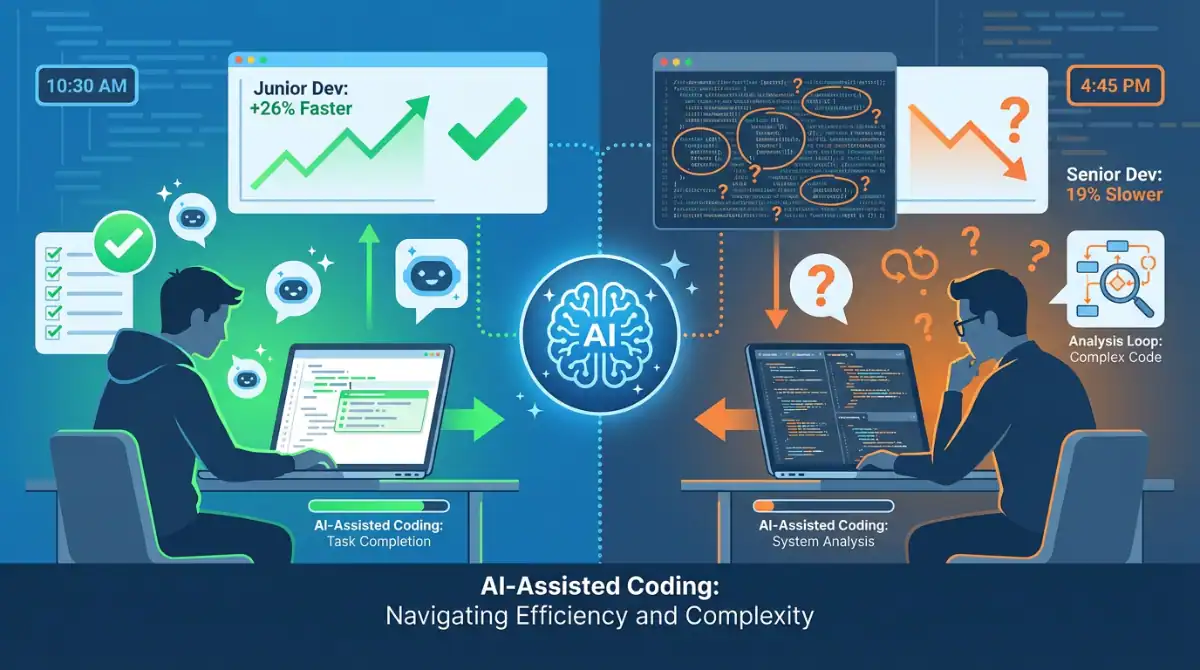
AI Code Generation Shows Mixed Results
Gen AI boosts productivity dramatically for some software developers while slowing others down—and the difference comes down to experience level, according to multiple studies released in early 2026. With close to one-third of code now AI-generated at companies like Microsoft and Google (ℹ️ TechCrunch), understanding who benefits most from these tools has become critical for the tech industry.
Key Findings
- Junior developers using AI coding tools complete tasks 26% faster on average
- Experienced developers working with AI take 19% longer on familiar codebases
- Microsoft and Google report that 30% of their code is now AI-generated
- Developers’ self-perception about AI productivity often contradicts actual performance data
Background
Generative AI coding assistants like GitHub Copilot, Cursor, and Claude have exploded in popularity since 2023. According to Stack Overflow’s 2025 Developer Survey, 65% of developers now use these tools at least weekly (ℹ️ MIT Technology Review).
The technology works by suggesting code completions, generating entire functions from natural language descriptions, and even debugging existing code. Major tech companies have invested heavily in these capabilities—both Microsoft CEO Satya Nadella and Google CEO Sundar Pichai confirmed in 2025 that approximately 30% of their companies’ code is now AI-generated (ℹ️ Entrepreneur).
What Happened
Multiple research studies published in 2025 and early 2026 reveal a surprising pattern: Gen AI boosts productivity most dramatically for less experienced developers, while slowing down senior developers in certain contexts.
A study analyzing nearly 5,000 developers across Microsoft, Accenture, and a Fortune 100 company found that those using GitHub Copilot saw a 26% productivity boost overall. Crucially, junior developers experienced the largest gains, with some seeing their output nearly double.
However, a randomized controlled trial conducted by METR, which involved 16 experienced open-source developers, revealed a different outcome. When working on their own familiar repositories, developers using AI tools took 19% longer to complete tasks compared to working without AI (ℹ️ METR). Even more surprisingly, these developers believed AI had sped them up by 20%—completely misperceiving the actual impact.
McKinsey research found that AI coding tools delivered speed gains ranging from 50% for documentation tasks to 65% for code refactoring but noted that quality maintenance required active developer iteration with the tools (ℹ️ McKinsey).
Why It Matters
These findings have major implications for how companies should deploy AI productivity tools and manage their development teams.
First, the skill gap is narrowing. Junior developers using AI can now approach the output of mid-level developers, potentially accelerating onboarding and reducing training costs. This democratization of coding capability could reshape hiring practices across the industry.
Second, the 19% slowdown for experienced developers on familiar code suggests that AI tools aren’t universally beneficial. According to MIT Sloan research, less experienced developers showed higher adoption rates and greater productivity gains because they relied more on AI suggestions, while senior developers spent time evaluating and correcting AI outputs (ℹ️ MIT Sloan).
Third, developers spend only 20–40% of their time actually writing code (ℹ️ MIT Technology Review). The rest involves problem analysis, customer feedback, and strategy. This means even significant coding speedups may translate to modest overall efficiency gains unless AI is applied across all development activities.
What’s Next
Industry leaders are already adjusting their strategies based on these insights. Salesforce paused engineering hires in 2025 after reporting 30% productivity gains from AI.
Meta CEO Mark Zuckerberg predicted that within 12-18 months, most code for internal AI efforts would be AI-generated, with agents capable of running tests and improving code quality (ℹ️ The Outpost).
Companies are implementing structured approaches, including targeted training for prompt engineering, establishing clear guidelines for AI tool usage, and developing metrics to properly measure productivity beyond simple line counts. Organizations are also creating hybrid workflows where AI handles boilerplate and repetitive tasks while human developers focus on architecture and complex problem-solving.
The research suggests that maximizing AI-driven productivity gains requires matching tool deployment to developer experience levels and task types, rather than assuming universal benefit.
Source: Multiple authoritative sources—Published on January 31, 2026
Original sources: TechCrunch, MIT Technology Review, METR, MIT Sloan, McKinsey
About the Author
This article was written by James Carter, a productivity coach who helps professionals leverage AI tools to boost efficiency and save time. James specializes in practical, actionable strategies for integrating emerging technologies into daily workflows without requiring deep technical expertise.