
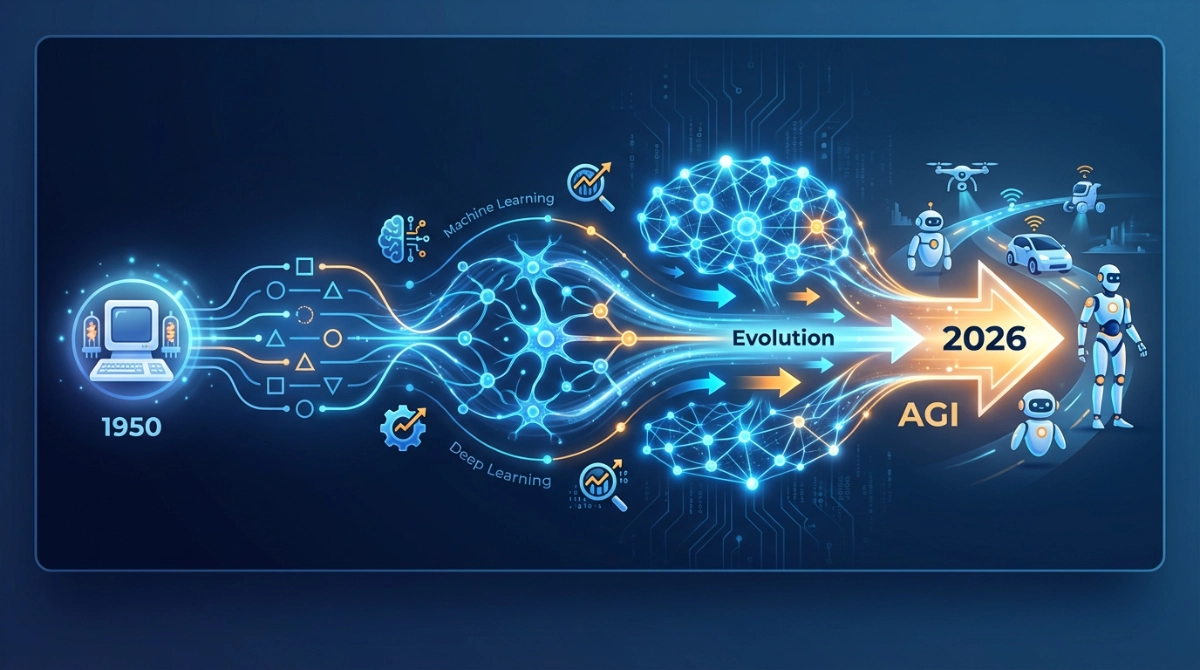
AI Evolution Reaches Critical Turning Point in 2026
Key Points
- Evolution of Artificial Intelligence has accelerated dramatically, with 2026 emerging as a predicted turning point for Artificial General Intelligence (AGI)
- Leading experts, including Elon Musk forecast AGI achievement by 2026, with AI surpassing collective human intelligence by 2030
- Experts predict a 50% increase in adoption and user acceptance for organizations implementing AI transparency and security measures.
- Educational institutions worldwide are integrating AI fundamentals into curricula, from kindergarten through university levels
- African nations, particularly Ghana, are establishing comprehensive AI strategies to position themselves as regional technology leaders
Background
The Evolution of Artificial Intelligence traces back to Alan Turing’s groundbreaking 1950 paper “Computing Machinery and Intelligence,” which questioned whether machines could manifest human intelligence (ℹ️ Swiss Cyber Institute). The formal birth of AI as an academic field occurred at the 1956 Dartmouth Conference, where John McCarthy coined the term “artificial intelligence.”
Throughout its history, AI has experienced cycles of advancement and setbacks, including “AI winters” of reduced funding and interest. However, the field has witnessed unprecedented acceleration in recent years, driven by improved computational power, massive datasets, and algorithmic breakthroughs.
What Happened
Industry leaders are now predicting that 2026 represents a fundamental inflection point in AI development. According to recent analysis, we are entering what experts call the “technological singularity”—a threshold where AI comprehensively surpasses human intelligence and gains capacity for self-evolution and exponential improvement (ℹ️ TradingKey).
Research published in January 2026 shows that Artificial Intelligence systems have changed from being tools that need human instructions to becoming independent systems that can plan, carry out, and improve tasks on their own. This shift represents a fundamental change in how humans interact with AI—moving from conversational interfaces to delegative relationships where users assign goals rather than ask questions (ℹ️ Jakob Nielsen).
The Beijing Academy of Artificial Intelligence recently released its “Top Ten AI Technology Trends for 2026” report, highlighting that AI systems are now beginning to possess the ability to understand and model the real physical world through World Models and Next-State Prediction technologies.
Global Implementation
Nations worldwide are recognizing the strategic importance of understanding AI fundamentals. Ghana’s National Artificial Intelligence Strategy (2023–2033) exemplifies how developing countries are positioning themselves for the AI-driven future (ℹ️ Digital Watch Observatory). The strategy, developed with support from Smart Africa and GIZ FAIR Forward, aims to transform Ghana into an AI-powered society by 2033.
Educational initiatives are expanding rapidly. Recent research published in January 2026 looks at how African countries are including Generative AI education in schools, focusing not just on technical skills but also on ethics, culture, and teaching methods. (ℹ️ Springer Nature)
Why It Matters
The Evolution of AI fundamentals is reshaping every sector of society. Organizations that operationalize AI transparency, trust, and security are projected to achieve a 50% improvement in adoption rates, business goals, and user acceptance by 2026, according to Gartner research (ℹ️ TechTarget).
This transformation extends beyond corporate applications. AI is becoming integral to healthcare diagnostics, financial services, autonomous transportation, cybersecurity, and educational systems. The technology’s ability to analyze vast datasets, recognize patterns, and make predictions is democratizing access to sophisticated capabilities previously available only to large institutions.
However, the rapid advancement also raises critical concerns about safety, privacy, and ethical use. As Dr. Ayaz Karimov, AI expert at the Swiss Cyber Institute, emphasizes, “People need to understand what AI can and can’t do in their specific context, including when to verify outputs and what data should never be shared.”
What’s Next
The coming year will determine whether ambitious AGI predictions materialize. Industry observers note that while progress has been remarkable, achieving true Artificial General Intelligence—systems with flexible learning and thinking capabilities matching human intelligence—remains uncertain.
Educational institutions are prioritizing AI literacy as a fundamental twenty-first-century competency. The focus is shifting from technical implementation to responsible governance, with organizations establishing frameworks for ethical AI use, data privacy protection, and algorithmic transparency.
Countries like Ghana are establishing AI Centers of Excellence and integrating AI concepts into core curricula starting from upper primary levels, with curriculum development drawing from global models while adapting to local socioeconomic realities.
Deep Details
The fundamental architecture underlying modern AI systems has evolved from symbolic reasoning in the 1960s to today’s deep learning neural networks. Training computation has increased exponentially, with current systems requiring billions of floating-point operations. This computational power, combined with transformer architectures and attention mechanisms, has enabled breakthrough capabilities in natural language processing, computer vision, and decision-making.
Current AI can be categorized into three types: Artificial Narrow Intelligence (ANI), which exists today and excels at specific tasks; Artificial General Intelligence (AGI), theoretical future AI with human-like flexible learning; and Artificial Superintelligence (ASI), hypothetical AI surpassing human intelligence across all domains.
The path from ANI to AGI involves solving fundamental challenges in transfer learning, common-sense reasoning, and context understanding. Recent advances in multimodal systems—AI that can process text, images, audio, and video simultaneously—represent significant steps toward more general intelligence.
Conclusion
The Evolution of Artificial Intelligence and its fundamentals represents one of humanity’s most significant technological achievements. As we stand at the threshold of potentially transformative breakthroughs in 2026, the emphasis must remain on developing AI systems that are not only powerful but also safe, transparent, and beneficial to all of society. Understanding AI fundamentals is no longer optional—it’s essential for anyone navigating the modern digital landscape.
Source: Multiple authoritative sources—Published on January 27, 2026
Original sources: Swiss Cyber Institute, TradingKey Analysis, Digital Watch Observatory
About the Author
Nadia Chen is an expert in AI ethics and digital safety, helping non-technical users understand and safely navigate artificial intelligence technology. Nadia specializes in making complex AI concepts accessible while emphasizing responsible use and privacy protection. With a focus on empowering everyday users to harness AI’s benefits while avoiding common pitfalls, Nadia provides trustworthy guidance on emerging technologies.