
AI Finds 1,400 Cosmic Oddities in Hubble Archive
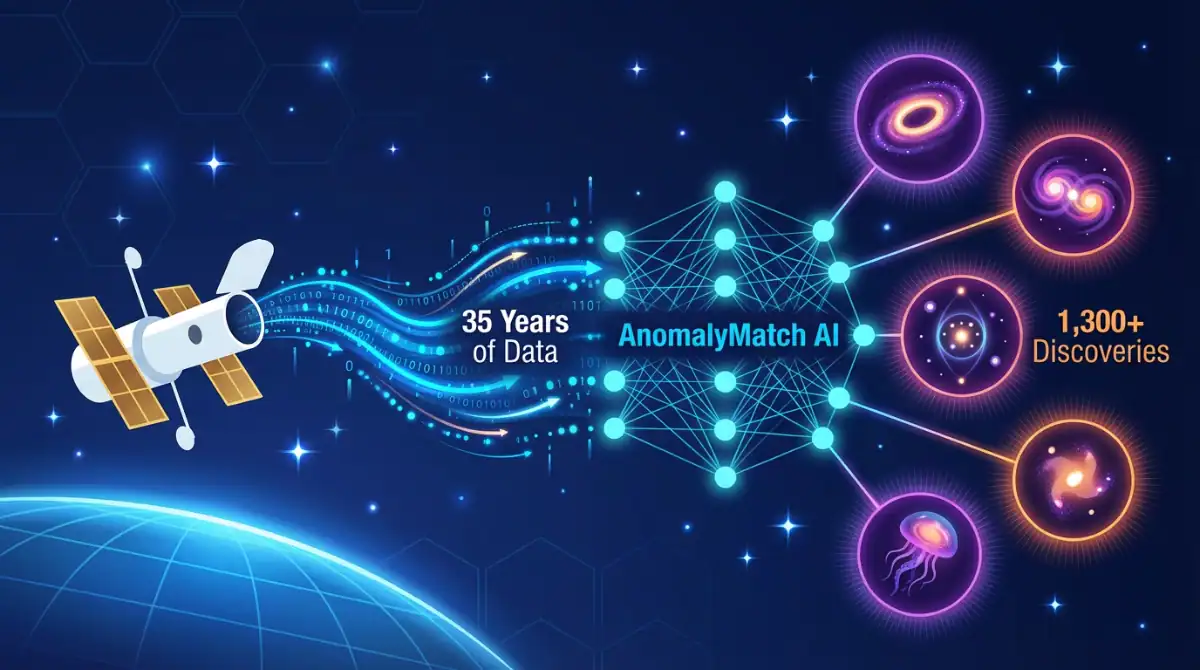
Hidden Cosmic Oddities in Hubble Data have been unveiled thanks to a breakthrough AI tool that scanned 35 years of space telescope observations. In just two and a half days, the neural network discovered more than 1,300 rare astronomical objects—over 800 of which had never been documented before.
Background: Decades of Hidden Treasures
Since its launch in 1990, NASA’s Hubble Space Telescope has captured nearly 100 million images of the cosmos. These observations sit in the Hubble Legacy Archive, forming one of astronomy’s most valuable datasets. Yet the sheer volume has made it impossible for human researchers to manually review every image for unusual objects.
Traditional methods rely on expert astronomers spotting anomalies during routine observations or stumbling upon them by chance. Citizen science projects have helped, but they can’t keep pace with the massive scale of astronomical modern archives. (ℹ️ NASA Science)
What Happened: AI Scans 100 Million Images
Researchers David O’Ryan and Pablo Gómez from the European Space Agency developed AnomalyMatch, a neural network trained to recognize rare cosmic objects by detecting patterns in astronomical data. The AI mimics how the human brain processes visual information but works at speeds humans simply can’t match.
The team fed AnomalyMatch nearly 100 million small image cutouts from the Hubble Legacy Archive—each just 7 to 8 arcseconds across. In only two and a half days, the algorithm identified potential anomalies. O’Ryan and Gómez then manually verified the top candidates, confirming more than 1,300 as genuine cosmic oddities. (ℹ️ ESA)
What the AI Found
The discoveries included:
- Merging galaxies with distorted shapes and long tails of stars and gas
- Gravitational lenses where foreground galaxies bend spacetime and warp background galaxy light into arcs or rings
- Jellyfish galaxies with gaseous “tentacles” streaming behind them
- Ring galaxies formed by cosmic collisions
- Edge-on planet-forming disks resembling hamburgers
- Dozens of unclassified objects that don’t fit any existing category
The variety of finds shows just how much we’ve been missing in archival data.
Why It Matters: The Future of Space Discovery
This achievement represents the first systematic search for Hidden Cosmic Oddities in Hubble Data across the entire archive. “Archival observations from the Hubble Space Telescope now span 35 years, offering a rich dataset in which astrophysical anomalies may be hidden,” O’Ryan explained in research published in Astronomy & Astrophysics. (ℹ️ Phys.org)
The technique is already proving valuable beyond Hubble. ESA’s Euclid space telescope, NASA’s upcoming Nancy Grace Roman Space Telescope, and the Vera C. Rubin Observatory will all generate enormous amounts of data—far more than current archives. AI tools like AnomalyMatch will be essential for scientists to keep up and potentially discover entirely new types of cosmic phenomena.
“This is a fantastic use of AI to maximize the scientific output of the Hubble archive,” said study co-author Gómez. “Finding so many anomalous objects in Hubble data, where you might expect many to have already found, is a great result.”
What’s Next: Expanding AI Analysis
The research team plans to apply AnomalyMatch to other major astronomical datasets. The tool can be adapted for different telescopes and survey missions, helping astronomers handle the massive influx of observations expected in coming years.
For the broader scientific community, this work demonstrates how AI can unlock value from existing data archives—not just in astronomy, but potentially in medicine, climate science, and anywhere large datasets contain rare but important patterns.
FAQ: Understanding the Discovery
How did the AI identify these cosmic oddities?
AnomalyMatch uses neural network technology to recognize visual patterns in astronomical images. It was trained on known rare objects like gravitational lenses and unusual galaxy shapes, then applied that learning to scan millions of Hubble images for similar anomalies.
Why weren’t these objects found before?
The Hubble archive contains nearly 100 million images—far too many for humans to manually review. While some objects were captured in images, they went unnoticed until AI systematically searched the entire dataset.
What makes these cosmic objects “anomalies”?
These objects display unusual features: galaxies merging in dramatic collisions, light bent by extreme gravity, or structures that don’t fit existing classification systems. They’re rare compared to typical galaxies and can reveal important physics about how the universe works.
Will this affect future space telescope missions?
Yes. Upcoming missions like the Nancy Grace Roman Space Telescope will generate even more data than Hubble. AI tools like AnomalyMatch will be crucial for analyzing these massive datasets and making new discoveries efficiently.
Source Attribution
Source: NASA Science, European Space Agency (ESA)—Published on January 27, 2026
Original articles:
– NASA Science
– ESA Official Release
About the Author
Abir Benali is a friendly technology writer who specializes in making complex AI and space science topics accessible to non-technical readers. With a passion for explaining cutting-edge discoveries in clear, everyday language, Abir helps readers understand how artificial intelligence is transforming fields from astronomy to healthcare.