
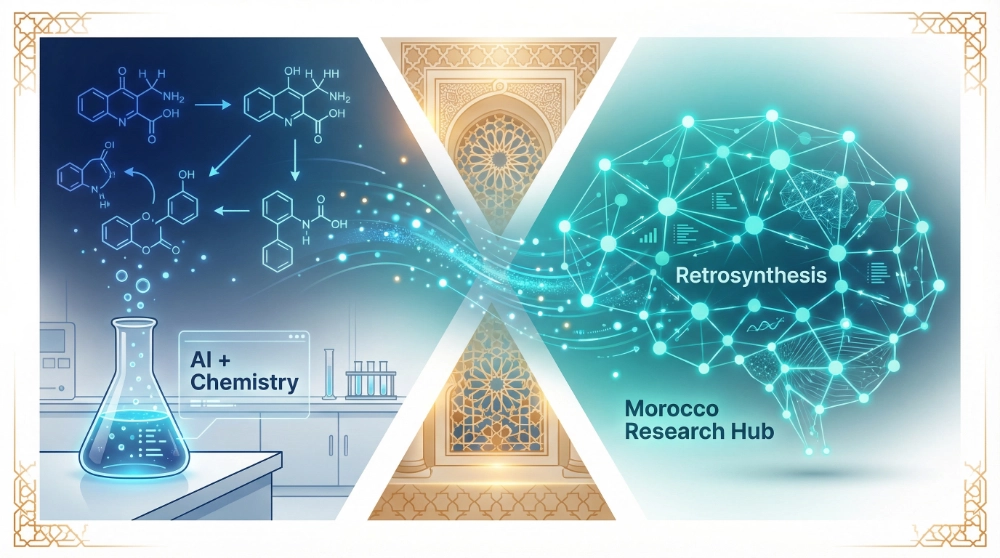
AI Retrosynthesis Research Role Opens at Moroccan University
Artificial Intelligence Applied to Retrosynthesis Reaction Prediction represents one of the most exciting frontiers in computational chemistry, and Mohammed VI Polytechnic University (UM6P) in Morocco recently advertised a postdoctoral position that highlights this cutting-edge field. This opportunity, posted on Times Higher Education (ℹ️ Times Higher Education), closed on January 11, 2026, but it signals something much bigger: Africa’s rising prominence in AI research.
What Is Retrosynthesis, and Why Does AI Matter?
For students and researchers interested in chemistry, retrosynthesis is like solving a complex puzzle backwards. Instead of mixing chemicals to see what you get, you start with your desired molecule and work backward to figure out which simpler compounds you need and how to combine them.
Traditionally, this required years of expertise and countless hours poring over chemistry textbooks. But artificial intelligence is changing everything. According to research published in the Journal of Medicinal Chemistry (ℹ️ PubMed), AI has revolutionized retrosynthesis prediction recently, significantly increasing the accuracy and diversity of predictions for target compounds.
The Position: What Students Should Know
The postdoctoral position at UM6P’s Center for Chemical and Biochemical Sciences (CBS) sought a researcher to develop machine learning models for automated retrosynthetic analysis. This isn’t just an academic exercise—it has real-world applications in pharmaceuticals, agrochemicals, and sustainable chemistry.
Key responsibilities included:
- Developing graph neural networks and transformer-based models
- Applying deep learning to predict reaction outcomes
- Working with massive chemical reaction datasets
- Collaborating with synthetic chemists to validate predictions
- Publishing research in high-impact journals
For students wondering what skills matter, the position required expertise in Python programming, familiarity with frameworks like TensorFlow or PyTorch, and knowledge of cheminformatics tools. This shows how modern chemistry increasingly demands computational skills alongside traditional lab expertise.
Why Morocco Matters in AI Research
UM6P isn’t just another university—it’s becoming a regional AI powerhouse. The institution houses the Ai Movement center (ℹ️ UM6P Ai Movement), Morocco’s International Center for Artificial Intelligence, which promotes emerging Moroccan and African expertise in AI and data sciences.
According to recent reports from the International Association of Universities (ℹ️ IAU Global), UM6P researchers published groundbreaking work in June-July 2025 across several domains, including green chemistry and AI applications. The university ranks among the Top 400 in the 2026 Times Higher Education World University Rankings (ℹ️ Wikipedia).
What This Means for Students
If you’re a student interested in computational chemistry or AI, this position illustrates several important trends:
Interdisciplinary skills are essential. Modern research requires both domain expertise (chemistry) and technical skills (machine learning, programming). The best opportunities go to people who can bridge these worlds.
Africa is becoming an AI hub. Morocco World News reported in May 2025 (ℹ️ Morocco World News) that UM6P hosted the Deep Tech Summit with over a thousand startups focusing on AI applications. You don’t need to study in Silicon Valley to access cutting-edge research.
Practical applications drive research. The position emphasized sustainable chemistry and industrial applications, not just theoretical work. Modern research increasingly focuses on solving real-world problems.
Getting Started in This Field
For students inspired by this opportunity, here’s what you can do:
Start with the fundamentals. Learn Python programming and familiarize yourself with basic machine learning concepts. Free resources like Python tutorials and TensorFlow documentation make this knowledge accessible.
Understand the chemistry. While you need computational skills, you also need to understand chemical reactions and organic synthesis. Take courses in organic chemistry alongside your computer science classes.
Explore cheminformatics tools. Tools like RDKit are open-source and free to use. Practice working with chemical data and molecular representations.
Build a portfolio. Work on small projects combining chemistry and coding. GitHub repositories showing your work matter beyond perfect grades.
What’s Next?
While this specific position has closed, UM6P regularly posts similar opportunities. The university announced in July 2025 (ℹ️ IAU Global) new calls for PhD and postdoctoral positions in fields including AI for Development and Sustainable Agriculture.
For students worldwide, positions like this demonstrate that Artificial Intelligence Applied to Retrosynthesis Reaction Prediction isn’t just theoretical—it’s a growing field with real career opportunities. Whether you’re in Morocco, Europe, Asia, or anywhere else, the combination of chemistry expertise and AI skills creates opportunities.
The message is clear: if you’re passionate about science and technology, start building your skills now. The future of chemistry is computational, and that future needs researchers who can think across disciplines.
Source: Times Higher Education—Published on February 09, 2026
Original posting: https://www.timeshighereducation.com/unijobs/listing/404250/cbs-postdoctoral-position-artificial-intelligence-applied-to-retrosynthesis-reaction-prediction/
References
- Mohammed VI Polytechnic University Ai Movement Center: https://aim.um6p.ma/en/home/
- Journal of Medicinal Chemistry- AI in Retrosynthesis: https://pubmed.ncbi.nlm.nih.gov/39883477/
- International Association of Universities – UM6P Updates: https://iau.global/news/ump6-august-2025
- Morocco World News—Deep Tech Summit: https://www.moroccoworldnews.com/2025/05/198265/ai-and-africas-big-leap-deep-tech-summit-kicks-off-in-morocco/
About the Author
Rihab Ahmed is an educator and student passionate about making AI accessible for learners worldwide. She specializes in explaining complex technical topics in ways that encourage students to explore emerging technologies. Rihab believes that anyone, regardless of their background, can contribute to the future of AI and computational sciences. Through her work at howAIdo.com, she helps students discover opportunities and build skills for tomorrow’s challenges.