
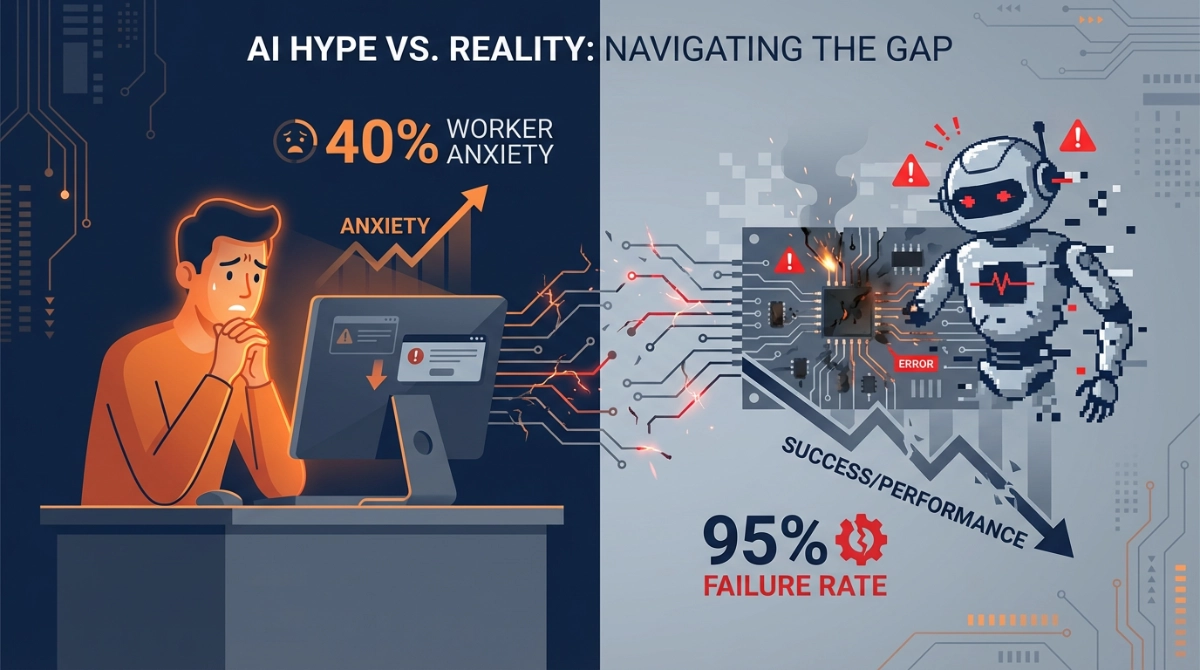
AI Tools Fall Short in Real Jobs, Yet 40% of Workers Fear Replacement
A widening gap between AI hype and reality reveals a troubling paradox: the technology struggles to deliver in most real-world applications, yet nearly half of all workers fear losing their jobs to artificial intelligence.
Key Points
- AI tools fail at 95% of real-world workplace implementations, according to MIT research
- Worker concerns about AI-driven job loss jumped from 28% in 2024 to 40% in 2026
- Microsoft study confirms AI cannot fully perform any single occupation independently
- The disconnect between AI’s actual capabilities and worker anxiety highlights need for transparency and education
Background
The artificial intelligence revolution promised to transform workplaces, boost productivity, and reshape entire industries. But as 2026 begins, a stark reality check is underway. While companies pour billions into AI infrastructure and workers increasingly fear for their jobs, mounting evidence shows that AI tools fail at most practical workplace tasks they’re assigned to handle.
According to MIT’s State of AI in Business 2025 study, 95% of generative AI pilots implemented by businesses could not scale and failed to create tangible impact (ℹ️ MIT Technology Review). This failure rate represents a sobering wake-up call for organizations that rushed to adopt AI without fully understanding its limitations.
What Happened
Despite widespread implementation challenges, worker anxiety about AI has reached unprecedented levels. Employee concerns about job loss due to AI have skyrocketed from 28% in 2024 to 40% in 2026 , according to preliminary findings from consultancy firm Mercer’s Global Talent Trends 2026 report, which surveyed 12,000 people worldwide. (ℹ️ CNBC)
Meanwhile, real-world testing reveals significant gaps in AI capabilities. Microsoft Senior Researcher Kiran Tomlinson confirmed that their research “shows that AI supports many tasks, particularly those involving research, writing, and communication, but does not indicate it can fully perform any single occupation.” (ℹ️ Windows Central)
The technology’s actual performance often falls dramatically short of expectations. A November study by researchers at Upwork found that agents powered by top LLMs from OpenAI, Google DeepMind, and Anthropic failed to complete many straightforward workplace tasks by themselves. (ℹ️ MIT Technology Review).
Why It Matters
This disconnect between AI’s actual capabilities and worker fears creates what safety experts call a crisis of transparency. Workers are making career decisions based on inflated claims about AI’s potential, while organizations waste resources on implementations that don’t deliver.
Harvey Lieberman, a clinical psychologist in New York, reports that “what I hear most often is a fear of becoming obsolete” among his patients (ℹ️ CNBC). This psychological toll extends beyond individual anxiety to affect career planning, education choices, and workforce stability.
The gap between expectation and reality also carries financial consequences. S&P Global shows 42% of AI initiatives were scrapped in 2025, sharply up from 17% a year earlier (ℹ️ Pwrteams), representing billions in wasted investment.
From a safety and ethics perspective, this situation demands urgent attention. When workers lack accurate information about AI’s true capabilities, they cannot make informed decisions about skill development, career transitions, or workplace negotiations. Companies, meanwhile, continue citing AI as justification for layoffs even when the technology cannot adequately replace human workers.
What’s Next
Sander van’t Noordende, CEO of Randstad, the world’s largest staffing firm, stated that 2026 is “the year of the great adaptation,” where individuals and team leaders need to start thinking about how to integrate AI and lock in productivity gains (ℹ️ CNBC).
Experts emphasize the need for transparency about AI’s limitations alongside education about its actual capabilities. Workers deserve honest assessments of which tasks AI can genuinely handle and which require human judgment, creativity, and emotional intelligence.
Source: Multiple authoritative sources including MIT, CNBC, Microsoft Research, and Mercer—Published January 26, 2026
Original coverage: CNBC AI Labor Market Impact | MIT Technology Review
About the Author
Nadia Chen is a digital safety expert and AI ethics specialist dedicated to helping non-technical users understand and protect themselves against emerging technological threats. With a focus on practical, actionable security advice, Nadia translates complex cybersecurity concepts into strategies that anyone can implement. She believes that safety and privacy are fundamental rights in the digital age and that clear, honest education is the best defense against evolving threats.