
Airtable Launches Superagent: Multi-Agent AI System
Key Points
- Superagent from Airtable launched as the company’s first standalone product in 13 years, built on multi-agent AI coordination
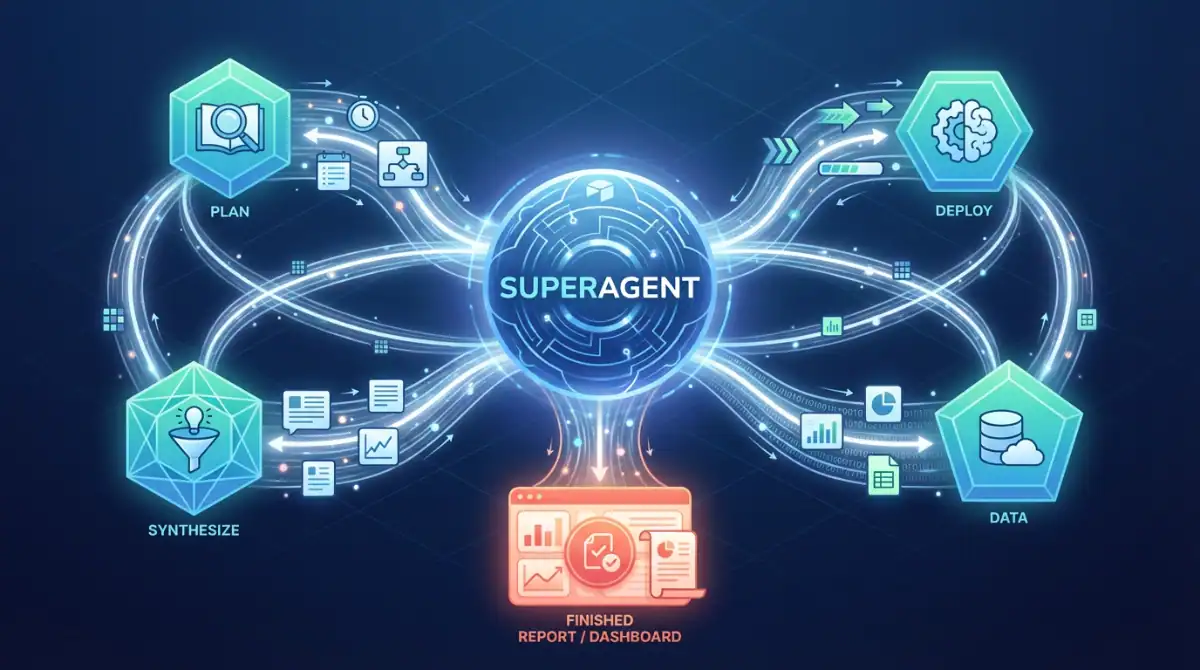
- The system deploys specialized AI agents working in parallel to tackle complex business research and deliver interactive, finished reports
- Built on Airtable’s acquisition of DeepSky (formerly Gradient) and led by former OpenAI executive David Azose as CTO
- Available now at superagent.com with pricing from $20 to $200 per month per user
- Uses premium data sources including FactSet, Crunchbase, and SEC filings for verified, cited outputs
Background
Airtable, the no-code platform serving over 500,000 organizations, including 80% of the Fortune 100, has been steadily transforming into an AI-native company. In October 2025, the company acquired DeepSky, an AI agent startup that raised $40 million (ℹ️ Airtable). This acquisition, combined with hiring David Azose as Chief Technology Officer after his role leading ChatGPT’s business products at OpenAI, set the stage for this launch.
The move comes as Airtable’s valuation has dropped from $11.7 billion in 2021 to approximately $4 billion on secondary markets, though the company maintains strong financial health with $700 million in cash reserves and positive cash flow (ℹ️ WebProNews).
What Happened
On January 27, 2026, Airtable CEO Howie Liu announced Superagent, describing it as a fundamental shift from single AI assistants to coordinated teams of specialist agents. Unlike traditional AI chat tools that process tasks sequentially, Superagent deploys a central coordinating agent that breaks down complex queries, assigns specialized agents to work simultaneously, and synthesizes their outputs into polished, interactive deliverables (ℹ️ Airtable).
The system operates through three phases: First, it builds a comprehensive research plan identifying investigation areas and dimensions users might not have considered. Second, it deploys specialized agents in parallel—one handling financials, another competitive analysis, and another management review. Finally, it synthesizes these parallel work streams into interactive artifacts with filterable matrices, expandable detail cards, and visual positioning maps.
DeepSky’s founding team—Chris Chang, Mark Kim-Huang, and Forrest Moret—runs Superagent semi-independently within Airtable, preserving the startup’s agile approach while integrating with Airtable’s broader platform.
Why It Matters
This launch represents more than just another AI product—it signals Airtable’s bet that multi-agent coordination, not faster models, will define the next phase of enterprise AI. Liu positioned the product as infrastructure for knowledge work, comparing it to how Airtable democratized app-building for structured data.
The practical implications are significant. When asked to evaluate Google as a three-year investment, Superagent delivers structured assessments with earnings call citations, competitive analysis against OpenAI and Anthropic, and risk factors—ready for immediate use rather than requiring hours of additional processing.
Early user feedback has been positive. Kunal Kushwaha called it “the best AI tool I have seen so far this year,” praising its interactive visuals over text-heavy outputs. Antonio Grasso tested geopolitics scenarios and received structured reports with sources, while Eli Schwartz got consulting-grade brand analysis in 15 minutes.
What’s Next
Airtable plans to deepen Superagent’s integration with its main platform, allowing users to invoke the system directly from Airtable bases for automated research and intelligence gathering. The company will also expand its premium data sources while refining the flexible agent architecture that allows backtracking and adaptation during complex tasks.
Liu didn’t rule out Superagent eventually becoming larger than Airtable itself, telling TechCrunch, “Optionality is a good thing.”. For now, Superagent represents what Liu calls “wartime leadership”—making bold bets on emerging technology rather than protecting existing market position.
Deep Details
Superagent distinguishes itself through its technical architecture. Unlike many products marketed as “AI agents” that are essentially predetermined workflows with LLM calls, Superagent uses what Liu describes as an “open-ended agent harness.” This flexible system gives agents autonomy to navigate different approaches, coordinate with each other, backtrack when needed, and adapt to specific task requirements (ℹ️ Airtable).
The system accesses premium data sources, including FactSet for financial data, Crunchbase for startup information, SEC filings for regulatory disclosures, and earnings transcripts for corporate intelligence. All insights are verified, cited, and traceable—addressing one of the key concerns with AI-generated business research.
The pricing structure follows emerging AI product patterns: an entry tier at $20 per month per user, scaling up to $200 for power users with generous inference credits. “We’re not trying to optimize for profit margin right now,” Liu stated (ℹ️ Yahoo Finance), indicating Airtable’s focus on market adoption over immediate profitability.
Source: Airtable Newsroom, TechCrunch via Yahoo Finance, WebProNews—Published on January 27-29, 2026
Original articles:
About the Author
Abir Benali is a technology writer specializing in making AI accessible to non-technical users. With a focus on clear, jargon-free explanations, Abir helps readers understand how emerging technologies can improve their daily workflows.