
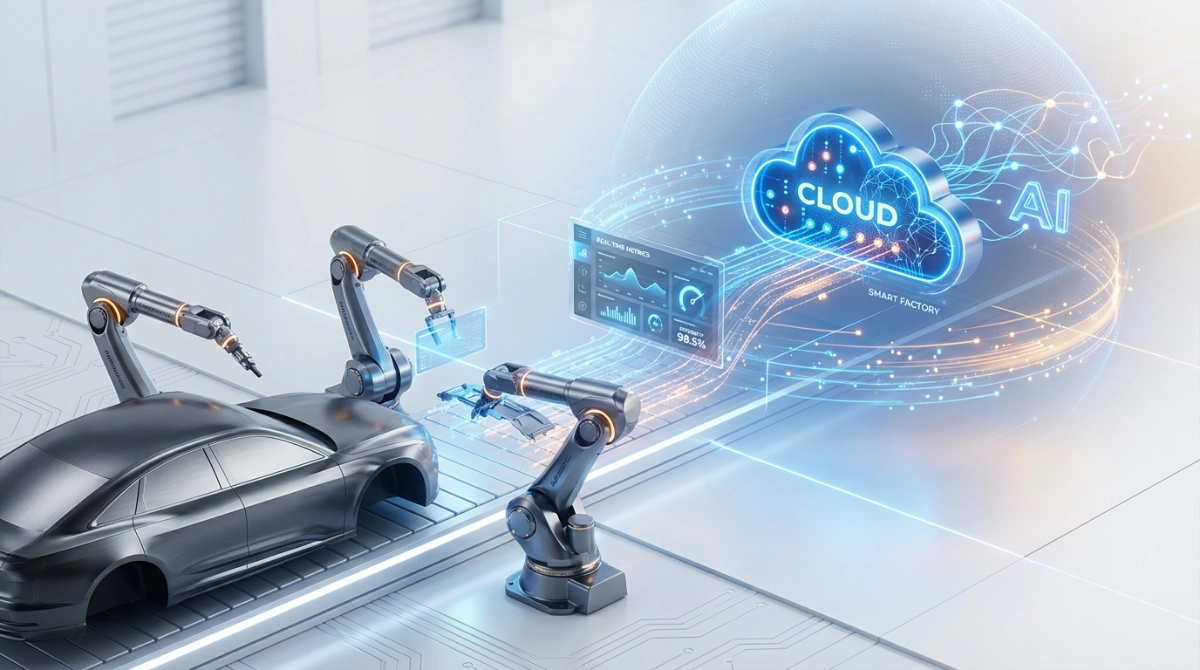
Audi Transforms Production with AI and Cloud Innovation
Key Points
- Audi Automotive Manufacturing Solutions deploys Edge Cloud 4 Production (EC4P) across entire production network, transforming German facilities
- Cloud migration eliminates over 1,000 industrial PCs, replacing physical controllers with virtual systems for unprecedented flexibility
- First-ever virtual programmable logic controllers (vPLCs) now control high-volume production of A5 and A6 bodies at Neckarsulm
- AI-powered ProcessGuardAIn platform launches in Q2 2026 for predictive maintenance and real-time quality monitoring
- Strategic partnerships with Siemens, IPAI Heilbronn, and technology leaders accelerate smart factory transformation
Background
The German automotive industry has long set global standards for precision manufacturing, but today’s market demands something revolutionary: production systems that think, adapt, and optimize themselves in real-time. As automakers face mounting pressure to reduce costs while increasing flexibility, the traditional hardware-heavy approach to factory automation has reached its limits.
Enter Audi Automotive Manufacturing Solutions—the premium manufacturer’s bold answer to Industry 4.0 challenges. Rather than incremental improvements, Audi is fundamentally reimagining how vehicles are built by virtualizing the “brains” of its factories and teaching machines to work smarter through artificial intelligence.
What Happened
On January 27, 2026, Audi announced a comprehensive rollout of its Edge Cloud 4 Production (EC4P) platform across its production environment, marking a quantum leap in automotive manufacturing technology (ℹ️ Audi MediaCenter).
The transformation is both dramatic and practical. The cloud now delivers worker guidance systems at Audi’s German plants, which previously required dedicated industrial computers. The result? More than 1,000 industrial PCs were eliminated—reducing hardware costs, simplifying maintenance, and dramatically improving IT security.
But the real breakthrough came at the Neckarsulm body shop, where Audi achieved an industry first: using virtual programmable logic controllers to manage high-volume production. Around 100 robots now work together through EC4P with millisecond precision, manufacturing several hundred A5 and A6 vehicle bodies daily across three shifts.
Gerd Walker, Audi’s Board Member for Production and Logistics, explains that artificial intelligence represents a significant improvement in production efficiency. “We are transforming our plants into smart factories where AI acts as a partner, providing our employees with tailored support.”
The AI-powered innovations extend beyond infrastructure. Audi’s Weld Splatter Detection system uses machine vision to identify metal deposits on vehicle underbodies—a physically demanding inspection task now handled by robots. The technology will soon expand to six Ingolstadt plants (ℹ️ Audi MediaCenter).
Why It Matters
This isn’t just about Audi—it’s about the future of manufacturing itself. By proving that cloud-based production control works in high-stakes, high-volume automotive manufacturing, Audi is setting a new industry benchmark that competitors worldwide will need to match.
The implications ripple across multiple dimensions:
For the Industry: Audi’s EC4P demonstrates that software-defined automation can replace hardware-dependent systems even in demanding production environments. This opens new possibilities for rapid reconfiguration, faster innovation cycles, and dramatically lower infrastructure costs.
For Workers: Rather than replacing humans, Audi’s AI systems are designed to augment human capabilities. ProcessGuardAIn—the company’s proprietary monitoring platform launching in Q2 2026—will detect anomalies early and guide employees step-by-step through solutions via mobile apps. AI handles ergonomically strenuous tasks while employees focus on problem-solving and innovation.
For Technology: The partnership with Innovation Park Artificial Intelligence (IPAI) in Heilbronn demonstrates how cross-industry AI collaboration accelerates innovation. An AI model from a completely different industry is now optimizing Audi’s paint shop dryer operation, with energy-saving tests running through summer 2026
(ℹ️ Audi MediaCenter).
What’s Next
Audi’s roadmap is ambitious and concrete. The ProcessGuardAIn platform will enter series production in Q2 2026, initially monitoring paint shop processes at Neckarsulm before expanding across all plants. The system will eventually serve as a central tool for predictive maintenance and quality assurance throughout the Volkswagen Group.
The Next2OEM project at Ingolstadt is pushing even further—demonstrating complete digitization and automation of wiring loom production and installation, a process that remains less than 10% automated industry-wide. Success here could slash lead times for manufacturing changes from weeks to minutes.
Meanwhile, Audi continues deepening partnerships with Siemens, Broadcom, Cisco, and IPAI, creating an innovation ecosystem that blends decades of manufacturing expertise with cutting-edge digital solutions.
Deep Details
The technical sophistication behind Audi’s transformation reveals careful engineering and strategic thinking. The EC4P platform doesn’t just move data to the cloud—it fundamentally restructures how production systems communicate and respond.
Traditional factory automation relies on programmable logic controllers (PLCs) installed physically on production lines. Each requires dedicated hardware, individual maintenance, and manual updates. Audi’s virtual PLCs eliminate this hardware dependency entirely, running as software instances in the cloud while maintaining the millisecond-level precision required for robotic coordination.
The P-Data Engine platform from the company is the basis for AI development. It brings together system and plant data from all of the company’s production facilities at the same high quality level. This standardized data infrastructure allows Audi’s 60-person Production Lab and P-Data Factory teams to rapidly develop and scale AI applications like ProcessGuardAIn (ℹ️ Audi MediaCenter).
Security and ethical considerations remain paramount. Audi’s binding Code of Conduct and AI policy statement emphasize respect, security, and transparency—ensuring the technology serves both business objectives and employee welfare. The Data Sharing Code of Practice ensures responsible data handling aligned with company values.
Source: Audi MediaCenter—Published on January 27, 2026, 10:13 AM UTC
Original article: https://www.audi-mediacenter.com/en/press-releases/audi-scales-up-deployment-of-artificial-intelligence-in-production-17002
About the Author
Alex Rivera, a creative technologist who is passionate about making AI and emerging technologies accessible to everyone, wrote this article. Alex specializes in translating complex industrial innovations into inspiring stories that show how technology empowers people rather than replaces them. With a background in both engineering and creative storytelling, Alex helps readers see the human side of digital transformation.