
CarPlay Opens to AI Chatbots: Safety First Guide
Key Points
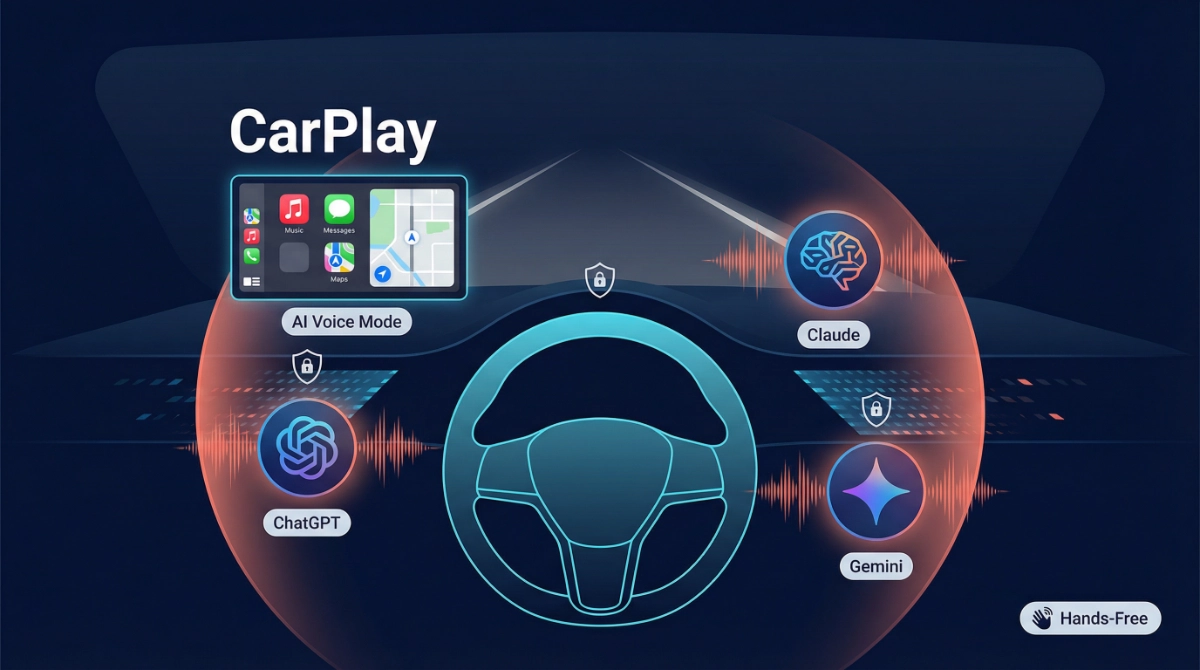
- CarPlay will support third-party AI chatbots, including ChatGPT, Claude, and Gemini within coming months
- Users must manually open apps to access AI assistants—no wake words or Siri replacement allowed
- AI chatbots cannot control vehicle functions or access iPhone system settings
- Timeline aligns with Apple’s enhanced Siri rollout in iOS 26.4 and iOS 27
- Over 80 million CarPlay users will gain access to conversational AI while driving
Background
Apple’s CarPlay system has maintained strict app category limitations since its 2014 launch, prioritizing navigation, communication, and entertainment while keeping the in-car experience simple and distraction-free. Currently, AI companies like OpenAI and Anthropic cannot create native CarPlay applications, forcing users to rely exclusively on Siri for voice assistance.
This controlled approach has defined Apple’s safety-first philosophy for automotive interfaces. However, competing automakers like Tesla have already integrated advanced AI assistants directly into vehicle systems, creating pressure on Apple to expand CarPlay’s capabilities while maintaining its commitment to driver safety.
What Happened
Apple engineers are developing support for third-party AI chatbot applications in CarPlay, according to Bloomberg’s Mark Gurman (ℹ️ Bloomberg). The feature will enable drivers to access ChatGPT, Claude, and Google Gemini through voice commands in their vehicles.
Implementation details reveal Apple’s cautious approach. Drivers must manually open the AI app to activate voice mode—there are no wake words like “Hey Claude” or buttons replacing Siri. App developers can design experiences that automatically launch voice-based chat when opened, streamlining the process while maintaining Apple’s control over the primary assistant interface.
The third-party chatbots will operate in a restricted sandbox. They cannot control vehicle functions, adjust iPhone settings, or access system-level features. This limitation addresses critical safety concerns about distraction and unauthorized vehicle control.
Why It Matters
This development raises important questions about driver safety and data privacy that every CarPlay user should consider carefully.
From a safety perspective, conversational AI introduces new cognitive demands. Unlike Siri’s task-focused interactions, chatbots encourage open-ended dialogue that could extend driver distraction. The requirement to manually open apps adds a crucial friction point—forcing intentional activation rather than impulse use during critical driving moments.
Privacy implications deserve equal attention. When you speak to ChatGPT or Claude in your car, your voice data travels to external servers operated by OpenAI, Anthropic, or Google. These companies’ data handling practices differ significantly from Apple’s on-device processing approach. Voice recordings may be stored, analyzed for model training, or associated with your account—creating privacy considerations that don’t exist with Siri.
AI chatbots also lack contextual awareness of your driving environment. They cannot detect if you’re merging into traffic, approaching an intersection, or navigating complex road conditions. This absence of situational awareness means the responsibility for safe use rests entirely with the driver.
Consider what information you share with these assistants while driving. Avoid discussing sensitive topics—addresses, financial details, personal conversations—that could be stored on external servers. Remember that your vehicle’s location data may be accessible to the AI app, creating potential tracking concerns.
What’s Next
Apple plans to release third-party AI chatbot support “within the coming months,” likely aligning with iOS 26.4’s March or April 2026 release (ℹ️ MacRumors). The exact timeline remains unconfirmed.
This rollout coincides with significant Siri upgrades. iOS 26.4 brings enhanced Siri powered by large language models, enabling complex queries and multi-step tasks. By iOS 27, expected in mid-2026, Siri will gain full chatbot capabilities, including Apple’s partnership with Google Gemini for backend processing.
App developers can begin preparing CarPlay-compatible versions of their AI assistants, designing voice-first experiences optimized for automotive use. However, Apple’s review process will likely enforce strict safety and privacy requirements before approving these applications.
Deep Details
The technical architecture reveals Apple’s balancing act between innovation and control. Third-party AI apps will integrate with CarPlay’s existing framework but operate under tighter restrictions than traditional app categories. Voice interaction happens through the app’s own interface rather than system-level integration, preventing these assistants from becoming alternative voice assistants that could fragment the user experience.
Apple’s decision acknowledges competitive realities. With over 80 million CarPlay users globally, the platform faces pressure from automakers bypassing CarPlay entirely to offer native AI integrations. Tesla’s xAI Grok chatbot and other manufacturer-specific AI systems demonstrate growing consumer demand for conversational AI in vehicles—demand Apple can no longer ignore without risking CarPlay’s relevance.
The feature also represents Apple’s shifting AI strategy. Rather than exclusively promoting in-house solutions, the company increasingly partners with or accommodates external AI providers. Recent moves include the $1 billion annual deal with Google to power enhanced Siri capabilities and the $2 billion acquisition of Israeli startup Q.ai for silent speech technology.
From a user privacy standpoint, the key difference between Siri and third-party chatbots centers on data processing location. Siri increasingly processes requests on-device through Apple Intelligence, keeping sensitive information private. Third-party chatbots require internet connectivity and cloud processing, meaning your conversations leave your control.
Best practices for safe AI chatbot use while driving
- Only activate AI assistants when parked or during highway cruising with clear conditions
- Avoid complex multi-turn conversations requiring sustained attention
- Never share sensitive personal information through voice commands
- Review each AI provider’s privacy policy regarding voice data retention
- Disable location access for AI apps unless absolutely necessary
- Consider using Siri for vehicle-related tasks and saving complex queries for when parked
Source: Bloomberg—Published on February 6, 2026, 11:49 AM PST
Original articles:
Frequently Asked Questions
Will AI chatbots replace Siri in CarPlay?
No. Siri remains the primary voice assistant. You must manually open third-party AI apps to use them, and they cannot respond to wake words or replace the Siri button.
Can ChatGPT control my car’s features?
No. Third-party AI chatbots cannot control vehicle functions, adjust climate settings, or access car systems. They’re limited to conversational responses.
Is my voice data private when using these AI assistants?
No. Unlike Siri’s on-device processing, third-party chatbots send your voice to external servers. Review each provider’s privacy policy regarding data retention and use.
When will this feature be available?
Apple plans to launch support “within the coming months,” likely with iOS 26.4 in March-April 2026 or iOS 27 later in 2026.
Which AI chatbots will work with CarPlay?
Initially, ChatGPT (OpenAI), Claude (Anthropic), and Gemini (Google) are confirmed. Additional AI assistants may be added as developers create CarPlay-compatible versions.
About the Author
Nadia Chen is an expert in AI ethics and digital safety, dedicated to helping non-technical users navigate artificial intelligence tools responsibly. With a background in privacy advocacy and consumer technology, Nadia focuses on practical guidance for using AI safely while protecting personal information. Her work emphasizes transparency, informed consent, and user empowerment in an increasingly AI-driven world.