
ChatGPT Ads Launch: OpenAI Targets $125B Market
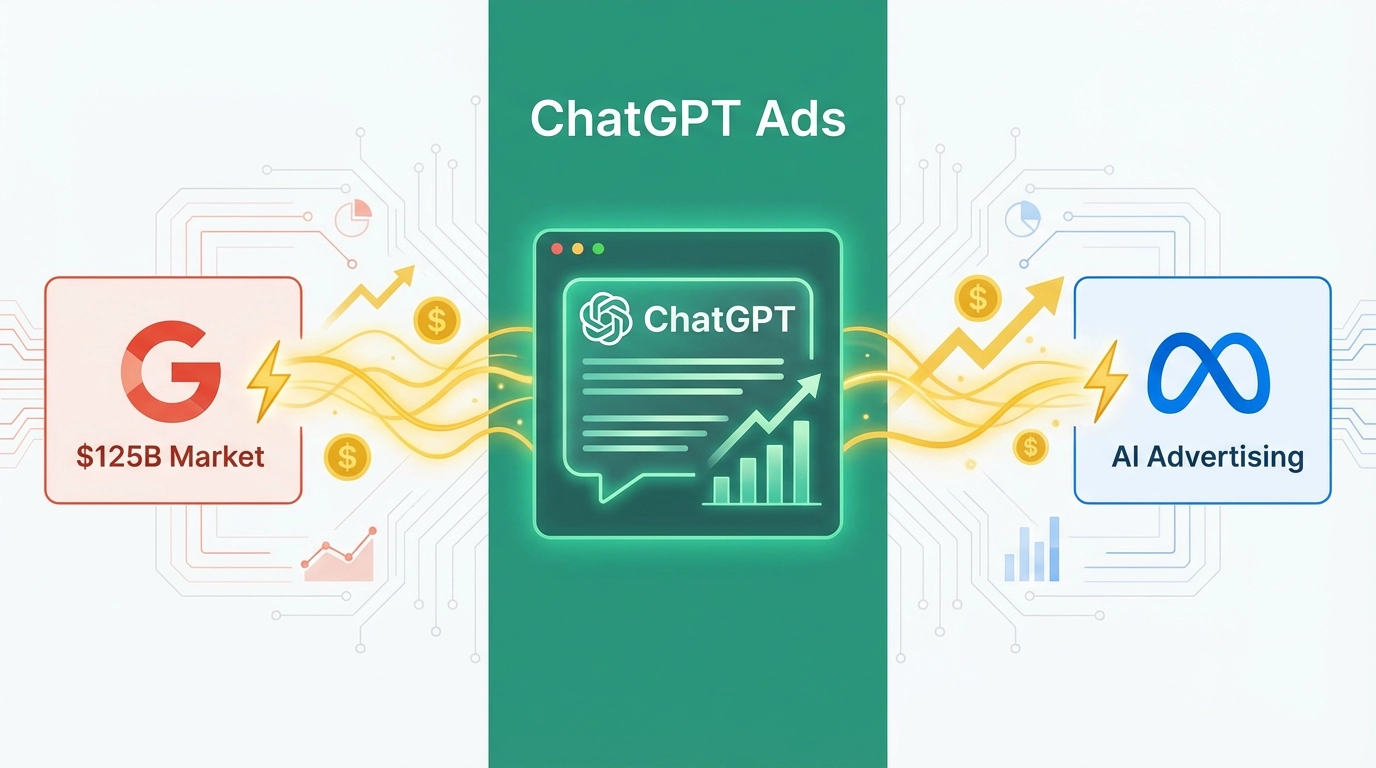
OpenAI ChatGPT ads are transforming the digital advertising landscape. On January 16, 2026, OpenAI announced it will begin testing advertisements within ChatGPT for free and ChatGPT Go users in the United States, marking a pivotal move into the lucrative advertising market dominated by Google (GOOGL) and Meta (META). This strategic decision positions OpenAI to compete for a share of the combined $125 billion quarterly advertising revenue currently controlled by these tech giants (ℹ️ Mirror Review).
Key Points
- OpenAI will test ChatGPT ads with 800 million monthly users, but only 5% currently pay for subscriptions
- Ads appear at the bottom of ChatGPT responses, labeled as “sponsored,” and won’t influence AI answers
- Google generated $74.18 billion in Q3 2025 ad revenue, while Meta earned $50.08 billion
- OpenAI needs revenue to fund its $1.4 trillion AI infrastructure commitment over eight years
- The move signals a fundamental shift in conversational AI monetization strategies
Background
The digital advertising market has long been dominated by two powerhouses. According to verified Q3 2025 earnings reports, Google’s advertising revenue reached $74.18 billion in a single quarter, driven primarily by Search and YouTube (ℹ️ Mirror Review). Meanwhile, Meta’s advertising revenue hit $50.08 billion in the same period, growing at 25.6% year-over-year—nearly double Google’s 12.6% growth rate.
OpenAI, despite achieving an estimated $20 billion annual revenue run rate in 2025, faces mounting infrastructure costs. The company has committed to spending $1.4 trillion on AI infrastructure over the next eight years (ℹ️ CNN Business). With only approximately 35 million paying subscribers out of 800 million monthly users, advertising represents a critical revenue stream.
What Happened
OpenAI announced it will begin testing ChatGPT advertising in the coming weeks for adult users in the United States. The ads will appear exclusively on the free tier and the newly launched ChatGPT Go subscription ($8/month). Premium tiers—ChatGPT Plus ($20/month), Pro ($200/month), and Enterprise—will remain ad-free (ℹ️ CNN Business).
The sponsored content will display at the bottom of ChatGPT’s responses, clearly labeled to maintain transparency. OpenAI CEO Sam Altman, who previously expressed reservations about introducing ads, stated the company is “hopeful a business model like this can work” for users unwilling to pay for AI services.
According to Jeremy Goldman, an analyst at Emarketer, “If ChatGPT turns on ads, OpenAI is admitting something simple and consequential: the race isn’t just about model quality anymore; it’s about monetizing attention without poisoning trust.” (ℹ️ TechXplore)
Why It Matters
This development fundamentally reshapes digital advertising competition. OpenAI’s entry threatens to disrupt the Google-Meta duopoly that has controlled digital advertising for over a decade.
The implications are significant for marketers and businesses. ChatGPT’s conversational interface enables highly contextual advertising—if a user asks about vacation planning, relevant hotel or travel ads could appear. This represents a shift from keyword-based advertising to intent-driven advertising embedded within AI conversations.
For Google and Meta, the challenge is existential. Google’s Q3 2025 advertising grew 12.6%, while Meta’s surged 25.6%, but both now face a new competitor with 800 million monthly users (ℹ️ Mirror Review). The traditional “10 blue links” search format competes against conversational AI that answers questions directly.
Meta has already responded by introducing Meta AI advertising in December 2025, using chatbot interactions to personalize ads. The advertising battlefield has shifted from search results and social feeds to AI-powered conversations.
What’s Next
OpenAI plans to expand testing throughout 2026, starting with select advertisers in controlled categories before a broader rollout. The company emphasizes user privacy protections: conversations remain private from advertisers, user data won’t be sold, and personalization can be disabled (ℹ️ CNN Business).
Industry analysts project OpenAI could generate $25 billion annually from advertising if adoption reaches projected levels. However, success depends on maintaining user trust—a challenge given that users share personal and sensitive information with ChatGPT.
The competitive pressure will intensify throughout 2026 as Google, Meta, and OpenAI battle for advertising market share. For businesses and marketers, this means adapting strategies from keyword-based campaigns to conversational AI advertising that requires understanding natural language queries and user intent.
The introduction of ChatGPT advertising marks the beginning of a new era where AI assistants become advertising platforms, fundamentally changing how businesses reach consumers online.
Source: Multiple verified sources including CNN Business, TechXplore, Mirror Review, and company earnings reports — Published on January 16-27, 2026
Original sources:
About the Author
James Carter is a productivity coach and technology journalist who helps professionals leverage AI tools to boost efficiency and save time. With extensive experience covering digital transformation and AI adoption strategies, James focuses on making complex technological shifts accessible to everyday users. His work emphasizes practical applications and actionable insights for businesses adapting to AI-driven changes in their industries.