
Faculty Warn GenAI Threatens University Degree Value
University degrees are facing their biggest challenge yet as faculty warn GenAI is fundamentally changing higher education. I’ve been following AI’s impact on learning for years, but this latest survey stopped me in my tracks—and it should get your attention too.
Key Points
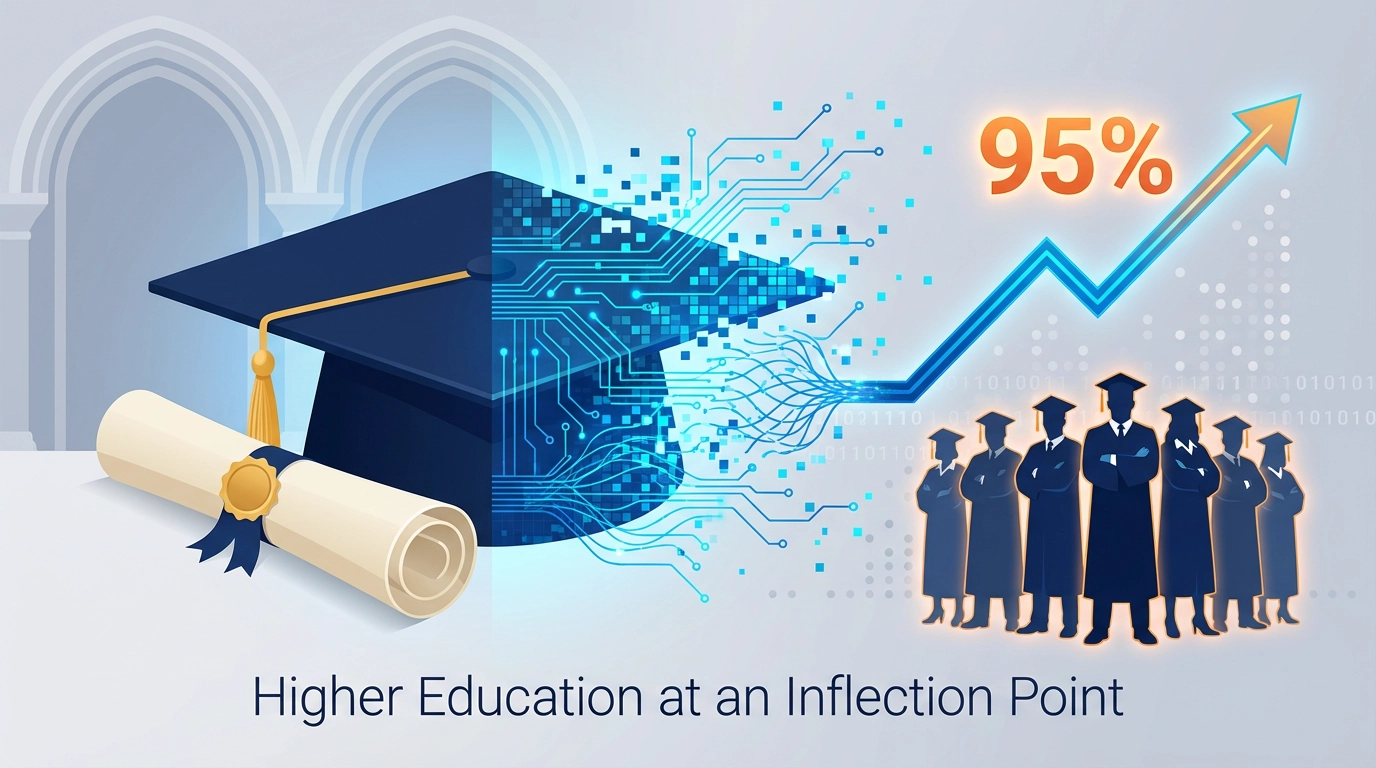
- 95% of surveyed faculty believe GenAI will increase student overreliance on AI tools
- 90% warn that critical thinking skills are diminishing because of generative AI
- 74% say the integrity and value of academic degrees is worsening
- Survey conducted by Elon University and AAC&U included 1,057 faculty members nationwide
- Only 37% believe spring 2025 graduates were prepared to use GenAI in the workplace
Background
Higher education has weathered many technological shifts, but generative AI represents something different. Unlike previous tools that helped students research or write, GenAI can now complete entire assignments, answer complex questions, and even mimic creative thinking. This has created what researchers at Elon University’s Imagining the Digital Future Center call “an inflection point” for universities.
The survey, conducted between October 29 and November 26, 2025, captured perspectives from faculty across diverse academic disciplines, school sizes, and student populations (ℹ️ Elon University).
What Happened
The American Association of Colleges and Universities, working with Elon University, surveyed 1,057 college and university faculty members to understand how GenAI tools are impacting teaching and student performance. The results paint a concerning picture.
According to the joint survey, 78% of faculty reported that cheating has increased since GenAI became widely available, with 57% saying it has increased “a lot.” Even more striking, 73% have personally dealt with academic integrity issues involving students’ use of AI (ℹ️ Elon University).
The survey found that 48% of faculty believe their students’ research has deteriorated because of GenAI, compared to just 20% who think it has improved.
Why It Matters
This isn’t just about cheating or shortcuts. The survey reveals deeper concerns about what happens when students rely on AI instead of developing their own thinking. Lee Rainie, director of Elon’s Imagining the Digital Future Center, explained that faculty are “divided” about GenAI use—some are innovating, others resist, and many are simply trying to figure out the path forward (ℹ️ Elon University).
Eddie Watson, vice president for digital innovation at AAC&U, noted that the findings don’t call for abandoning AI, but rather for “intentional leadership—rethinking teaching models, assessment practices, and academic integrity so that human judgment, inquiry, and learning remain central.” (ℹ️ Elon University)
The workplace preparedness statistics are particularly troubling: 63% of faculty members expressed concern about their spring 2025 graduates’ lack of adequate preparation for using GenAI in professional settings.
What’s Next
Despite widespread concern, the survey found that many faculty are taking action. A significant 87% have created explicit policies for students on acceptable and unacceptable uses of AI in coursework, while 69% are addressing AI literacy topics like bias, hallucinations, and ethics in their teaching (ℹ️ Elon University).
However, institutional support appears lacking. The survey revealed that 59% of faculty believe their institution isn’t well prepared to use GenAI effectively, and 68% say their school hasn’t adequately prepared faculty to use GenAI for teaching or mentoring.
Looking ahead, 79% of faculty expect that typical teaching models will be affected by GenAI tools, with 43% anticipating significant impact.
Deep Details
The survey uncovered a paradox in faculty attitudes. While expressing serious concerns about GenAI’s negative effects, 61% still believe these tools could enhance or customize learning in the future. This suggests the issue isn’t the technology itself, but how it’s being integrated into education.
Faculty concerns extend beyond the classroom. When asked about longer-term consequences, 62% believe GenAI will worsen student learning outcomes over the next five years, and 54% expect it will have a more negative than positive impact on students’ overall campus lives.
The research also highlighted a fragmented policy landscape. Only 48% of faculty reported that their institution has clear, campus-wide guidelines for AI use in teaching and learning, and just 35% said their departments have established such policies (ℹ️ Elon University).
The attention span crisis emerged as another major concern, with 83% of faculty warning that GenAI will decrease student attention spans, including 62% who expect substantial impact.
Source: Elon University—Published on January 21, 2026
Original article: https://www.elon.edu/u/news/2026/01/21/elon-aacu-national-survey-95-of-college-faculty-fear-student-overreliance-on-ai/
About the Author
Rihab Ahmed, an educator passionate about assisting students in responsibly navigating AI tools, penned this article. As someone who’s witnessed firsthand how technology shapes learning, I believe understanding these challenges is the first step toward using AI as a tool for growth rather than a crutch. My goal is to make complex tech topics accessible to students and lifelong learners everywhere.