
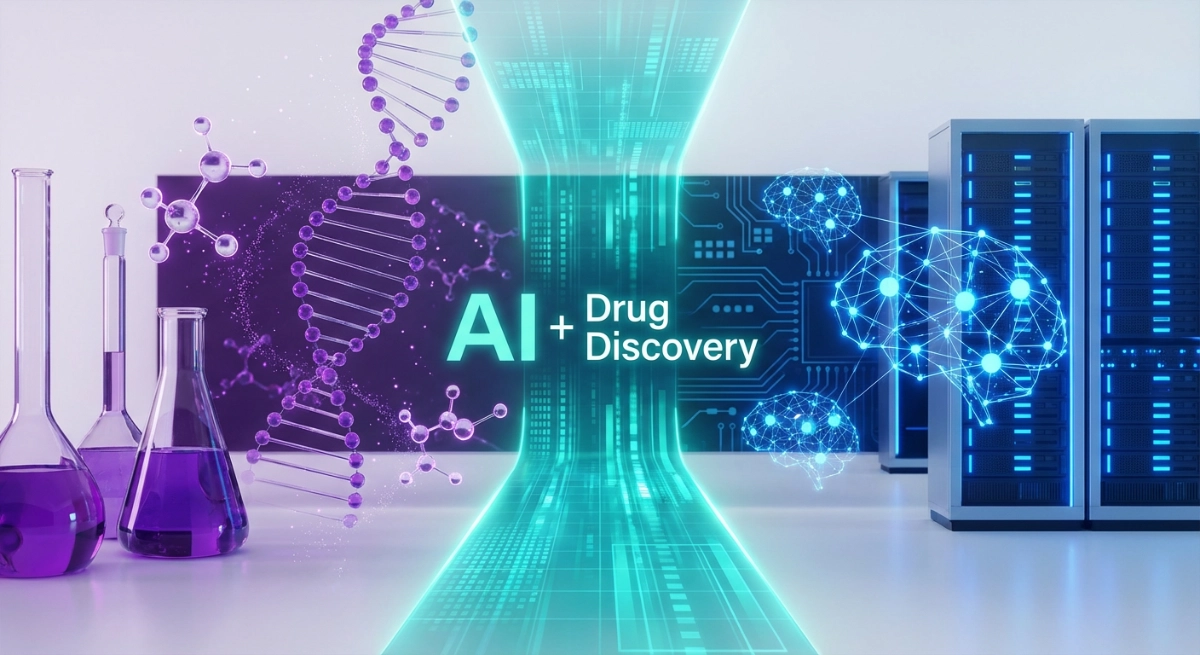
NVIDIA & Lilly Launch $1B AI Lab for Drug Discovery
Key Points
- NVIDIA and Eli Lilly announce $1 billion five-year investment in AI co-innovation lab
- Lab will combine wet and dry labs using “scientist-in-the-loop” framework for 24/7 experimentation
- Built on NVIDIA BioNeMo platform and upcoming Vera Rubin architecture
- Located in San Francisco Bay Area, it is expected to begin operations early 2026
- Partnership aims to transform drug discovery from artisanal process to engineering discipline
Background
Drug discovery traditionally takes over a decade and costs billions of dollars, with most experimental compounds failing before reaching patients. The pharmaceutical industry has long sought ways to accelerate this process while maintaining safety and efficacy standards.
The collaboration between NVIDIA, the world’s leading AI and accelerated computing company, and Eli Lilly, a pharmaceutical pioneer with nearly 150 years of history, represents one of the largest disclosed AI partnerships in the industry (ℹ️ Drug Discovery Trends).
What Happened
On January 12, 2026, at the J.P. Morgan Healthcare Conference in San Francisco, NVIDIA and Eli Lilly unveiled their first-of-its-kind AI co-innovation lab (ℹ️ NVIDIA Newsroom). The two companies will jointly invest up to $1 billion over five years in talent, infrastructure, and computing resources.
The lab will co-locate Lilly’s domain experts in biology, science, and medicine with NVIDIA’s top AI engineers in the San Francisco Bay Area. This setup enables them to work side-by-side, generating large-scale data and building powerful AI models using NVIDIA BioNeMo as the critical platform.
“AI is transforming every industry, and its most profound impact will be in life sciences,” said Jensen Huang, founder and CEO of NVIDIA. “NVIDIA and Lilly are bringing together the best of our industries to invent a new blueprint for drug discovery—one where scientists can explore vast biological and chemical spaces in silico before a single molecule is made.”
David A. Ricks, chair and CEO of Lilly, emphasized the transformative potential: “Each small molecule discovery is like a work of art. If we can make that an engineering problem, versus this sort of discovery, this artisanal drug-making problem, think of the impact on human life.”
Why It Matters
This partnership introduces a revolutionary “scientist-in-the-loop” framework that creates a continuous learning system connecting Lilly’s agentic wet labs with computational dry labs. This enables 24/7 AI-assisted experimentation, allowing experiments, data generation, and AI model development to continuously inform and improve one another.
The lab will harness unprecedented computing power for the pharmaceutical industry, building next-generation foundations and frontier models for biology and chemistry. The initiative expands on Lilly’s previously announced AI supercomputer—the most powerful in the pharmaceutical industry—which uses NVIDIA’s DGX SuperPOD technology with DGX B300 systems.
Beyond drug discovery, the collaboration will explore AI applications across clinical development, manufacturing, and commercial operations. Using NVIDIA Omniverse and NVIDIA RTX PRO Servers, Lilly can create digital twins of manufacturing lines to model and optimize supply chains before implementing physical changes (ℹ️ HealthTech Magazine).
What’s Next
The lab’s work is expected to begin in South San Francisco early in 2026. The infrastructure will leverage NVIDIA’s upcoming Vera Rubin architecture, which promises significant advances in AI processing capabilities.
The co-innovation lab will also support both companies’ startup ecosystems. NVIDIA’s Inception program provides startups with technical mentorship and computing access, while Lilly TuneLab offers biotech companies access to Lilly’s proprietary drug discovery models. TuneLab will integrate NVIDIA Clara open foundation models for life sciences as part of future workflow offerings (ℹ️ Fierce Biotech).
Frequently Asked Questions
How will this AI lab differ from traditional drug discovery methods?
The lab creates a continuous 24/7 learning loop where AI models, robotic experiments, and scientists work together simultaneously, dramatically accelerating the traditional sequential process.
When will the lab begin operations?
We expect the lab to start operations in South San Francisco early in 2026, while we build the infrastructure throughout the year.
What technology platforms will power the lab?
The lab will use NVIDIA BioNeMo for AI drug discovery, NVIDIA Vera Rubin architecture for computing power, and NVIDIA Omniverse for digital twin manufacturing simulations.
Source: NVIDIA Corporation & Eli Lilly and Company—Published on January 12, 2026
Original articles:
About the Author
Alex Rivera is a creative technologist passionate about making AI accessible to everyone. With a background in computational biology and a talent for breaking down complex innovations into beginner-friendly insights, Alex helps readers understand how emerging technologies like AI are transforming industries from healthcare to everyday life. When not writing, Alex experiments with AI tools and mentors aspiring tech enthusiasts.