
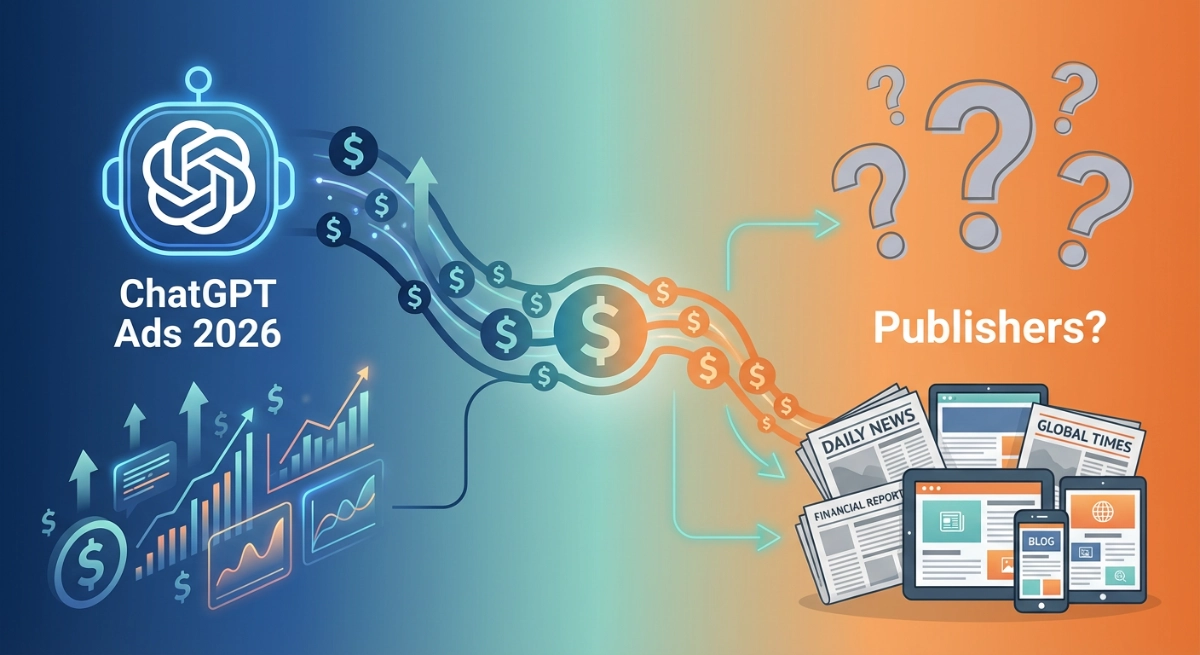
OpenAI Launches ChatGPT Ads: Can Publishers Share Revenue?
Key Points
- OpenAI announced January 16, 2026 it will test ads in ChatGPT for US free-tier users
- The move targets $25 billion in ad revenue by 2029 from 800 million weekly users
- Publishers already have content licensing deals, but it’s unclear if they’ll share ad revenue
- Ads appear at conversation bottom, labeled “sponsored”—premium tiers stay ad-free
- Analysts see this as necessary monetization to offset $1.4 trillion infrastructure costs
Background
OpenAI is chasing advertising dollars to address mounting financial pressures. Despite reaching $20 billion in annual recurring revenue in 2025, the company faces significant losses due to massive AI infrastructure costs. OpenAI CEO Sam Altman said in November that the startup was on track to generate $20 billion in annualized revenue (ℹ️ CNBC), yet the company does not expect to be profitable for years and has committed to spend about $1.4 trillion on data centers and chips for AI. (ℹ️Bloomberg)
Meanwhile, publishers have been signing content licensing agreements throughout 2025. Deals with Axios, The Associated Press, News Corp, Vox, Financial Times, and The Guardian provide OpenAI access to trusted journalism that appears with attribution in ChatGPT responses. Publishers receive licensing fees and technology access—but the advertising revenue question remains unanswered.
What Happened
On January 16, 2026, OpenAI announced it will be testing advertisements in ChatGPT for US users on the free tier and the new $8-per-month Go subscription CNN. The ads will show up at the bottom of ChatGPT’s answer to a user’s query and will be labeled as sponsored.
OpenAI is beginning to test advertising on its popular ChatGPT platform, potentially opening up a multibillion-dollar annual revenue opportunity. The timing follows intense competition from Google, which announced plans to bring advertisements to its Gemini AI chatbot in 2026.
The company emphasized user protection: ChatGPT’s responses will not be influenced by ads, and OpenAI said it will never sell users’ data to advertisers. Additionally, users under the age of 18 will not see ads, and advertisements will not appear near certain topics, including politics, health, and mental health (ℹ️ CNBC).
Why It Matters
This shift represents a fundamental change in AI monetization strategy. With only 35 million paying subscribers among 800 million weekly users, introducing ads to ChatGPT could help OpenAI meet its ambitious spending commitments.
Industry analysts project substantial revenue potential. Mark Mahaney, a senior analyst at Evercore ISI, predicts that OpenAI could achieve billions of dollars in advertising revenue by 2026 and exceed $25 billion by 2030 (ℹ️ TradingKey).
For publishers, the critical question is whether content licensing partnerships translate to advertising revenue sharing. While partnerships establish OpenAI as a legitimate content distribution channel similar to how Google became essential for publishers through search traffic, the revenue model remains unclear.
Matt Prohaska, CEO of Prohaska Consulting, noted, “We’re actually trying to cut a deal with OpenAI on behalf of one of our publisher clients right now with our Magnify team and struggling” (ℹ️ Digiday).
What’s Next
OpenAI plans a phased rollout throughout 2026. Limited beta testing of search ads with select advertisers in controlled verticals, including travel, retail, and technology, is expected in Q1 2026, followed by expanded deployment for English-speaking markets.
Publishers face strategic decisions about their relationships with AI platforms. As traditional search traffic declines with AI Overviews, with some publishers reporting 50-90% lower click-through rates when AI summaries appear, alternative revenue streams become essential.
The advertising infrastructure is actively being built. OpenAI has hired executives with advertising backgrounds, including Fidji Simo, a former Meta executive, and posted job listings for advertising platform engineers (ℹ️ DataSlayer).
Whether publishers can meaningfully participate in ChatGPT’s advertising economy—beyond receiving licensing fees—will shape the future relationship between AI platforms and journalism. For now, publishers watch closely as OpenAI tests whether advertising can coexist with user trust in conversational AI.
Source: Multiple authoritative sources including CNN Business, Bloomberg, CNBC, Fast Company, Digiday, and TradingKey
Published: January 26, 2026
Original Coverage: CNN Business, Bloomberg, CNBC
About the Author
James Carter is a productivity coach specializing in AI tools and efficiency strategies. He helps professionals and businesses leverage artificial intelligence to save time and streamline workflows. James focuses on making complex AI developments accessible and actionable for everyday users.