
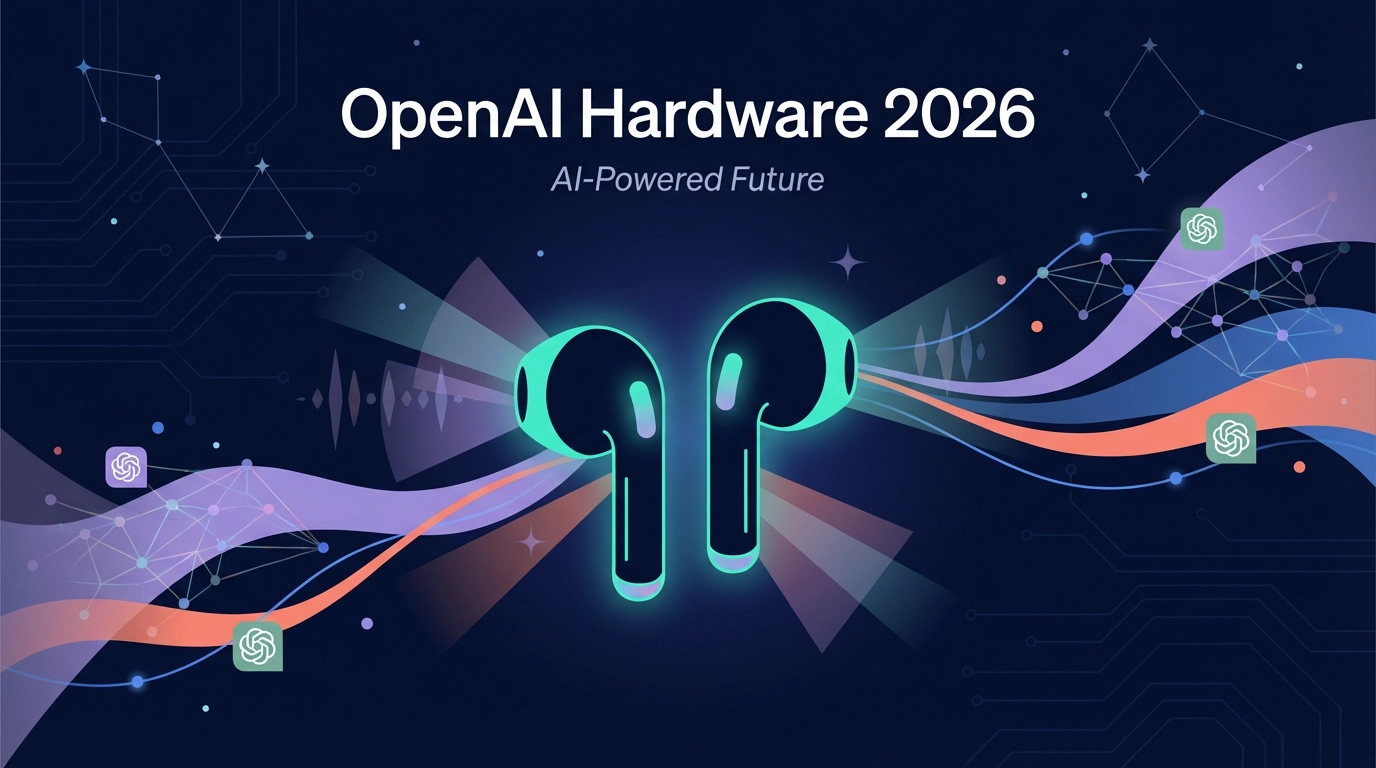
OpenAI to Reveal Its First AI Hardware in Late 2026
Key Points
- OpenAI confirms its first consumer hardware device will be unveiled in the second half of 2026
- The device is reportedly AI-powered earbuds codenamed “Sweet Pea” with a unique behind-the-ear design
- Designed in partnership with former Apple design chief Jony Ive following the $6.5 billion acquisition of his startup io
- Expected to feature local AI processing on a custom 2-nanometer chip, eliminating cloud dependency
- OpenAI aims to ship 40-50 million units in the first year, targeting a screen-free AI experience
Background
OpenAI to reveal Its First AI Hardware in Late 2026 marks a pivotal shift for the company best known for ChatGPT. Since launching its viral chatbot, OpenAI has dominated the software side of artificial intelligence, but hardware has remained unexplored territory. That changed dramatically in May 2025 when OpenAI acquired io, the hardware startup founded by legendary Apple designer Jony Ive. The $6.5 billion deal brought not just Ive’s design genius but an entire team of former Apple engineers who helped create iconic products like the iPhone and AirPods (ℹ️ TechCrunch).
The collaboration sparked immediate speculation: What would happen when the minds behind ChatGPT teamed up with the designer of the iPhone? CEO Sam Altman had previously hinted at something radically different from smartphones—a device that would be more “peaceful and calm” than the screen-dominated devices we carry today.
What Happened
At the Axios House event during the World Economic Forum in Davos, Switzerland, Chris Lehane, OpenAI’s Chief Global Affairs Officer, made the company’s most concrete announcement yet. Speaking to reporters, Lehane confirmed that OpenAI is “on track” to unveil its first physical device in the second half of 2026 (ℹ️ Business Standard).
While Lehane remained intentionally vague about specifications, he emphasized that the timeline reflects operational commitment rather than exploratory research. “We are looking at something in the latter part of the year,” he stated, while cautioning that exact timing would depend on how development progresses.
Recent leaks from Asian electronics bloggers suggest the device will be AI-powered earbuds with a distinctive design. Unlike traditional earbuds that sit inside the ear canal, these reportedly feature a behind-the-ear placement with an egg-shaped charging case. The codename? “Sweet Pea” (ℹ️ Silicon Republic).
Why It Matters
OpenAI to Reveal Its First AI Hardware in Late 2026 signals a fundamental reimagining of how we interact with artificial intelligence. For years, AI has been trapped behind screens—whether on smartphones, tablets, or computers. OpenAI’s hardware push represents something different: ambient AI that exists alongside you without demanding constant visual attention.
This matters because it challenges the smartphone’s dominance as the primary interface for AI. With nearly a billion weekly ChatGPT users already relying on third-party platforms, OpenAI’s own hardware gives the company direct control over the entire user experience. Imagine real-time translation during conversations, contextual assistance that anticipates your needs, or hands-free AI interaction throughout your day—all without pulling out your phone.
The competitive implications are massive. Meta’s Ray-Ban smart glasses are already struggling to meet demand (ℹ️ TechCrunch). Amazon recently acquired Bee, an AI meeting recorder. The race for post-smartphone AI interfaces is intensifying, and OpenAI just positioned itself at the starting line with one of tech’s most celebrated designers.
What’s Next
OpenAI plans to share more concrete details “much later in the year,” according to Lehane. Manufacturing partnerships are reportedly being finalized, with Taiwan’s Foxconn emerging as the likely partner over China-based Luxshare. The same company that assembles iPhones and Pixel devices may soon be producing OpenAI’s AI earbuds.
Internal reports suggest OpenAI is targeting 40 to 50 million units in the first year of sales—an ambitious goal that would put it in direct competition with established players like Apple’s AirPods and Google’s Pixel Buds. However, success will depend on more than just hardware elegance. The device needs seamless OS integration, compelling AI features that justify the purchase, and a price point that makes sense for mass adoption.
For now, the second half of 2026 remains the target window for the official unveiling, though Lehane emphasized that timelines could shift as development advances.
Deep Details
Technical specifications remain largely under wraps, but leaks point to impressive hardware. The device is expected to run on a custom 2-nanometer processor capable of handling AI computations locally rather than sending every request to the cloud. This would dramatically improve response times and protect user privacy by keeping data on-device.
The unique behind-the-ear design distinguishes it from traditional earbuds. Instead of inserting into the ear canal, the capsule-shaped earpieces reportedly wrap around the ear and sit against the head—potentially offering better comfort for all-day wear while housing the necessary AI processing chips.
This isn’t OpenAI’s first brush with consumer hardware ambitions. Sam Altman previously invested in Humane, the AI pin startup that struggled to gain traction and was eventually sold to HP. That experience may inform OpenAI’s more cautious approach this time, emphasizing design excellence and practical functionality over gimmicks.
The broader strategy extends beyond a single product. Multiple sources indicate OpenAI envisions a “family of devices” that could include smart glasses, digital voice recorders, and other AI-native hardware. The earbuds appear to be just the opening move in a longer game to embed AI throughout our physical environment.
Source: TechCrunch—Published on January 21, 2026, 7:20 AM PST
Original article: https://techcrunch.com/2026/01/21/openai-aims-to-ship-its-first-device-in-2026-and-it-could-be-earbuds/
About the Author
Alex Rivera, a creative technologist passionate about making AI accessible to everyone, wrote this article. Alex specializes in translating complex tech developments into practical insights that inspire innovation and experimentation. When not exploring the latest AI breakthroughs, Alex mentors aspiring tech creators and builds tools that make technology more human.